In short
Reliable dog recall training starts on a long line, not off leash. Protect a single recall cue for rewards only, build it up against real desert distractions, and treat trails near Scottsdale and Cave Creek, including popular spots like Brown's Ranch and Cave Creek Regional Park, as advanced practice, not a testing ground. Dogs with strong prey drive or a history of bolting are often safer working on a long line indefinitely instead of going off leash at all.
Why Recall Training Matters for Arizona Dogs
Watching a dog run free in the desert is a real payoff for the work you put in, but Arizona trails carry real risk alongside the scenery. Rattlesnakes, cactus, steep rock, washes, and other hikers and dogs who are not expecting an off-leash visitor are all part of the picture near Scottsdale and Cave Creek. A missed recall out there is not an awkward chase across a park, it can mean a snake encounter, a fall on loose rock, or a scared dog running toward a road.
A dog who reliably comes when called is safer on every walk, not just on trails where the leash comes off. Reliable recall keeps a dog from bolting toward traffic, chasing a rabbit toward a wash, or rushing up to a stranger on a narrow path. It changes the whole outing: instead of managing your dog at the edge of panic every time something moves, you are working as a team.
Real recall is trained on purpose, not wished for. It comes from a protected cue, generous reinforcement, and practice that is honestly built up against distraction step by step, never rushed onto a trail near Brown's Ranch or Pinnacle Peak before it holds up in the backyard first.
How to Choose and Protect a Recall Cue
Start by picking one word or a whistle you use only when you are ready to pay generously for it. Say it once, in an upbeat tone, then make the next ten seconds the best part of your dog's day: a handful of high-value treats, a quick game, or a release back to sniffing once they reach you.
Protect the cue by only ever using it for something good, never as a summons to something your dog dislikes. Avoid calling your dog with your recall word for a bath, a nail trim, or the end of a park visit until the behavior is genuinely solid. Every time the cue predicts something unpleasant, it loses a little of its pull, and that pull is the whole point.
Long-Line Foundations for a Reliable Recall
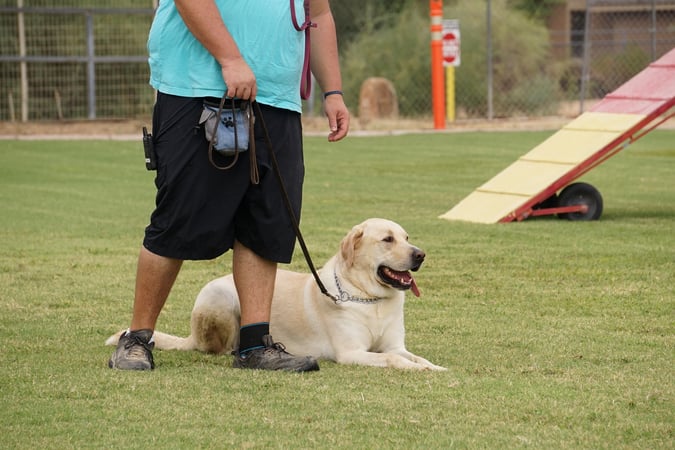
A long line, 20 to 30 feet, is the tool that lets you practice honestly without gambling on a hard stop. Practice in a safe, open area, a fenced field or a quiet, permitted desert wash, and start in the cooler parts of the day so heat is not competing for your dog's attention.
- Let your dog sniff and explore on the long line, then call once in a cheerful tone.
- Back away as you call so your own movement helps draw your dog toward you.
- Praise the moment your dog turns, then pay big when they reach you: food, a favorite toy, or a short game.
- Release your dog back to exploring, or clip the leash and simply change direction, so coming to you never means the fun automatically ends.
The long line is a leash length away from off-leash freedom, not a shortcut around it. It lets your dog rehearse the right choice hundreds of times before a real off-leash decision is ever on the table.
Recall Games That Make Coming Back the Best Choice
Once the mechanics are in place, the goal is to make your recall game so rewarding that your dog chooses it over a lizard, a bird, or another dog on the trail. That does not happen by accident. Treat recall like the best-paying game in your dog's life, not a command that interrupts one.
Two simple setups build this fast. In a round-robin game, two or three family members spread out and take turns calling the dog, rewarding heavily every time. In a "restaurant game," you call your dog, pay generously, then release them to go back to whatever they were doing, so coming to you is a quick, profitable stop rather than the end of the outing.
If coming when called always ends the fun, a dog learns to avoid it. Many owners accidentally teach "come" to mean "leash on, walk over," especially on trails. Break that pattern early by rewarding and releasing far more often than you reward and leave.
Next step
Not sure why recall keeps breaking down
A PD360 assessment gives you a clear read on what is actually driving the missed recalls, whether that is prey drive, distraction, or gaps in the foundation, before you spend more time guessing.
Proofing Recall Around Wildlife, Hikers, and Real Distractions
Once your dog is reliable in easy settings, layer in desert-specific distractions one at a time instead of all at once. Rushing this step is where most recall training falls apart on real trails.
- Mild wildlife at a distance. Practice when birds, rabbits, or lizards are visible but far away, rewarding heavily every time your dog chooses you over the movement.
- Other hikers and dogs. Work at wide trailheads where you can keep real distance, calling your dog to your side as people pass rather than testing recall at close range.
- Changing terrain. Call your dog from behind a boulder, across a shallow wash, or around a bend, so they learn to find their way back to you even when they briefly lose sight of you.
Instinct beats training the first few times a dog meets real prey drive, so the long line has to do the safety work until the behavior catches up. Keep it attached anywhere wildlife is likely, including washes and dense brush, even after recall feels solid in easier spots. A dog who fixates hard on movement often needs a more structured approach; our prey drive training program breaks that pattern down step by step. Rattlesnake season adds another layer of risk on the same trails, and dogs who have gone through rattlesnake avoidance training carry that safety skill into every hike alongside recall.
Building a Weekly Arizona Recall Routine
Recall gets strong from repetition spread across the week, not from one big test on a crowded trail. Map your week the way you would map any other training goal.
- Run short recall games in your yard or a quiet park several times a week, always on the long line while the behavior is still developing.
- Add one or two field trips a week: early-morning or evening visits to wider, less crowded spots like a McDowell Sonoran Preserve trailhead or Cave Creek Regional Park, where you can keep distance and still practice in real desert conditions.
- Sprinkle recall into everyday life: call your dog away from the door when guests arrive, in from the side yard when landscapers are working, or back inside before dark.
Recall gets stronger from many short, easy wins, not from one hard test on a crowded trail. A dog who succeeds ten times a week in manageable settings builds real confidence faster than a dog pushed once into a scenario they were not ready for.
When Your Dog Is Not Ready to Go Off Leash
Some dogs are never fully safe off leash around wildlife, roads, or steep terrain, no matter how much training happens, and that is a realistic outcome, not a failure. Others may only be ready for off-leash freedom in fully fenced spaces rather than open desert.
Watch for red flags: strong prey drive toward rabbits or lizards, a history of bolting after wildlife, recall that is still shaky in easy, low-distraction settings, or reactivity toward other dogs and people on the trail. Any one of these is a reason to stay on the long line, not a reason to give up on training.
A leash is not a failure, it is the responsible choice until recall is actually proven. If you are stuck at a certain level of distraction, or your dog has already had a scary off-leash incident, a recall training plan built around what is actually going wrong is more useful than repeating the same walk and hoping. Private lessons work well for a specific trigger, while Foundation Camp gives a dog a full reset on obedience fundamentals, including recall, inside a structured program. Every dog in a Partners Dogs program trains at one trainer for every ten dogs, never the crowded ratios of a warehouse daycare, so recall reps stay real reps instead of getting lost in a crowd.
Frequently asked questions
How long does it take to train a reliable dog recall in Arizona?
There is no universal timeline. It depends on your dog's prey drive, distraction history, and how consistently the cue gets protected and rewarded. Most dogs need weeks of layered, low-pressure practice before recall holds up against real desert distractions like wildlife or another hiker's dog. If progress stalls, a PD360 assessment can pinpoint what is actually driving the breakdown.
What is the best recall cue to use with my dog?
Any single word or whistle works as long as it stays protected, meaning it only ever predicts something your dog wants, like food, play, or a release back to sniffing, and is never used to call your dog toward something they dislike, such as a bath or the end of a park visit.
Is it safe to let my dog off leash on Arizona hiking trails?
Only after recall has been built and proofed on a long line against real desert distractions, and only for dogs without a strong prey drive, a history of bolting, or reactivity toward other hikers and dogs. Trails near Scottsdale and Cave Creek carry real risk from rattlesnakes, washes, and wildlife, so many dogs are safer staying on a long line permanently.
What should I do if my dog chases wildlife instead of coming when called?
Go back to an easier setting and a shorter distance until your dog reliably chooses you over movement, and keep a long line attached anywhere wildlife is likely, including washes and brush. A dog with strong prey drive toward rabbits or lizards often needs a structured, professional plan to build real reliability.
What Partners Dogs programs help with recall and everyday obedience?
A PD360 assessment identifies what is behind a shaky recall, whether that is missed foundational reps, distraction, or prey drive, and points toward the right next step, which is often Foundation Camp for a full obedience reset or private lessons for one-on-one work on a specific trigger.
Build the foundation
Give your dog a real obedience reset
Foundation Camp builds recall and everyday obedience from the ground up, and Behavior Camp goes further for dogs whose prey drive or reactivity keeps recall from sticking.
Keep reading