In short
The Partners Dogs training journey moves through five fixed stops: a PD360 assessment, a matched program, a climb through eight cumulative grade levels, a tested graduation day, and a lifetime maintenance plan.
What the Dog Training Program Journey Looks Like at Partners Dogs
Every dog who trains with us, at our Scottsdale or Cave Creek campus, moves through the same five stops in the same order: a PD360 assessment, a matched program, a climb through eight cumulative grade levels, a tested graduation day, and a maintenance plan that keeps tracking your dog for life. A puppy learning basic manners and a dog working through real aggression can walk in on the same Monday and land in different programs by the afternoon, but the five stops themselves never move.
Here is that same shape as a quick reference: what happens at each stop, and roughly how long it takes.
| Stop | What happens | How long it takes |
|---|---|---|
| 1. PD360 Assessment | A senior trainer reads your dog across nine dimensions and writes a program plan | One day: drop-off 9 to 10am, pickup 3 to 4pm |
| 2. Program match | The written plan names Foundation Camp, Behavior Camp, Transform Camp, or Group Classes | Decided the same day as the assessment |
| 3. Grade-level climb | Your dog moves through eight cumulative grades, in weekly classes or a boarded camp | Ongoing; 14 boarded nights (Foundation Camp), or 21 boarded nights (Behavior Camp) to 28 boarded nights (Transform Camp) within a 12 to 16 week arc that includes follow-up coaching |
| 4. Graduation day | Skills are tested on the floor against a fixed point target for that grade | At each grade transition |
| 5. Maintenance | The PD360 Pet Progress Tracking System keeps scoring your dog after graduation | Indefinite, for the life of the dog |
The sections below walk each stop in order, starting with the one every family completes first, no matter what originally brought them through the door.
Stop 1: The PD360 Assessment Is Where Every Journey Starts
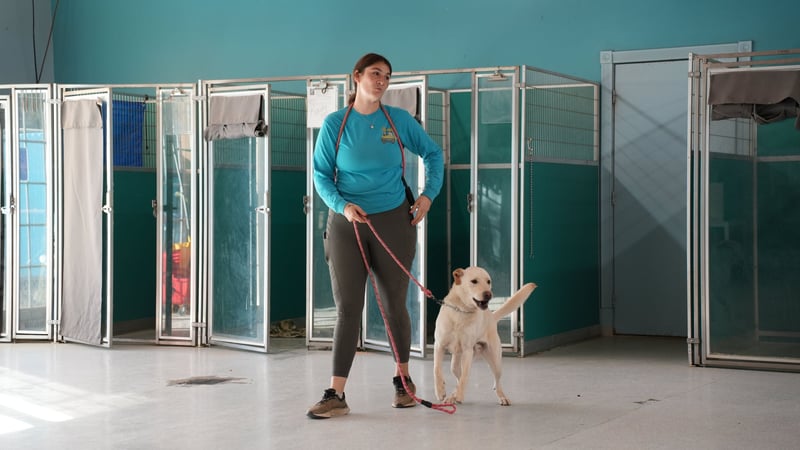
Every family's first stop is the same: a full day for the PD360 Assessment at our Scottsdale or Cave Creek facility, where a senior trainer reads your dog across nine dimensions, from behavioral evaluation and temperament to what motivates your dog to learn. Drop-off runs 9 to 10am, pickup is 3 to 4pm, and you leave with a written program plan that same day.
Assessment rates, including a lower second-dog rate, are on the pricing page, and the fee is credited toward enrollment in your recommended camp or a membership, so the assessment never becomes a sunk cost if your dog enrolls in the recommended program. PD360 is required before Behavior Camp and Transform Camp, and it is the recommended first move for any family unsure which program fits. Twenty-eight years of refinement and 70,000+ dogs of outcomes sit behind that one assessment day.
- Behavioral evaluation: how your dog responds to real triggers and handling
- Temperament profile: confidence, drive, and how fast your dog recovers from stress
- Learning profile: what motivates your dog, food, toy, praise, or pressure
- Environmental and lifestyle factors: home, yard, other pets, and your household's schedule
- Custom program plan, a measurable progress baseline, and a family coaching plan for the humans at home
The plan you carry out the door states your dog's score across all nine PD360 dimensions, names the exact program match, and sets the numeric grade-level starting point your dog's climb begins from, plus the family coaching plan the humans use that same week.
Reviews describe that same read from the family's side of the table:
"We took our dog Bella for a 360 assessment and discuss the programs available to address her behavior issues with resource guarding. Lucy was the trainer that worked with Bella and she was very knowledgeable and explained different options to help. We are going back next week for a follow up assessment before we decide how to proceed. Overall, our first impression was very positive."
Stop 2: The Written Plan Names an Actual Program
The written plan from PD360 names one specific program for your dog. A puppy six months and up with more energy than manners is usually matched to Foundation Camp, our 14-night board and train. A dog carrying reactivity, fear, or aggression is routed to Behavior Camp, 21 boarded nights, or for more severe cases Transform Camp, 28 boarded nights, each part of a 12 to 16 week arc that includes the boarded stay plus follow-up coaching once your dog is home. A dog who is already social and just needs weekly reps is matched straight into Group Classes.
The match comes directly from what the assessment finds during that one observation day. That is the point of putting a senior trainer's hands on your dog for a full day before anyone recommends anything.
Stop 3: Eight Grade Levels, One Cumulative Curriculum
Once your dog is out of a camp program, or straight into Group Classes from day one, the climb runs through eight cumulative grade levels: Pre-School, Kindergarten, Elementary, Middle-School, High-School, College, Masters, and Dogtorate. Each level stacks new behaviors on top of the last, so a skill learned in Pre-School keeps getting used and deepened all the way to Dogtorate.
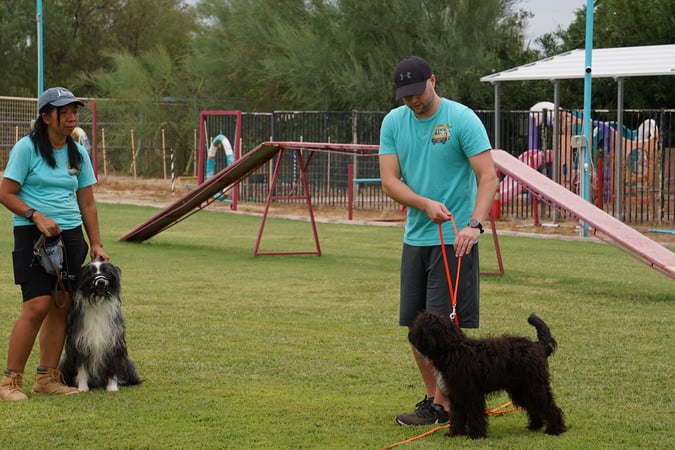
115+ behaviors are tracked in PD360 across the eight levels, and open enrollment means there is no session to wait for. Classes run in small groups of six dogs or fewer, taught by master trainers, in a fixed 45-minute shape built for reps: a 20-minute interval block at rotating stations, 15 minutes of whole-group work around distraction, a 5-minute AMRAP push on one behavior, and a 5-minute trainer demo that sets your one focus for the week. Drop-in class rates are on the pricing page.
Most dogs graduating a board-and-train camp land in Kindergarten, since Foundation Camp already builds the Pre-School fundamentals. Dogs who are outwardly reactive typically start in Pre-School on the Adult track instead, where confidence and desensitization come first. Placement is based on demonstrated skill and temperament, never on age or how long a dog has been enrolled.
The Four Stages Every Skill Climbs Through
A grade level is not pass or fail. Every individual behavior your dog knows sits at one of four stages, and a level's score is the sum of every skill's stage across the board. Teaching, Reinforcing, Proofing, and Maintenance are the same four stages that track every skill in every Partners Dogs program, from Group Classes to Foundation Camp to DaySchool.
- Teaching: the behavior takes shape through shaping, luring, and low-distraction reps until your dog recognizes the goal.
- Reinforcing: reinforcement moves from continuous to variable until your dog shows full comprehension.
- Proofing: the longest stage, working duration, distraction, distance, direction, and difficulty until the behavior holds up somewhere new.
- Maintenance: ongoing and indefinite, because a skill only stays sharp if it keeps getting used.
A behavior taught at one grade level is Reinforcing by the next, then Proofing, then folded into Maintenance while newer behaviors take the Teaching slot. That is why the curriculum is cumulative instead of a stack of separate classes.
Start here
Find Your Dog's Starting Point
Take the quiz to see which of these five stops your dog would start on, or book the PD360 assessment directly if aggression or reactivity is already part of the picture.
Stop 4: Graduation Day, What Hitting the Target Means
Every grade level has a graduation target, a specific point total built from where each of that level's skills sits across the four stages. Pre-School graduates at 28 points across 14 behaviors. Dogtorate, the top of the curriculum, graduates at 484 points across 115 cumulative behaviors. Each of the six ranks in between carries its own point target, scaling with how many cumulative behaviors that grade adds. The same scoring follows your dog across every Partners program, so Group Classes, DaySchool, DayCamp, private lessons, and boarding all read from the same dashboard.
Graduation is tested, not assumed. Recall at distance, a heel past a real trigger, and a settle in a busy room: these get tested on the floor at graduation and again at every follow-up. When the score hits target and the real-world test holds, that grade level is done and the next one opens.
Families see that standard hold up once they are home too:
"We enrolled our ten-month-old chocolate lab in the 14-day training camp and we could not be more pleased with the results. We appreciated the daily report cards informing us of how he was progressing in training. The transition home has been awesome! We're so happy to have him back home and he is doing great following his commands. He seems so much more comfortable because he has confidence in knowing what he is supposed to do. We are so grateful! His training was definitely worth the investment. His trainer, Noa, was the perfect match for Rigs and us!"
Stop 5: Maintenance Is Not the End, It Is the Point
Most training programs go quiet the day you pick your dog up. Ours keeps working: the PD360 Pet Progress Tracking System keeps scoring your dog after graduation. Six tracking dimensions follow your dog for life: a behavior scorecard, a skill milestone tracker through all four stages, real-world test results, owner confidence scoring, trigger response mapping, and maintenance plan compliance.
That last one matters more than it sounds. After graduation, PD360 tracks whether the at-home plan is holding, through weekly check-ins and goal re-evaluations, so regression gets caught before it costs your dog the work already done. Skills stay sharp because they keep getting used: in class, at DaySchool or DayCamp, during boarding, and at home.
How Foundation Camp Graduates Keep Climbing
Foundation Camp is a clear example of how every stop connects. The 14-night board and train opens with a PD360 check-in and closes with a transition lesson, but what happens in between is the same curriculum climb described above: your dog comes home carrying Kindergarten and Elementary-level skills. The camp price already includes 3.5 hours of private family lessons, 16 DaySchool reinforcement days, and 8 Pet Parenting group classes, so the climb into Group Classes is already built into the program.
After any camp, Pet Parenting classes hold a special lifetime rate for graduates, listed on the pricing page, which is the maintenance stage made concrete: a standing place to keep proofing skills long after the 14 nights are over. The same shape applies on the behavior track. A dog who starts in Behavior Camp or Transform Camp graduates carrying real skills too, then moves into the same grade-level system everyone else climbs, usually starting in Pre-School on the Adult track for the extra confidence work.
Reviews describe that same shift, in the family's own words:
"We got my dog Rowan from the Maricopa County Animal Shelter. He had been observed living on the streets for quite some time but had been extremely difficult to capture. This poor dog was terrified of everything, had no idea how to live in a house with people, understood zero commands and was EXTREMELY reactive to other animals. We really wanted to rescue this dog because I could see the "good boy" hidden behind all his fear. So, we enrolled him in Partner's (Scottsdale) "Foundation Camp". He lived at Partner's for 2 weeks to get consistent, daily training. When we went to pick him up we could not believe the changes. Rowan was now a very calm dog, understood and performed many commands correctly and actually wanted to go play nicely with the other dogs."
Frequently asked questions
What is the Partners Dogs training journey, step by step?
It runs through five fixed stops: a PD360 assessment that reads your dog across nine dimensions, a program match built on what that assessment found, a climb through eight cumulative grade levels, a tested graduation day, and a maintenance plan that keeps tracking your dog after the program ends. The path in between differs by dog, but every dog at our Scottsdale or Cave Creek campus follows that same shape.
Do I have to start with the PD360 assessment?
PD360 is required before Behavior Camp and Transform Camp, and it is the recommended first step for any family unsure which program fits. Current assessment rates, including the second-dog rate, are on the pricing page, and the fee is credited toward enrollment in your recommended camp or a membership; it does not apply to à la carte bookings or general reservations such as boarding, drop-in daycare or DaySchool days, or grooming booked on their own.
What are the eight grade levels in order?
Pre-School, Kindergarten, Elementary, Middle-School, High-School, College, Masters, and Dogtorate. The curriculum is cumulative, so a behavior learned at Pre-School keeps getting reinforced and proofed as your dog climbs, all the way through 115+ tracked behaviors at Dogtorate.
What do Teaching, Reinforcing, Proofing, and Maintenance mean?
They are the four stages every individual skill moves through. Teaching shapes the behavior in a low-distraction setting. Reinforcing moves the reward pattern from continuous to variable until your dog fully understands the goal. Proofing is the longest stage, testing the behavior against duration, distraction, distance, direction, and difficulty. Maintenance is ongoing and indefinite, keeping the skill sharp through regular use.
Does training ever really end after graduation?
No, and that is by design. The PD360 Pet Progress Tracking System keeps scoring your dog after graduation through weekly check-ins, goal re-evaluations, and maintenance plan compliance checks, so skills stay sharp instead of quietly slipping once the formal program is over.
Where does my dog start after Foundation Camp?
Most dogs graduating Foundation Camp's 14-night board and train enter Group Classes at Kindergarten, since the camp already builds the Pre-School fundamentals. The camp price includes 16 DaySchool reinforcement days and 8 Pet Parenting group classes, so the next climb is already built in rather than something you have to add on afterward.
Start the climb
Give Your Dog the First Stop on the Journey
Whether your dog needs 14 nights of board and train or a weekly seat in Group Classes, the path starts the same way: one full day with a senior trainer, reading where your dog is right now.
Keep reading