
In short
The right dog trainer is the one whose personality fits your dog, whose experience you can actually verify, and who teaches you alongside your dog instead of handing him back trained and you untrained. In Scottsdale and Cave Creek, that means touring the facility in person, checking real reviews, and asking directly about training philosophy before you sign anything.
Choosing a dog trainer is closer to choosing a school for your child than to hiring a contractor. You are handing over a living animal and a good part of what daily life at home will feel like, and every trainer's website says almost the same thing. Here is how to choose a dog trainer in Scottsdale or Cave Creek, in the order we would check it ourselves.
Does the Trainer's Personality Match Your Dog's?
Every dog is different, and so is every handler. A loud, high-drive trainer is often the wrong fit for a subdued, insecure dog. A soft, quiet handler may not be able to hold a highly reactive, intense dog. Getting that pairing right is a real part of whether the training works, not a detail to skip past.
Ask how a school decides who works with your dog. A trainer who cannot answer that in specifics has not thought about it. We take a detailed intake profile on every dog before training starts, so the dog is matched with the trainer most likely to get results. The same question matters for the program: whether your dog needs foundational obedience like Foundation Camp or more targeted work like Behavior Camp, fit should drive the decision.
How Do You Check a Trainer's Real Experience?
Every trainer will tell you how long they have been doing this. Time is not the same as experience: someone can say they have trained dogs since they were five, and when you dig in it was mostly their own dogs and a few friends' dogs.
You want someone who has worked with every breed, size, and problem, including the one you have. Ask how many dogs the trainer works with in a typical month, then do the math across the years they claim. Partners Dogs has been training dogs in Arizona since 1997, 28 years now, and more than 70,000 dogs have come through our programs across our Scottsdale and Cave Creek campuses. Ask for a number you can verify, not a feeling.
How Do You Read Dog Trainer Reviews?
Reviews are imperfect, and so are the references a trainer hands you, but they are still the best signal available. Search the trainer's name, read the bad reviews as carefully as the good ones, and look for patterns rather than single incidents.
One angry review tells you very little. Ten describing the same problem tell you a lot. Our own rating sits at 4.8 stars across more than 2,000 reviews, and we would rather you read them yourself than take our word for it. Do the same for anyone else you are considering.
Should You Tour the Training Facility First?
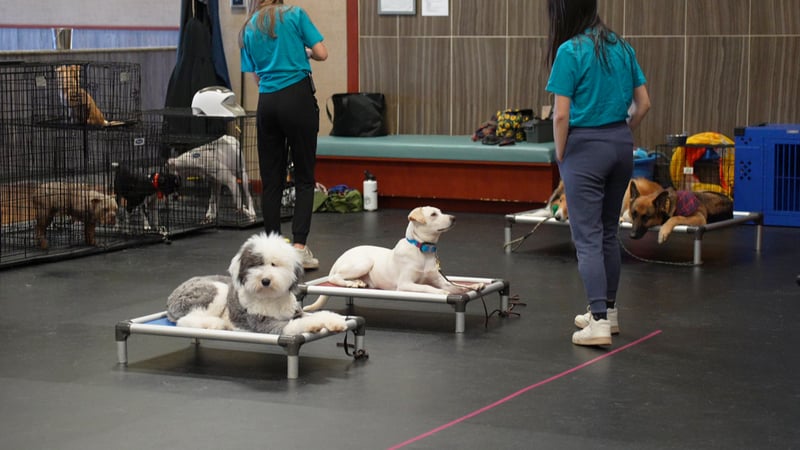
The fastest way to know whether a trainer is right is to walk through the place where your dog will actually stay. Go in person if you can, and bring a list. Ask:
- Where do the dogs sleep, and do they have room?
- Are kennels cleaned and sanitized daily? This is how a facility keeps disease out.
- Is the space climate controlled? In Arizona this is not optional.
- Is it quiet, or is every dog living in constant noise?
- What happens in a power outage?
- What does a dog's day actually look like, hour by hour?
- How much training does each dog get per day, and what happens the rest of the time?
- Who does the training, the person who sold you, or someone else?
If a trainer will not show you where your dog sleeps, you have your answer. Tour our Scottsdale campus on Shea Boulevard by the 101, or visit us in Cave Creek, and schedule a walk-through before you decide anything.
Before you compare another website
Get a Clearer Read on What Your Dog Actually Needs
A two-minute quiz can point you toward the right program before you read another trainer website that says the same thing.
One Trainer or a Team?
Consider what one person has to cover alone: cleaning kennels, answering phones, writing notes on every dog, check-ins, potty breaks, baths, and then training at the end of a long day. Compare that to a team, where the facility stays clean, notes are written so every trainer is aiming at your goals, and the trainers spend their day training instead of everything else.
A dog who works with a variety of people learns to listen to a variety of people. A dog trained by one handler alone often becomes handler-happy: he performs beautifully for that one person and ignores everyone else, including you. A single-trainer setup also gives your dog very little exposure to other dogs and people, a real problem if socialization is part of what he needs.
What Training Philosophy Does the Trainer Use?
Broadly there are three approaches, and you should know which one you are buying before you sign anything.
Purely positive training uses little or no correction. Obedience is shaped by rewarding the right behavior. Behavior problems are handled by redirecting, so a dog who growls and lunges at a stranger gets pulled onto a toy or a treat rather than taught a different response to it.
Compulsion, sometimes called force training, leads with corrections, and the dog learns a negative association with the behavior. It can move fast, but it is hard to maintain at home and dogs frequently shut down or build a tolerance until the correction stops meaning anything.
Balanced training is where we sit. We lean heavily on positive training and on channeling difficult behavior into something productive, and we also believe in telling a dog no when he already knows the behavior is wrong. If a dog jumps on a guest, he hears no, he may get a leash correction, and the moment he is back on the floor he is rewarded and put into a sit. If your dog matches the stranger example above, see how we work with a dog who reacts to strangers for a closer look.
Pick the philosophy you can live with and hold your trainer to it. Watch them work with other dogs before you decide, it tells you more than any website description.
Are You Included in the Training?
This is the one people skip, and it might be the most important item on this list. Your dog spends a few weeks with a trainer; he spends the rest of his life with you.
If you never learn what the trainer knows, the training starts to fade the week your dog comes home. Make sure private lessons, group classes, and real follow-up support are part of what you are buying, so your education matches your dog's. If a program hands your dog back without teaching you anything, keep looking.
Is Price the Whole Picture?
With dog training you largely get what you pay for. This is an investment in daily life for the next decade, not a one-time purchase, and most families end up happier having spent more on a trainer who solved the problem than less on one who did not.
Ask what is included, ask what happens if the problem comes back, and compare the whole package, not the headline number. If you are not sure yet what your dog actually needs, a PD360 behavior assessment is a straightforward way to get an honest, specific answer before you commit to a program, and the fee is applied as store credit when you enroll in your recommended camp or a membership; it does not apply to à la carte bookings or general reservations.
Be clear about what you expect, and hold whoever you choose to it.
Frequently asked questions
How do I know if a dog trainer is legitimate?
Ask for a number you can verify, not a feeling: how many dogs the trainer works with in a typical month, and for how many years. Read the trainer's reviews, including the negative ones, and look for the same complaint repeated rather than a single bad day. A legitimate trainer will also let you tour the facility in person before you commit.
What is the difference between group classes, private lessons, and a full training program?
Group classes teach foundational obedience alongside other dogs and owners, which helps with socialization and cost. Private lessons are one-on-one and work well for a specific problem or a tight schedule. A full immersive program works best for dogs who need faster, more consistent progress than a weekly class can give.
Should I choose a purely positive trainer or a balanced trainer?
It depends on what you are comfortable with and what your dog actually needs. Purely positive training rewards the right behavior and can be slow to change an established habit. Balanced training combines positive reinforcement with clear, fair correction, which tends to move faster on real behavior problems.
How much does it cost to hire a dog trainer in Scottsdale?
Cost varies by trainer and by what the dog needs, so the honest answer is to get a specific assessment rather than guess from a price list. A PD360 behavior assessment gives you a clear, individual read on your dog, with current rates for a first dog and any additional dog listed on the pricing page, and that fee is credited toward enrollment in your recommended camp or membership.
What questions should I ask when I tour a dog training facility?
Ask where the dogs sleep, whether kennels are cleaned daily, and whether the space is climate controlled, which matters in Arizona. Ask how much individual training each dog gets per day and who actually does it, the person who sold you, or someone else. If a facility will not let you see where your dog will stay, that tells you what you need to know.
Next step
Get a Straight Answer About What Your Dog Needs
A PD360 assessment gives you a specific plan instead of a guess, credited toward enrollment in your recommended camp or membership.
Keep reading
/Programs/Transform%20Camp/Safer%20home%20(1).jpeg?width=800&height=450&name=Safer%20home%20(1).jpeg)