If you only read one thing
A private, in-home puppy trainer buys flexible scheduling and a familiar living room, but a puppy only learns to hold a sit around real distraction by practicing around real distraction. Partners Dogs opens formal enrollment for Private Lessons and Pre-School Puppy at 20 weeks (the same floor at both the Scottsdale and Cave Creek campuses). Pre-School Puppy then runs as a small, capped class where your puppy meets other puppies and other people on a fixed weekly schedule, something a solo living room session can't supply. Current rates for both formats are on the pricing page.
What's the real difference between an in-home puppy trainer and Pre-School Puppy?
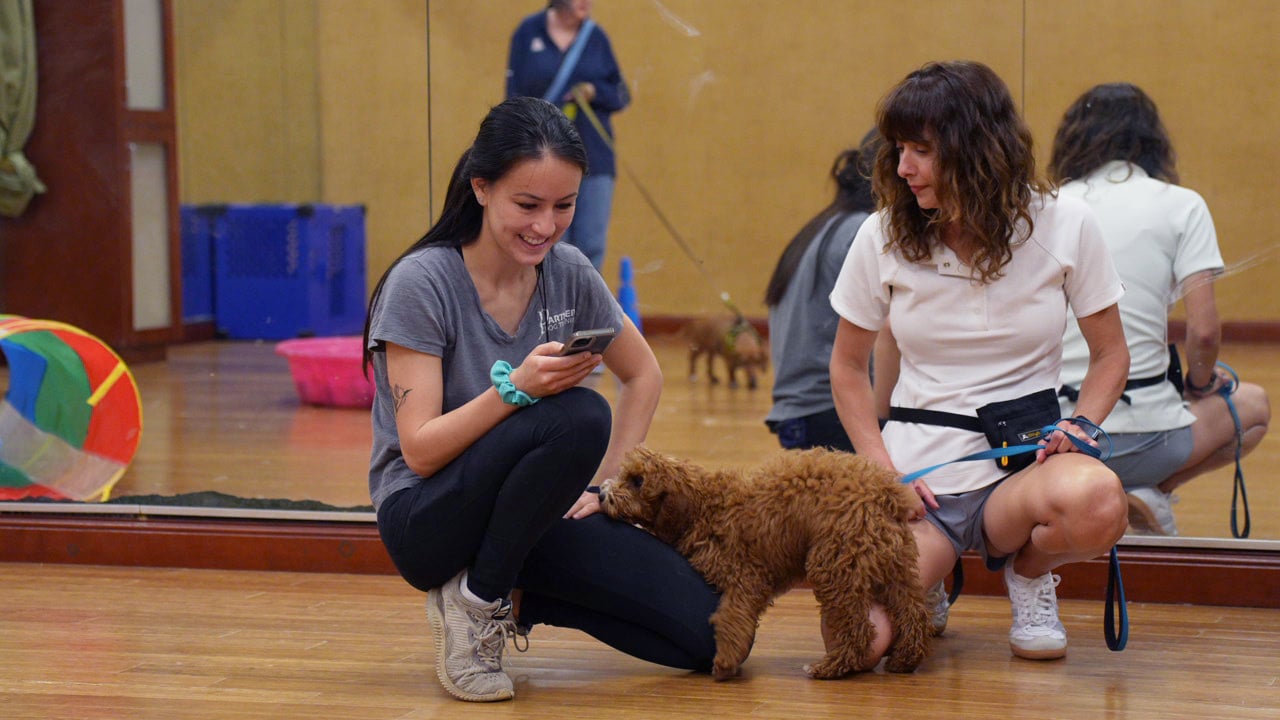
An in-home trainer teaches your puppy inside one house; Pre-School Puppy teaches your puppy inside a room full of strangers, which is closer to where the rest of its life actually happens. Picture a Carefree family two days past their puppy's twenty-week mark, laptop open at the kitchen table, comparing a private trainer's rate sheet against the class schedule pinned to the vet's bulletin board. Both options are chasing the exact same first goal: a puppy who can sit, settle, and take direction from a person holding food. Pre-School Puppy is the ground floor of Partners Dogs' eight-level grade curriculum: Pre-School, Kindergarten, Elementary, Middle-School, High-School, College, Masters, and Dogtorate. It's a small, capped class where a puppy practices those first skills next to other puppies instead of next to the couch. An in-home trainer runs the same early skills (sit, down, name recognition, loose-leash basics) but works them solo, in the puppy's own kitchen, with no other dog in the room to prove the skill holds up anywhere else.
Sarah M., a Scottsdale client, put it plainly: “We do day camp as well as group classes and the dog trainers here are so kind, patient, and educated.” That's the version of the comparison that matters more than any brochure: not which format sounds better on a phone call, but which one a family keeps showing up for, month after month. The Group Classes ladder is built for exactly that, a puppy who starts at Pre-School and keeps climbing the same curriculum without switching trainers or starting over.
What does an in-home puppy trainer get right?
A private trainer who comes to the house wins on schedule, wins on a familiar room, and wins on undivided attention for the whole session. There is no drive time, no waiting for a class slot to open, and no other family's schedule to work around. For a puppy who startles easily or shuts down around unfamiliar dogs, the first few sessions in a quiet, known space can matter more than anything else on the syllabus, and some dogs genuinely relax faster at home than they ever will in a room with five other puppies pulling on leashes. A private trainer can also move at whatever pace a specific puppy needs: slower for a nervous rescue, faster for a food-driven Labrador who is bored within a week of the basics.
None of that is a small thing, and it's why Private Lessons stay on the menu at both Partners Dogs campuses instead of being phased out in favor of classes. A puppy recovering from a rough first vet visit, a household juggling three kids and two work-from-home schedules, or a family who simply wants one session before committing to a weekly class, all of those are legitimate reasons to start one-on-one. The honest question isn't whether in-home training works. It does, for the goals it's built to solve.
Set the plan in motion
Find out where your puppy stands before you pick a format
A sit that only holds in your kitchen isn't finished yet. Start with a straight read on your puppy's current skills, then ask a Partners Dogs trainer how that maps onto Private Lessons or Pre-School Puppy for your household.
Where does solo, one-on-one training hit a ceiling with a young puppy?
A puppy that sits perfectly for one trainer in one kitchen hasn't learned to sit. It has learned to sit in this room, for this person, which is a narrower skill than it looks like. A puppy's brain files a new skill under the exact conditions it was taught in, not as a rule that travels on its own: a second person, a strange dog, or a leash held by someone else all have to be taught back in separately if none of them were part of the original lesson. Pre-School Puppy builds those variables in from week one on purpose. Multiple staff, multiple owners, and a rotating cast of other puppies mean a dog is generalizing the skill across handlers before it ever leaves the building, instead of generalizing it for the first time out on a real walk.
| Factor | In-home puppy trainer | Pre-School Puppy |
|---|---|---|
| Where it happens | Your kitchen, your yard, your rules | A dedicated training room at the Scottsdale or Cave Creek campus |
| Who's in the room | One trainer, one puppy, one household | A small, capped group of puppies and owners plus a Partners instructor |
| Scheduling | Built around your calendar | A fixed weekly slot, same time each week |
| Distraction level | Low, by design | Real, graded exposure to other puppies, leashes, and noise |
| If a session gets missed | Usually rescheduled one-to-one | Open enrollment means a missed week never costs your spot |
| Cost | Priced per session | Priced per class or by the month |
There's also an accountability gap that only shows up over time. One private trainer means one person's schedule, health, and availability stand between a family and that week's lesson; a class has a bench of instructors and a room full of other households, so a single absence never stops the clock for anyone else. And the handoff-home step that solo sessions have to invent fresh every week is already built into a class format. The same handoff gap shows up on Partners Dogs' other puppy track, Foundation Camp, a boarded program that runs on its own intake evaluation rather than the 20-week class floor described above. Bubbles was a four-and-a-half-month-old Golden Retriever working the same ordinary puppy list there: jumping, mouthing, leash pulling, and crate barking, but at a higher level of intensity, with more than one trainer checking the same skill before it counted as learned. Her second week shifted into thresholds at doors and gates and a proper greeting routine, and on transition day her trainer ran through Bubbles' full command list with her owner and coached her hands-on through the newer cues, the exact transfer-home step that a single trainer working alone has to rebuild from scratch every session.
When can a puppy near Carefree or Cave Creek start Group Classes?
Partners Dogs opens formal Private Lessons and Group Classes enrollment once a puppy turns 20 weeks old, and that floor is the same at both the Scottsdale and Cave Creek campuses. The veterinary behavior consensus (laid out in the AVSAB puppy socialization position statement) names the first three months of a puppy's life as the most important window for exposure to new people, animals, and environments, which is exactly why the weeks before a puppy hits twenty weeks still matter no matter which format a family eventually picks. House manners, name recognition, and crate comfort can start the day a puppy comes home, whether the plan afterward is Private Lessons or Pre-School Puppy. For a family in Carefree, the Cave Creek campus is the closer of the two, a short pull down Cave Creek Road rather than a weekly grind through Scottsdale traffic, and the same fixed class slot opens as soon as that puppy clears the twenty-week mark.
Is Pre-School Puppy the best fit for a family in Carefree, and what does it cost?
For most families within a short drive of Cave Creek, including Carefree, Pre-School Puppy is the better starting format because it puts a puppy's new obedience in front of the exact distractions it will need to ignore for the rest of its life: other dogs, new people, an unfamiliar room. A private trainer can still be the right first step for a puppy who needs a slower on-ramp, and plenty of Carefree families book one or two Private Lessons sessions before their first class just to take the edge off. But for a puppy with a reasonably ordinary temperament, weekly reps around other dogs early tend to pay off faster than the same reps repeated alone at home. Current rates for both Private Lessons and Pre-School Puppy are on the pricing page, and pricing is the same for every household regardless of which campus or zip code they're driving in from.
Key takeaways
Partners Dogs opens formal Private Lessons and Pre-School Puppy enrollment at 20 weeks, the same floor at both campuses. Pre-School Puppy is the entry level of an eight-level grade curriculum: Pre-School, Kindergarten, Elementary, Middle-School, High-School, College, Masters, and Dogtorate. Open enrollment means a missed week never costs a family's spot in Pre-School Puppy. AVSAB names the first three months of a puppy's life as the most important socialization window. A skill learned in one room for one trainer isn't the same skill proven in a room full of strangers, because a puppy's brain ties a new skill to the conditions where it first learned it.
Book the first step
See when Pre-School Puppy meets at your closer campus
Compare the format and the schedule side by side, then check which weekly slot fits your household at whichever campus is the shorter drive.
Frequently Asked Questions
Is Group Classes the best choice for a puppy out in the 85262 corridor, past Rio Verde and the far reaches of North Scottsdale?
Usually, yes, once a puppy clears the 20-week floor. The drive to the Scottsdale campus is longer from that corridor than it is from Carefree or Cave Creek, but the tradeoff is the same either way: a fixed weekly class puts a puppy around real distraction sooner than solo sessions can. Families further out sometimes start with a Private Lesson or two first to make the drive count, then move into Pre-School Puppy once the puppy is comfortable riding in the car and walking into a new building.
What does Group Classes cost for a family out in the 85262 area?
The same as it does for a family in Scottsdale or Cave Creek. Partners Dogs prices Pre-School Puppy and the rest of the group class ladder the same way regardless of a household's zip code or which campus they attend, since travel distance doesn't change what a class costs to run. Current rates are on the pricing page.
Can I add Private Lessons alongside Pre-School Puppy for extra one-on-one time?
Yes, and a fair number of families do exactly that. A Private Lesson is a good way to pre-teach a skill a puppy is struggling with in class, like loose-leash walking or settling on a mat, so the group session becomes practice instead of the first exposure. It also gives a shy puppy a calmer place to build confidence before the next class.
What if my puppy seems nervous around other puppies during the first Pre-School Puppy class?
That's common in a first class and instructors watch for it directly, keeping a nervous puppy at a distance where it can observe before it's asked to greet anyone. A single rough first class isn't a sign the format is wrong, and most puppies loosen up within a few sessions once the room stops being brand new. If the nervousness looks more like fear than shyness, a look at the puppy socialization behavior guide is a good next stop before the following week's class.
Keep reading