Start with this
Arizona has no state license or certification requirement for dog trainers, so the letters after a name matter less than the hours, process, and facility you can actually verify before you book.
Does a diploma on the office wall tell you anything reliable about the person about to handle your dog? In Arizona, not by itself. No state board licenses dog trainers, no exam is required to open a business, and nobody checks a trainer's hours before they take your money. That gap is exactly why the question keeps coming up, and why it deserves a straight answer instead of a marketing page full of logos.
Does Arizona require a license to work as a dog trainer?
No. Arizona does not license, certify, or regulate dog trainers as a profession. Anyone can call themselves a trainer, hang a shingle, and start taking clients the same afternoon. The state licenses veterinarians and boards animal-care facilities in narrower ways, but the person actually handling the leash operates under no credentialing law at all. A dog itself still needs a county license, and current fees for that are published by Maricopa County Animal Care and Control, but that requirement applies to the dog, not to whoever trains it.
That absence of a floor is uncomfortable for a lot of pet parents, and reasonably so. It means the burden of vetting shifts entirely onto the family, at the exact moment they are also managing a dog with a real problem.
What does a credential like CPDT-KA actually verify?
A certification proves a trainer passed a written test, not that they can read a dog in a real room. The letters after a name come from private membership organizations, not the government, and each one tests something different. None of them puts a trainer in front of an evaluator with a live dog before handing out the credential.
| Credential or body | What it verifies | What it does not verify |
|---|---|---|
| CCPDT (CPDT-KA) | A written exam on training theory, built on self-reported experience hours | Whether the trainer can handle a real dog under real pressure |
| IAABC | A case-study submission reviewed by other members | Day-to-day handling across a group of dogs |
| APDT | Paid membership and continuing education | Any hands-on skill requirement at all |
| Partners Dogs University (PDU) | Supervised hours logged working real dogs across breeds and behaviors | — |
None of that makes the outside credentials worthless. It means a certification answers "did this person study the subject," not "can I trust them with my dog this week." Those are different questions, and only one of them is answered by a certificate.
What should you check instead of a certificate on the wall?
Ask about hours, supervision, and what happens when a session goes sideways. A trainer with real hours behind them can describe, specifically, what they do when a dog escalates instead of settling, and can name the last time a plan changed mid-session because the dog needed something different. That answer is harder to fake than a wall of logos.
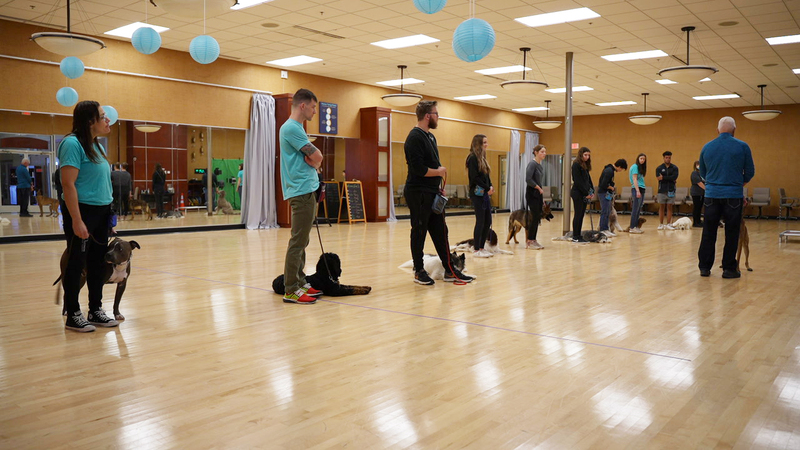
Facility matters as much as the individual. Ask what the ratio of staff to dogs actually is, whether a trainer is running the floor or a separate attendant is, and what a bad day looks like when it happens. Our 1:10 trainer-to-dog ratio is the answer we give when families ask us that question directly, and it is a fair thing to ask anyone else.
"This was an amazing place, the trainers were so knowledgeable and helpful."
Tehani E., Scottsdale
Is a service dog required to carry certification in Arizona?
No, and this is where certification confusion causes the most trouble. Federal disability-rights law does not require a service dog to carry any certificate, vest, or ID card, and Arizona follows that same standard. A business can ask only two questions: whether the dog is required because of a disability, and what task it is trained to perform. Anything sold online as an "official" service-dog certification is not a legal requirement and carries no legal weight.
That is a separate question from professional trainer certification, but the two get confused constantly because both use the same word. One is about who trained the dog. The other is about what the dog is legally allowed to do.
How does Partners Dogs build accountability without a state mandate?
Since Arizona will not set the floor, we set our own and hold it internally. Partners Dogs has run structured training across both campuses since December 1997, working with 70,000-plus dogs along the way, and that volume is where our own accountability comes from: a trainer's read on a dog gets checked constantly, not once at hiring.
Every dog on the floor gets scored against the same PD360 framework, and every trainer runs it the same way, so a family can compare notes across sessions instead of taking one person's word for how a dog is progressing. That structure does the job an outside credential cannot: it catches drift in real time, not on a renewal cycle.
What does our own trainer ladder look like?
Ours is measured in supervised hours, not a single test date. A Partners Dogs trainer completes coursework before ever running a session alone. From there the trainer logs supervised hours working real dogs toward an Instructor title, then logs still more across a wider range of breeds and behaviors before reaching Senior Instructor. We wrote out the full ladder hour for hour, and how it compares with outside credentials, in Dog Trainer Certifications Compared. It is worth reading before you compare us to anyone else. In fairness, PDU is our own internal ladder, not a nationally recognized certification body, and we say so plainly: the case for it rests on the hours themselves, not on the name.
Frequently Asked Questions
Do Scottsdale or Cave Creek license dog trainers separately from the state?
No. Arizona has no state trainer license, and neither Scottsdale nor Cave Creek adds one at the city level. Local ordinances cover dog licensing and the six-foot leash rule, not who is allowed to train a dog for pay.
Is a CPDT-KA credential the same as a government-issued license?
No. CPDT-KA comes from a private membership organization, not a government body, and passing it is voluntary. It is a useful signal that someone studied training theory, but it is not a legal requirement to practice.
Does hiring an uncertified trainer create legal risk for a dog owner?
Not automatically. Since no license exists, hiring an uncertified trainer breaks no law. The real risk is practical, not legal: a trainer without real supervised hours can misread a dog and make a behavior worse, which is why hours and process matter more than a certificate.
How is Partners Dogs University different from an outside certification?
Partners Dogs University is our own internal ladder, built on supervised hours working real dogs rather than a single written exam. It is not a nationally recognized outside credential, and we say so directly rather than implying otherwise.
Skip the guessing
See what actually separates our trainers from a certificate
If hours and supervision matter more to you than letters after a name, see how our own trainers are built before you book anywhere.
Keep reading