In short
A dog afraid of fireworks or thunder needs steady comfort without matching his panic, a crate or safe room he already trusts, and a plan to keep him from bolting. Fireworks around the Fourth of July and monsoon thunderstorms through the Arizona summer are the two heaviest stress periods of the year for dogs in the North Scottsdale area, and structured training brings the fear down over time instead of just managing it night to night.
Fireworks and monsoon thunder are two of the hardest nights of the year for a lot of dogs. More dogs show anxiety around the Fourth of July than any other day, and in Scottsdale and Cave Creek the Arizona summer storm season stretches that stress across weeks rather than one evening.
Being nervous about a sound that shakes the house is a perfectly normal reaction. That does not make it easier to watch. Here is what to look for and what actually helps.
Signs Your Dog Is Afraid of Fireworks or Thunder
Watch for drooling, shaking, pacing, whining, and teeth chattering before a storm or a fireworks show even starts. These are the early signs most owners miss:
- Salivating or drooling more than usual
- Shaking or quivering
- Teeth chattering
- Pacing and an inability to settle
- Whining
Dogs handle stress in one of three ways, and it helps to know which one you are seeing.
- Fight. Becoming reactive or snappy toward you, other people, or other pets in the house.
- Flight. Hiding, or pushing to get into a small enclosed space to escape the noise.
- Freeze. Going stiff and unresponsive. This one gets missed most often because a frozen dog looks like a calm dog.
Comfort Him, Then Give Him a Job
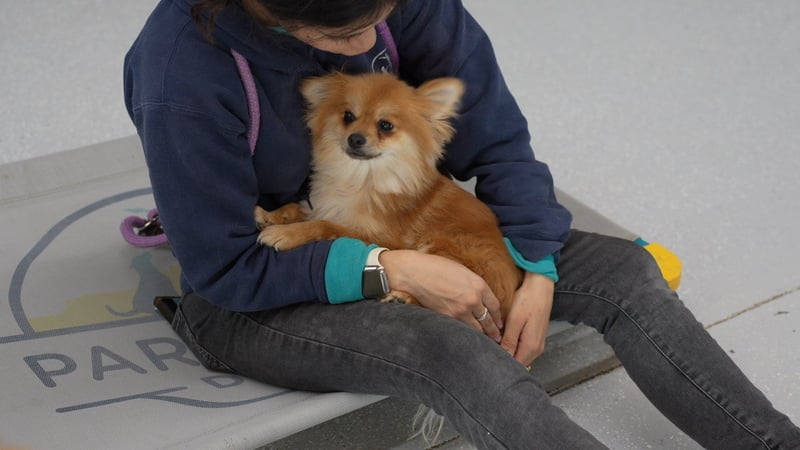
Comfort your dog without matching his panic, then redirect that nervous energy onto something he can succeed at. If your dog comes to you frightened, comfort him. Steady contact and a level voice will not make him more afraid. Your dog reads you before he reads the room, so the thing to avoid is not the comfort itself, it is matching his panic. Hovering, fussing, and a tense voice confirm to him that something is genuinely wrong. Keep your movements normal while you settle him.
Comfort gets him through the moment. It does not raise his tolerance, so pair it with a job. Redirect him onto a favorite toy, a food puzzle, or a few easy obedience reps he knows cold. Channeling that nervous energy into something he can succeed at works far better than trying to talk him out of the fear, and it is the first piece of the structured work that gets him through the next storm with less help.
Exercise earlier in the day helps too. A dog who has already worked has less fuel to pour into panic. In an Arizona summer that means early morning or evening, and it means checking the ground first. Put your palm flat on the pavement. If you cannot hold it there, your dog cannot walk on it.
A Safe Place to Retreat
A crate he already trusts is the surest way to give him somewhere to feel secure, but it has to be built weeks before storm season starts, not the week of. He has to already be crate trained. Do not try to introduce a crate the week of the Fourth. A dog who is frightened cannot learn efficiently, and you will end up teaching him that the crate is where bad nights happen. Build that work weeks ahead.
Pressure wraps such as a Thundershirt are worth trying. They wrap the body and create the sensation of being held, which many dogs find settling.
Next step
Find Out How Deep the Fear Runs
If your dog's anxiety shows up outside of storms too, not just on the loudest nights, a PD360 Assessment maps out what is actually going on and what would help.
Mask the Sound
Play music with a wide range of pitch, not a flat track like ocean sounds, and dim the lights and close the curtains to take the edge off the whole room. Music or white noise gives your dog an alternative thing to listen to. One detail people get wrong: choose music with a wide range of pitch, high and low tones moving around, rather than a flat monotonous track. The varied sound covers the fireworks far more effectively.
Worth knowing that it is often the percussion, the low thump you feel through the floor, that frightens dogs more than the crack of the sound itself. Closing curtains, turning lights down, and covering the crate all help normalize the environment and take the edge off.
Assume Your Dog Will Try to Leave
Fear triggers the urge to run, and a current microchip is the single highest-value safeguard on this list. Dogs escape yards and houses on the third and fourth of July more than any other days of the year. Dogs looking for quiet will go through screens, over fences, and in some cases through drywall.
- Microchip your dog, and keep the registration current. A chip with an old phone number on it does nothing. This is the single highest value thing on this list.
- Stay home if you can. Nothing beats being there.
- If you cannot, contain him properly. A crate he is comfortable in, or a secure interior room. Not the yard.
On Medication
Our position is that behavior should be trained rather than medicated, but some dogs genuinely need medication, and that call belongs to your veterinarian. Some dogs have anxiety severe enough that training alone will not get them through the night, and medication can be the right call.
That decision belongs to your veterinarian, not to a blog post and not to us. Talk to your vet, tell them everything your dog is already taking, and follow their guidance on what and how much. Do not improvise dosing at home.
The Longer-Term Fix
Managing a bad night and training the fear down are not in competition, one gets him through tonight, the other means he needs less help next year. If your dog falls apart at every storm and every firework, management alone will wear you both down. Comforting him in the moment and training him out of it work together, they are not a choice between one or the other.
Noise fear responds well to structured work on confidence and control, and it tends to get worse rather than better if it is left alone for years. Our guide on building confidence in a dog with noise phobia and storm anxiety covers what that training actually looks like.
If you are not sure how far the fear actually reaches, whether it is storms only or something wider, a PD360 Assessment is where we map that out and point you toward the right next step. Fear that generalizes beyond storms, a dog who is also nervous around new people, new places, or other dogs, usually needs more than one skill fixed in isolation. A structured day program like DayCamp is built for exactly that kind of dog, reactive, fearful, or undersocialized, and steady daily structure outside of storm season is what makes the crisis nights easier too.
A dog with consistent training, a place to retreat, and an owner who stays calm can get through a loud night without it costing him anything.
Frequently asked questions
Why is my dog afraid of fireworks or thunder?
Many dogs are naturally sound sensitive, and the sharp crack of fireworks and the low percussion of thunder trigger a fear response that shows up as fight, flight, or freeze. It is a normal reaction, not a training failure, and it responds well to structured work over time.
What are the signs my dog is anxious during a storm or fireworks?
Drooling, shaking or quivering, teeth chattering, pacing, and whining are the signs most owners notice. Hiding and going stiff and unresponsive are just as common and easier to miss, since a frozen dog can look calm when he is actually shut down.
Should I comfort my dog during fireworks or a storm?
Yes. Comforting a frightened dog with steady contact and a normal voice will not make the fear worse. What makes it worse is matching his panic with your own. Hovering, fussing, and a tense voice all confirm to him that something is genuinely wrong.
Does medication help with firework or thunderstorm anxiety in dogs?
For some dogs, yes. Partners Dogs trains behavior rather than defaulting to medication, but a subset of dogs have anxiety severe enough that training alone will not get them through the night. That decision belongs to your veterinarian, who should know everything your dog already takes before recommending anything.
How do I stop my dog from running away during fireworks?
Keep him contained in a crate he already trusts or a secure interior room, never the yard, stay home if you can, and confirm his microchip registration has your current phone number before storm season starts. Dogs escape more often around the third and fourth of July than on any other days of the year.
Can training actually fix noise phobia in dogs, or do I just have to manage it forever?
Structured training builds real tolerance over time. Left unaddressed, noise phobia tends to get worse over the years rather than better, so it does not have to be a permanent routine of managing every bad night.
Ready when you are
Build a Steadier Dog Before Next Storm Season
Behavior Camp gives noise-phobic and anxious dogs structured, in-person work that management alone cannot provide. If a full camp is not the right fit yet, Private Lessons build the same skills on your schedule.
Keep reading
/Programs/Boarding/Top%20of%20Page.jpeg?width=800&height=450&name=Top%20of%20Page.jpeg)