The gist
Stop dog jumping on guests by giving your dog a better job: train a solid place command, then remove every scrap of attention the instant paws leave the floor. Jumping runs on attention, so pay the calm choice and starve the jump. Consistency from everyone in the house is what makes it stick.
- Jumping is self-rewarding: the dog jumps because it pays in attention, any flavor, every time.
- Train place (go to a mat and settle until released) as the incompatible default, and pay it every time.
- The instant paws leave the floor, all attention dies (−P); switch it back on the moment the dog offers the default.
- Proof place across the five D's, then run the numbered doorbell-arrival protocol with every guest briefed on the rules.
- Fair correction enters only after the default is understood, at the lowest level the dog notices.
This is for the Pet Parent whose dog turns every doorbell into a wrestling match: the 70-pound Lab launching at your mother-in-law, the doodle shredding your guest’s good pants. You did not adopt a dog to dread the doorbell. This guide walks through why the jump keeps paying off, the place-command fix, a numbered doorbell protocol, and how to proof it until it holds. For the framework behind every term below, see our methodology.
Jumping is a paycheck problem: the dog keeps spending paws because the payout, your attention, never misses.
Why does your dog jump on guests?
Your dog jumps because jumping works. Every jump buys attention, and attention is the paycheck.
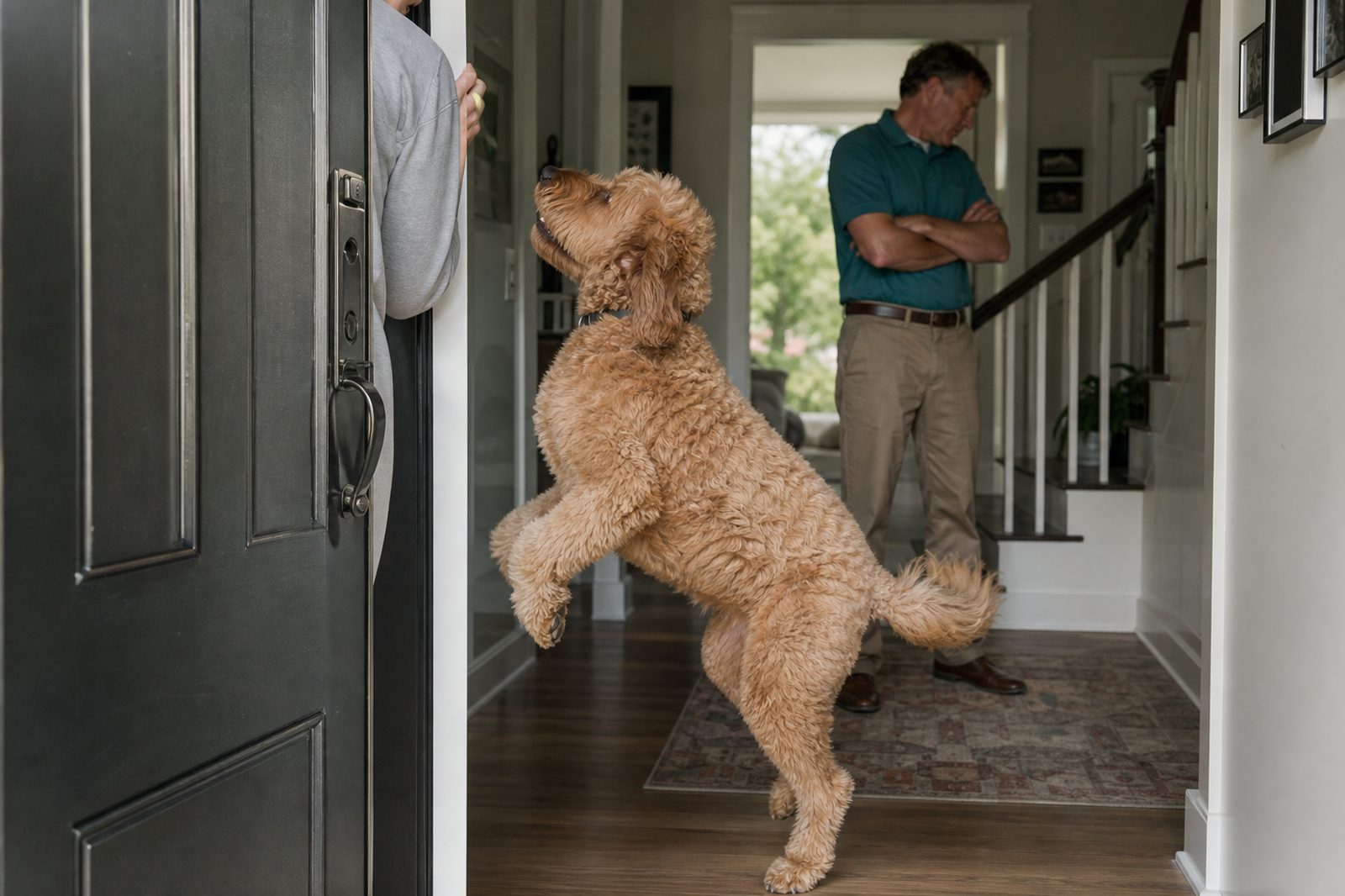
Read the chain the way we do. The trigger is a person at the door: sound, motion, novelty, a face coming down to dog height. The chemistry arrives before the thinking does: dopamine spikes with anticipation, cortisol with arousal, and the loop starts running. The response is paws off the floor. The outcome is the part that seals it: someone talks, touches, laughs, pushes, or yells. Any of it pays, which is why the loop is self-rewarding and needs no permission from you. Your dog has rehearsed this pattern over and over, and each rep made it faster and louder. The AKC’s trainers say the same thing from their side of the fence: dogs often jump because they are excited and seeking attention, and the habit gets unintentionally reinforced when people talk to, touch, or otherwise acknowledge them (retrieved 2026-09-16). A dog with no useful pattern at the door invents its own, and jumping is the easiest one to invent.
Guests are the highest-value trigger in the house. Family members get boring. A new person at the door is the lottery ticket: new smell, new voice, new face coming down. That is why the dog that never jumps on you launches at your guests. The rule did not fail. The distraction level changed, and the behavior was never proofed against it. In a Group Class at Partners, this is the exact distraction we proof against: real people coming through a real door, at distances chosen for your dog, with a trainer reading both ends of the leash.
How do you stop dog jumping on guests for good?
You stop the jump by changing what it buys: install an incompatible default and starve the jump of attention.
The plan has two parts, and you need both.
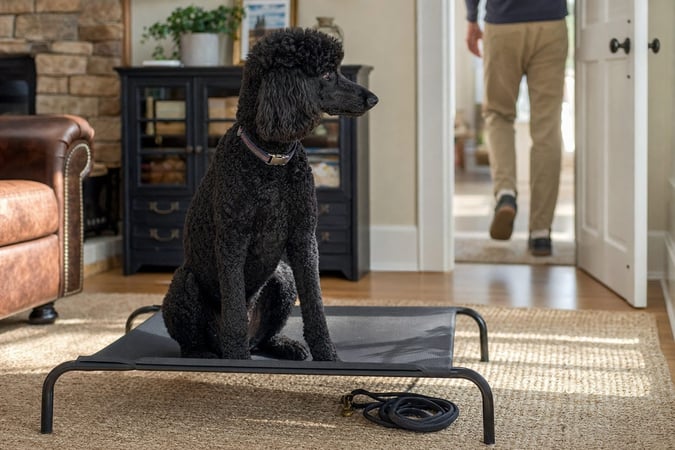
Part one: teach an incompatible default. A dog holding place cannot be climbing your guest. “Place” is our word for a trained default response: go to a mat and settle there until released. Sit works for some dogs, but place wins at the door because it is a location with a job, not a posture the dog has to hold while a stranger leans over it. The default gets paid every single time it is offered: treats, calm praise, the greeting itself. You make the right choice the richest choice in the room.
Part two: make the jump worthless. The moment paws leave the floor, every human in the room goes silent and still, and the dog gets nothing from the jump. This is negative punishment in action.
When the dog lands and offers the default, attention switches back on immediately. Appropriate greetings turn attention on. Jumping turns it off. Dogs learn this accounting fast when every human in the house keeps the same books.
Order matters. The plan runs our four phases: Teach the place, Reinforce it until the dog offers it freely, Proof it against real doorbells and real guests, Maintain it with reps. Skip straight to punishing the jump and you get a dog that knows only what not to do.
How do you teach the place command?
Start boring and quiet. The door comes later.
- Pick the place. A mat, a bed, or a low cot in a consistent spot. One place, one meaning: go there and settle.
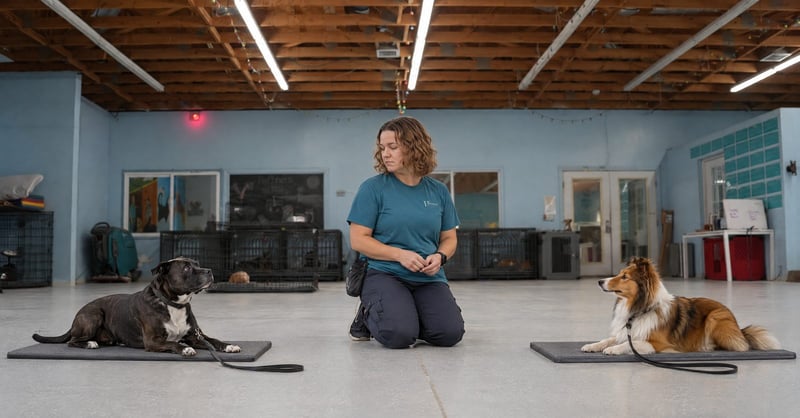
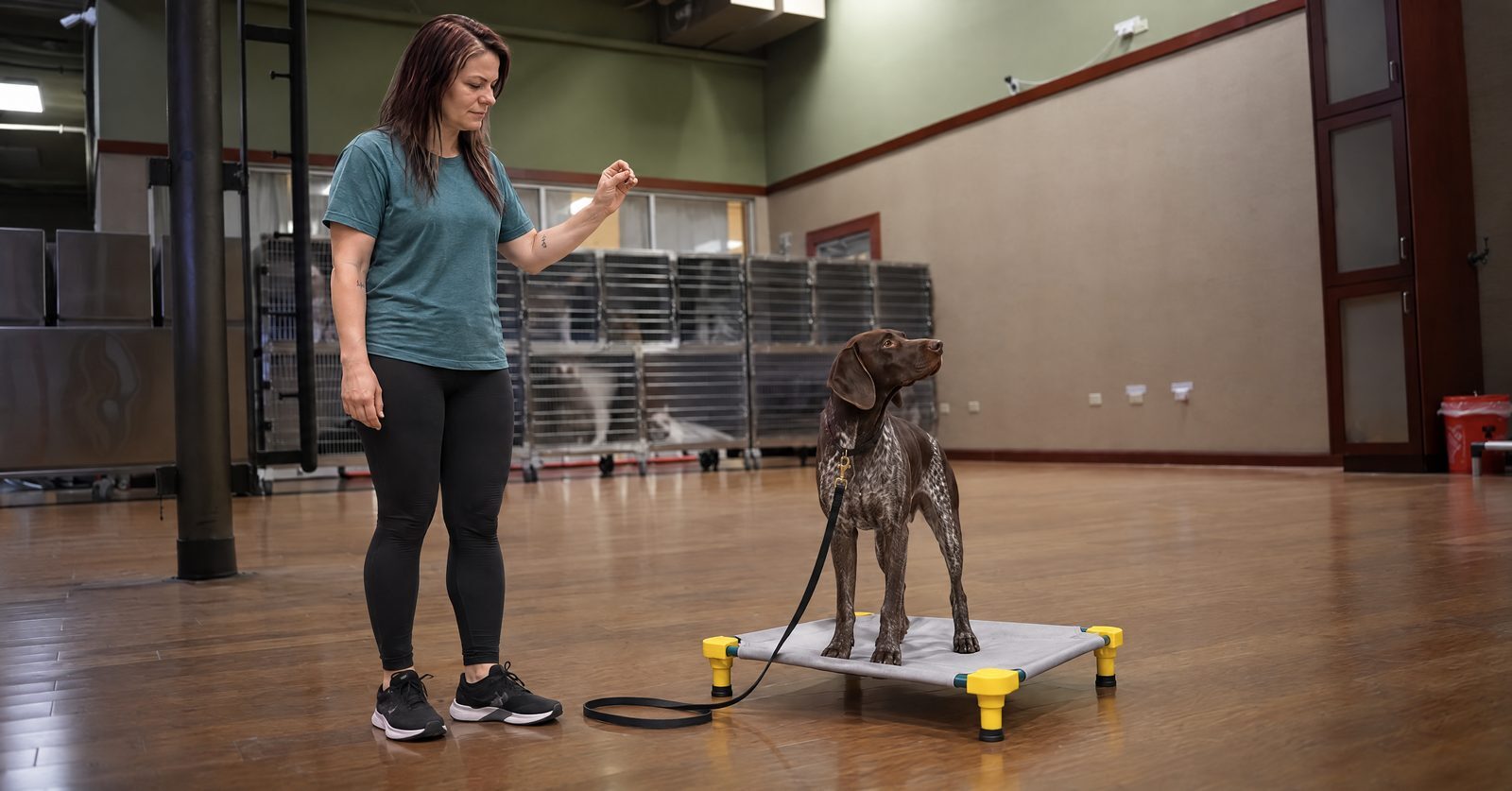
- Pay any paw on it. The first session is shaping. Any paw touching the mat earns a marker and a treat. Build to all four paws, then to a sit or down on the mat. Several short sessions beat one long one.
- Build duration before you name it. Feed the dog for staying on the mat for longer stretches: seconds first, then a minute, then the length of a real conversation. Add the cue word “place” only after the dog is already running to the mat on its own.
- Add distance. Send the dog to place, take one step away, return and pay. Two steps. Across the room. The dog learns that staying pays even when you move.
- Add a release cue. “Free” or “okay” ends the job. No release, no leaving the mat. The release is part of the training, not an afterthought.
- Run it through the day. Ask for place before meals, before the leash goes on, while you cook. You are building a habit, and habits come from reps in real life, not from weekend drills.
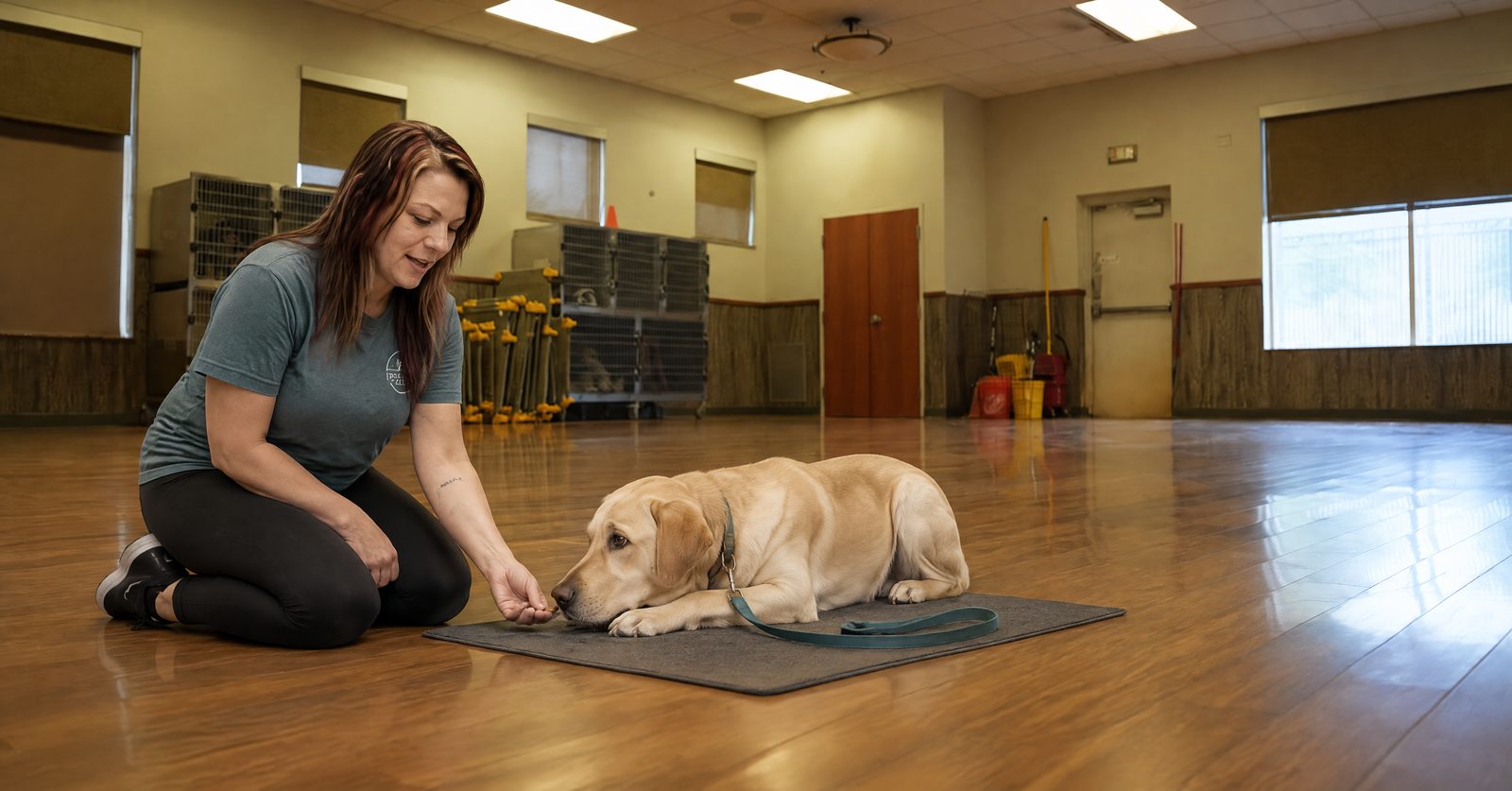
Work several short sessions a day, a few minutes each. If the dog breaks, you asked for too much too fast. Back up one step and rebuild. That is not failure. That is the Reinforce phase doing its job.
How do you proof place against real guests?
A sit in the kitchen is Teach. Place at the door with guests walking in is Proof.
Run the place command up this ladder, one D at a time:
- Duration. The dog holds place for a full greeting, from the doorbell through the small talk while coats come off. Build this in the living room with a timer and a book before you add people.
- Distraction. Knock on the table. Then the wall. Then play a doorbell sound on your phone. Then a family member walks through the front door. Each level only enters after the previous one holds.
- Distance. You stand next to the mat, then across the room, then with your hand on the doorknob. Place has to hold while you do the thing the dog cares about.
- Direction. Dogs pattern-match locations, so proof every entry point the dog might meet a guest at.
- Difficulty. One calm family member first. Then a friend. Then the favorite person, the one your dog loses its mind over. The favorite person is the final exam, not the first lesson. In the Valley, snowbird season is the real final exam: a house full of visiting relatives in January.
Move up only when the current level holds. A dog that breaks at level three does not need more correction. It needs more reps at level three.
What is the doorbell-arrival protocol?
Manage the trigger, run the default, enforce the accounting. One action per step:
- Set the stage before anyone arrives. A dog that has had a real walk or a training session that day has less arousal to spend at the door. That is management, and management stacks the deck before training even starts.
- Text your guests the house rules. “Heads up: we are training the dog. When you come in, ignore him completely unless all four paws are on the floor. No petting a jumping dog, even for a second.” Guests who know the rules stop being the loophole.
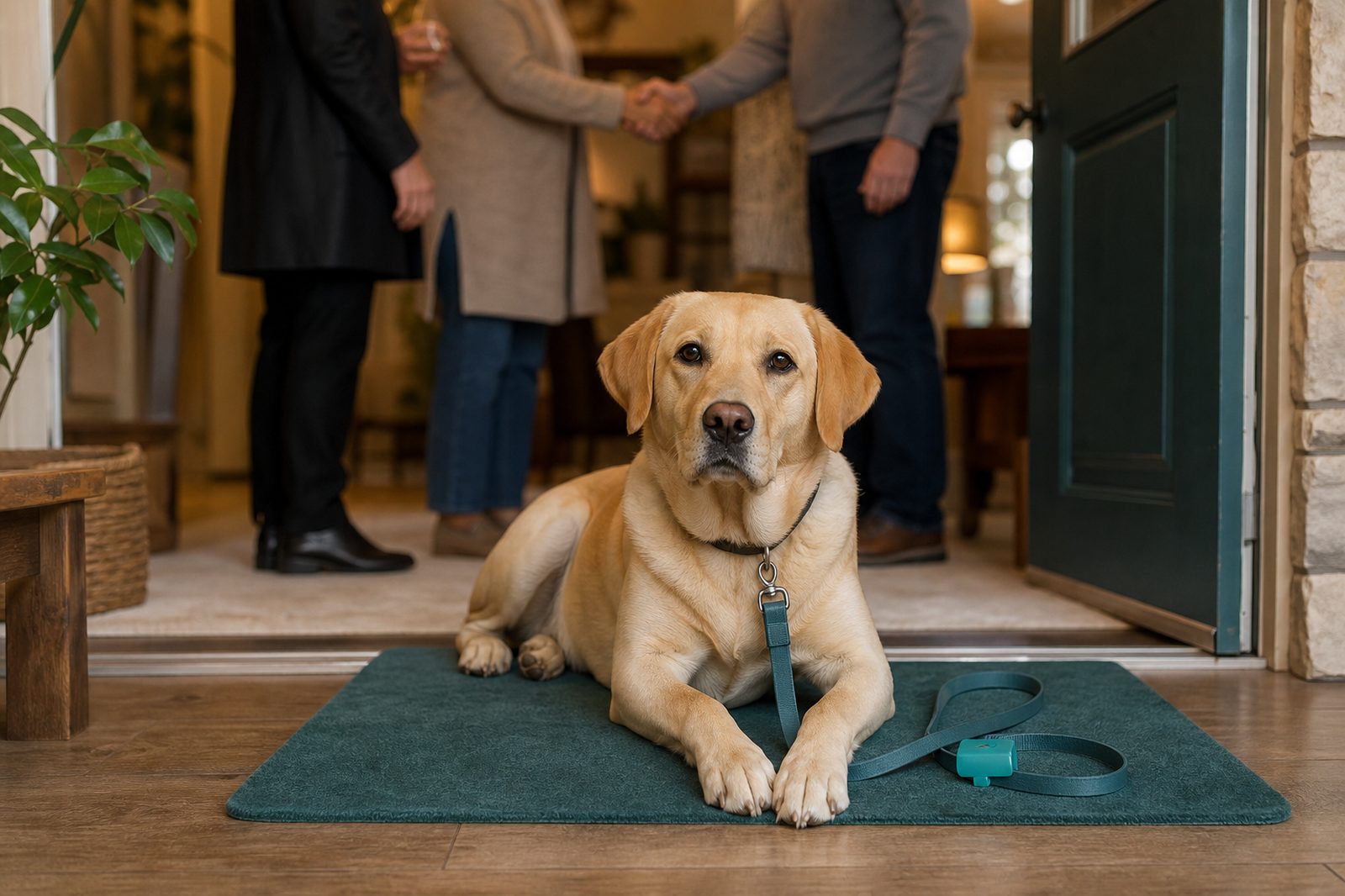
- Park the dog on place before the bell rings. Send the dog to place and pay it there while you wait. During the learning phase, a leash on the dog and a baby gate at the entry are management, not failure.
- Bell rings: pay the place harder. Doorbell is a cue to the dog that the good stuff flows on the mat. Jackpot the dog on place right after the bell rings.
- Answer the door with the dog already working. You open the door. The guest walks in. The dog holds place and watches the richest choice in the room sit on a mat.
- Paws leave the floor: everything dies. You say nothing. The guest turns or steps back. All attention, eye contact, and talking stop until four paws are back on the mat. Then pay the reset like it matters, because it does.
- Release to a calm greeting after the settle. The greeting is the paycheck for the default. The guest pets the dog only while the dog holds the default. Then release with your cue and get on with your evening.
Between real visits, run fake arrivals. Have a friend ring the bell and walk in twice a week. Real guests are the test. Rehearsals are the training.
Step one
Install the Default for You
In Foundation Camp (14 nights, two-plus training sessions a day), our trainers install place and the doorbell protocol through all four phases, then teach you to run it at the handoff lesson. We teach the dog, then we teach you.
Mistakes that make jumping worse
- Kneeing the dog. The AKC’s own guidance warns against it: many dogs read a raised knee as attention or the start of a game, it can strain your relationship with the dog, and in some cases it can cause injury (retrieved 2026-09-16). The dog learns that jumping starts a fun shoving match.
- Yelling “down” or “off” on repeat. Yelling is attention with volume. The dog hears your voice spike and reads it as excitement joining in. Say the cue once in a normal voice, then enforce it with your feet and your attention.
- Pushing or grabbing the dog. Pushing turns into a wrestling game, especially for young, physical dogs. Hands on the dog during the jump pay the jump.
- Letting one person allow it. If three people ignore the jump and grandma hugs the dog for it, the dog keeps jumping. You just built a slot machine: sometimes jumping pays big, so the dog keeps pulling the lever. Everyone keeps the same books or the plan fails.
- Correcting before the dog knows the job. Punishing a dog that was never taught the default teaches it that guests predict bad things, not that place predicts good things. Teach first. Always.
When is correction fair?
Correction enters only after the default is understood, at the lowest level the dog notices, and only to interrupt the mistake so you can show the right answer.
Our position first: positive reinforcement is the primary method and the base of everything we run. Fair, minimal, well-timed correction is also legitimate and necessary. For most jumpers the default plus starved attention does the whole job. For the big, physical, rehearsed ones, the jump can be so automatic that the dog blows through the −P and keeps going.
Here is what fair looks like in this exact situation, and only here: the dog knows place cold, you sent it to place, it left the mat and launched anyway. You interrupt once, calmly, at the lowest level that gets through: a flat leash guide back to the mat, a quiet interrupter word you have already conditioned, no anger, no volume. Then you show the right answer and pay it. One correction, then the default, then the paycheck. That is the whole event.
What it never looks like: kneeing, alpha rolls, leash yanks that lift the dog, or yelling the dog into the mat. And it never starts before the dog understands place. Correcting a dog that does not know the job is not training. It is frustration with a leash attached.
You will also hear trainers say you should never correct a dog at all. We will be plain about that: a method with no correction has no answer for the moment the treat bag is empty and your mother-in-law is at the door. Positive-only pressure turns aversive when the owner gets frustrated, and the dog pays for that frustration with worse handling. The Hard Lines prohibit abuse and dogma. They do not prohibit a fair, well-timed correction.
The test is simple. If you are correcting more than a couple of times in a session, the dog does not know the default well enough yet. Back up a phase. Keep correction rare and minimal. The default does the teaching. You are the mentor, not the remote control.
Which program fits
Private Lessons: Your Door, Your Dog, Your Guests
A trainer comes to your home and installs the doorbell protocol on your actual front door with your actual guests, then coaches you through the reps. Start with an assessment so the plan matches the dog.
By the numbers
Serving Phoenix Valley families since 1997.
Key takeaways
Key takeaways
- Jumping is a paycheck problem: the behavior buys attention in any flavor, so it keeps getting rehearsed. Change the payout and the pattern starves.
- Install an incompatible default. Place means go to a mat and settle until released; a dog on place cannot be on your guest.
- Remove all attention the instant paws leave the floor (−P), then switch attention back on the moment the dog offers the default.
- Proof place across the five D’s before you trust it at the door: duration, distraction, distance, direction, difficulty.
- Kneeing and yelling fail because they pay the jump with attention or turn it into a game. Everyone in the house keeps the same books.
- Correction is fair only after the default is understood, at the lowest level the dog notices, and only to interrupt so you can show the right answer.
Where to go from here
The jump is not a character flaw. It is a pattern that paid off, and patterns can be replaced. Install the default, starve the jump, proof it against your actual front door, and keep the whole household on the same page. If you want it installed faster, our trainers do this every week at both campuses.
Scottsdale: 8642 E Shea Blvd, 85260. Cave Creek: 4640 E Forest Pleasant Pl, 85331. Serving the Phoenix Valley.
Frequently Asked Questions
What is the first step if my dog jumps on every guest?
Book a PD360 Assessment at either campus. A senior trainer reads your dog across nine dimensions, figures out whether the jumping is arousal, habit, or part of a bigger pattern, and routes you to the right program. Foundation Camp installs the default and the doorbell protocol; Private Lessons builds it on your actual front door.
Why doesn’t kneeing my dog work when he jumps?
Because the dog reads it as attention or the start of a game, and the AKC’s trainers warn it can strain your relationship and risk injury. The knee pays the jump with exactly what the dog wanted: you engaging. Turning away and removing all attention teaches the dog that jumping buys nothing. Starve the behavior instead of feeding it.
Should I yell “down” when my dog jumps on guests?
No. Yelling is attention with volume, and dogs read your excitement as permission to escalate. Say the cue once in a normal voice. If the dog does not respond, enforce with your feet and your attention: turn, step back, reset to place. The enforcement is the teacher. The volume is just noise.
How many weeks does it take to stop jumping on guests?
The place command itself comes together in a few weeks of short daily sessions. Reliability at the door takes longer, because guests are the highest distraction in the house and proofing runs the five D’s in order. Plan on a month or more of consistent reps: one guest who allows the jump can undo a week of work.
My dog only jumps on certain people. What am I doing wrong?
Nothing is broken. Some people are higher-value triggers than others: the favorite person, the new smell, the excited voice. The default holds where you proofed it and breaks where you did not. Proof place against the specific people the dog loses its mind over, and brief those guests on the rules before they arrive.