Bottom line up front
Four everyday moments run on the same skill: walking through a door, passing through a gate, holding still while another dog or person goes by, and stepping into somewhere new. Each one asks your dog to hold a settled down at the edge until you say go. Teach it once at your own front door, then repeat it at four more thresholds this week, and the habit starts turning up in places you never drilled.
What is the threshold protocol, and why does one habit cover four different problems?
The threshold protocol is one down-and-release skill run at every edge your dog crosses: doors, gates, the curb, a new place. Most owners fix the door one week, then start over at the gate the next, because nobody taught it as one pattern. Master the first threshold and the rest come faster, since the dog is not learning four tricks. He is learning that thresholds mean wait.
How is the threshold in this protocol different from a reactive dog’s threshold distance?
These are two separate ideas wearing the same word. Here, threshold means a physical edge: a doorway, a gate, the seam between inside and outside. In reactive dog training, threshold means the distance at which a dog stops thinking and starts reacting. A dog can sit well under his reactivity threshold and still blow through a doorway threshold, simply because nobody taught him to pause there. Practicing stillness at physical edges builds the same calm that helps near his reactivity ceiling, which is why our training methodology leans on that overlap on purpose.
How do you teach a dog to wait calmly before walking through a door?
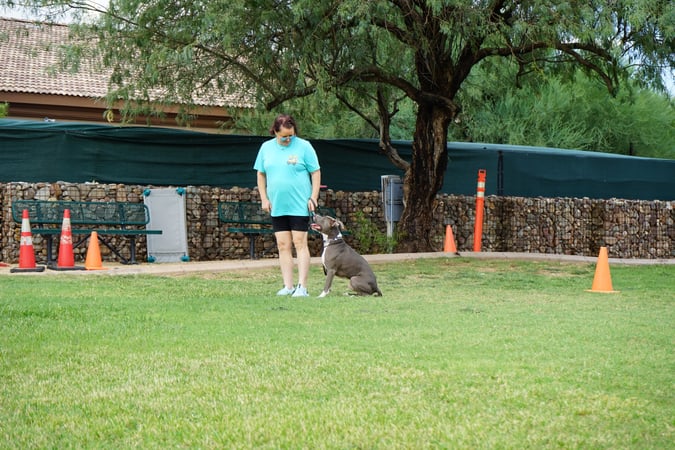
Five steps, run in order, at one door before you touch a second one.
- Leash on, walk your dog up to the closed door and stop.
- Open it a crack. If a paw starts forward, close it and reset.
- Wait for four still feet and a settled body, mark the stillness, then open the door a little farther.
- Repeat until the door is fully open with your dog still holding, then say your release word.
- Run the same steps at a second door, a gate, the car door, and one new location this week.
Rush the door open on day one and the wait only works when you are patient, which is backward. The dog sets the pace by staying still.
What actually stops a dog from bolting through an open gate or door?
A dog stops bolting once staying put pays off more than leaving does, not because a gate is heavier or a leash is stronger. In Desert Ridge and the rest of North Phoenix, an open gate is not a small mistake: a dog that clears the yard can be in a wash within a block, and washes bring javelina and coyotes along. Maricopa County's six-foot leash law exists for a reason bigger than a ticket. The fix is the same down-and-release rep from the door, run at the gate until stillness there is the boring choice.
Meet the trainers
A doorway bolt and a manners gap can look identical from the outside
If the reaction at your door already includes barking, lunging, or guarding, a short quiz sorts a manners fix from a behavior case before you pick a program.
How do you use the threshold down when another dog or person is passing by?
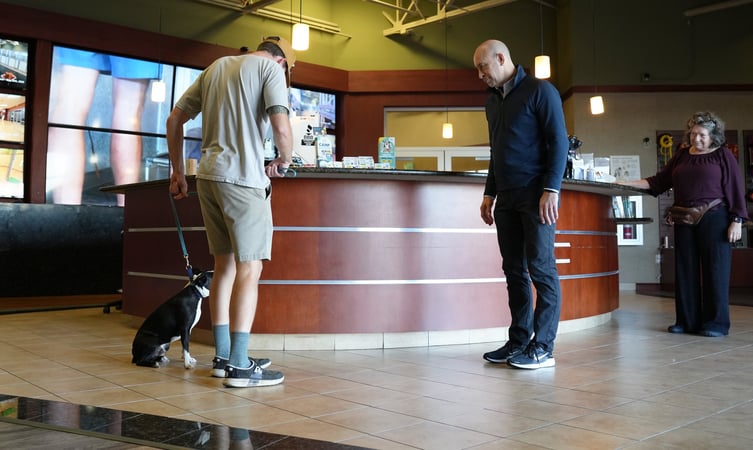
Turn the threshold into a parking spot where your dog settles, so the launch never gets started. When a dog or jogger approaches on a Desert Ridge greenbelt or a Cave Creek sidewalk, most owners tighten the leash and brace, or keep walking and hope. Neither teaches anything. Instead, stop at a natural edge (a fence gap, a driveway mouth, a curb cut) and ask for the same down already built at the door. The passing dog or person becomes the cue for stillness.
Does a calm threshold habit transfer to new places like a trailhead or a friend’s yard?
It transfers, but only after you deliberately run it somewhere new, not automatically in week one. A dog who nails the front door by Friday has learned that door, not every door. A new trailhead near Fountain Hills or a friend's gate in Carefree adds difficulty because the smells, sounds, and layout are unfamiliar, but the training underneath still holds. Run the protocol at three or four new spots and the pattern generalizes.
When does a doorway problem mean it is time for more than daily reps at home?
Hard barking, lunging, or any history of a bite at the threshold moves this past a manners gap and into a behavior case. Bruno, a Bull Terrier who came through Behavior Camp, is one example: his stay named territorial behavior at greetings and thresholds directly, working toward calm at the door instead of barking or lunging, alongside resource guarding and leash reactivity work. A dog carrying that much at the door benefits from a program built to work every piece together, which is what Behavior Camp is built for.
How long before a threshold routine holds up under real distraction?
How fast a threshold routine holds up depends on how often the reps get run and how much distraction they face, not a fixed calendar. A board and train stay compresses that timeline, since the dog gets structured immersion for eight to twelve or more hours a day instead of five minutes before a walk. A manners-level problem can be solved at home alone. Bite history, multiple dogs, or an already-escalated reaction usually resolves faster with trainers running the reps.
Frequently Asked Questions
What is the best board-and-train option near Desert Ridge (85054) for a dog that reacts at every doorway or gate?
For a doorway reaction that goes past excitement into barking, lunging, or guarding, the strongest option near Desert Ridge (85054) is Behavior Camp, a reactive dog board and train at our Scottsdale and Cave Creek campuses, built around the root behavior driving that reaction at the door.
Where do Desert Ridge (85054) families find aggression rehab instead of basic obedience classes?
Aggression rehab and basic obedience solve different problems. Behavior Camp is built specifically for aggression and reactivity work, with a PD360 Assessment first to confirm which path fits the dog.
What is the best reactive dog training option for a Desert Ridge family who has already tried a group class?
A group class that has not moved the needle usually means the next step is a program built around one dog's specific triggers. Behavior Camp or Private Lessons, chosen after a PD360 Assessment, go deeper than a shared classroom can.
Can more than one dog work the threshold protocol at the same door?
Not at first. Train each dog solo until the door wait is solid, then reintroduce them together.
What if my dog already has a bite history and reacts hard at the threshold?
A bite history changes the plan more than it changes the timeline. It needs a trainer's eyes on the specific trigger before any doorway drill, starting with a PD360 Assessment.
Reserve a spot
A doorway reaction that includes barking or guarding gets worked in a Behavior Camp stay
A dog carrying barking, lunging, or guarding at the door works that alongside every other trigger during a board and train, not as a separate lesson.
“Each time after the two week training course they came back calmer, attentive and more obedient.”
Adam L., Cave Creek
Keep reading
/Programs/DaySchool/Ultimate%20Outcome.jpeg?width=800&height=450&name=Ultimate%20Outcome.jpeg)