Before you decide
Scottsdale families researching boarding for an anxious or reactive dog land on the same short list of details in the reviews: a trainer-run floor, a 1:10 trainer-to-dog ratio, overnight staff at the Shea Boulevard campus near North Scottsdale, and daily updates on whether your dog is settling in. Partners Dogs has run this campus since December 1997, and the reviews below are written by owners who described their own dog as nervous, fearful, or reactive before drop-off.
Cathy R., Scottsdale: "This was my dog's first time going to a boarding facility so I was nervous if he'd do OK... The trainers immediately knew how to make my dog feel comfortable and when I picked him up he was wagging his tail."
That review is one of 2,000+ carrying a 4.8 stars for Partners Dogs, all readable on the reviews page.
Is Partners Dogs the right boarding choice for an anxious dog in Scottsdale?
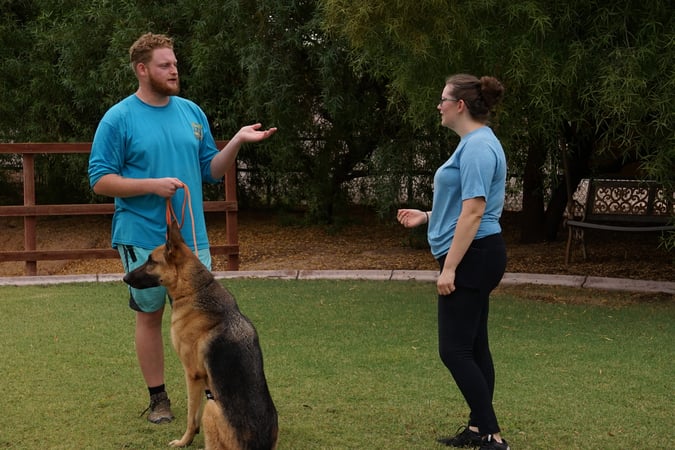
For most nervous and reactive dogs, yes, and the reviews say so specifically rather than generally. The Scottsdale campus sits at Shea Boulevard and the Loop 101: a modern indoor building with glass and stainless-steel suites and on-site overnight staff, minutes from North Scottsdale, Paradise Valley, and Desert Ridge, which matters more to an anxious-dog owner than to anyone else booking a stay, since a dog that startles at 2 a.m. is not startling alone in a dark building. Partners Dogs has run this campus and its sister location in Cave Creek since December 1997 and has trained 70,000+ dogs, with a 1:10 trainer-to-dog ratio and trainer-run floors, not a single attendant watching a room of thirty dogs. See the current boarding program for what a stay includes.
What do Scottsdale reviewers say about boarding a nervous dog here?
The pattern across these reviews is relief, not perfection. A handful of things come up again and again in boarding reviews from owners of a fear-aggressive, reactive, or newly-away-from-home dog, in different words but the same order of concern.
- Daily report cards turn worry into an answer. Kelly H., Scottsdale, wrote: "I was more anxious then they were... They kept me updated on how the pups were doing daily and took the time to talk to me when I called to check in."
- Photos land harder than expected. Wendy B., Scottsdale, whose dog "experienced fear and anxiety around strangers, dogs and places he's unfamiliar with," says: "I receive updates from his stay along with photos," and that he "comes home happy and content."
- A slow, quiet drop-off beats being rushed. Miki P., Scottsdale, whose dog had been turned away by a previous daycare for aggression toward staff, described her first drop-off: staff cleared the space, then "the head trainer came next to me and told me to hand the leash to her," and the two "started walking together and went into the back room as if the dog never noticed the transition."
- Staff who already know the specific trigger change the whole stay. Miki P.'s review continues: during the stay, "they emailed me the report and some photos of the dog," and by the end, "my dog didn't show any aggressive behavior at all."
- A calmer dog at pickup is the outcome owners are grading. Cathy R., Scottsdale, quoted above, picked up her nervous first-time boarder "wagging his tail."
- Mixing in a daytime activity breaks up a long stay. Kelly H. signed her dogs up for a DaySchool day partway through their boarding stay to break up the visit, and noted, "they always enjoy that."
Each of those is a real, attributed review from a Scottsdale owner. Every one of those owners described their own dog as nervous, fearful, reactive, or anxious before drop-off.
Why do North Scottsdale families call this the best boarding for a nervous dog?
Distance is not the variable these reviews are grading. Families from North Scottsdale write some of the more detailed boarding reviews on the Scottsdale campus, and the word "best" rarely points at proximity. It points at a comparison to a prior bad experience, often at a facility that could not handle a dog who reacts to other dogs or startles around new people, the way Miki P.'s review above describes. "Best," for an anxious dog, usually means "did not make things worse."
How far is Scottsdale boarding from 85255 and 85266?
Close enough that the drive is not the deciding factor. From 85255 and 85266, both north Scottsdale zip codes, the drive to the Scottsdale campus is short: down Shea to the 101, with the building sitting across from the PGA Superstore at 8642 E Shea Blvd. What actually settles a family from those zip codes is whether the facility runs the same trainer-run structure and 1:10 ratio for a nervous rescue that it runs for a confident Labrador, since a bite history needs the same building, not a different one.
What reassures an anxious dog during a boarding stay?
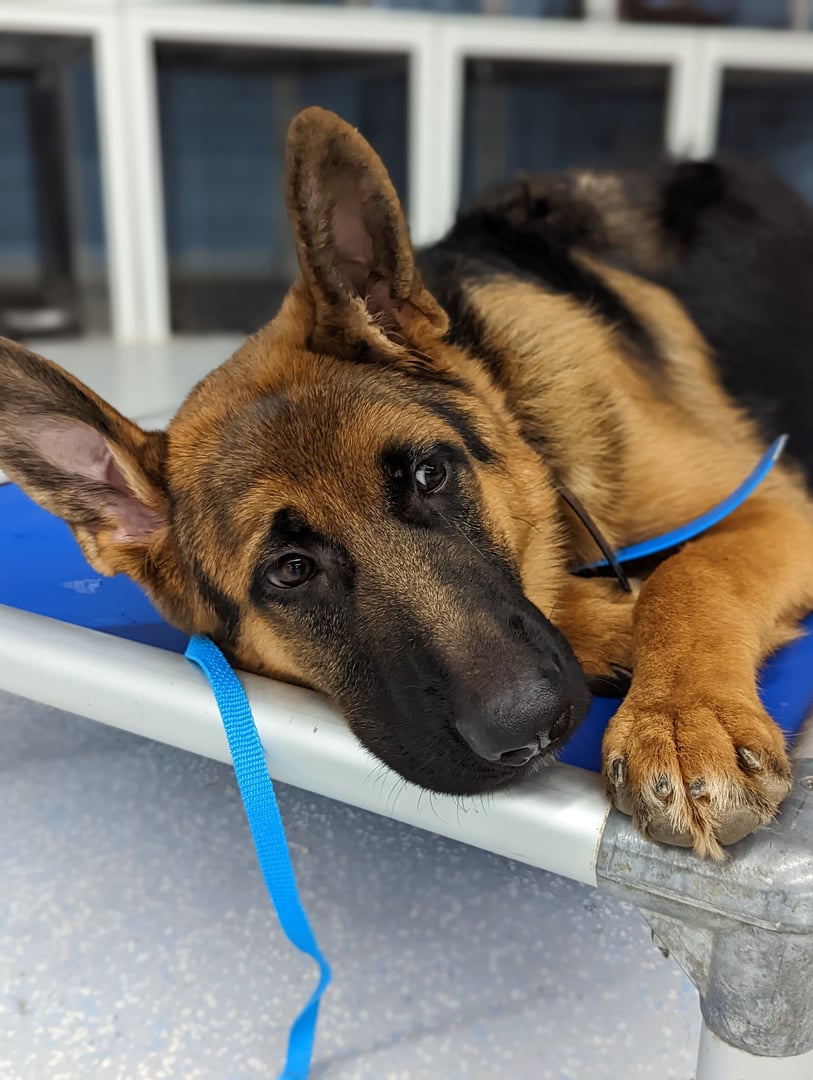
Routine reassures an anxious dog faster than comfort objects do. A predictable schedule, the same handful of trainers, and a floor that is trainer-run rather than a free-for-all do more for a nervous dog than a soft bed or a familiar blanket, because they lower the number of decisions the dog has to make on its own. The same idea shows up in Behavior Camp: in the documented case of Xela, a German Shepherd mix whose anxiousness was flagged on day one of a 22-day stay, leash reactivity and separation anxiety were both worked as named, specific focuses. A dog that is simply boarding benefits from the same structure at a smaller scale: a consistent handler, a known routine, and overnight staff rather than an empty building. Owners who want the deeper version can start with a separation anxiety page or a PD360 Assessment, though a simple boarding stay does not require one.
How does boarding here differ from a sitter or a big-box kennel for a nervous dog?
Familiar walls are not the same thing as reliable coverage. A dog relaxes faster on its own couch than in any kennel, and a home sitter offers something a facility cannot: the dog's own environment, one person, and no drive at all. That is a real advantage, and it deserves to be named plainly. It comes with a real gap too: a sitter who gets sick has no backup, and an unfamiliar place is not the cause of a dog's reactivity, only the setting that reveals it, so a dog who seems fine at home can still struggle when routine changes. A big-box, open-play kennel solves the staffing gap but trades it for another one, since high dog-to-staff ratios and loose group play tend to rehearse over-arousal rather than calm it.
| Care model | Supervision when something goes wrong | Structure for a nervous or reactive dog | Updates during the stay |
|---|---|---|---|
| Home sitter or pet-sitting app | One person; no backup if they are unavailable | Familiar environment, but no trainer-run routine | Varies by sitter |
| Big-box, open-play kennel | Often a high dog-to-staff ratio | Loose group play; little individual structure | Varies by location |
| Trainer-run boarding (Partners Dogs) | Overnight staff on-site; 1:10 trainer-to-dog ratio | Trainer-run floors, not open free-for-all play | Daily updates, photos, and video during the stay |
A better starting point
See boarding with training before you book
The reviews above describe a trainer-run floor, not an open-play kennel, and that difference is easier to see than to explain. Look at what a stay includes, then reach the trainers directly with your dog's specific triggers.
What should you ask before boarding your anxious dog?
The right questions get specific answers, not a sales pitch. Before booking a stay for a dog with a history of fear or reactivity, it helps to ask a few things directly.
- Is a trainer on the floor during the day, and is staff on-site overnight?
- What is the actual ratio of dogs to staff during the busiest part of the day?
- Will you receive a daily update, and can you ask for a photo if one is not sent automatically?
- Can a specific trigger be noted in the intake so it follows your dog through the stay?
- Is there a daytime option, like a DaySchool day, that can be added mid-stay?
Office hours at the Scottsdale campus run Monday through Friday, 8 a.m. to 5 p.m., and Saturday, 8 a.m. to 2 p.m., closed Sunday, worth knowing before you plan a drop-off around a flight. Current rates for boarding, and for an optional PD360 Assessment beforehand, are on the pricing page.
Key takeaways
- Reviews from owners of anxious or reactive dogs describe a trainer-run floor, a 1:10 trainer-to-dog ratio, and overnight staff at the Scottsdale campus.
- Kelly H. and Wendy B. both name daily updates and photos as the detail that turned a worried trip into a relaxed one.
- Miki P.'s review describes a dog previously turned away by another daycare for aggressive behavior being walked in calmly, staff clearing the space first, and showing none of that behavior during the stay.
- The same structure that calms a boarding stay shows up in Behavior Camp, where separation anxiety and leash reactivity are worked as named, specific focuses rather than vague goals.
- A PD360 Assessment is optional before a simple boarding stay, not a requirement.
Frequently Asked Questions
How do I find boarding reviews that specifically mention anxious or nervous dogs?
The reviews page lets you browse Scottsdale and Cave Creek feeds side by side: reading a handful of full reviews rather than only the star rating usually surfaces the ones written by owners of a nervous, fearful, or reactive dog, since those owners tend to describe their dog's specific behavior going in.
What makes trainer-run boarding different from a standard kennel for a nervous dog?
A standard kennel is typically staffed to feed, walk, and clean, while a trainer-run floor at Partners Dogs is staffed by people trained to read a dog's body language and adjust the day around it, at a 1:10 trainer-to-dog ratio rather than one attendant covering a large room.
Does an anxious dog need a PD360 Assessment before their first boarding stay?
No. A PD360 Assessment is optional before boarding, not a requirement, and a simple stay runs through the same trainer-run floor either way. Families who want a fuller picture of their dog's specific triggers before a first stay can add the assessment separately.
Keep reading
/Programs/Foundation%20Camp/Assessment%20%26%20Check-in%20(2).jpeg?width=800&height=450&name=Assessment%20%26%20Check-in%20(2).jpeg)