What we tell families
AVSAB's position statement asks a real question about training methods, and the honest answer is that reward-based methods work and deserve to come first. It does not answer a different question: whether a reactive dog in Scottsdale, Cave Creek, or anywhere in the Phoenix area needs a single weekly session or full-time structured immersion to actually change. Partners Dogs runs Behavior Camp as reward-based-first, supervised at a 1:10 ratio, because format is the part AVSAB's statement never addresses.
Is it true that AVSAB says reward-based training is the only humane option?
Yes, and that part of the record is accurate. The American Veterinary Society of Animal Behavior's 2021 position statement is direct: only reward-based methods should be used for all dog training, including the treatment of behavior problems. On aggression cases specifically, AVSAB is just as direct: “There are no exceptions to this standard.” AVSAB is a professional body of veterinarians and behaviorists, and its stance reflects real research on stress-related behavior, cortisol, and dog-owner attachment. That is the accurate, current version of AVSAB's position, and an honest article says so plainly.
What does AVSAB's position statement recommend?
AVSAB recommends verbal or visual cues, a marker signal, and consistent reinforcement, never pain or intimidation. The statement names capturing, shaping, and luring as core techniques. By its own definition, an aversive method is anything relying on force, pain, or discomfort. The list of tools to avoid names specifics: choke chains, prong collars, and shock collars, alongside intimidation tactics like shouting, staring, and alpha rolls. That is not editorializing; AVSAB's own document names those exact tools.
What does the AVSAB statement leave unanswered?
It never once addresses where or how often training happens. Read the whole document: there is no mention of board-and-train, in-home sessions, daycare, group class, or any other training format. AVSAB writes about method: what a trainer's hands should and should not do in a given moment. It says nothing about a dog's actual week, about who holds the leash on a Tuesday versus a Saturday, or about how many repetitions in how many settings a new response needs before it survives outside a living room. For the fuller picture on causes and warning signs, see our complete guide to reactive dog training in Arizona. That gap is not a flaw in the statement. It is simply outside its scope, and it is exactly the gap that decides whether reward-based training holds up in the real world or falls apart the first time the dog meets a jogger on a Scottsdale greenbelt.
Why does a reactive dog behave differently at home than out in the world?
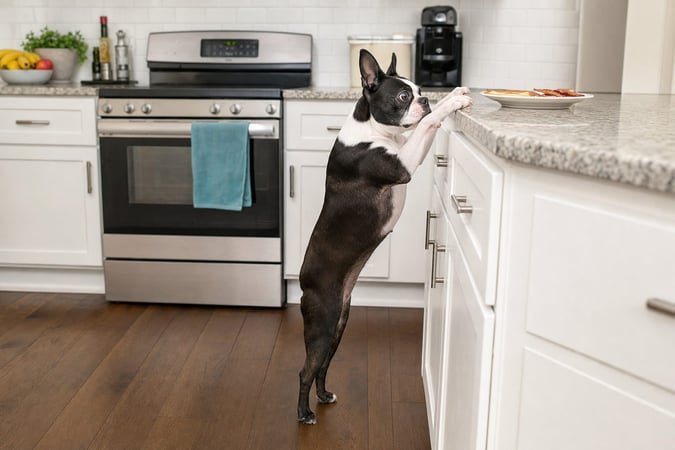
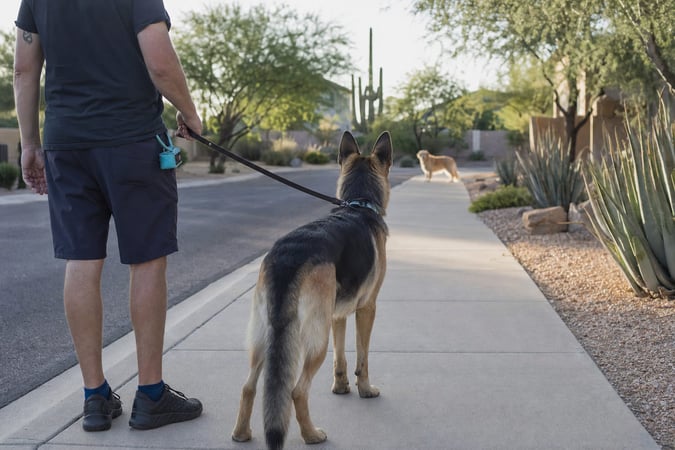
A new setting does not create the reactivity; it exposes how narrow the original training was. A dog can sit, down, and take a treat calmly in a quiet kitchen, then lunge at the end of the leash the moment a bike passes on a Cave Creek trail. That is generalization failing to happen rather than any contradiction in the dog. Skills built with one person, in one room, on one schedule tend to stay attached to exactly that: one person, one room, one schedule. That is what leash reactivity usually is under the surface, a rehearsed response to a narrow set of conditions rather than a fixed trait.
Catherine L., Cave Creek, put it plainly: "I took my dog Rex to the behavioral camp because he was so reactive with dogs." He worked mostly with one trainer but also with others, and "it is amazing how much he learned and how responsive he is now to commands." The method Rex learned under was reward-based-first. What changed his behavior across contexts was the volume and variety of structured repetition, not a different set of cues.
Does a weekly in-home session change what happens on a trail in Cave Creek or a patio in Scottsdale?
Not on its own, and the gap is about dosage, not the method underneath it. An in-home trainer who uses exactly the methods AVSAB recommends can still only be present for an hour a week, and the rest of that week (the vast majority of it) belongs to the family alone: managing a dog that reacts to javelina rustling a wash at dusk, a coyote crossing a Paradise Valley cul-de-sac, or a stranger at the door during monsoon season when everyone is inside and on edge. One handler, one environment, one session asks a lot of a single hour to hold against that, and dosage is a question AVSAB's statement was never written to answer.
Is board-and-train the best option for a reactive dog in Phoenix, Scottsdale, or Cave Creek?
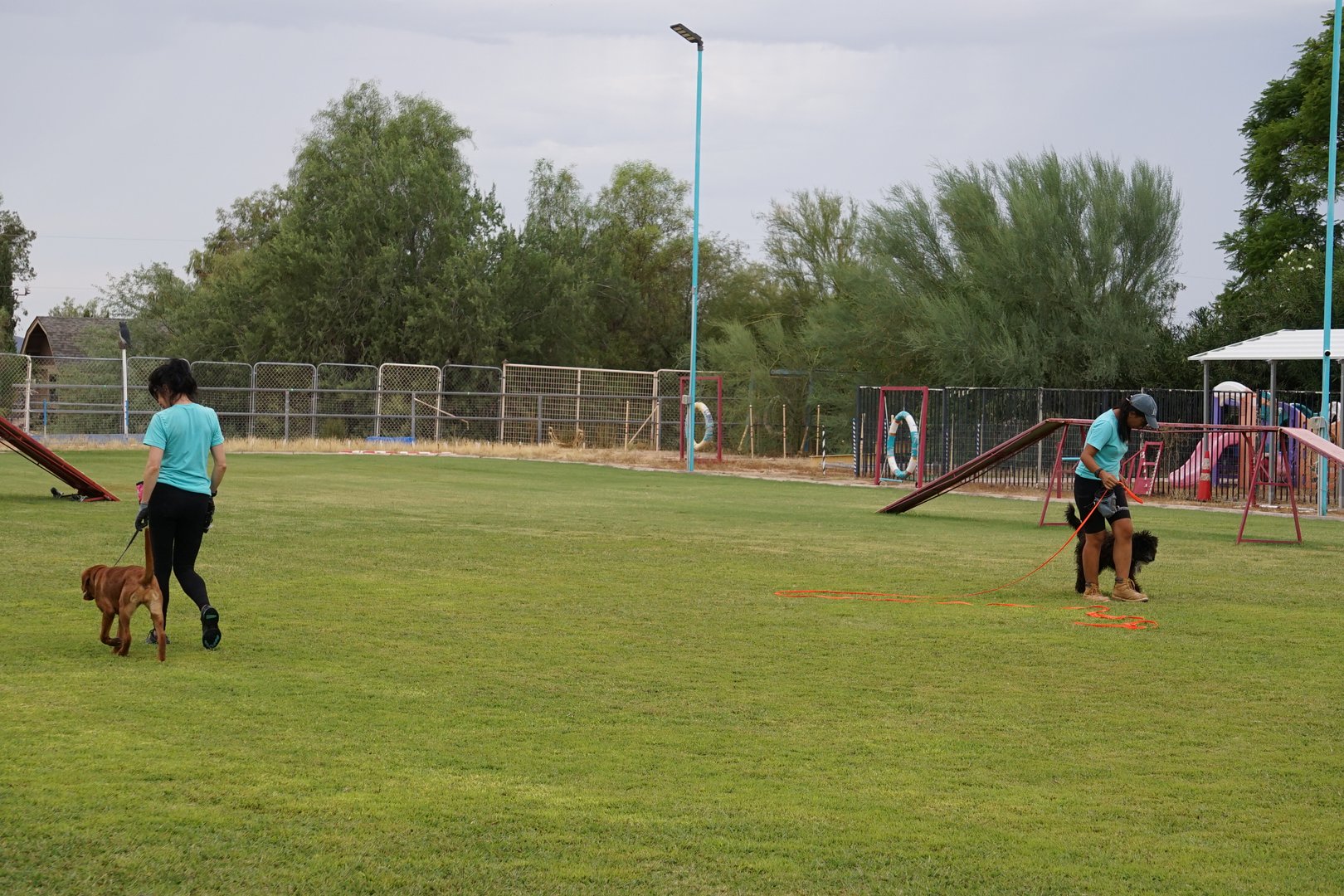
For a dog whose reactivity shows up outside the house, structured immersion usually closes the gap faster than a once-a-week visit. Board-and-train is not automatically better for every dog or every family; a well-mannered dog working on a handful of cues can do fine with private lessons or group class. But leash reactivity, resource guarding, and public-only fear behave differently: a program working the dog across multiple trainers, rooms, and real Phoenix-area distractions in one stay gives more reps in less time than most families can arrange alone. Partners Dogs runs Behavior Camp at a 1:10 trainer-to-dog ratio, drawing on professional experience across 70,000+ dogs since December 1997, with near-open intake: the bite-history dogs other programs decline are the dogs we are built to take, and only a handful of neurological cases have ever been turned away.
Take the first step this week
See if structured immersion fits your dog
A PD360 Assessment gives your dog's reactivity an honest look across real environments, then maps it to Behavior Camp, Transform Camp, or whatever program actually fits before you commit to a format.
What actually changes for a reactive dog inside Behavior Camp?
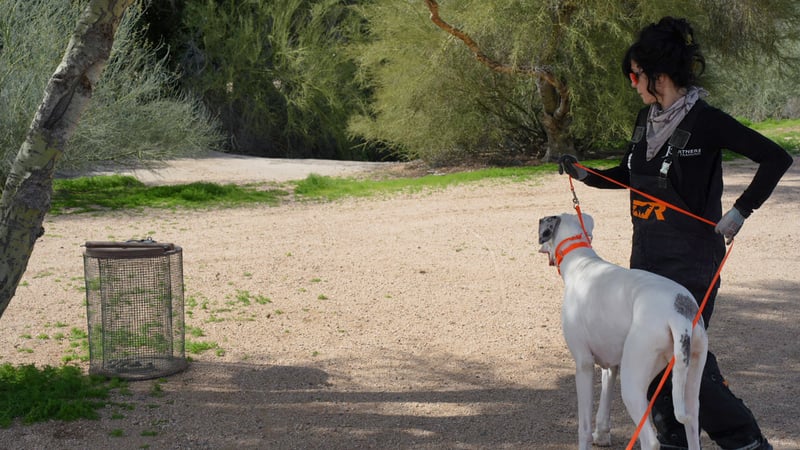
Structured immersion, spread across more handlers and settings than one session ever touches. A Behavior Camp day runs 8-12+ hours of structured immersion, mixing focused training sessions with modeled learning throughout the rest of the day, so a dog is practicing calm responses to real triggers dozens of times before a family ever sees a training log. Bruno, a Bull Terrier who came in for resource-guarding, sibling-aggression, leash-reactivity, and territorial-aggression, worked leash reactivity directly for the first time on day 12 and territorial behavior at greetings again on day 19, with equipment stepping down across the stay rather than staying fixed (see Bruno's full story). That is what format buys: enough repetition, across enough handlers and settings, that a skill stops belonging to one room.
How does Partners Dogs use reward-based methods without treating AVSAB's statement as a format answer?
We start every dog on reward-based teaching, and this article's argument stands on its own: format, not tools, is the open question. AVSAB's statement settles the method question well; it is silent on the format question, and that silence is what a family actually has to resolve before booking anything. Citing a methods statement does not tell a family whether their dog needs an hour a week or a full-time stay, and no position paper can make that call from the outside. That decision needs an assessment of the dog in front of you.
Key takeaways
- AVSAB's 2021 position statement recommends reward-based methods only, with no stated exceptions for aggression cases.
- The statement addresses training method only; it never addresses training format, including board-and-train, in-home sessions, or daycare.
- Reactive behavior often shows up in one environment and not another because skills built with one handler in one room do not automatically generalize.
- Partners Dogs runs Behavior Camp at a 1:10 trainer-to-dog ratio, teaching reward-based-first across structured immersion with multiple handlers and settings.
- Professional experience spans 70,000+ dogs since December 1997, with near-open intake for bite-history cases that other programs decline.
Frequently Asked Questions
Does AVSAB recommend board-and-train or in-home training for a reactive dog?
AVSAB's position statement is about training method, not training format, so it does not recommend one setting over another. Reward-based teaching can happen in an in-home session, a group class, or a supervised board-and-train stay; the setting question is a separate decision that depends on how much repetition and generalization your specific dog needs.
What is the best board-and-train for a reactive dog in the Phoenix area?
The best fit is a program that works your dog across multiple trainers, rooms, and genuine everyday distractions at a supervised ratio, using reward-based teaching first. Partners Dogs runs Behavior Camp at a 1:10 trainer-to-dog ratio across its Scottsdale and Cave Creek campuses for families throughout the Phoenix area, and a PD360 Assessment is the fastest way to see whether that format fits your dog before you book anything.
Does using only reward-based methods guarantee a reactive dog behaves the same everywhere?
No. A method decides how a skill is taught, not how many environments, handlers, and everyday distractions the dog has practiced it in. A dog can be taught entirely with rewards and still react outside the house if the skill was only ever built in one quiet room.
Who should a family talk to if a trainer's methods do not match AVSAB's position?
Ask the trainer directly what tools and corrections they use and why, and if the answer does not sit right, get a second opinion from a credentialed trainer or a PD360 Assessment before committing to a program. A PD360 Assessment gives an honest, independent look at what your dog needs, and its fee is applied as store credit when you enroll in your recommended camp or a membership; it does not apply to a la carte bookings or general reservations.
Keep reading