The quick read
Barrier frustration is a fear, excitement, or frustration reaction to being blocked by a fence, gate, or leash, and it can look like aggression without being aggression. True aggression carries clear intent to make a threat go away and does not calm down once the barrier disappears. If your dog in Carefree, Cave Creek, or the 85262 area is exploding at the fence or losing it on leash, a PD360 Assessment sorts out which one you are dealing with, and Behavior Camp’s 21 nights of structured work fix the one you have.
What does barrier frustration look like in a dog?
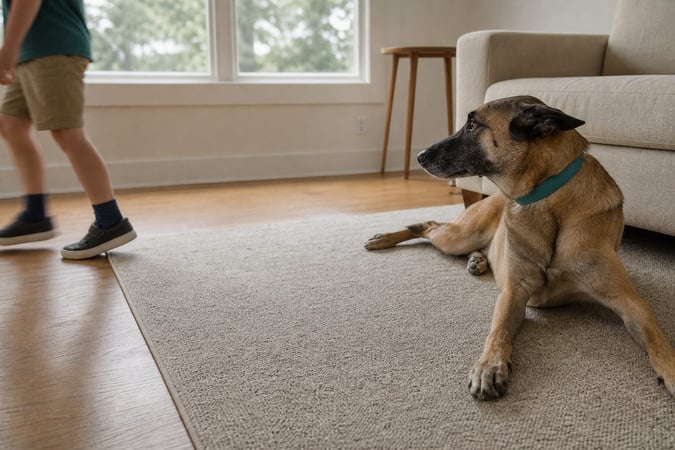
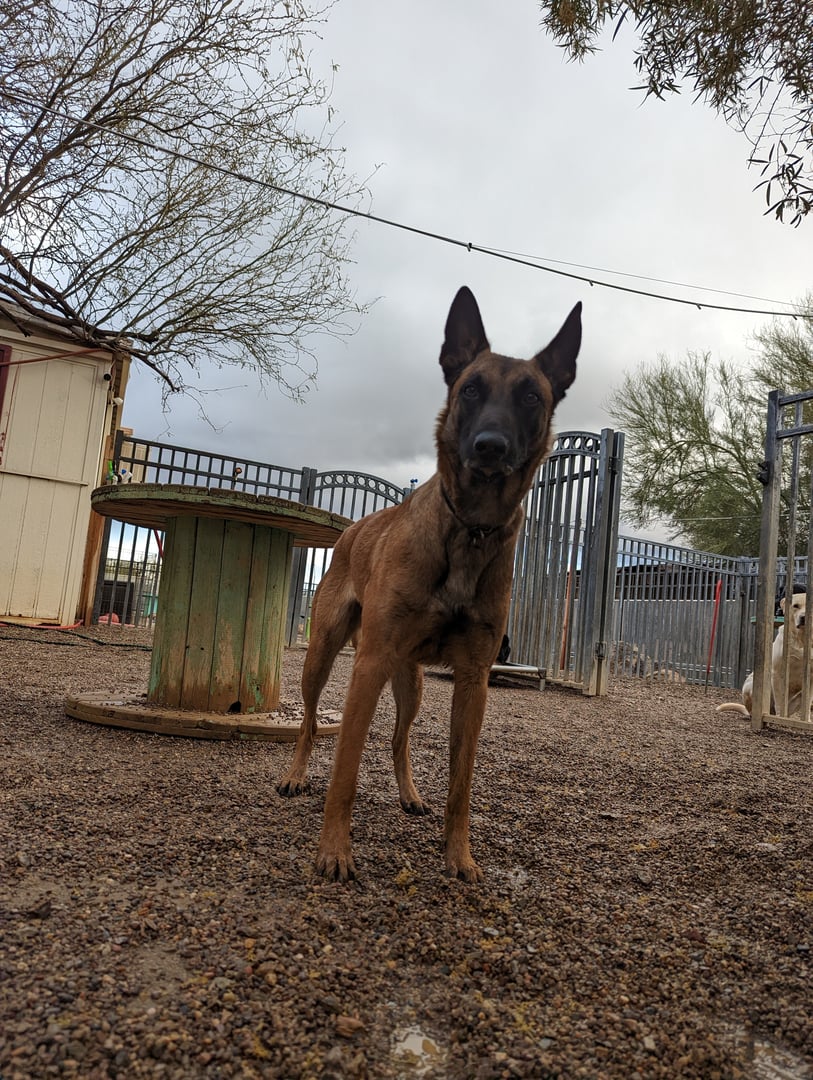
A dog that turns into a different animal at the fence line is not necessarily a dangerous dog. Picture a five-year-old Labrador mix dozing on a Carefree patio until the mail carrier’s cart rolls past the block wall. In two seconds he is airborne against the chain-link, teeth bared, throat raw from barking. His owner comes outside expecting a fight and instead gets a different scene entirely: leash clipped on, gate open, same mail carrier ten feet away, and the dog does nothing but sniff the air and wag. That gap is the whole question this article answers.
Barrier frustration is what happens when a dog wants something on the other side of a fence, gate, glass door, or leash and physically cannot get to it. The wanting does not disappear. It backs up into barking, lunging, and a bark that reads a full register angrier than the dog is. True aggression is a different animal. The dog is not blocked from something it wants, it is trying to make something go away, and taking the barrier down just gives it room to act on that.
A Scottsdale family watched the frustration version resolve after board and train work with their dog, Frijole. His owner wrote: "He has even stopped being reactive towards barriers such as gates and fences," after three weeks of leash-manners and obedience work (Ka’ryn C., Scottsdale).
How is barrier frustration different from true aggression?
The fastest tell is what happens the instant the barrier disappears. Frustration deflates once the dog gets access: sniffing, greeting, sometimes an anticlimactic ignore. Aggression does not deflate, because removing the barrier does not remove the reason the dog wanted distance in the first place. The table below breaks down the rest of the tell.
| Signal | Barrier frustration | True aggression |
|---|---|---|
| What triggers it | Something the dog wants (a person, a dog, a squirrel, a passing car) blocked by a fence, gate, or leash | A perceived threat, imagined or not, that the dog wants to increase distance from |
| Body language | Loose and high through the body, front feet may leave the ground, tail often up and moving in bursts | Stiff, weight forward or low, tail slow, a hard stare, lips may curl back |
| What happens when the barrier is removed | Usually deflates into sniffing, greeting, or play within seconds | Usually holds or escalates, since the dog still wants distance, not contact |
| What it looks like from across the street | Identical to true aggression to an untrained eye | Identical to barrier frustration to an untrained eye |
| Risk if left alone | A rehearsed arousal habit that still carries meaningful bite risk over time | Higher, more urgent bite risk that needs professional eyes sooner |
Treating true aggression like simple frustration under-protects everyone involved. Treating frustration like true aggression means months of unnecessary avoidance for a dog who never gets the practice he needs.
Is my dog fence fighting or territorial?
Territorial aggression and barrier frustration share the same fence, but not the same motive. A dog defending territory is trying to push an intruder off ground he considers his, and the fence is incidental to that goal. A dog with pure barrier frustration is trying to get to the delivery driver, not push him away, and the fence is the entire problem. Our earlier breakdown of territorial behavior at the door and fence covers the threshold-guarding version in more depth. This piece is about the diagnostic step that has to happen first: territory, frustration, or some blend of both, before you build a plan around the wrong one.
Fence fighting, where two neighboring dogs charge the same shared fence line day after day, usually rehearses whichever driver started it into a habit that keeps escalating on repetition alone. If that pattern sounds familiar, our fence fighting and window barking guide covers the fence-specific steps. For the underlying behavior itself, our territorial aggression profile lists the fuller symptom picture.
Why does a leash or gate turn a friendly dog into a monster?
A leash removes the one option every dog wants when it is overwhelmed: distance. Off leash, a dog can retreat, circle, or simply walk away from something that is too much. On leash, that option disappears, and a dog with even mild frustration or mild fear starts rehearsing the only tool left, which is noise and forward motion. That is leash reactivity, and it can come from the same root as fence-line barrier frustration even though the two look different day to day. Add a tight leash transmitting the handler’s own tension straight down the line, and a dog that would ignore another dog from thirty feet away in an open field starts exploding at ten feet on a Scottsdale sidewalk.
The practical difference between fence and leash reactivity is proximity plus restraint. A fence gives a dog a fixed boundary to pace along. A leash puts a person directly in the loop, next to the trigger, with no room for the dog to create its own space. The same dog can look calm in a backyard and combustible on a walk because the environment changed, not the temperament.
Is board-and-train in Carefree worth it for a barrier-reactive dog?
Board-and-train earns its cost when the problem is bigger than a five-minute training video can fix. Families in Carefree, Cave Creek, and the 85262 area near Desert Hills tend to ask this after months of one routine: gates, sprays, and yelling from the porch, none of which touch the underlying driver. A structured stay works because it removes the dog from the one environment where the habit gets rehearsed daily and replaces it with 8-12+ hours a day of structured immersion across new environments, new people, and new distractions, with a trainer reading the dog’s threshold as it happens instead of guessing from across a yard.
Behavior Camp, our 21-night board and train, is built for exactly this diagnostic gap. One dog (Xela, a Scottsdale German Shepherd mix) came in carrying leash reactivity, resource guarding, and territorial behavior at greetings. Leash reactivity was named as a training focus on day 5 and again as the day’s primary focus on day 12, and territorial behavior at greetings was worked on day 13 and again on day 19. Read the full Xela story for the day-by-day arc.
Whether it is worth the drive from Carefree or Desert Ridge comes down to a fair comparison: not board-and-train against a free fix, but against months of a dog rehearsing the same fence-line explosion daily while a once-a-week lesson tries to out-pace a habit with more repetitions than the lesson gets. Behavior Camp exists for dogs whose barrier reactions have already become a rehearsed habit, not an occasional bad afternoon.
What is the decision checklist before you call a trainer?
A five-question checklist gets most families to an honest answer in under ten minutes. Before calling anyone, work through these in order.
- Watch what happens in the first three seconds after the barrier comes down. Sniffing and greeting point toward frustration. Continued hard staring or an attempt to close distance on the trigger points toward aggression.
- Check the body language, not just the volume. Loose, bouncy, tail-up barking reads differently than a stiff, low, slow-moving stare.
- Note the trigger’s specificity. A dog that reacts to one dog on the block, or to men in hats, or only to the mail carrier is telling you something different than a dog that reacts to almost everything that moves.
- Test the same trigger away from the barrier, on a walk somewhere new or in a friend’s yard. If the reaction disappears, the barrier itself is doing most of the work. If it travels with the dog, the barrier is not the root cause.
- If the answers still feel unclear after being honest about all four, stop guessing and get a professional read. Our decision center is built to match the symptom picture to the right program instead of a one-size-fits-all camp.
What should you do right now if you are not sure which one you have?
Management buys time, it does not replace a plan. A few steps cut the daily rehearsal without requiring a diagnosis first. Limit the dog’s visual access to known triggers rather than letting the fence line become a stakeout post. Keep greetings at the gate short and calm instead of letting a visitor lean over the barrier to say hello, which rewards exactly the wrong response. Avoid stacking triggers: a hot afternoon, a delivery truck, and a neighbor’s dog barking back all at once turns a manageable reaction into a stressful afternoon for everyone.
If the reactivity is aimed at another dog in your own house rather than a fence-line stranger, that is a different multi-dog dynamic with its own escalation pattern, and our multi-dog household program is built around exactly that setup. For a single dog reacting to the outside world, the goal is simple: fewer rehearsals, not zero, until you have a clear read on what is driving the behavior.