In short
A dog growling at your kids is rarely the first warning, it is the last one. Yawning, lip licking, stiffening, and trying to leave the room usually come first and get missed. Read those earlier signs, manage every interaction between your dog and your kids, and build the obedience work that gives your dog something else to do around children besides handle them himself.
Kids and dogs are both near and dear to us, which is exactly why this topic gets handled badly. Reactivity toward children is one of the most common problems Scottsdale and Cave Creek families bring to us, and it is the one with the least room for error. When a dog and a child get it wrong, somebody gets hurt, and the dog often pays for it with its home.
The good news is that dogs telegraph this well in advance. Almost every serious incident had a warning nobody read.
Why Kids and Dogs Sometimes Do Not Mix
It is rarely one bad dog or one bad kid. It is a predictable collision of two parties with the same problem: neither one is great at reading the other yet.
- Both run on high, unpredictable energy.
- Both experiment constantly to see what happens.
- Children have not developed the handling skills that adults take for granted.
- Children cannot read a dog's signs of discomfort, so they push past warnings an adult would catch.
- Children play rough, and they do not always know when to stop.
- Children cry, scream, and run, and any of those can trip a dog's prey drive or a fearful reaction.
None of that makes a dog dangerous. It makes the situation dangerous, and the situation is the part you control.
What Are the Warning Signs Before a Dog Growls?
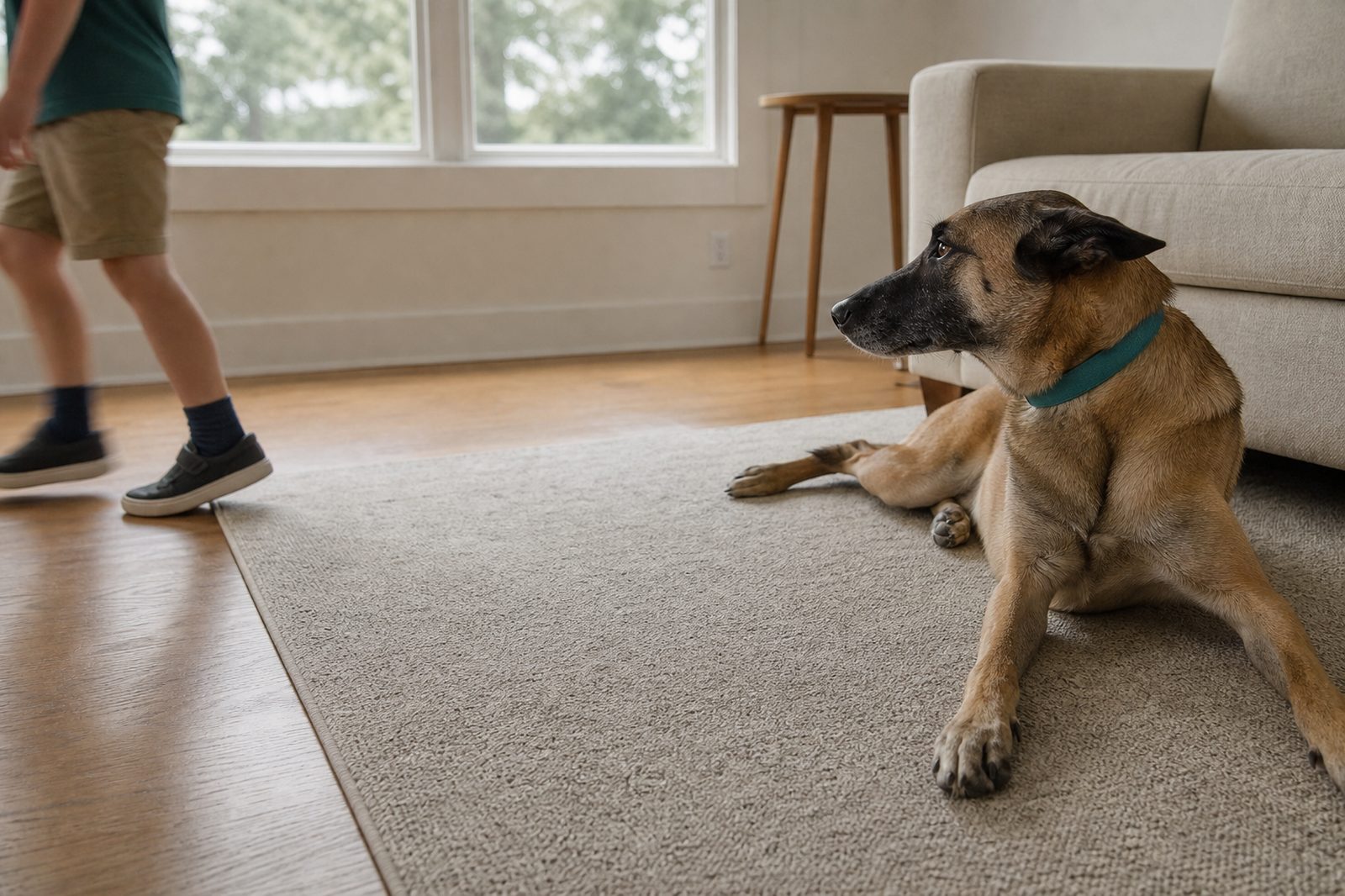
Growling is late in the sequence, not early. By the time your dog growls, a whole set of quieter signals has usually already been ignored. Watch for:
- Yawning when the dog is not tired
- Lip licking
- Trembling
- Crouching or lowering the body
- Ears pinned back
- Tail tucked
- Evasiveness, or trying to leave the room
The more serious end of the scale is growling, snarling, and snapping. Your dog has run out of quieter ways to ask for space and has landed on behavior that is not acceptable around a child. Read it, and then act on it.
What to Do When Your Dog Growls at a Child
Correct your dog, separate him from the child calmly, and redirect his focus onto something constructive. Lunging, nipping, and biting are unacceptable around a child, and so are the cues that lead there. A growl your dog gets away with is a growl that worked, and what worked once tends to escalate.
The correction is only half the job. On its own it takes the noise away and leaves the discomfort underneath exactly where it was, which is not a dog you want around children. Work out what put your dog in that spot, then set parameters so it stops recurring: a settle place the kids do not go into, house rules for how children approach him, and short controlled interactions rather than open access.
Build obedience alongside it so your dog has something to do around children instead of handling them himself. The foundation work we build in Foundation Camp is exactly that, a dog who has a job (settle, place, leave it) instead of an opinion about your kids. Until that work is done, a dog who has growled at a child is never left unmanaged with one, and every interaction is supervised.
If the pattern keeps repeating, that is the point to bring in professional help with reactivity toward family members rather than managing it alone. Behavior Camp is built for exactly this: a dog who has growled or snapped at a child and needs real correction plus a real plan, not just quiet.
Next step
Get a Plan Before the Next Growl
A PD360 Assessment tells you exactly what is driving the growling and what your dog needs to feel comfortable around your kids again, before it escalates to a bite.
Do Puppies Growl at Kids Too?
Puppies, like children, are testing boundaries. They growl at littermates in play and sometimes carry that straight over to people, and it is roughly the equivalent of kids roughhousing.
Play can turn, though. Fixation, stiff posture, and raised hackles mean the puppy has stopped playing and is heading somewhere else. When you see that shift, end the interaction and redirect your puppy to a favorite toy. Learning to tell the difference between a puppy experimenting and a puppy escalating is one of the most useful skills an owner can build, and it is a core part of what we teach in Pre-School Puppy.
The rule of thumb runs both directions. Teach the puppy what is acceptable, and teach the child how to handle and behave around the puppy. Training only one half of that pair does not work.
Six Things Every Family Should Hold Onto
- Read the cues. Learn the signals that show discomfort. Not every cue means trouble is coming, and not every dog gives you the full set.
- Stay in control. Manage every interaction your dog has with children. Watch your dog, but watch the kids just as closely, and head off the behavior that is likely to set your dog off.
- Do not test it. If you think your dog may escalate, do not put a child in front of your dog to find out. Supervise every interaction, every time.
- Correct the growl, then fix what caused it. Let your dog know the behavior is unacceptable, separate him, and redirect him to a chew or a training routine. Then put the parameters and the training in place that resolve the discomfort behind it. Correction with no plan behind it only buys you quiet.
- Safety first, always. If an interaction is drifting somewhere dangerous, take control of it immediately. Being early is never the wrong call here.
- Get help when you need it. Reactivity around children is not the problem to experiment on. In the end, you are responsible for your dog's behavior.
A dog who is comfortable around children is not born that way. It comes from an owner who read the signs early, managed the room, and did the foundation work before it was urgent. That is the version of this where everyone gets to relax.
Frequently asked questions
Why does my dog growl at my kids but not at adults?
Kids move differently than adults. They run, scream, grab, and make sudden movements an adult would not, and they miss the quiet warning signs, like a lip lick or a stiff posture, that an adult would catch and back off from. The dog is not singling your child out, the child is simply the one triggering and then missing the earlier signals.
Is it normal for a dog to growl at a child?
A growl is a warning, not an attack, and it is your dog's way of saying it is uncomfortable. It should never be ignored, but it also is not proof your dog is dangerous. What matters is what you do next: read what led up to it, manage the situation so it does not repeat, and get professional help if the pattern continues.
Should I punish my dog for growling at my child?
Correct the behavior in the moment, calmly separate your dog from the child, and redirect him to something constructive. Harsh punishment for growling teaches a dog to skip the warning next time and go straight to a snap or a bite, which is the opposite of what you want. The correction only addresses the moment, the real fix is finding what caused the discomfort and putting management and training in place so it stops happening.
What are the early warning signs before a dog growls at a child?
Watch for yawning when the dog is not tired, lip licking, trembling, crouching, ears pinned back, a tucked tail, or the dog trying to leave the room. These usually show up well before a growl. Catching them early means you can separate your dog and the child calmly before it ever reaches a growl.
Do puppies grow out of growling at kids?
Puppy growling during play with people is often the same thing puppies do with littermates, and with the right handling on both sides, most puppies learn what is acceptable. It does not resolve on its own, though. It resolves because an owner teaches the puppy the rules and teaches the child how to behave around the puppy at the same time.
When should I get professional help for a dog that growls at my kids?
Get help as soon as the pattern repeats, not after it escalates to a nip or a bite. A PD360 Assessment identifies what is driving the reactivity and whether Behavior Camp or Transform Camp is the right level of support for your dog, so you are not guessing with your child's safety.
When it is time for help
Give Your Dog and Your Kids a Safer Home
If growling around your kids keeps repeating despite management, it is time for a program built for it. Both Behavior Camp and Transform Camp begin with a PD360 Assessment, so your dog gets matched to the right level of support instead of a guess. Most families start with Behavior Camp. If your dog has already moved past growling into snapping or biting, Transform Camp goes deeper.
Keep reading