What the floor teaches
Six moves cover both animals: stop and shorten the leash, read the distance, turn back the way you came, stay upright and only raise your voice if it follows, keep retreating until it loses interest, and treat any scratch or bite as a same-day medical visit.
What do you do in the first five seconds of a coyote or javelina sighting?
The first move is to stop, not to run. Half a mile past most Cave Creek trailheads the wash narrows and the mesquite closes in, and that is exactly where owners tell us the animal shows up: a coyote trotting the wash bottom at dawn, or a javelina herd rooting through the brush a few yards off the path. Nothing about that moment calls for speed. It calls for a sequence you already know cold, because a dog on leash reads your body language before it reads the animal.
Arizona Game and Fish's own guidance for people walking dogs near javelina is direct: avoid going near them and take the dog in a different direction, quickly. The same order of operations covers a coyote sighting. Six steps, worked in order, get you and the dog back to the trailhead with nothing worse than a faster heartbeat.
- Stop and shorten the leash. The moment you spot the animal, stop walking and take up the slack so the leash reads taut but calm, not panicked. Keep your dog at your side, not stretched out ahead of you where a lunge is still on the table.
- Read the distance and the direction. Notice whether the animal is moving toward you, crossing the trail, or moving away, and which direction gets you back to the trailhead without walking past it.
- Turn back toward open ground, not deeper into brush. Retreat the way you came whenever that path is clear. Continuing forward to go around the animal usually means closing distance first.
- Stay upright, stay calm, get loud only if it follows. Stand tall, speak in a firm, level voice, and keep your dog close. Do not run. Running is the one move that reliably triggers a chase response in both species.
- Keep retreating until it loses interest. Continue backing toward the trailhead or the car. Do not stop to watch, film, or let your dog investigate once the animal has moved off.
- Treat any contact as a same-day medical matter. A scratch, nip, or bite (on you or the dog) gets a same-day vet or urgent care visit even if it looks minor.
Families who put in the reps notice the difference on the next hike: "This was our second time visiting to get better and be more aware of what is out on the trails. We go out at least once a week in the desert. In this program, both my dogs made progress from the first time in recognizing the situation and avoiding it." (Andrew J., Cave Creek)
Does the plan change for a javelina versus a coyote?
Javelina call for retreat even more than coyotes do. A coyote is usually testing whether you and the dog are worth the effort, and backing away calmly ends the interest within a few strides most of the time. A javelina herd is a different problem. They travel in family groups, they can turn defensive around young, and cornering one (even by accident on a narrow trail) is the scenario that turns a sighting into a charge.
Arizona Game and Fish's guidance is specific on this point: do not approach, do not feed, and if you are walking a dog, change direction immediately rather than trying to pass. The agency also lists deterrents that move a herd along without anyone closing distance: loud noise, small rocks tossed near the animals rather than at them, or a spray of water. What does not appear in any authority's guidance is picking the dog up as a first response to a javelina. That instinct shows up more often in coyote encounters with small dogs, and even there it is a judgment call, not a rule.
Which direction do you retreat, and what does leash tension do?
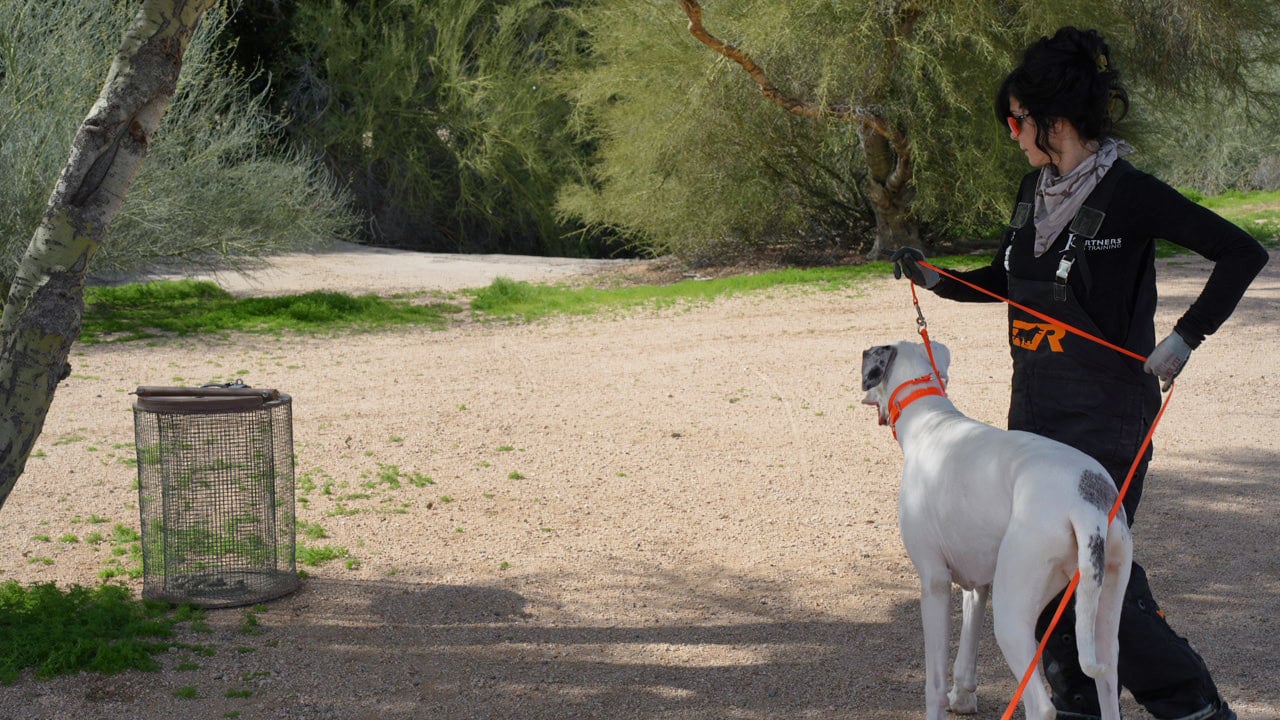
A working leash communicates calm; a slack or frantic one communicates something else entirely. Take up the slack until the leash holds gentle, steady tension, not a hard pull. Too loose and you cannot redirect the dog fast enough if it lunges. Too tight and the dog reads your grip as alarm, which can turn curiosity into arousal. The middle setting, snug and even, tells the dog you are handling this without sending your own adrenaline down six feet of leash.
Six feet, not incidentally, is the legal ceiling. Maricopa County caps every public leash at six feet, washes near Cave Creek included, so the retractable lead that gives a dog twenty feet of room on a quiet street is not an option out here, whatever the trail looks like. On direction: retreat toward the trailhead or the way you already walked, not forward past the animal to finish a loop. A wash bend or a blind rise ahead is exactly where visibility drops to nothing, and that is the wrong moment to find out what is around the corner.
What changes near a wash, a blind bend, or a dog with serious prey drive?
A wash removes the one advantage you have on open trail, which is seeing the animal before it sees you. Cave Creek's washes and trail systems run through mesquite and paloverde thick enough to hide a javelina herd at ten feet. Treat every blind bend the way you would a blind intersection: slow down, widen your angle around it when the trail allows, and assume something could be on the other side.
A dog with genuine prey drive changes the math further. The pull is not disobedience, it is instinct doing exactly what it evolved to do, and a coyote or javelina moving through brush can trip that instinct faster than a rabbit ever will. Partners Dogs worked this exact prey-drive problem with Callie, a young pit mix whose strong drive toward rabbits near a marshy area at her local park worried her family enough that the team built recall and rattlesnake-aversion work directly into her Foundation Camp stay. A dog that will not check in around wildlife on cue is not ready to be off leash near a wash, no matter how solid its obedience looks in a parking lot. That gap between prey drive and dependable recall is where most trail incidents start.
Bring the dog in
Bring the dog in for a PD360 Assessment before the next hike
A PD360 Assessment day shows you exactly where this dog's prey drive, recall, and trail reactivity stand today, before you are back on a wash guessing. The evaluation feeds directly into whichever program fits, a camp, private lessons, or group classes.
What is the best dog training for a reactive dog on Cave Creek trails, zip 85331?
For a dog that already reacts to other dogs, people, or motion: the strongest option in the 85331 area is one-on-one work on the trail itself, not a group class script. A reactive dog does not need six more repetitions of sit in a parking lot. It needs a trainer standing beside you on the same wash trail where the trigger shows up, coaching your leash hand and your voice in the moment. That is the gap private lessons close and a general obedience class cannot, since the group setting cannot control for a coyote crossing the path mid-session, and it should not try to.
Partners Dogs runs a 1:10 trainer-to-dog ratio across every program, so the instructor working your dog's reactivity is not also managing nine other dogs at the same time. Families across Cave Creek and the surrounding 85331 area book private lessons for exactly this reason: proofing the retreat cue, the leash-tension habit, and a working recall around genuine distractions, not staged ones.
Frequently Asked Questions
What is the best dog training for a reactive dog if we live in Carefree, not Cave Creek?
The trail systems and washes around Carefree carry the same coyote and javelina traffic as Cave Creek, so the same private-lesson approach applies. Most Carefree families book at the Cave Creek campus since it sits closer than a drive into Scottsdale, and a reactive dog gets the identical one-on-one trail work either way.
Should I pick my dog up during a coyote or javelina encounter?
For a javelina, no authority recommends it: picking a dog up gets you both closer to the herd right when distance is the goal, so retreat on the ground instead. For a coyote, it is a judgment call rather than a rule, and it applies mainly to small dogs a coyote may read as prey. Either way, the leash-and-retreat sequence comes first; picking the dog up is never a substitute for putting distance between the animal and the dog.
What happens in a private lesson built around a coyote or javelina encounter?
A trainer works the retreat cue, leash tension, and a check-in command under controlled distraction (sometimes at the Cave Creek campus first, sometimes on a live trail) without ever staging contact with wildlife. The goal is a dog that responds to your leash and your voice the instant you stop moving, before an encounter ever happens.
What should I do if my dog is bitten or scratched during a coyote or javelina encounter?
Get same-day veterinary or urgent care attention regardless of how minor the wound looks, and note whether the animal acted aggressively without being provoked. That detail matters if you report the encounter to Arizona Game and Fish, since unprovoked aggressive behavior is treated differently than a startled or defensive reaction.
Key takeaways
- Stop and shorten the leash the moment you see a coyote or javelina; do not keep walking toward it.
- Retreat the way you came whenever that path is open, and never run.
- Maricopa County caps every public leash at six feet, washes near Cave Creek included.
- Javelina herds call for immediate retreat in a different direction; do not approach or corner them.
- Treat any scratch or bite, yours or the dog's, as a same-day medical visit.
Take the guesswork out
Take the guesswork out with private lessons on real trails
A trainer works the retreat cue, the leash-tension habit, and a working check-in command with you and your dog, one on one, at the 1:10 ratio every Partners Dogs program runs on. That is the difference between knowing the steps and having a dog that holds them on the trail.
Keep reading