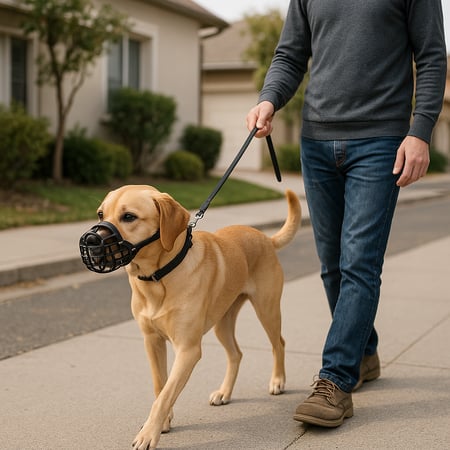
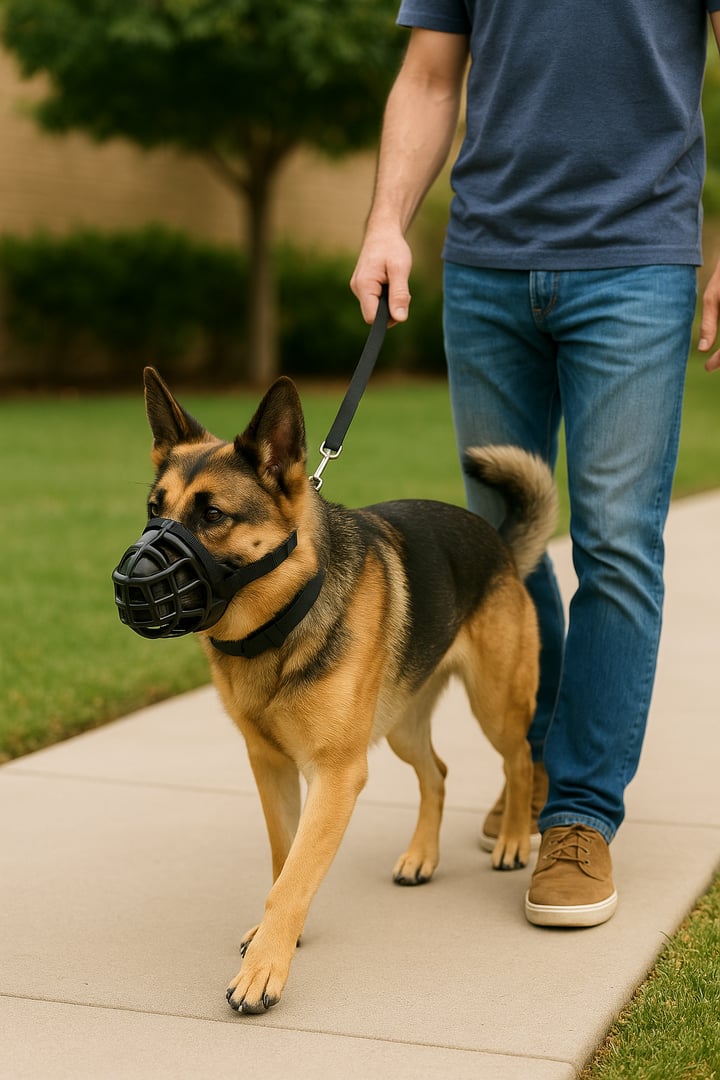
In short
How to muzzle train a dog starts with correct sizing: measure snout length and circumference, size to the Baskerville Ultra Muzzle chart, then pass a short fit test (pant, drink, take a treat) before asking for extended wear time. Conditioning then happens in five-minute sessions spread across days, building up to full wear over about two weeks.
Every family that brings up a muzzle in a training conversation at our Scottsdale or Cave Creek campus is worried about the same thing: does putting one on my dog mean I have given up on him. It does not. A properly sized, properly conditioned basket muzzle is one of the most useful pieces of gear a dog owner can own, whether your dog has a documented bite history or you are simply being smart ahead of a stressful vet visit. Here is exactly how to size it, fit-test it, and build the conditioning so your dog wears it calmly instead of fighting it.
Basket Muzzle vs. Soft Muzzle vs. Custom Leather: How the Options Compare
Three options come up whenever bite risk or fit questions arise: a soft nylon muzzle, a custom leather basket muzzle, and the basket-style Baskerville Ultra we stock and fit in person. The table below lines up what each is built for before the rest of this guide walks through sizing and conditioning the Baskerville Ultra.
| Tool | Best for | Size / chew strength | Price | Where fitted |
|---|---|---|---|---|
| Soft nylon muzzle (not sold by Partners) | A calm dog for a brief, five-minute vet-office hold | Not bite-resistant; blocks full panting, unsafe for extended wear or hot weather | Not sold by Partners, price varies by pet store | Not fitted, sized by the owner |
| Custom leather basket muzzle (specialty muzzle makers) | Dogs needing a heavier-duty daily-wear fit built to exact measurements | Highest bite resistance of the three, built to order | Not sold by Partners, custom-order pricing well above an off-the-shelf basket muzzle | Not fitted in-store, ordered and sized directly with the maker |
| Baskerville Ultra Muzzle, sizes 1 through 6 (what we stock) | Everyday safety wear for vet visits, grooming, trail walks, and camp intake | Toy breeds through giant breeds; lets a dog pant, drink, and take treats | $23.99 (size 1) to $29.99 (size 6) | In-store, Scottsdale or Cave Creek, or sized at home using the guide below |
Prices shown reflect 2026 rates and can change; see the current pricing page for today's numbers.
A soft muzzle is enough for that one calm five-minute hold at the vet's office, and it costs less. It is not built for longer wear, a panting dog on an Arizona summer walk, or any dog who might try to work it off. A custom leather muzzle makes sense if your dog needs heavy daily wear built to exact measurements and you are willing to wait on a custom order. For most families, the Baskerville Ultra covers the most ground: sized and conditioned correctly, it holds up everywhere day-to-day life calls for one. The rest of this guide walks through getting that fit and conditioning right.
A Muzzle Is a Safety Tool Like a Seatbelt
A muzzle is a safety tool you put on before something goes wrong, not a punishment you reach for after it does. Nobody feels guilty putting a seatbelt on a toddler, and the same logic applies here: you are managing a risk you cannot fully control.
Dogs end up in a muzzle for reasons that have nothing to do with being a bad dog. A rescue with an unknown bite history. A dog who guards food or a favorite spot from other dogs. A dog who is relaxed at home but goes rigid the moment a stranger reaches for his collar at the vet. A dog already in a dog aggression assessment and training plan who needs a bridge tool while the underlying work happens. None of those dogs are beyond help. There is no dog we turn away and no person we cannot help, and a muzzle is simply one more tool in that process. We do not lean on any single method: we reach for whatever combination gets a nervous or guarded dog to a calmer place. Many will not need the muzzle for life once the underlying work is further along. A muzzle buys room to train, to travel, to visit the groomer, without betting a bite on how the next ten minutes go.
Muzzle-trained dogs tend to get more freedom over time. A dog who calmly accepts a basket muzzle can go to the vet without a full team holding him down, walk a busy trail without a leash-tension standoff, sit through a nail trim instead of being sent home unclipped. Owners who skip muzzle training because it feels wrong often end up with a dog who is more restricted: fewer places he can go, fewer people willing to handle him.
Measuring Your Dog for a Basket Muzzle
Two measurements decide the size, snout length and snout circumference, and you need both before you guess by breed. Breed narrows the range, but the tape measure sets the actual size. A stocky, short-nosed dog and a lean, narrow-headed dog of the same breed can need different sizes.
- Snout length: measure from the tip of your dog's nose back to just below the eyes, where the muzzle meets the rest of the skull.
- Snout circumference: wrap a soft tape (or a length of string you then measure) around the widest part of the snout, about an inch back from the nose. Add a small gap, roughly a finger's width, for comfortable panting room.
- Take both measurements during a calm, relaxed moment, with treats on hand. Fighting a tape measure onto an already-stressed dog gives you bad numbers and a worse association. If your dog will not tolerate the tape yet, that is useful information: start with the conditioning steps below, then come back to sizing.
Write both numbers down. If your dog's length and circumference point to two different sizes on the chart, size up to the larger of the two rather than splitting the difference. A muzzle that runs slightly roomy still lets your dog pant and drink; one that is even a little tight will not, no matter how good the fit looks otherwise.
Baskerville Ultra Sizes: Picking the Right One
We stock the Baskerville Ultra Muzzle in sizes 1 through 6, and the range covers more ground than most owners expect. Size 1 fits toy and small dogs with short, narrow snouts: think Yorkshire Terriers, Jack Russells, and small Shiba-type dogs. Size 6 fits large, broad-muzzled dogs like Mastiffs, Great Danes, and Rottweilers. Most of the dogs we see land between sizes 3 and 4, with notably smaller or larger dogs falling on either side of that middle band.
The manufacturer's published measurements for the middle-to-large sizes give you a sense of the scale:
- Size 3 (roughly a Border Collie, Corgi, or Standard Poodle build): about 2.75 inches of snout length, 11 inches of circumference.
- Size 4 (roughly a Greyhound, Husky, or Springer Spaniel build): about 3 inches of snout length, 12.5 inches of circumference.
- Size 5 (roughly a German Shepherd, Labrador, or Golden Retriever build): about 3.75 inches of snout length, 14.25 inches of circumference.
- Size 6 (roughly a Mastiff, Great Dane, or Rottweiler build): about 4 inches of snout length, 16.5 inches of circumference.
Sizes 1 and 2 scale down from there for toy and small breeds. These breed comparisons give a sense of scale. Your own two measurements set the actual size, since a narrow-headed dog and a broad-headed dog of the same breed can land a size apart. Match your numbers to the chart on the product listing, and if your dog sits right between two sizes, size up.
Brachycephalic, flat-faced, dogs are the one group where a standard basket chart often will not give you a clean fit. Pugs, French Bulldogs, English Bulldogs, and Boston Terriers have a shortened snout and airway structure the Baskerville Ultra size run was not built around, so even a careful measurement can land you between a size that is too shallow to clear the nose and one that is too loose to stay put. If your dog is brachycephalic, a purpose-made muzzle designed for that shorter face shape is worth looking into rather than forcing a standard basket muzzle to work. Ask a trainer if you are not sure which route fits your dog.
The Fit Test: Pant, Drink, Take a Treat
A muzzle that fits should let your dog do three things without hesitation: pant fully, drink water, and take a treat through the front. If any one of those fails, look first at the size or the strap adjustment.
- The pant test. With the muzzle on and the straps snug but not tight, your dog's mouth should open enough for a full, relaxed pant. A muzzle that clamps the jaw shut is the wrong style entirely, a basket muzzle should never do that.
- The drink test. Hold a bowl of water up to the front of the basket. Your dog should be able to lap normally. If the basket sits too shallow or too tight against the nose, water access gets awkward fast, and that matters on an Arizona summer walk.
- The treat test. Drop small treats through the front openings one at a time. Your dog should reach them with his tongue without the basket rim pressing into his face. This is also your main conditioning tool, so it needs to work smoothly from day one.
- Check the strap fit last. You should be able to slide one finger under the strap behind the ears. Any tighter and you are trading a safety tool for a discomfort your dog will start avoiding.
If your dog passes all three with the size you ordered, you are ready to start conditioning. If not, size up or down and run the test again before moving forward.
Get the right size the first time
Skip the guesswork on sizing
We stock the Baskerville Ultra Muzzle from toy breeds through giant breeds, so you can order once and get a fit your dog will tolerate. Not sure which size or whether a muzzle is even the right tool for your dog's situation? Ask a trainer before you order.
Conditioning Over Two Weeks of Short Daily Sessions
Do not put the muzzle on and expect your dog to just deal with it. That is how dogs learn to fear the muzzle instead of tolerate it. Conditioning builds a positive association in small steps, one to two five-minute sessions a day, so putting it on becomes as unremarkable as clipping on a leash.
- Days 1 to 2, no muzzle contact yet. Let your dog sniff the muzzle and drop treats near it and inside the basket. It should predict good things before it ever touches his face.
- Days 3 to 4, nose touches. Hold the muzzle still and let your dog push his nose into the open basket for a treat waiting inside. No straps yet.
- Days 5 to 6, brief holds. Guide his nose in and feed a steady stream of small treats through the front for two or three seconds, then remove it before he tries to back out on his own.
- Days 7 to 9, add the strap loosely. Fasten it without fully tightening, feed through the front for ten to fifteen seconds, then release. Extend the time as he stays relaxed.
- Days 10 to 14, full duration and movement. Fasten it properly, walk around the house or yard together, and taper the treats off as wearing it becomes routine. By the end, most dogs tolerate five to ten minutes of calm wear without constant treats.
Two weeks is a reasonable target for a dog with no prior negative muzzle experience. A dog who has been muzzled roughly before needs the same ladder, just slower. Watch for lip licking, yawning, pawing, or backing away: all are signs to slow down.
Where a Muzzle Earns Its Keep: Vet, Groomer, Trail, Camp Intake
A conditioned muzzle helps far beyond dogs with a bite history: it makes ordinary errands less stressful for everyone involved. A few places it pays off:
- The vet's office. Blood draws, ear exams, and nail trims can trigger fear or defensiveness in a dog who is otherwise easygoing at home, especially dogs already working through reactivity toward strangers handling them. A muzzle-conditioned dog gets through the appointment faster and with less restraint.
- The groomer. Nail trims, ear cleaning, and sensitive-area brushing during a grooming appointment are common flashpoints even for dogs who are fine on walks. A conditioned muzzle means the job gets done without a struggle, and your dog leaves less rattled.
- The trail. Hiking Scottsdale and Cave Creek's busier trails means off-leash dogs and blind corners you cannot control. A muzzle-conditioned dog gives you a management option on days you would otherwise skip the walk.
- Camp intake day. If your dog is headed into a PD360 Assessment ahead of Behavior Camp or the more intensive Transform Camp, a dog who already tolerates a muzzle calmly gets through intake handling with far less stress than one meeting the tool for the first time under pressure.
None of this requires constant wear. The point is having the muzzle ready, and your dog comfortable in it, for the handful of moments a year when it matters. Handling a nervous or guarded dog calmly is routine for our trainers, part of why Partners holds a 4.8-star average across 2,000+ reviews.
Mistakes That Make a Dog Hate the Muzzle
Almost every dog who hates the muzzle was rushed into wearing one. A few patterns we see often:
- Skipping straight to full wear. Putting the muzzle on for the first time right before a vet visit or a fight aftermath teaches your dog it predicts something scary. Run the ladder during a calm week, well before you need it.
- Buying the wrong size to save a step. A muzzle too tight to pant or drink in gets fought no matter how good your technique is. Go back to the measurements before blaming the training.
- Forcing it onto a dog with existing guarding issues. If your dog already struggles with resource guarding around food or objects, jamming a muzzle over his face without the slow buildup can stack a new fear on top of an old one. Give these dogs extra time at every rung of the ladder.
- Only using it for bad moments. If the muzzle only appears before something unpleasant, your dog learns to associate it with unpleasant things. Practice wearing it during easy moments too, a short walk or a calm five minutes on the couch.
- Removing it the moment your dog paws at it. That can teach your dog that pawing gets the muzzle off. Wait for a calm moment, even a few seconds of stillness, before removing it, so calm behavior earns the release.
None of these mistakes are permanent. A dog with a bad prior muzzle experience just needs the same ladder, slower and with more patience at each rung.
Frequently Asked Questions
How long does it take to muzzle train a dog?
Most dogs with no prior negative muzzle experience get comfortable in about two weeks of short, five-minute daily sessions. Dogs who have been muzzled roughly before, or who carry significant anxiety, can take longer. The pace should follow the dog's comfort at each step of the ladder.
What size Baskerville Ultra Muzzle does my dog need?
Measure your dog's snout length (nose tip to just below the eyes) and circumference (around the widest part of the snout, with a finger's width of room), then match both numbers against the size chart on the Baskerville Ultra Muzzle listing. If the two measurements point to different sizes, order the larger one.
Can my dog still pant and drink water in a basket muzzle?
Yes, that is the entire point of a basket-style muzzle over a soft or sleeve-style one. A properly sized Baskerville Ultra lets your dog pant fully, drink from a bowl, and take treats through the front openings. If your dog cannot do any of those, the size or strap adjustment needs to change.
Does my dog need a muzzle if he has never bitten anyone?
Not necessarily, but plenty of dogs wear one anyway as a precaution: rescues with an unknown history, dogs anxious at the vet or groomer, or dogs still working through a behavior program. A muzzle is a management tool for reducing risk in situations you cannot fully control.
Will muzzle training help before my dog's PD360 Assessment or camp intake?
Yes. A dog who already wears a muzzle calmly moves through intake handling and the early days of Behavior Camp or Transform Camp with noticeably less stress than one encountering it for the first time under pressure. It is one fewer new thing for your dog to adjust to on top of a new environment.
What if my dog fights the muzzle no matter what I try?
Slow the ladder down further, check the size and strap fit again, and make sure the muzzle is not only appearing before stressful events. If your dog is still struggling after a patient, correctly sized attempt, bring it to a trainer directly rather than continuing to force it, since a fear response that strong is often tied to a bigger underlying issue.
Ready when you are
If the muzzle is part of a bigger behavior picture, start there
A muzzle helps you manage risk while you train. If your dog's underlying trigger needs deeper work, a PD360 Assessment sizes the case and places your dog in the program that fits.
Keep reading