The gist
Dog pool safety in Arizona comes down to three layers: train one pool exit until it is a default response, fence and alarm the yard, and keep your dog supervised near water. Not every dog can swim. The exit is the skill that saves lives.
- Teach one exit, the steps: short sessions, a visible marker at water level, pay every rep, proof from anywhere, refresh seasonally.
- Manage the yard: 5-foot fence, self-closing and self-latching gates, pool alarm. Arizona law (A.R.S. §36-1681) requires enclosures where young children live.
- Brachycephalic and heavy-bodied breeds may not swim at all. Vest them and never leave them near water alone.
- Rinse the chlorine off and dry the ears after every swim.
If you are a Scottsdale or Cave Creek Pet Parent with a pool, this is your plan. Nine rules: how to train the pool exit, how to manage the yard, which dogs to never trust near the water. The training runs on our methodology: teach, reinforce, proof, maintain.
Rule 1: face the real risk: dogs can drown
The short version: yes, dogs can drown, and the exit is what fails them.
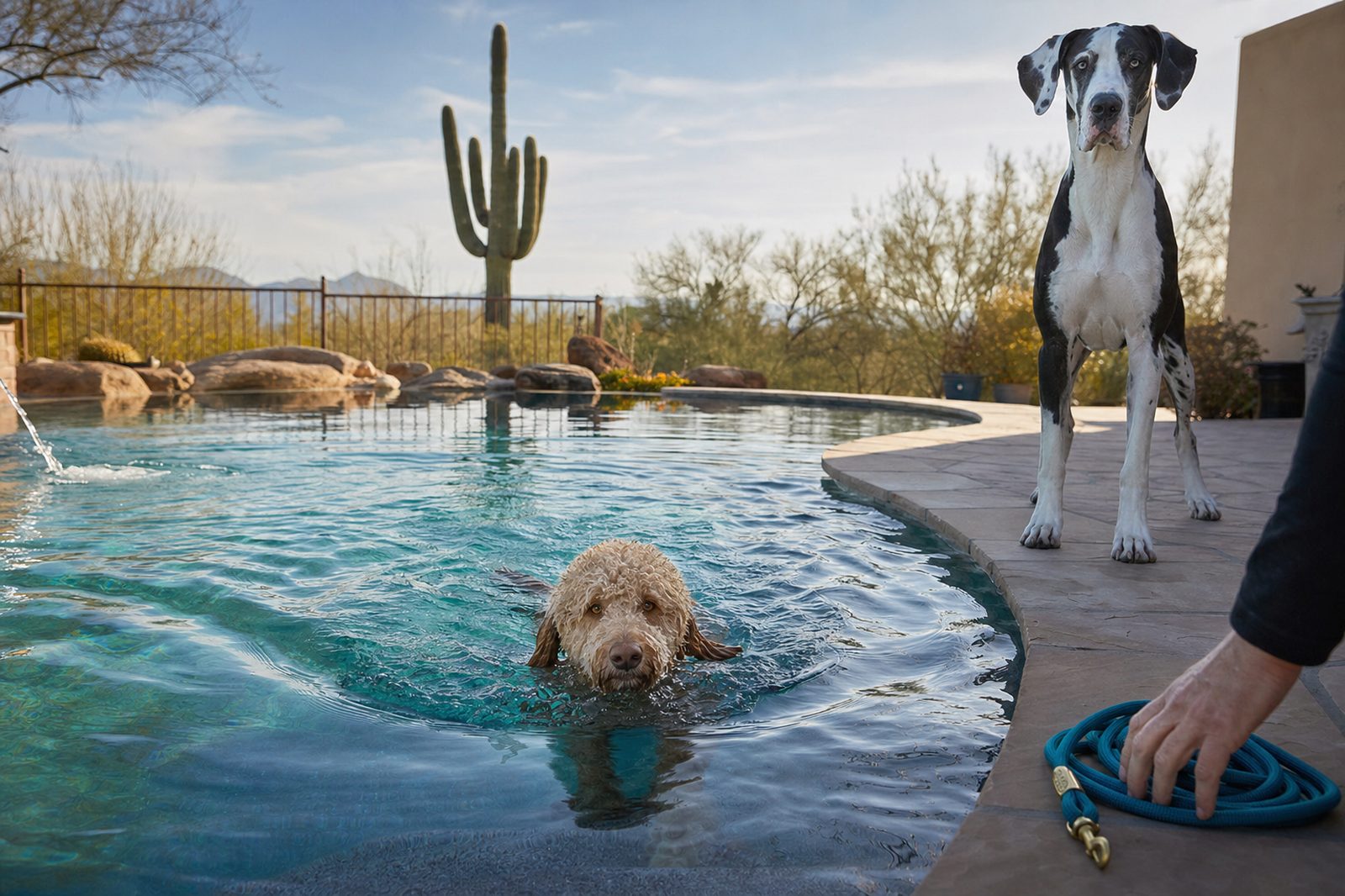
Dogs drown in backyard pools. Nobody tracks a number, so we will not invent one. The mechanism is documented by rescue groups: a dog falls or jumps in, cannot find the steps, panics, and swims to the nearest wall. It grabs the edge and scrambles at a wall it cannot climb instead of swimming to the steps. It exhausts itself and drowns, sometimes with people a few feet away (Southern California Golden Retriever Rescue, retrieved 2026-09-16).
In Arizona the stakes are high: children ages 1 to 4 here drown at nearly twice the national rate (Drowning Prevention Coalition of Arizona, via First Things First, retrieved 2026-09-16). Serious water for kids means serious water for dogs. If you have watched your dog walk the pool’s edge, slip on the coping, and paddle straight for the wall instead of the steps, you have seen the failure mode. This article fixes that failure mode, one drill at a time.
Prevention runs on three layers, and every rule below belongs to one of them.
Rule 2: teach the pool exit until it is a default response
The short version: pick one exit, the steps, and train it until the dog chooses it without thinking.
Panic runs on chemistry, not thinking. The exit has to be a pattern: fall in, swim to the steps. Think of it like a school fire drill: nobody reads the exit map while the alarm is ringing. Feet find the door because they have walked it a hundred times. The pool exit works the same way.
Teach
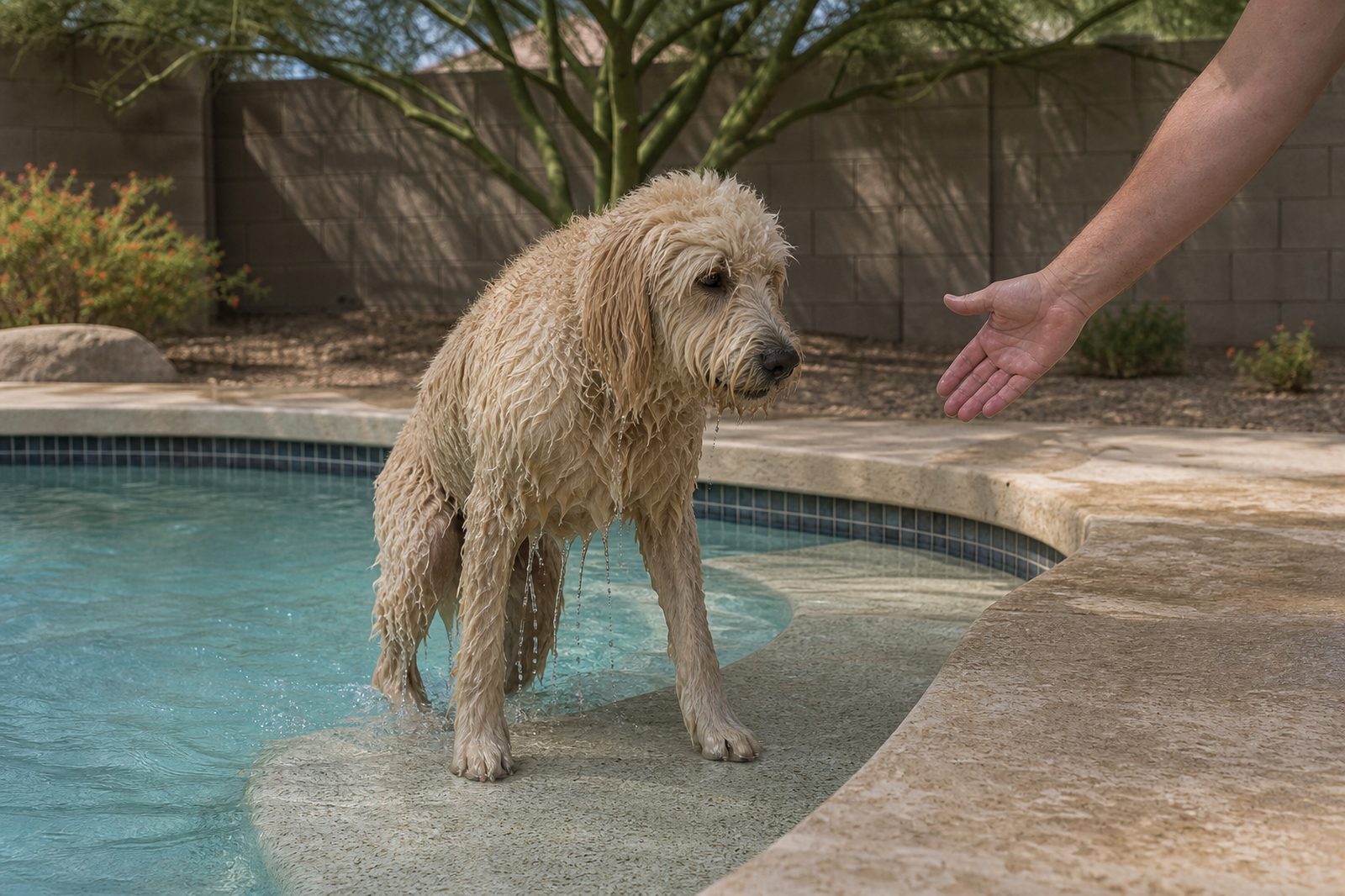
- Pick the steps and mark them. One exit: the steps or a ramp, never the ladder. Dogs panic on ladders, and the AKC says ladders are a separate skill (AKC, retrieved 2026-09-16). Mark the steps with something visible from water level.
- Name it on dry land. Leash on. Walk the dog to the steps, let it touch the marker, say "steps," and pay. Repeat before any swimming.
- Start in the shallows. Feet on the top step. Say "steps," let the dog walk out, pay at the exit. Ten minutes max: swimming tires dogs fast.
- Never throw the dog in. A forced dunk can make a dog fear water for life.
Reinforce
- Pay every exit. Start farther from the steps each session, always ending at the steps.
- Enter from new spots. Once the dog swims to the steps from mid-pool, start from different sides. Wherever you start, you finish at the steps.
Proof
- Proof from anywhere. Far end of the pool, dusk light, a floating toy. Run the five D’s: distance, duration, distractions, direction, difficulty. If the dog breaks for the edge, go back a stage.
- Vest the weak swimmers. Heavy-bodied or short-faced dogs wear a fitted life vest with a handle. Hold the handle in early sessions.
A dog that falls in and can’t find the steps doesn’t swim. It panics. Train the exit, not the hope.
This is the drill our trainers run in-home, in the Pet Parent’s actual pool, before the swim season opens. And the trainer teaches the Pet Parent to run the drill, because the skill only survives if the whole household can run it.
Step one
We Train the Pool Exit in Your Pool
A Partners trainer works in your home, in your pool, with your dog: one marked exit, short coached sessions, and a proofing schedule so the skill holds when nobody is watching.
Rule 3: put it on the calendar: refresh the exit
The short version: trained dogs forget the steps. Refresh the exit several times a year.
Even a dog that has used your pool can forget the steps. Run the exit drill several times a year: at the start of pool season, after any long stretch without swimming, whenever the setup changes (SCGRR, retrieved 2026-09-16). Move the marker and you moved the map. Our trainers run this refresh the same way every pool season: the first session is always from the far end of the pool, because that is the honest test of whether the drill survived the winter.
Rule 4: supervise like a lifeguard, not a spectator
The short version: eyes on the dog and a body close enough to act, the whole time.
The AKC’s first pool rule is the simplest: never leave your dog unsupervised in the pool. A dog in trouble may not be able to bark. It is using everything it has to stay up (AKC, retrieved 2026-09-16).
Name one adult the dog’s watcher. Watch for the dog going flat or paddling with the front legs only. Get it out and let it rest.
Keep the games sane. Long fetch sessions where the dog swallows half the pool can cause water intoxication, a real and potentially lethal risk (Whole Dog Journal, retrieved 2026-09-16). Fresh water on the deck, take breaks.
Rule 5: fence it, alarm it, manage the yard
The short version: a fence and an alarm are management, and management keeps your dog alive on the day training is not enough.
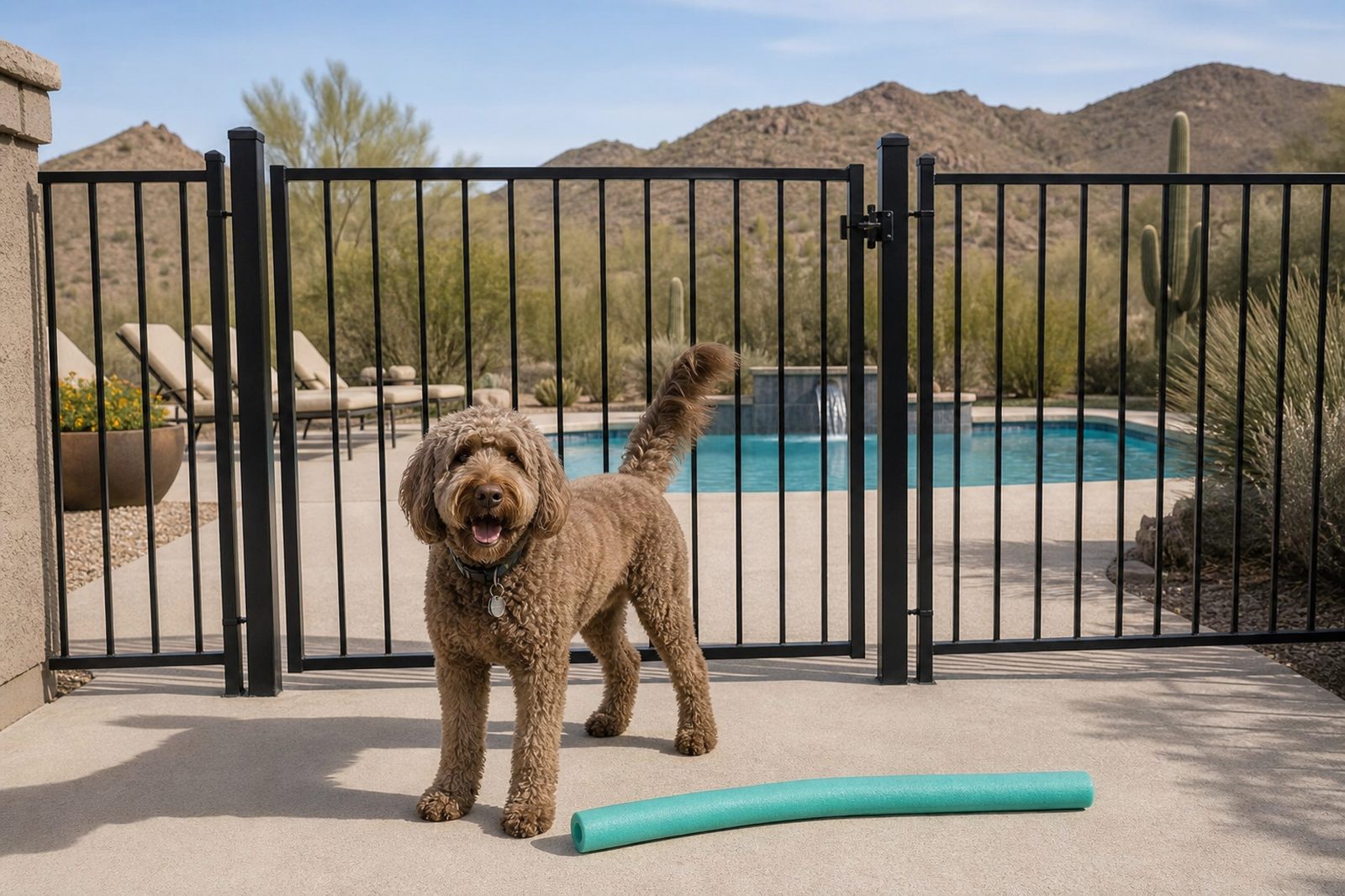
A fence is management, not punishment. Train the exit AND manage the yard: one layer is a hope, two is a plan. It is the seatbelt-and-airbags logic: the belt covers one kind of crash and the bag covers another. The trained exit is the seatbelt; the fence and the alarm are the airbag.
Arizona already requires the fence. Under A.R.S. §36-1681, any residential pool where a child under six lives must be fully enclosed: at least 5 feet high, no openings wider than 4 inches, nothing climbable from the outside, self-closing, self-latching gates (Arizona Department of Health Services, Residential Pool Safety Notice, retrieved 2026-09-16). The law was written for children; the same fence keeps your dog from wandering in at midnight. Many Valley cities go further, so check your city code.
Add what the law does not require: a pool alarm for the seconds that matter, and a secured, bolted-down cover, because a loose cover the dog walks onto is a trap.
| Layer | What it does | Where it stops |
|---|---|---|
| Trained exit | Gives the dog a default response: fall in, swim to the steps | Cannot help a dog that never learned it |
| Barriers and alarms | Keep the dog out of the water when nobody is watching | Cannot help once the dog is already in the water |
| Active supervision | Puts a rescuer seconds away | Ends the moment you look away |
Rule 6: be honest about your dog’s body
The short version: not every dog can swim, and the breeds that can’t are easy to name.
Breed is a hypothesis, not a verdict. On swimming, the hypothesis is strong. Brachycephalic breeds are poor swimmers by construction: big head, short muzzle, dense body, short legs. Tufts University’s veterinary school says it straight: bulldogs are not gifted swimmers, and some may not swim at all (Tufts Now, retrieved 2026-09-16).
The honest list: English and French Bulldogs, Pugs, Boxers, Boston Terriers, Shih Tzus, plus the heavy short-legged builds, Dachshunds, Basset Hounds, Corgis, Mastiffs. If your dog is on it: life vest on, always, never unsupervised near water. And teach the exit anyway. The dog that cannot swim needs the steps most.
Rule 7: fatigue drowns strong swimmers
The short version: swimming is hard exercise. Tired dogs drown in pools they could handle fresh.
Even a strong swimmer is only strong for a while. The AKC warns that swimming uses new muscles and dogs tire quickly (AKC, retrieved 2026-09-16). Watch the dog, not the clock: heavy panting, slowing down, front-legs-only paddling. Get the dog out, find shade, offer fresh water.
In an Arizona summer this matters double. A dog swimming at 3 p.m. in July is working in brutal heat, so know the early heatstroke signs in dogs and cut the session short. For the full summer picture, see how to exercise your dog when it’s 115°F outside.
Keep drinking water on the deck, not in the pool. Too much pool water upsets the stomach, and chlorine irritates eyes and skin (Hill’s Pet and PetMD, retrieved 2026-09-16).
Rule 8: run the after-swim routine
The short version: rinse the chlorine off, dry the ears, check the eyes. Every swim.
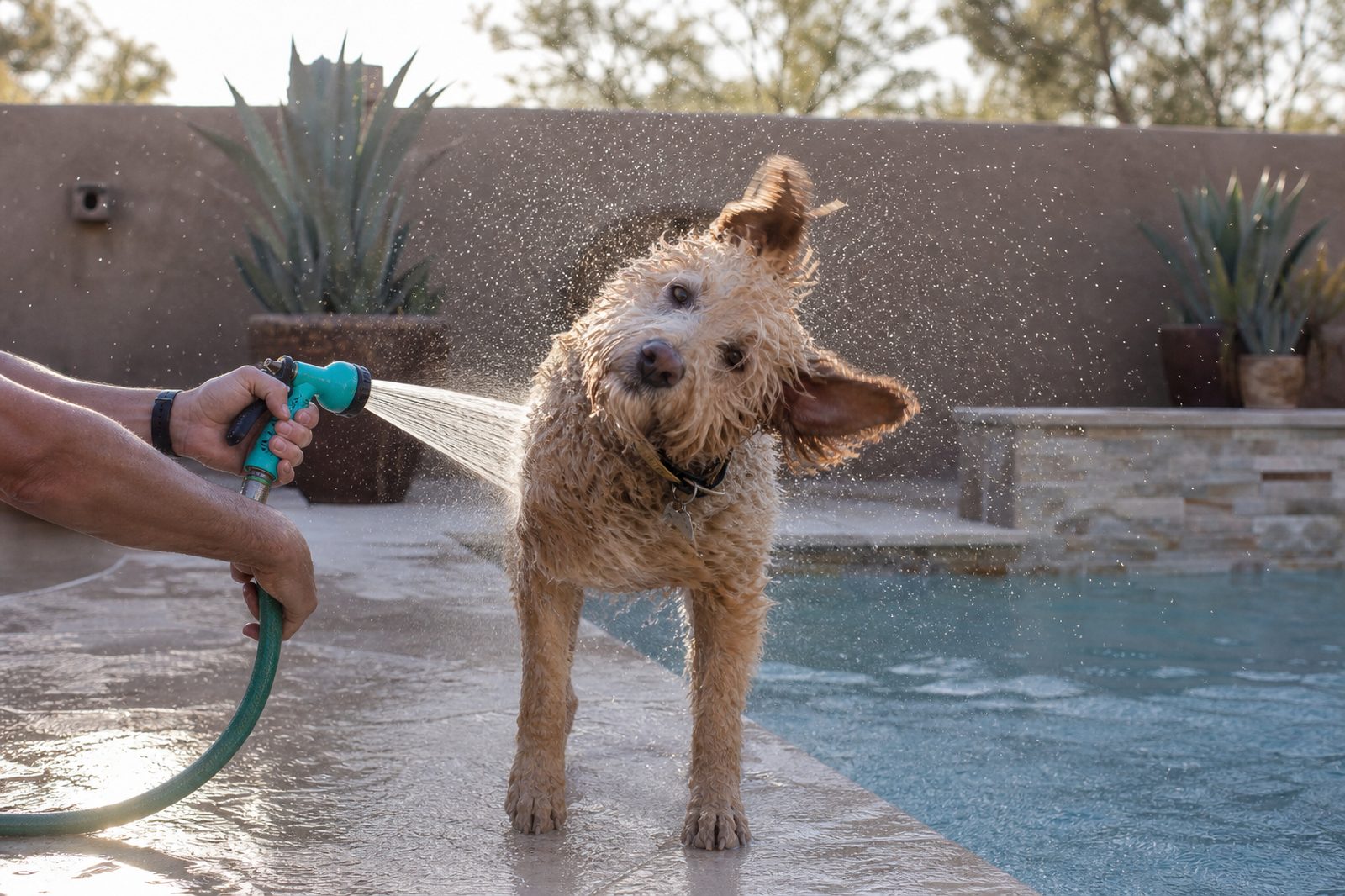
Pool chemicals are dosed for people, not dogs. Rinse your dog with the hose after every swim to wash chlorine off the coat. If a rash or heavy scratching shows up even with a good rinse, skip the pool and talk to your vet (Hill’s Pet, retrieved 2026-09-16).
Then the ears. Dab them dry, especially floppy ears: most ear infections in floppy-eared dogs come from water sitting in the ear (AKC, retrieved 2026-09-16).
Rule 9: dog pool safety at night: plan for the fall-in nobody sees
The short version: the most dangerous swim is the one nobody watches. Manage the night.
The scenario trainers describe most: the dog goes out for a last bathroom break after dark, does not see the water’s edge, and falls in.
- The fence gate stays latched. Every night. No "just for a minute."
- The pool alarm stays on. It is what wakes you up.
- The dog goes out on leash after dark if the yard opens onto the pool.
- Keep a light on over the steps and the exit marker visible. A lit exit is a findable exit.
A secured, bolted-down cover helps. An unsecured cover is worse than none: the dog slides in under it.
By the numbers
Myth vs. fact: dogs and pools
| Myth | Fact |
|---|---|
| All dogs are natural swimmers. | The dog paddle is a survival reflex, not a swim stroke. Brachycephalic and heavy-bodied breeds may not be able to swim, period. |
| A strong swimmer is safe around the pool. | Strong swimmers drown when they cannot find the exit. Train the exit as hard as the swimming. |
| Pool water is fine for dogs to drink. | Chlorine irritates eyes and skin, and too much pool water upsets the stomach. Keep fresh water on the deck. |
| My dog already knows the way out. | Even dogs that have used the pool can lose track of the steps. Refresh the exit drill several times a year. |
Mistakes that make it worse
- Assuming the dog knows the steps. Most dogs do not, and the ones that once did can forget.
- Training the exit once and calling it done. One lesson is Teach. The default comes from proofing and refreshers.
- Trusting a strong swimmer unsupervised. Strong swimmers drown in pools they cannot exit.
- Letting a poor swimmer near the pool without a vest. The honest list gets a fitted life vest and constant supervision, every time.
- Skipping the rinse and the ear dry. Chlorine sits on the coat and water sits in the ears.
What fits your dog
Water-Shy or Water-Obsessed? Match the Program to the Dog
Some dogs fear the water. Some will not get out of it. A PD360 Assessment reads your dog across nine dimensions and matches it to the right program, in your home or on campus.
Key takeaways
Key takeaways
- Dogs drown in pools when they cannot find the exit. No public data set tracks dog drownings, so treat every pool as a real risk.
- Train one exit until it is a default response: teach, reinforce, proof. Mark it, pay every rep, refresh seasonally.
- Manage the yard: 5-foot fence, self-closing and self-latching gates, pool alarm, secured cover.
- Not every dog can swim. Brachycephalic and heavy-bodied breeds need a life vest and constant supervision.
- Rinse the chlorine off and dry the ears after every swim.
- Latch the gate, keep the alarm on, leash the dog after dark. The swim nobody sees is the dangerous one.
Frequently Asked Questions
Can dogs drown in swimming pools?
Yes. Dogs drown when they cannot find a way out: a panicked dog clings to the nearest edge instead of swimming to the steps, then exhausts itself. No public data set tracks dog drownings, so treat every pool as a real risk.
How do I teach my dog to find the pool steps?
Pick one exit, the steps, and mark it with something visible from water level. Name it on dry land, start the dog in the shallows, and reward every exit. Move the start point farther out over short sessions, always finishing at the steps. Proof from anywhere, refresh seasonally.
Which dog breeds are poor swimmers?
Brachycephalic breeds (English and French Bulldogs, Pugs, Boxers, Boston Terriers, Shih Tzus) and heavy, short-legged breeds (Dachshunds, Basset Hounds, Corgis, Mastiffs). Tufts University advises a life preserver around water and never leaving them alone near pools.
What is the first step if I want my dog's pool exit trained professionally?
Book a PD360 Assessment: a senior trainer evaluates your dog across nine dimensions, then matches it to the right program. For pool safety that usually means Private Lessons, in your home, in your pool.
Do Arizona's pool fence laws protect dogs too?
They help. A.R.S. §36-1681 requires enclosures (at least 5 feet high, no openings wider than 4 inches, self-closing and self-latching gates) at homes where a child under six lives. The same fence keeps your dog from wandering in at night.
Where to go from here
Pool safety is a trained skill plus managed access. A trainer can install the pool exit in your pool, with your dog, then hand you the schedule that keeps it sharp. Most Valley pools open early and stay open late, so the honest version is a trained exit plus a locked gate, every night.
Scottsdale: 8642 E Shea Blvd, 85260. Cave Creek: 4640 E Forest Pleasant Pl, 85331. Serving the Phoenix Valley.