First things first
Most trainers on the floor at Partners Dogs, across both the Scottsdale and Cave Creek campuses, started exactly where an applicant starts: an apprentice with zero floor hours logged. Advancement to Instructor and then Senior Instructor runs on supervised hours, an in-person evaluation across a range of dogs, and time worked inside real programs, not a fixed calendar and not an outside certificate mailed in from somewhere else. The fastest way onto that path is a real application through our careers page, not a resume line.
Before you send an application to our careers page, here is exactly what the four-step path looks like and what each step asks of you:
- The coursework an apprentice has to know cold before ever touching a leash on the floor.
- What a week of floor apprenticeship actually looks like, hour by hour, across programs.
- The floor hours and evaluation that make someone eligible for Instructor.
- What separates an Instructor from a Senior Instructor in daily responsibility, and where to apply.
What is the dog trainer career path at Partners Dogs, stage by stage?
The path runs through four steps, and none of them are a straight calendar count. An apprentice starts in coursework, moves onto the floor under a mentor, earns Instructor status once supervised hours and an evaluation clear, and reaches Senior Instructor by demonstrating range across programs and mentoring the next apprentice behind them. Fifty-plus trainers work across our Scottsdale and Cave Creek campuses today, running programs for a client base of 70,000+ dogs since we opened in Cave Creek in December 1997. Most of them, including the instructors who now run a full Behavior Camp or Transform Camp arc solo, came up through this same four-step structure.
- Coursework. Learning theory, canine body language, safe handling, and the stage framework (Teaching, Reinforcing, Proofing, Maintenance) that every one of our programs is built on.
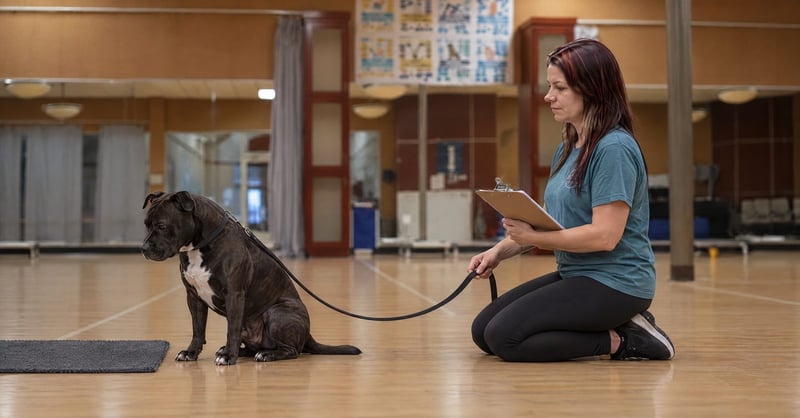
- Floor apprenticeship. Supervised hours shadowing across DaySchool, group classes, and camp arcs, working toward client-facing sessions under a mentor's direct supervision.
- Instructor eligibility. A defined range of supervised floor hours plus an in-person evaluation across a variety of dogs and cases, cleared before running sessions solo.
- Senior Instructor eligibility. Demonstrated range across camps, behavior cases, and daily programs, plus mentoring the apprentices coming up behind you.
What coursework does an apprentice complete before touching a leash?
Nobody works a dog solo on day one, and the coursework exists for a reason. Before an apprentice is cleared to handle a client dog unsupervised, the coursework covers learning theory (how and why reinforcement and correction actually change behavior), canine body language (reading a dog's threshold before it tips into flooding), safe handling and equipment fundamentals (leash mechanics, muzzle conditioning as a welfare tool rather than a punishment, crate protocols), and the four-stage framework, Teaching, Reinforcing, Proofing, Maintenance, that every camp, class, and DaySchool session runs on. That coursework sits underneath a bigger number. Full Instructor certification through Partners Dogs University runs on roughly 1,000 to 2,000 supervised hours across dogs and breeds by the time it is complete. Coursework is the first slice of that total, not the whole thing. A trainer who can recite the theory but has not put in the hours has finished a chapter, not the program.
This is also where a career changer's background matters less than people assume. Picture a project manager in her forties who has spent a decade in corporate compliance and wants out of a cubicle and onto a training floor. The coursework does not ask what she did before. It asks whether she can learn to read a dog's ears and weight shift before that dog reacts, and whether she can explain to an owner why a properly fitted tool needs fewer corrections than a dog straining against a flat collar every single day. Prior dog ownership helps. A degree does not hurt, but nothing in this coursework requires one.
What does the floor apprenticeship look like day to day?
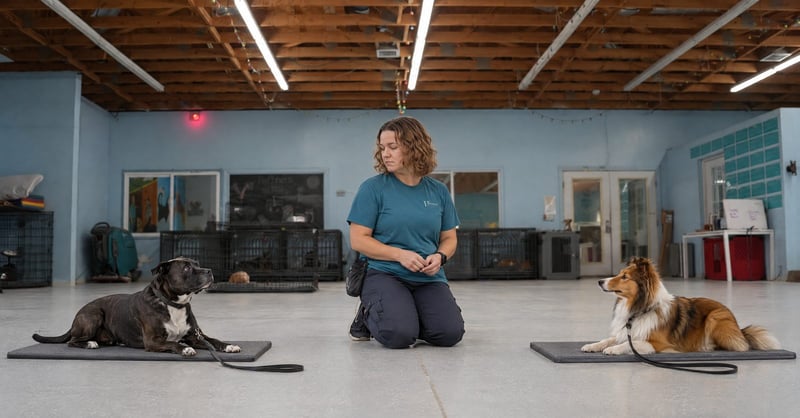
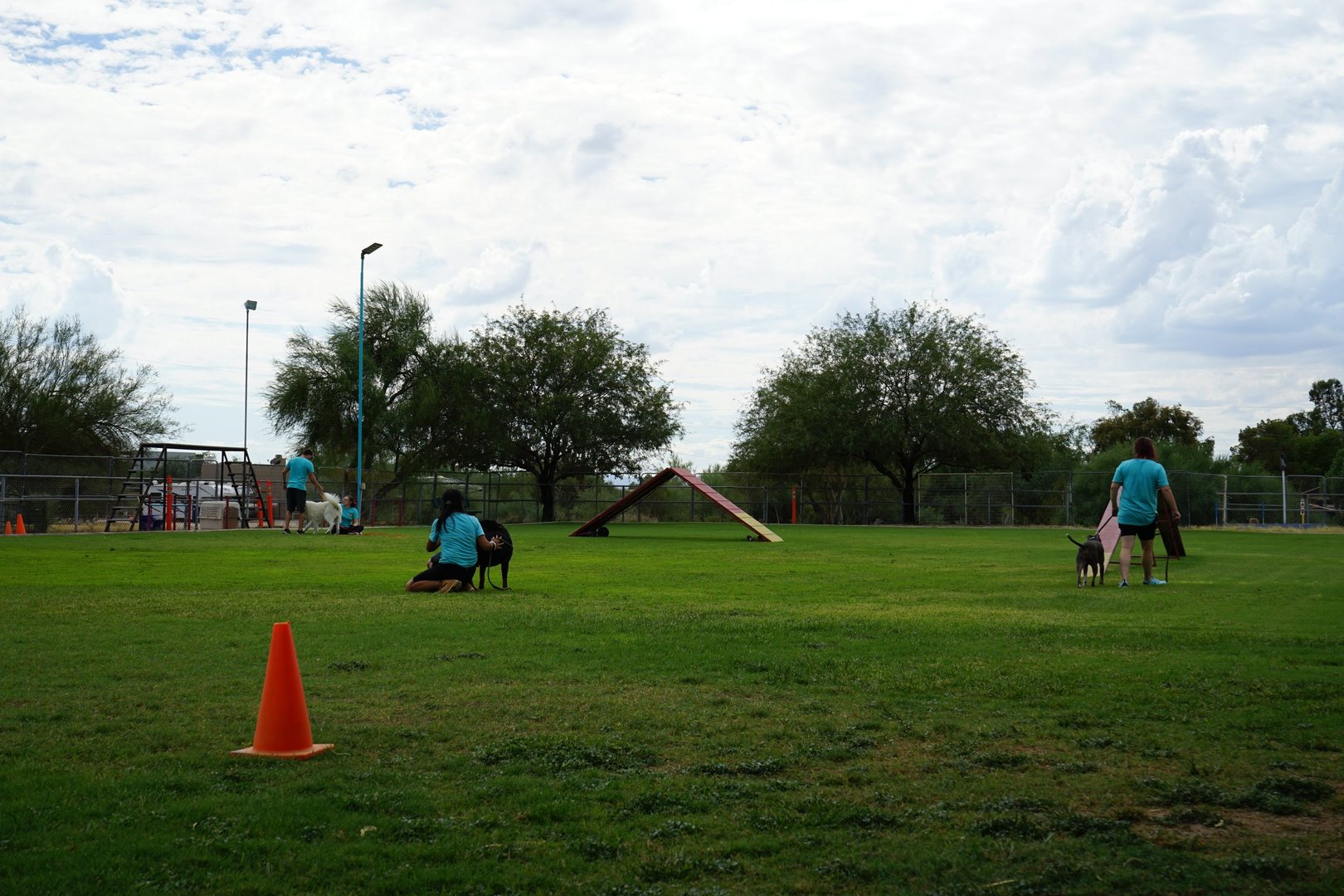
The floor doubles as a generalization lab, and that is deliberate. An apprentice does not spend a whole week with one dog in one room. In the same week they might shadow a DaySchool play group, sit in on a group class, and check in on a camp dog mid-arc, and that rotation is exactly the rep volume the generalization argument rests on elsewhere on this site: a dog that has only ever seen one handler in one quiet room has not generalized anything, and neither has a trainer who has only ever worked one context. With 50+ trainers running a 1:10 trainer-to-dog ratio across Scottsdale and Cave Creek, an apprentice also sees multiple mentors and multiple handling styles inside the same building, not one instructor's single method repeated for months.
This is a staff role on our schedule, not a volunteer stint squeezed in around another job, and it runs across both campuses. The Cave Creek campus sits one block north of Lone Mountain and Cave Creek Road, about ten minutes north of the 101, and building range across both locations means real time in the car between them, on top of the floor hours themselves. Applicants coming from Anthem, Fountain Hills, or Peoria should plan for that drive as part of the job, not an inconvenience on top of it.
When is a trainer eligible to become an Instructor?
Eligibility is a floor-hours-and-evaluation threshold, not a hire date. An apprentice becomes eligible for Instructor once supervised floor hours clear an internal minimum and once they pass an in-person evaluation working a range of dogs and temperaments, not a favorite easy case picked to look good. Because we run a near-open intake, taking on the bite-history dogs that other facilities decline (only a handful of neurological cases have ever been turned away), the caseload an apprentice is evaluated against is harder than most first-job trainer work. That is intentional. An Instructor who has only ever handled easy, well-socialized dogs is not ready to run a floor alone.
The training profession broadly frames a trainer's development the same way: education, hands-on experience with a variety of dogs, and certification, with no single fixed path required to get there. Our internal Instructor threshold is our own version of that same idea, built around the specific programs we run rather than a generic industry standard.
What does it take to become a Senior Instructor?
Senior Instructor is a range test, not a tenure test. An Instructor moves to Senior Instructor by demonstrating breadth across our full program list: camps, behavior cases, daily DaySchool and DayCamp work, private lessons, and mentoring the apprentices coming up behind them. The 21-night Behavior Camp arc documented in Bruno's success story is a useful window into what that range looks like in practice: a Bull Terrier who came in resource-guarding and reactive on leash, worked from muzzle conditioning and crate comfort through named resource-guarding sessions and a full in-home transfer visit, all run start to finish by one trainer. That is the kind of arc a Senior Instructor is trusted to carry alone.
You can also see the range this pipeline produces from the outside. One Google review from Courtney P., Scottsdale, put it plainly: "Partners is run like a finely tuned engine. The staff is knowledgeable, thorough, interested and supportive." Meet the current bench this exact four-step path built at partnersdogs.com/team.
Is Partners Dogs University the right path if I already hold an outside certification, or none at all?
Either starting point works, and neither one skips the floor hours. If you already hold a credential like CPDT-KA, it can sharpen your coursework foundation, but it does not replace the supervised floor hours our Instructor threshold requires. If you hold nothing at all, that is not disqualifying either. Partners Dogs University is not positioned as a nationally recognized, third-party accredited credential the way CCPDT certifications are, and we say that plainly rather than overstate it. The case for it rests on something more concrete: 1,000 to 2,000 supervised hours across a genuinely difficult, near-open-intake caseload, at a facility running a 1:10 ratio instead of a solo trainer's single caseload. For the certification-recognition question specifically, our companion piece, Partners Dogs University: How We Certify Dog Trainers, goes deeper into how that hour count and evaluation structure work. Start the application itself at partnersdogs.com/university.
Key takeaways
Most current trainers, out of the 50-plus on staff, came up through the same four-step apprentice-to-Senior-Instructor path. Full Instructor certification through Partners Dogs University rests on roughly 1,000 to 2,000 supervised hours across dogs and breeds, not a fixed calendar. Apprentices rotate across DaySchool, group classes, and camp arcs inside the same week, which is what builds the ability to generalize training across contexts. Instructor status requires an in-person evaluation across a range of dogs, not just a course completion certificate. Open Instructor and Senior Instructor roles are posted directly on our careers page.
Start the right way
See this training standard applied to your dog
Every trainer on our floor moved through the same four-step path: coursework, floor apprenticeship, Instructor, then Senior Instructor. A PD360 Assessment is the fastest way to see what that pipeline actually produces, and it starts with getting intake scheduled for your own household.
Frequently Asked Questions
Do I need a college degree to start a dog trainer apprenticeship at Partners Dogs?
No degree is required. The apprenticeship evaluates learning-theory coursework, hands-on handling skill, and floor hours, not a transcript. A four-year degree in a related field can help with the academic side of the coursework, but it does not substitute for supervised floor hours.
Is prior professional dog-handling experience required to apply as an apprentice?
No. Many apprentices arrive with only their own dogs at home and a genuine interest in the field. What matters more at the apply stage is willingness to complete the coursework and put in the supervised floor hours; professional experience can shorten some of the early learning curve but is not a prerequisite.
Will an apprentice work at both the Scottsdale and Cave Creek campuses?
Often, yes. Building range across programs is part of the path, and that can mean time at both campuses rather than one. The Cave Creek campus sits about ten minutes north of the 101, so apprentices should plan for regular driving between locations as part of the role.
What happens if an apprentice does not pass a floor evaluation on the first try?
They keep working supervised hours and try again. The evaluation is a checkpoint on real skill across a range of dogs, not a one-shot gate, and a mentor Instructor keeps working alongside the apprentice on the specific gaps the evaluation surfaced.
Is the apprenticeship a staff position or a volunteer arrangement?
It's a staff position, not a volunteer or unpaid internship arrangement. Current openings are posted directly on the careers page.
Can a Senior Instructor specialize in behavior cases instead of group classes?
Yes. Senior Instructors typically carry range across multiple program types, but many lean into a specialization once they have already demonstrated they can handle the full spread: behavior and reactivity work, camp arcs, or group-class instruction.
Make it concrete
See the instructor program behind this path
Every stage in this path runs through Partners Dogs University: coursework, floor hours, Instructor evaluation, and Senior Instructor range. The program page lays out exactly what each stage requires before you apply.
Keep reading