The core answer
Most dogs whose problems are pulling, jumping, and no impulse control belong in Foundation Camp, our 14-night board-and-train built on obedience and everyday manners. Behavior Camp is built for a different dog: one working through reactivity, fear, resource guarding, or aggression at the root. The PD360 Assessment is what decides the tier for a family in Chandler, Mesa, or Gilbert, so nobody has to guess from a phone call.
"Which one does my dog need?" is the question we hear more than any other during a PD360 Assessment. Families read the program pages and still cannot say, because a webpage describes an outcome and their dog is behavior happening in real time: pulling toward every dog on the trail, ignoring a recall the moment another dog appears. The fork between Foundation Camp and Behavior Camp comes up more than the harder fork into Transform Camp, because most dogs here are undertrained, not fearful or aggressive.
What is the difference between Foundation Camp and Behavior Camp?
Foundation Camp builds obedience and manners; Behavior Camp works the root cause of reactivity, fear, or aggression. Foundation Camp is our 14-night board-and-train for puppies, energetic adolescents, and adults who need reliable obedience: heel, sit, down, stay, come, and loose-leash manners. Behavior Camp runs longer: built for reactivity, anxiety, fear, resource guarding, or severe leash reactivity.
| Question | Foundation Camp | Behavior Camp |
|---|---|---|
| Length | 14 nights | Set day by day, no fixed count |
| Core problem | Manners, obedience, impulse control | Reactivity, fear, resource guarding, aggression |
| "He pulls and jumps on everyone" | Usually the right fit | Usually more than the dog needs |
| "He lunges at other dogs on leash" | Only if it is excitement | Usually right if it is fear |
| "He guards his bowl or a toy" | Not built for this | Usually the right fit |
| Where the tier gets decided | The PD360 Assessment, not a guess from a phone call | |
What signs point toward Foundation Camp?
A dog with too much energy and no structure, not fear or aggression, is a Foundation Camp dog. The pattern repeats: a young or adolescent dog, friendly with people and other dogs, who has never been taught to control himself around them. He jumps because jumping has always worked and pulls because nobody taught him what leash pressure means. Odin, a pit mix, came in for jumping, made worse by a smaller housemate whose own jumping never got corrected. Callie arrived for recall failures and a prey drive that needed channeling more than unpacking. Neither dog was miscategorized by taking the lighter tier.
What signs mean a dog needs Behavior Camp instead?
Fear, resource guarding, and reactivity rooted in anxiety or defensiveness call for Behavior Camp, not more obedience drills. The distinguishing feature is not intensity but source: a dog lunging for fun is a different animal than one bracing for a threat. Bruno (a Bull Terrier) carried resource guarding, sibling aggression at home, and leash and territorial reactivity. His 21-night stay worked muzzle conditioning, detailed in Bruno's success story. Xela, a German Shepherd mix, showed separation anxiety toward her owner and territorial defensiveness, covered in Xela's success story. Neither dog would have been served by two weeks of obedience polish.
What is the best board-and-train option for a Chandler, Mesa, or Gilbert dog that pulls and jumps?
An East Valley dog whose main issues are pulling, jumping, and no impulse control belongs in Foundation Camp, not Behavior Camp. Families driving in from Chandler, Mesa, or Gilbert tend to arrive at the same assumption: a dog who is hard to walk must need the deeper program. Usually he does not. Bubbles, a Golden Retriever puppy, is the clearest example: jumping, mouthing, leash pulling, and crate barking all came under control inside her 14-night stay, with only a leash-biting habit flagged at pickup to keep correcting at home, detailed in Bubbles's success story. An enthusiastic, undertrained dog gains little from weeks spent desensitizing fear he never carried. He gains from 14 nights of obedience across varied environments a backyard cannot replicate.
Where should aggression rehab start?
Aggression rehab starts with the PD360 Assessment, not with a pre-selected program. A dog showing guarding, defensive aggression toward strangers, or aggression toward another dog at home needs an evaluation before anyone commits to a tier. Aggression is rarely one clean behavior; more often it is a stack of fear plus a learned defense. The mix decides between Behavior Camp and Transform Camp's longer arc. Driving in for the wrong tier costs more in wasted time than the drive ever will.
Is board-and-train worth a longer drive?
For most families outside the immediate Scottsdale and Cave Creek radius, yes, because skipping the drive usually means months of weekly sessions in place of one committed stay. A Gilbert family an hour from Cave Creek is choosing between a two-to-three-week stay ending in a trained dog and a handoff protocol, or weekly in-home lessons adding up to far less repetition, in far fewer environments.
How can a family read the signs before assessment day?
What the dog does once the trigger is gone matters more than how big the reaction looked in the moment. A dog that lunges, then shakes it off and moves on once the other dog is gone is usually running on excitement and habit. A dog that stays stiff, avoids eye contact, tucks its tail, or will not settle for several minutes is running on something closer to fear. Volume is not the tell; what the dog does once the pressure lifts is.
Why let the PD360 Assessment decide the tier instead of guessing?
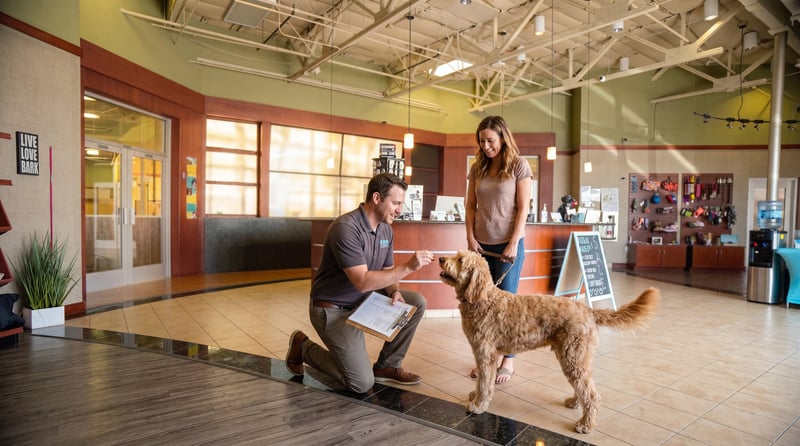
The PD360 Assessment exists because a phone description of a dog's behavior is not enough to pick a program correctly. A dog who "lunges at other dogs" could be describing frustration, fear, prey drive, or excitement: each points to a different plan. The assessment day is built to surface the answer:
- A 30-minute drop-off meet between 9 and 10am, a direct read on the dog.
- An evaluation across varied environments through the day.
- A 30-minute pick-up meet between 2 and 4pm, a verbal breakdown and a revised PD360 score built into our system.
The assessment fee is applied as store credit when you enroll in your recommended camp or a membership; it does not apply to a la carte bookings or general reservations.
Get it on the books
See exactly what the evaluation day covers
Before you pick a tier, see how the PD360 Assessment works, from the drop-off meet to the revised score at pick-up.
Picking the heavier tier when a dog does not need it is not a safer choice, it is a slower one. One reviewer put it this way: "I took my dog Rex to the behavioral camp because he was so reactive with dogs. He worked mostly with Megan but also with other trainers and it is amazing how much he learned and how responsive he is now to commands." (Catherine L., Cave Creek)
Key takeaways
- Foundation Camp is 14 nights of obedience and everyday manners; Behavior Camp runs longer and targets reactivity, fear, guarding, or aggression at the root.
- Pulling, jumping, and no impulse control point to Foundation Camp, even when the behavior looks dramatic.
- Fear-based lunging, resource guarding, and territorial aggression point to Behavior Camp, not more obedience repetition.
- Our Foundation Camp graduates needed structure and repetition; Bruno and Xela needed root-cause Behavior Camp work instead.
- The PD360 Assessment decides the tier, not a phone call.
Frequently Asked Questions
What is the best reactive-dog training option near Chandler?
A Chandler dog lunging from excitement and poor impulse control usually resolves in Foundation Camp. Reactivity rooted in fear or guarding is Behavior Camp's job, and the PD360 Assessment tells you which one you have.
Can a dog move from Foundation Camp into Behavior Camp later if new issues surface?
Yes. Some dogs arrive with only manners problems visible, and a deeper issue surfaces once the obedience foundation is in place. The plan gets adjusted, not treated as a failure.
Does a friendly, high-energy dog ever need Behavior Camp?
Rarely. A dog who is friendly but simply untrained is almost always a Foundation Camp fit, even when the pulling looks severe. Behavior Camp is reserved for behavior rooted in fear, defensiveness, or guarding.
Can two dogs from the same house need different camps?
Yes, and it is common. One dog may need obedience work while another is guarding resources or reacting out of fear. Each gets its own PD360 Assessment and recommended tier.
Move from worry to plan
Get the reactive dog you love into Behavior Camp
When the PD360 Assessment points to root-cause work, Behavior Camp is built for exactly that dog, not for a longer version of manners training he does not need.
Keep reading