What we would do
Three things decide it for most North Scottsdale families: your dog's baseline, how many evenings a week your household can give to homework, and how much calendar runway is left before the holidays. A dog that already holds a sit around normal excitement, with an owner who can commit to steady evening practice, does well in Group Classes. A dog that falls apart around a stranger, another dog, or distraction out in the world, or a household that cannot promise those evenings right now, is better served at Foundation Camp.
Is dog training worth it for a North Scottsdale family with a full calendar?
Yes, for almost every dog, but the right format looks different for a stable adult than for a puppy still building impulse control. North Scottsdale usually means the stretch north of the Loop 101 toward Pinnacle Peak, Carefree, and Cave Creek, close enough to either Partners Dogs campus for most families. What "worth it" comes down to is your calendar: how much time your household can give the dog each week, whether that is a two-income home on a school schedule or a retired couple with open evenings. Partners Dogs has trained dogs across the Valley since December 1997, and the pattern holds regardless of neighborhood: training earns back fewer leash fights at the door and fewer mornings spent managing a dog instead of living with one.
Is board-and-train worth it, or is it overkill for an ordinary dog?
Board-and-train earns its cost when a dog's daily reality needs more repetition than a weekly hour can supply. Foundation Camp runs 14 nights of 8-12+ hours a day of structured immersion, focused training layered with modeled learning through the dog's whole day, at a 1:10 trainer-to-dog ratio across both campuses. That density fits a puppy still forming its foundation, a jumper who mobs every guest, a puller who makes walks unpleasant, or a family that already tried classes without landing reps. It is the wrong tool for a dog that is already close, since professional handling alone will not teach an owner to read and handle the dog. Foundation Camp is the right call when the problem is "we need more reps than we can give."
Are weekly Group Classes worth it if your dog is already stable at home?
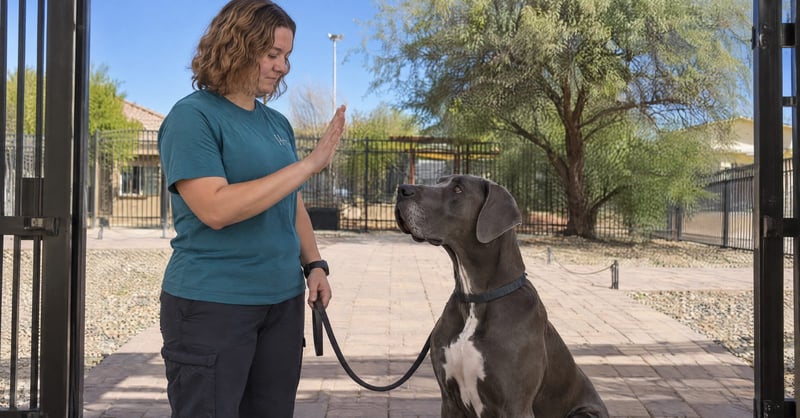
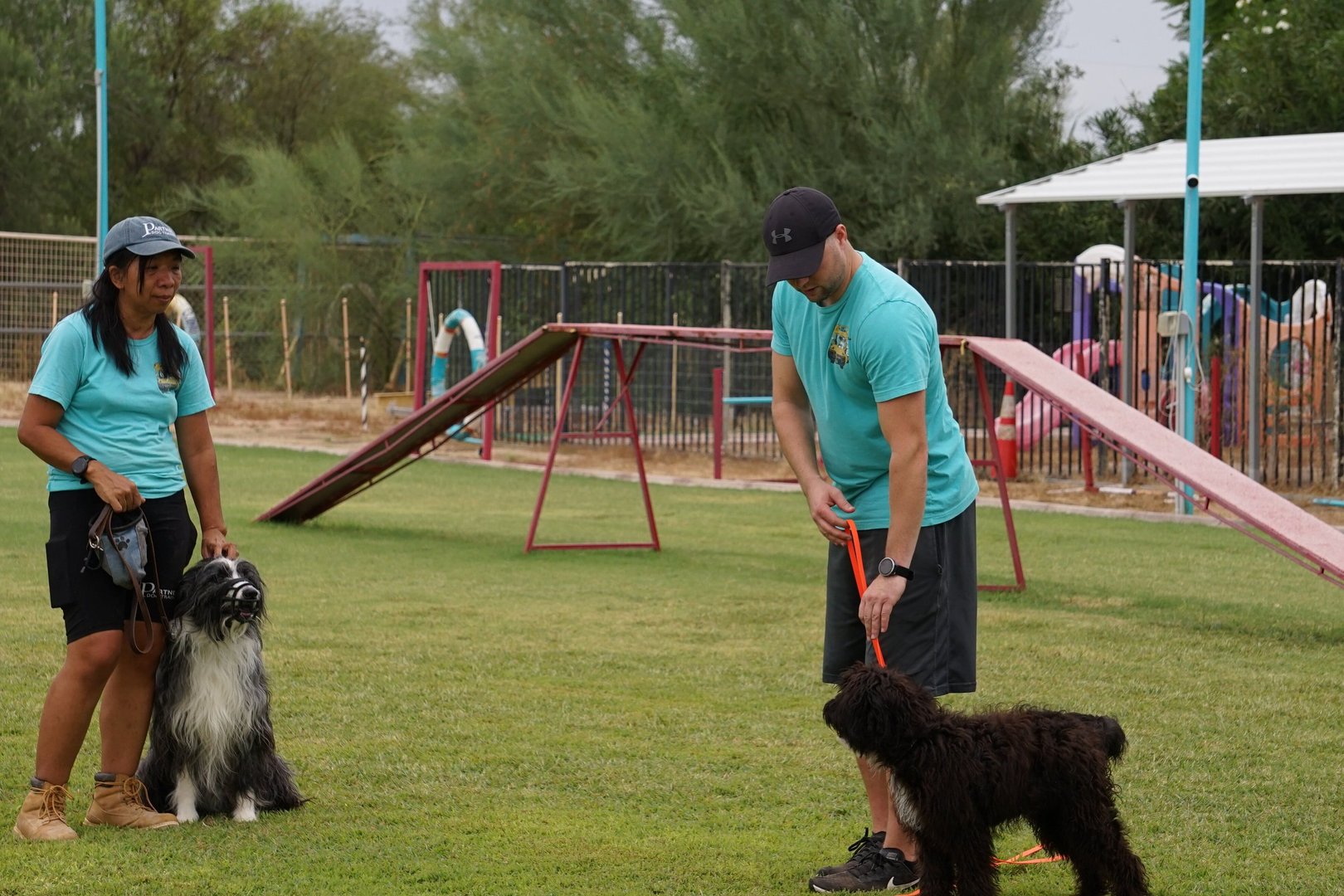
For a dog that already holds it together around ordinary excitement, weekly classes are usually the better fit. Group Classes move a dog through named grade levels, from Pre-School through Dogtorate, with the owner in the room learning the same handling the dog is learning. A dog can leave camp with a rock-solid heel and the family can still struggle with it at home if nobody there practiced holding the leash. One Partners Dogs client put it this way: "The classes and trainers are great. They really take the time to explain anything and everything. They are patient and really want to see you and your pup succeed." (Uzo, Scottsdale)
What does each program ask of your household calendar?
The real difference between the two programs is not which one works, it is which one asks something from your week. Foundation Camp asks for 14 nights away, then a follow-up lesson that hands the leash back to you, with home practice from there. Group Classes ask for a weekly session on campus plus daily reps between sessions, a smaller ask repeated often instead of one large ask up front. Before choosing, run through three questions in order:
- Where is the dog's baseline right now: manageable with occasional slips, or falling apart around normal excitement, strangers, or other dogs?
- How many evenings a week can this household realistically commit to homework?
- How much runway is left on the calendar before the holidays fill every evening?
A family whose answers lean toward "manageable," "most evenings," and "plenty of runway" usually lands on classes, while one whose answers lean toward "falling apart," "maybe one evening," or "not much runway" usually lands on camp.
What about the dog that is fine at home but falls apart out in the world?
This is the family that most often overbuys camp or underbuys classes. Callie, a young pit mix, is a useful example from Foundation Camp. Her intake assessment showed no aggression, just a typical, engaged pup reacting to stimulation. The bigger risk showed up at the local park, where her prey drive toward rabbits near a marshy area met Arizona's rattlesnake season, with recall too unreliable to trust. Fourteen nights of daily reps and rattlesnake aversion work built the foundation; at her follow-up lesson two weeks later, her owner admitted the family had not practiced much of the assigned homework, and Callie still hyperfixated on other dogs a few times, but he was able to reel her attention back each time rather than lose the walk entirely. A dog whose problems only surface out in the world is still a strong camp candidate.
What is the best board-and-train option for a dog that needs more than manners?
Foundation Camp is the standing answer for most North Scottsdale dogs; the more intensive camps exist for the smaller set carrying true reactivity or aggression. A PD360 Assessment is the fastest way to find out which lane a dog belongs in, since it scores the dog across everyday environments rather than guessing from a phone call. Most families who worry they need something heavier turn out not to: jumping, pulling, poor recall, and puppy chaos are exactly what 14 nights of structured immersion fixes. Behavior Camp and Transform Camp exist for a distinct, smaller group.
When are Group Classes the best call?
Group Classes are the best call when what is left to fix is polish work, not anything approaching a crisis. A dog that greets guests fine but forgets manners the moment the doorbell rings, a puppy building its first commands, or an adult dog moving up a grade level after graduating camp are all classes candidates. The format also suits families still deciding, since a few weeks in the room with a trainer, plus a private lesson or two if the pace needs adjusting, tends to make the next step obvious. Families still unsure are better served talking it through than guessing; the program decision center exists for that.
| Decision factor | Foundation Camp | Group Classes |
|---|---|---|
| Best starting point | Dog struggles with normal excitement, strangers, or basic impulse control daily | Dog is stable at home and needs polish, not a reset |
| Time asked of the household | 14 nights away, then a follow-up lesson and home practice | Weekly session on campus plus daily reps between classes |
| Who is doing the reps | Trainers, at a 1:10 ratio, for 8-12+ hours a day | The owner, coached in the moment by the trainer |
| Good fit for a busy calendar | Yes, when weeknights are consistently unavailable | Yes, when the household can keep up steady evening practice |
Key takeaways
- A stable dog with an owner who can keep up steady evening practice usually does well in Group Classes.
- A dog that falls apart around distraction out in the world, even if it looks fine at home, is a strong candidate for Foundation Camp.
- Foundation Camp runs 14 nights of 8-12+ hours a day of structured immersion at a 1:10 trainer-to-dog ratio.
- A PD360 Assessment sorts which lane a dog belongs in faster than guessing from home behavior alone.
- North Scottsdale families sit close enough to both campuses that drive time rarely decides it.
Frequently Asked Questions
How do I know if my dog is stable enough to start with Group Classes instead of camp?
Look at how the dog behaves around normal excitement, not only at rest. A dog that holds a sit through a doorbell, greets a stranger without jumping, and settles again within a minute is usually ready for weekly classes. A dog that escalates and stays escalated, or needs the same correction repeated many times a day with no improvement, usually needs the higher rep count Foundation Camp provides first.
Do North Scottsdale families have to choose one campus for camp drop-off and pickup?
No. Foundation Camp intake happens at whichever Partners Dogs campus, Scottsdale or Cave Creek, is the shorter drive; both run the same 14-night structure and trainer ratio. North Scottsdale sits within reasonable range of both, so most families choose based on which side of town they are already headed toward that week.
Can we start with Group Classes and move to Foundation Camp later if progress stalls?
Yes. It is common for a family to start in classes, find the dog needs more daily repetition than a weekly session can provide, and move into Foundation Camp from there. A PD360 Assessment at that point gives a clear read on whether the plateau is about format or about the underlying issue.
What if weeknight classes do not fit our family's schedule right now?
If steady evening practice is not realistic this season, that is itself useful information: it points toward Foundation Camp, where trainers carry the daily repetition and your job shifts to the follow-up lesson and home practice afterward. A private lesson or two can also bridge the gap while you decide.
Get in before the holidays
Get your dog's spot locked in before the calendar fills up
If your dog's baseline points toward Foundation Camp, weeks book up fast once holiday travel starts. See open dates now, or talk it through first.
Keep reading