In short
Press the back of your hand on the pavement for seven seconds. If you cannot hold it there, the surface is too hot for your dog's paws. Asphalt in direct sun at 77°F air can hit 125°F, and burns can start in about 60 seconds.
- Asphalt in direct sun with no wind reaches 125°F at 77°F air, 135°F at 86°F air, and 143°F at 87°F air (Berens, JAMA 1970, via the WSU College of Veterinary Medicine).
- Maricopa County summer pavement typically burns flesh from 9 a.m. to 7 p.m., with second-degree burns possible in 35 seconds of contact on most days from 10 a.m. to 5 p.m.
- The veterinary standard is the 7-second back-of-hand test. If the heat is unbearable before seven seconds, the answer is already no.
- Burned paws show as limping, refusal to walk, blistering or peeling pads, and nonstop licking. Suspected burns always go to your vet as soon as possible.
- Booties are a tool. Condition the dog to them before you need them: short sessions, rewards, never strapped on and dragged out the door.
Quick answer: Press the back of your hand flat on the pavement and hold it for seven seconds. If you cannot hold it there comfortably, it is too hot for your dog's paws. Test every summer walk, because asphalt in direct sun runs far hotter than the air, and paw burns can start in about a minute.
If you are a Scottsdale or Cave Creek Pet Parent walking a dog between May and September, this is your complete playbook for paws in the heat: how hot pavement really gets, how to test it in seconds, what burned pads look like, which booties are worth buying, and how to get your dog wearing them without a fight. The thread through all of it is conditioning. Booties are a tool, and like every tool in our method, the dog learns it before it is needed (our methodology). If you have ever carried a 60-pound dog across a parking lot in July because you misjudged the pavement, this is the guide that makes that never happen again.
How hot does pavement get for dogs' paws?
Hot pavement burns dogs' paws faster than most owners expect. At 125°F, skin damage can begin in about 60 seconds.
The numbers are measured, not folklore. Dr. James Berens published work on thermal contact burns in the Journal of the American Medical Association in 1970, and the WSU College of Veterinary Medicine still cites it: in direct sunlight with no wind, asphalt reaches 125°F when the air is only 77°F. At 86°F air it jumps to 135°F. At 87°F air, 143°F (WSU College of Veterinary Medicine, retrieved 2026-09-16).
A 77-degree day feels like perfect walking weather to you. Your shoes never notice. Your dog's bare pads get 125 degrees of it. Paw pads are tougher than the back of your hand, but they are not oven mitts.
This is Maricopa County, not a hypothetical. A 1995 study by physicians and first responders here found summer pavement typically ran hot enough to burn flesh from 9 a.m. to 7 p.m., with second-degree burns possible on most days from 10 a.m. to 5 p.m. within 35 seconds of contact (also via the WSU advisory). That study measured human skin, but it tells you what the ground in your neighborhood does every July afternoon. Phoenix's normal July high is 106.5°F (NWS 1991-2020 normals). That is why our paw-burn season runs May through September.
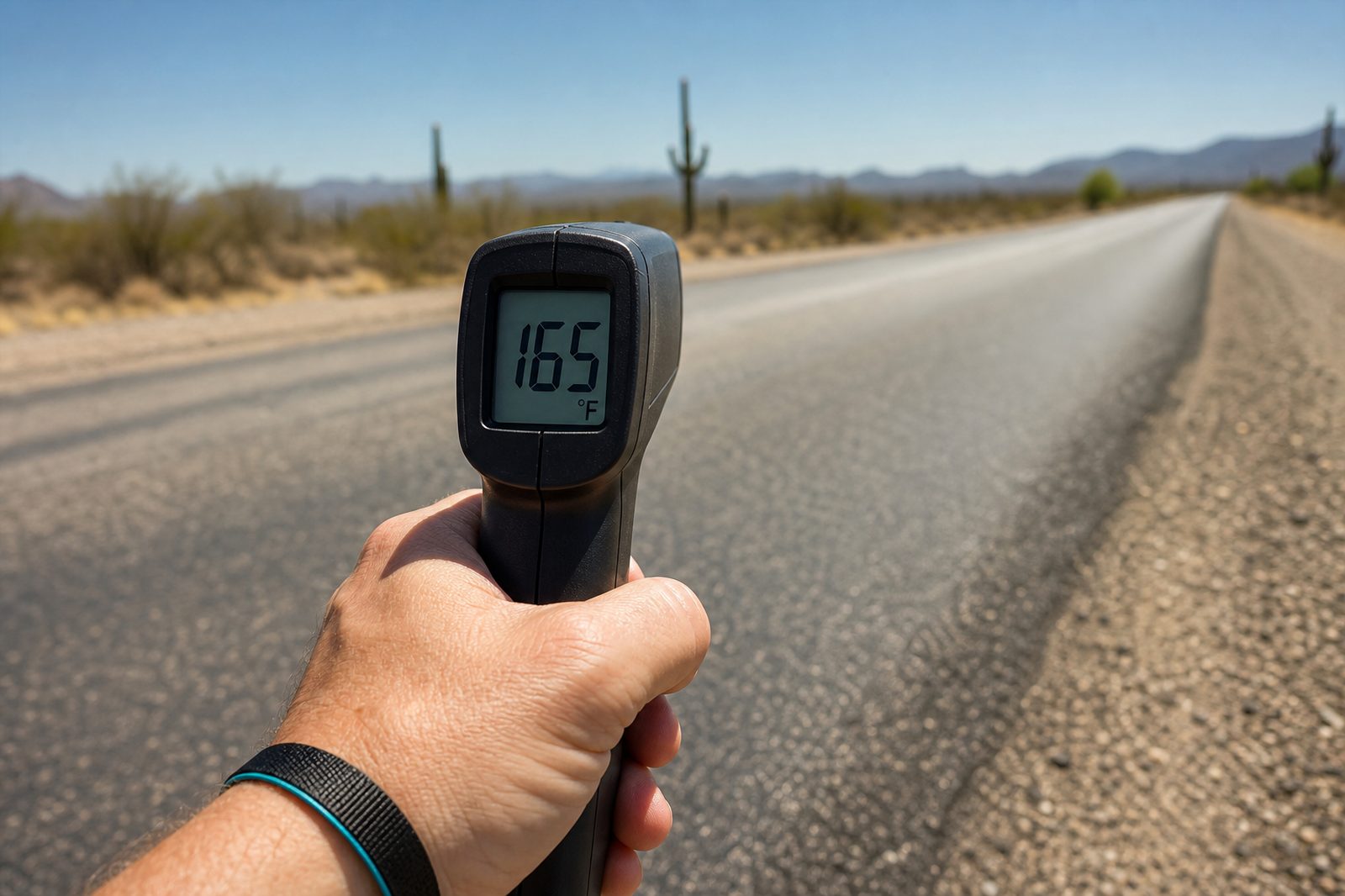
One honest limit on the numbers: Berens measured specific conditions (direct sun, no wind, asphalt). Your street varies with cloud cover, wind, shade, and surface. The direction never changes. The pavement is hotter than the air. Test instead of guessing.
What is the 7-second pavement test (and what do vet sources really say)?
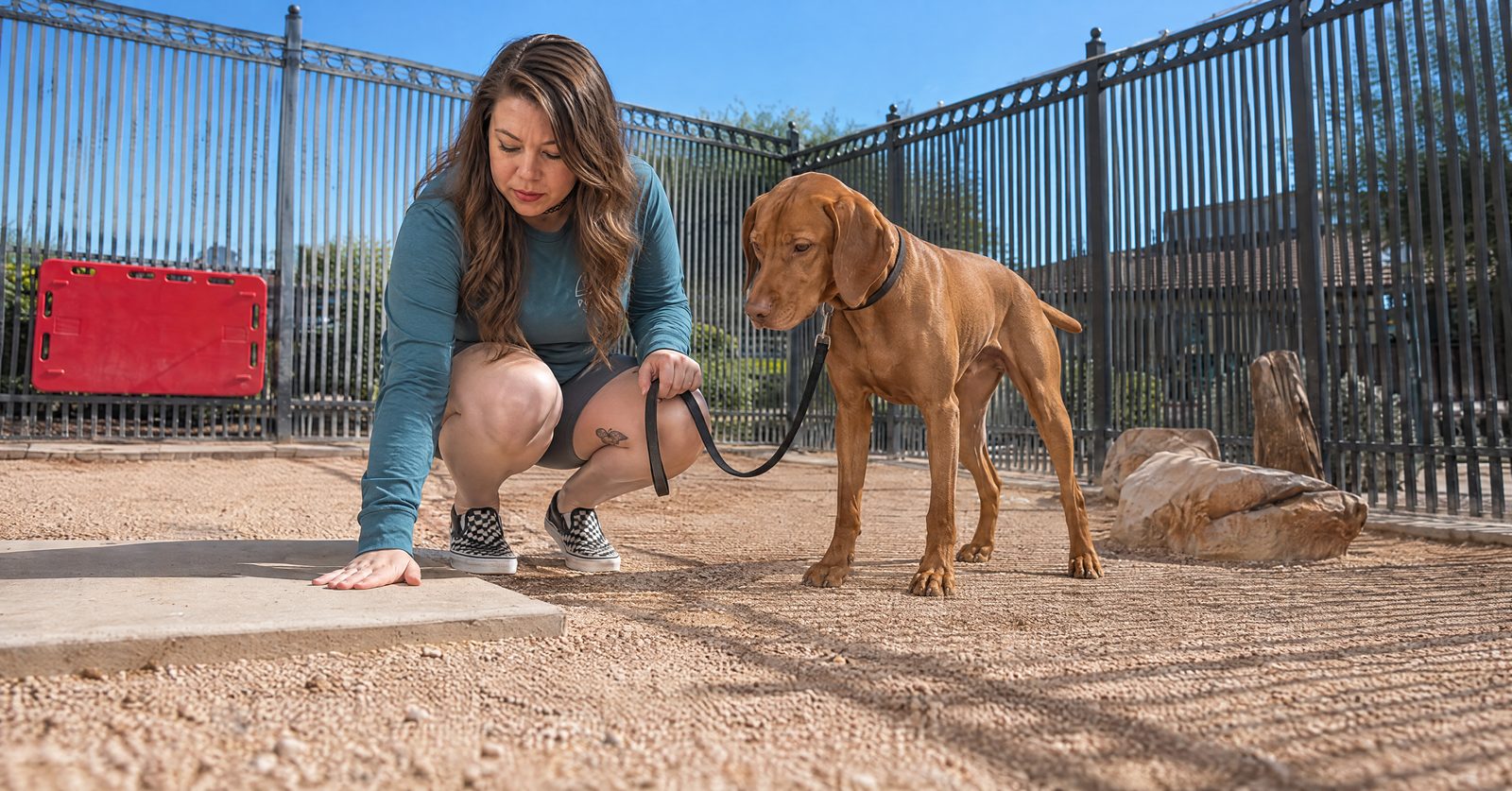
Press the back of your hand flat on the pavement and hold it for seven seconds. Too hot for your hand means too hot for your dog's paws.
Here is the honest version of the name. A few popular sources say five seconds, but the veterinary standard is seven. Dr. Raelynn Farnsworth of the WSU veterinary teaching hospital says seven seconds with the back of the hand: "If you can't hold it there for a full seven seconds it's too hot for a pet's paws." The Kennel Club agrees. The AKC's chief veterinary officer says ten. This article teaches the seven-second standard throughout.
Why is seven the number? Five seconds is the stricter reading, and stricter has its place: if your hand wants off at five seconds, you do not need the last two to know the answer. Hold for seven when you can stand it. Bail at five and you already have your answer.
How to do it right:
- Use the back of your hand, not your palm. The back is more sensitive to heat.
- Press it flat on the actual walking surface, not the grass next to it.
- Hold a full seven seconds if you can. Do not touch and lift. Seven seconds approximates standing on it, not stepping over it.
- Test where the walk goes, not just your driveway. Sun, shade, and surface change block by block.
- Test again on long walks. Afternoon pavement keeps climbing after you tested it.
What are the limits of the hand test?
The hand test is a screening tool, not a thermometer. It answers one question well and several questions not at all.
Your hand samples one spot at one moment. A walk crosses sun, shade, asphalt, concrete, and that one patch of dark sealant that runs hotter than everything else. The test also says nothing about the rest of the heat picture: a dog with cool paws can still overheat from the inside out on a 108-degree day. Paws are one failure point. Heatstroke is the other, and it does not care what your hand felt. Our heatstroke guide covers the signs and what to do before you reach the vet.
Some dogs burn faster than the test assumes. Puppies, seniors, indoor dogs, dogs with wet paws straight out of the pool, and dogs with already-irritated pads are all more vulnerable (per Dr. Boronat, cited by Chewy's veterinary-reviewed guide, retrieved 2026-09-16). If your dog fits any of those, read a borderline test as a fail. And remember the leash: a free dog's pain response will not let it stand on a burning surface, but your dog is leashed to you, walking where you walk. The test exists because your dog cannot vote with its feet. You vote for it, before the walk, every time.
How do you know if your dog's paws are burned?
Limping, refusing to walk, or licking paws nonstop after a hot walk means suspected paw burns. Get off the pavement now, cool the paws with water, and call your vet.
Paw burns do not always look dramatic right away. The WSU veterinary hospital warns that lesions take time to develop. Watch for the sequence: limping on a walk that was fine yesterday, favoring one paw then several, red or darkened pads, blisters or peeling pad skin, and incessant licking that makes everything worse.
First aid: get onto grass or shade and immerse the feet in cool water. No ice or ice baths; extreme cold on burned tissue causes its own damage (LSU AgCenter veterinary guidance, retrieved 2026-09-16). No home remedies or human burn creams.
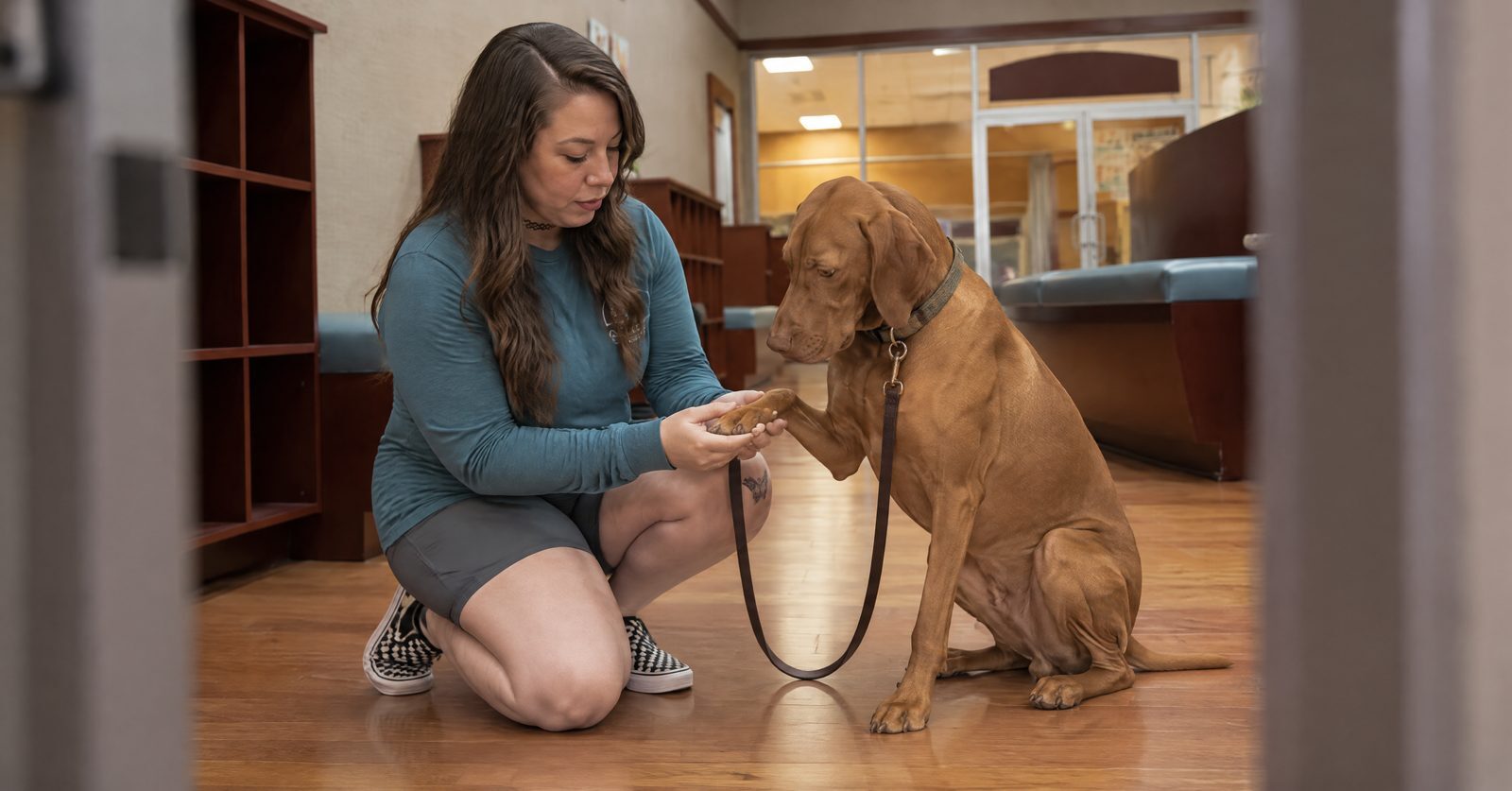
Then the vet gate, no exceptions. WSU says pets with suspected burns should always be seen by the family veterinarian as soon as possible. Typical care involves pain medication and cleaning and dressing the wounds, plus an Elizabethan collar to stop the licking that slows healing. Anything past mild redness warrants the visit. Burns are a medical issue, and no training article replaces your vet.
If the burn happened on your watch, change the system instead of carrying guilt: test before every walk, shift walk times, or condition booties. Guilt does not protect paws. Systems do.
Do dog booties actually work on hot pavement?
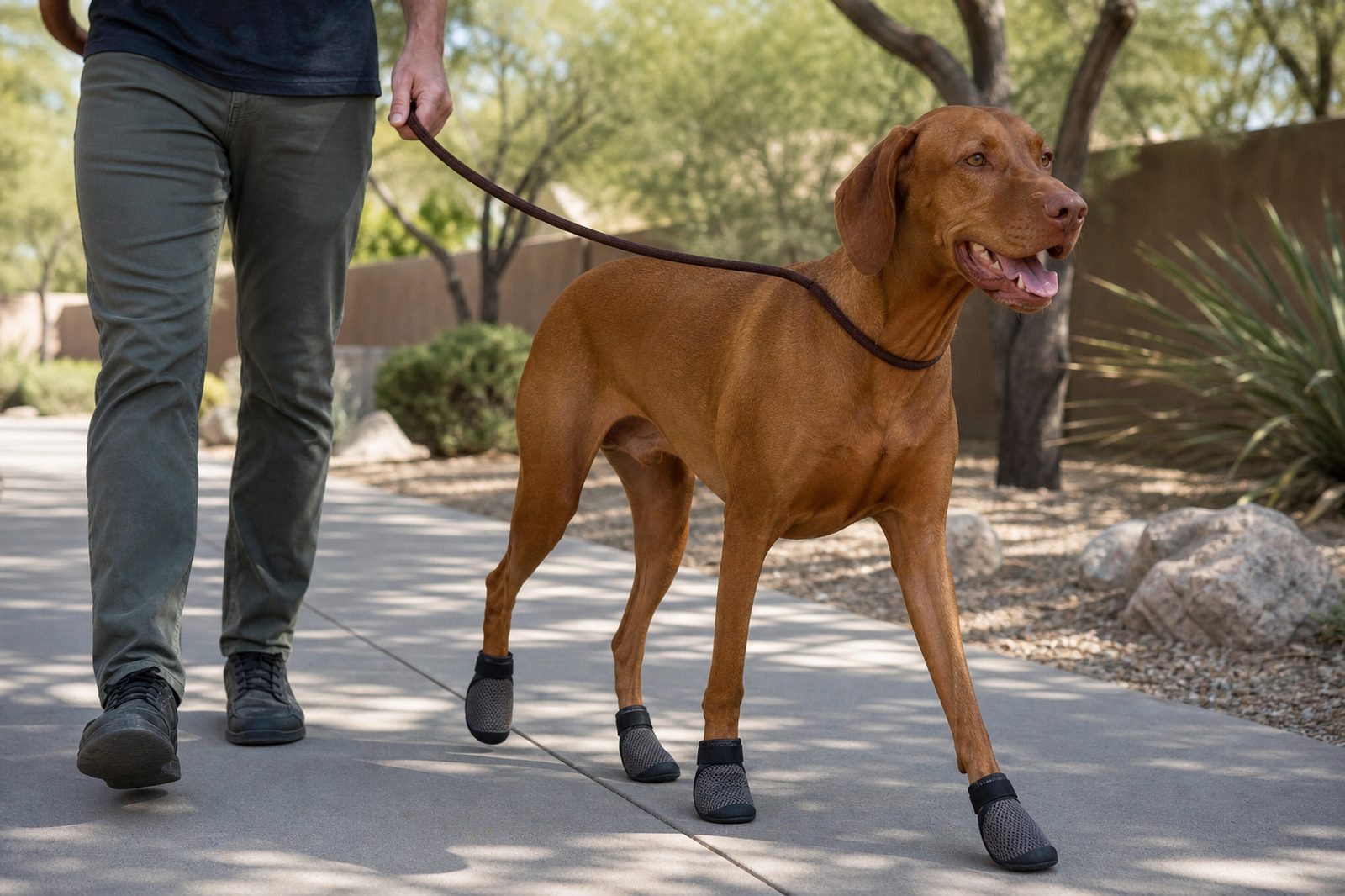
Yes. Booties put a barrier between pads and pavement, and for Scottsdale summers they are the most practical protection when you cannot avoid hot surfaces.
Dr. Sara Ochoa, a small-animal veterinarian, puts it plainly: concrete in very hot weather can cause sloughing of the foot pads, and booties make hot ground tolerable in desert climates (PetCoach, retrieved 2026-09-16). Think of them as PPE for paws.
What they do not do matters just as much. Booties protect pads. They do not cool the dog. Dogs dump heat mainly through panting, and booted feet on a 110-degree day still belong to a dog walking through 110-degree air. If the air is dangerous, booties do not make the walk safe. Our guide on what temperature is too hot to walk your dog in Phoenix covers the full call.
One more honest limit: dogs sweat a little through their paw pads, and a bootie traps some of that heat exchange. On truly brutal days the right answer is not better booties. It is no midday walk at all.
How do you choose booties that stay on and don't cook the feet?
Buy for summer, measure every paw, and prioritize fit and breathability over features. A bootie that falls off mid-walk protects nothing.
Generic guidance on purpose: no commissions, no brand lists. What to look for and what to avoid:
| Type | Best for | Watch out for |
|---|---|---|
| Mesh summer booties | Scottsdale heat. Breathable uppers, light soles, built for hot pavement. | Thin soles wear through on rough concrete; replace when the tread goes. |
| All-terrain boots | Rough trails, sharp rock, mixed surfaces. | Heavier and warmer; overkill for a neighborhood walk and hotter on the foot. |
| Rubber "balloon" socks | Cheap backup pair, light protection, easy to carry. | Thin barrier, tear on rough pavement, can trap heat. |
| Paw wax or balm | Mild heat, rough dry surfaces, pad care between walks. | Not a substitute for booties on truly hot pavement. Thin layer, wears off fast. |
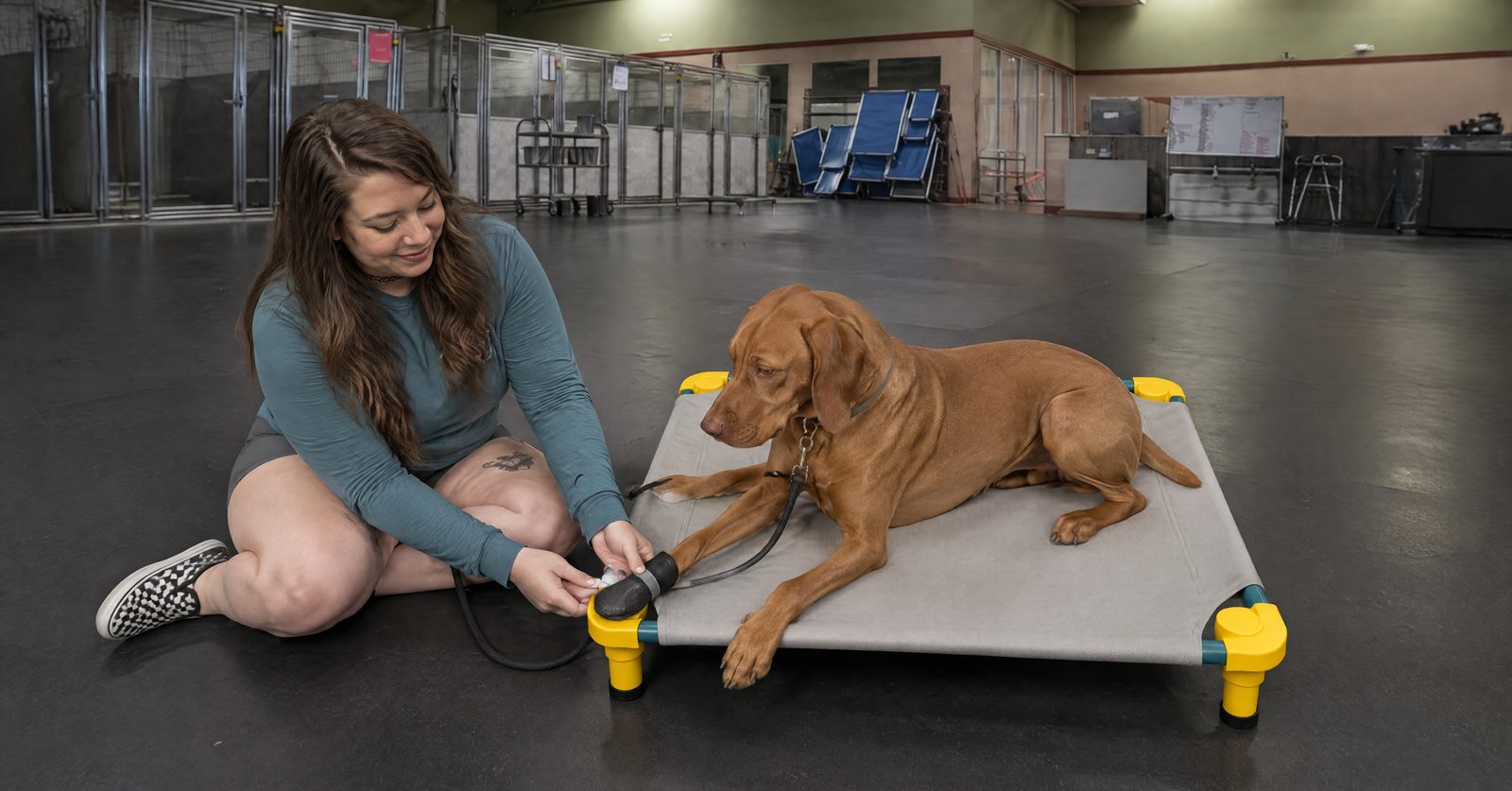
Fit rules that actually matter:
- Measure every paw. Front paws are usually wider than rear paws on the same dog. Size to the paw, not the breed chart.
- Snug, not tight. One finger under the closure. Too loose twists off mid-walk. Too tight cuts circulation.
- Secure closures beat extra straps. Boots that flex with the foot and stay put outperform stiff boots with decorative hardware.
- Easy on, easy off. A ten-minute wrestling match means you will stop using them.
- Check mid-walk. Heat and movement shift fit. A quick check at the turnaround catches a twisted bootie before it rubs a blister.
Avoid insulated or waterproof winter boots for summer walks, stiff decorative boots, any pair you did not measure for, and leaving booties on for long stretches in the heat. Paw wax is a supplement, not a shield.
How do you condition a dog to booties before you need them?
This is the same ethic we apply to every tool in training: condition first, use second. A dog that meets booties for the first time on a 105-degree day, already stressed and hot, learns one thing: booties mean panic. Condition in the cool of your living room and booties mean treats. Same gear, opposite lesson. One action per step:
- Booties appear, treats appear. Set the booties on the floor near the dog. Treat for noticing and sniffing. Booties go away, treats stop. Two or three short rounds.
- Touch feet with the bootie, then treat. Pick up a paw, touch it with the bootie, treat.
- One bootie on, jackpot, bootie off. Slide one bootie onto one front paw. Feed several treats in a row. Take it off. Two minutes total.
- All four, indoors, then a game. Booties on, then immediately do something the dog already loves: play, a known trick, dinner.
- Build duration over several days. Five minutes indoors becomes ten, becomes a trip to the backyard. Increase time before difficulty.
- First outdoor trip: cool morning, short route, high-value rewards. Not July at noon. The booties should be the only new thing.
- Proof it like any other skill. Different surfaces, different times of day, normal pace. If the dog freezes, back up one step.
A dog that panics in booties was not given a bootie problem. It was given a conditioning problem, and conditioning problems are fixed before the tool, never during.
Our trainers condition booties on campus exactly the same way, and the tells are identical: a dog that high-steps or kicks at the booties on day one is not being difficult. It is telling you the conditioning is at step one, not step four. Read the dog, not the plan.
Keep sessions to two or three minutes and end on a win. If the dog freezes, lies down, or chews at the booties, you moved too fast; drop back a step. Never correct a dog for reacting to gear it was never conditioned to. Never let the first real use be an emergency. July is not the month to start. Start in spring, when the pavement is forgiving and the stakes are low. For the conditioning framework behind this protocol, see our methodology.
First step
What Temperature Is Too Hot to Walk Your Dog in Phoenix?
The full walk-or-skip call for Phoenix summers: air temps, timing, surfaces, and when booties are not enough.
When aren't booties enough?
Booties protect paws. They do not make a dangerous day safe. When the air is extreme, skip the walk.
There are Scottsdale afternoons when the right gear list is a leash, a water bowl, and the front door staying shut. Booties solve the ground. They do not solve 112-degree air, radiant heat off every surface, or a flat-faced dog whose cooling system was already marginal in April. On those afternoons, the honest alternative is a DayCamp day: the dog's exercise, play, and rest happen in air conditioning instead of on a griddle. Heatstroke kills dogs every Arizona summer, and it does not start in the paws. If your dog is slowing down, panting hard with no recovery, drooling thick saliva, or looking glassy-eyed, the walk ends. Know the full signs before you need them: our heatstroke guide covers what to watch for.
Valley heat rules: walk before 8 a.m. or after the pavement has released its heat in the evening, which can be well after sunset. Favor grass, dirt, and shade. Carry water. Shorten the route before the dog tells you to. On days the hand test fails at 9 a.m., it fails harder at 3 p.m. And some dogs never accept booties, even well-conditioned. Read that as information. Manage those dogs with timing and surface choice instead of force.
What do the numbers say?
What myths about paws and hot pavement get it wrong?
| Myth | Fact |
|---|---|
| Dogs' paws are tough enough for any pavement. | Pads are tougher than your hand, not invincible. At 125°F, skin damage can begin in about 60 seconds, and 77°F air is enough to get asphalt there in direct sun. |
| Paw wax is all you need in an Arizona summer. | Wax is a thin, short-lived layer. On truly hot pavement it is not a substitute for booties, shade, or walking at cooler hours. |
| Booties are just for winter or for spoiled dogs. | Veterinarians recommend booties for hot pavement in desert climates. They are protective equipment, and summer mesh booties are built specifically for heat. |
What mistakes make paw burns more likely?
- Trusting the air temperature. 77°F air, 125°F asphalt. The number on your phone is not the number under your dog.
- The touch-and-lift check. Tapping the pavement for one second tells you nothing. Seven seconds, back of the hand, flat on the surface.
- Strapping on booties for the first time on a hot day. Unconditioned gear on a stressed dog teaches panic. Condition in spring, in your living room.
- Ignoring the limp. A dog that starts limping mid-walk is telling you something. Get to grass, check the pads, and do not finish the route on hot pavement to "toughen them up."
- Bootie-only thinking. Protected paws on an overheating dog is still an overheating dog. Watch the whole animal.
From here
Booties Protect Paws, Not the Whole Dog
Booties solve the ground. On extreme-heat days the right call is no walk at all: a DayCamp day keeps the dog's exercise, play, and rest going in air conditioning while the pavement burns.
Key takeaways
Key takeaways
- Test every summer walk: back of the hand, flat on the pavement, seven seconds. Too hot for your hand is too hot for paws.
- Asphalt in direct sun hits 125°F at 77°F air, 135°F at 86°F, 143°F at 87°F. Damage can begin in about 60 seconds at 125°F.
- Burned pads show as limping, refusal to walk, blistering or peeling, and nonstop licking. Suspected burns always go to the vet as soon as possible.
- Booties work for hot pavement when they fit, breathe, and stay on. Measure every paw; buy summer mesh for Valley heat.
- Condition booties like any tool: short sessions, rewards, in the cool house, weeks before you need them. Never strap and go.
- Booties protect paws, not the whole dog. Extreme air still means skip the walk.
Frequently Asked Questions
How long can a dog safely walk on hot pavement?
There is no safe fixed time. At 125°F, skin damage can begin in about 60 seconds, and Maricopa County pavement can cause second-degree burns within 35 seconds of contact on typical summer days. Do the 7-second hand test first. If it fails, use grass, cooler hours, or conditioned booties.
Do dogs really need booties in Scottsdale, or are their paws tough enough?
Pads are tougher than your hand but not built for 140-degree asphalt. Veterinarians recommend booties for hot pavement in desert climates. Between May and September in the Valley, they are the most practical protection when you cannot avoid hot surfaces.
My dog freezes and refuses to move in booties. How do I fix that?
That is a conditioning problem, not a bootie problem. Go back to short indoor sessions: one bootie on, treat, bootie off, building up over days. Never force it. If your dog panics about gear or handling in general, that is a behavior case. The first step is a PD360 Assessment.
What should I do first if my dog's paws are already burned?
Get onto grass or shade and immerse the paws in cool water. No ice. No home remedies. Then see your veterinarian as soon as possible; anything past mild redness needs professional wound care and pain medication. Blistering or peeling can develop a day or two after exposure.
Can booties replace skipping the midday walk in July?
No. Booties protect pads, but they do not cool the dog or make 110-degree air safe. On extreme days, walk before 8 a.m. or after the pavement has released its heat, keep it short, carry water, and favor grass and shade. Some afternoons the right call is no walk at all.
Where should you go from here?
The system is simple: test before every walk, walk at cooler hours, condition booties in spring before summer needs them, and treat any suspected burn as a vet visit. Our trainers work in this heat every day with Valley dogs, and the dogs that handle summer best are the ones whose owners planned for it in April. Every spring, our DaySchool dogs get the bootie protocol as part of their training blocks, so by the time the pavement turns dangerous the gear is old news.
Scottsdale: 8642 E Shea Blvd, 85260. Cave Creek: 4640 E Forest Pleasant Pl, 85331. Serving the Phoenix Valley.