Bottom line
Getting the whole family consistent with a dog takes four agreements, not a new training method: one cue per behavior, house rules that hold no matter who is home, assigned reps, and a five-minute weekly check-in. None of it requires retraining the dog. Most households get there fastest with a coached private lesson, where a trainer works with everyone in the room the dog tunes people out in, instead of handing over another video.
The pattern shows up in almost every intake call about a dog who "used to be so good." One adult put in the hours. The dog now reads that person perfectly, and everyone else in the house gets ignored, jumped on, or walked over. The dog is not choosing favorites, and the earlier training was not wasted. The house just has more than one rulebook running at once, and fixing it is a household project with a short, specific list of steps.
Partners Dogs holds a 4.8-star rating across more than 2,000 reviews, plenty of them from families who have been exactly here: one competent handler, and everyone else getting tuned out. Read the full range on the reviews page.
Why a Dog Listens to One Person and Ignores the Rest
Dogs learn cues attached to a specific voice, tone, timing, and follow-through rather than to a word in the abstract. If one person in the house consistently says "off" and then blocks the jump until it stops, the dog learns that voice means something. Everyone else who says "down," "no," or "get off" in a different tone without following through is training the dog that their version of the word is optional.
The gap almost always traces back to inconsistent follow-through, not a dog that has ranked the humans in the house by authority. A trainer working a case like this checks the same short list first: how many different words are being used for the same behavior, who follows through every single time, and who lets it slide when they are tired or in a hurry. Left alone, the pattern usually gets worse, because the dog keeps getting reinforced for testing everyone except the one consistent person. Building reliable listening in everyday life starts with closing that gap, not with more repetition aimed at the dog.
Step One: One Word Per Behavior, Written Down
Pick a single word for each behavior the household needs, and write it down somewhere everyone will see it: the fridge, a shared note, a card taped inside a cabinet. Every adult and every regular visitor uses that exact word, with no substitutes, no matter how natural the substitute feels in the moment. A four-word cue list covers most households:
- Off for four paws on the floor, not "down," "no," or "stop that."
- Leave it for anything the dog should not touch or eat, not "hey," "quit it," or a sharp noise.
- Place for going to a bed or mat and staying there, not "go lay down" or "go to your spot."
- Settle for calming down in general, separate from a specific spot in the house.
The word matters less than the agreement. A household that picks four different but consistent words and sticks to them beats a household using the textbook-correct word inconsistently every time.
Step Two: The House Rules That Hold No Matter Who Is Home
Cues are words for specific behaviors. House rules are the handful of boundaries that do not bend depending on who is home that day. Write down the three or four rules that matter most, and treat every exception as a rule that no longer exists. The common ones:
- No feeding from the counter or the table, ever, including a bite from a plate someone is about to finish. One soft night from a grandparent restarts counter surfing as a habit, not a memory.
- No greeting the dog at full volume the second someone walks in the door, even for a visitor who says they do not mind the jumping.
- No dog on furniture it is not allowed on, for anyone, including whoever is watching the house for the weekend.
A rule that only holds when the strictest adult is home is not a rule, it is that adult's personal habit. The fix is not more discipline. It is writing the three rules down and asking every adult and regular visitor to agree to them out loud before the next visit, not after the dog has already relearned the old pattern.
Step Three: Assign the Reps Instead of Hoping
A household that says "we'll all practice" usually means nobody practices. Assign specific reps to specific people on specific days: Dad walks the dog past the mail carrier on Tuesdays and Thursdays, the teenager runs a five-minute place-and-settle rep before dinner, Mom handles the door-greeting rep every time a delivery comes. A rep with no name and no day attached gets skipped the first busy week, and most weeks are busy weeks.
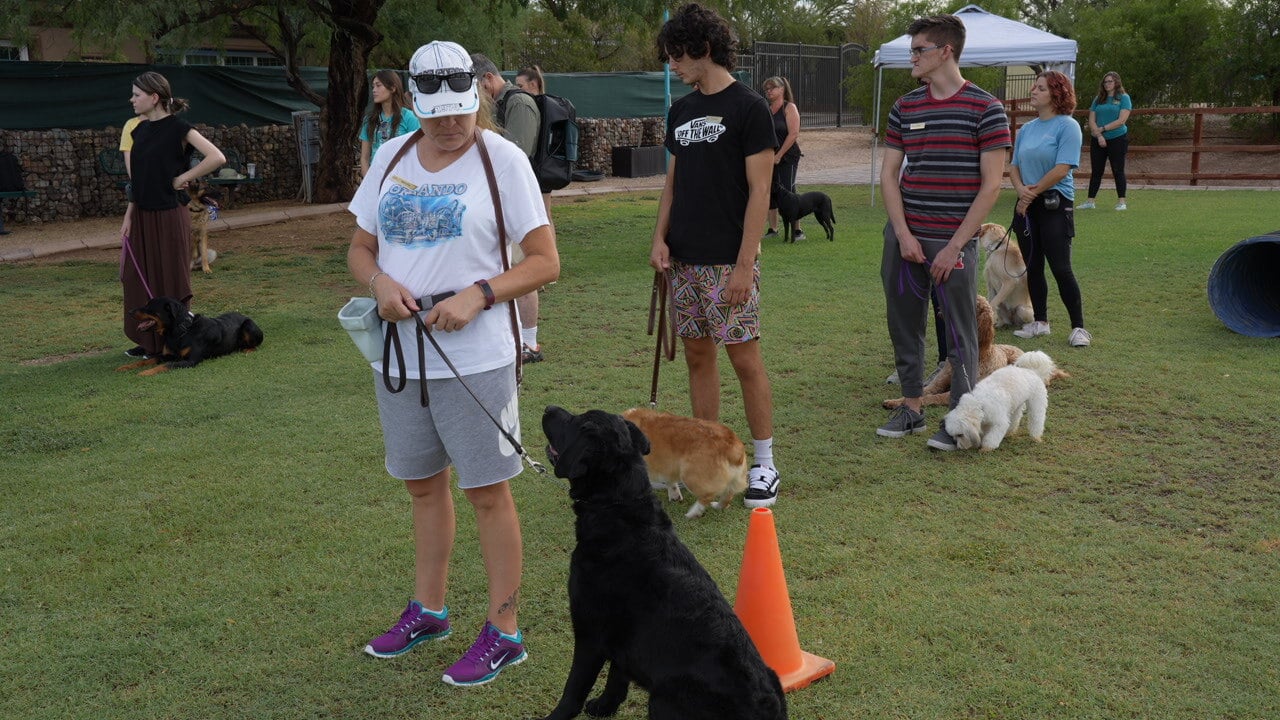
This is also where group classes earn their keep once the house has agreed on cues and rules. A weekly class gives the reps a deadline and a coach watching the handling, not just the dog.
"Noa took so much time to listen to us and to find out exactly what the issues were and what we wanted to accomplish with this training."
Ashley J., Cave Creek
Coach the whole house
Get Every Adult Doing the Same Thing
A private lesson puts a trainer in your kitchen or your entryway, watching who does what and fixing the mismatch on the spot instead of relaying it secondhand.
Kids, Teenagers, and Visiting Family: What to Ask of Each
Different people in a dog's world can reasonably be asked for different levels of consistency, but everyone gets at least the cue list and the house rules.
- Young kids should know the words, not enforce them. A six-year-old cannot be the one holding the leash through a jumping dog, but a six-year-old can learn to fold their arms and turn away instead of squealing and petting through the jump, which is usually what keeps jumping on people paying off for the dog.
- Teenagers can run full reps and often do it better than adults once they buy in, but they need the same cues in writing as everyone else, not a verbal summary that gets half-remembered by Friday.
- Grandparents and other regular visitors are the most common rule-breakers in this pattern, usually because a treat from the table or a big, excited greeting feels like love, not a training mistake. Send the cue list and the three house rules before the visit, not during it.
Give visiting family a one-line version if the full list feels like too much to ask: use the same word everyone else says, and do not feed from your plate. That single ask prevents most of the backslide a long weekend with grandparents can otherwise cause.
"as a first time dog owner, i felt that they were helpful not only for my dog, but also for my whole family in training us all how to handle our new puppy."
My T., Cave Creek
The Weekly Five-Minute Check-In
Pick one recurring time, Sunday night before the week starts is a common choice, and ask three questions out loud for five minutes: what worked this week, what did not, and who is covering which rep for the week ahead. Five minutes on a fixed day beats an hour-long conversation that only happens after something has already gone wrong.
Skipping one week is not a disaster. Skipping four in a row usually means the plan quietly died a few weeks back and nobody said so out loud yet. The check-in is the cheapest insurance in this whole list, and it is the step most households drop first because nothing about it feels urgent enough to protect.
Where a Coached Lesson Beats Another Video
A family consistency problem is usually a live, in-the-room problem: tone of voice, timing, body language, who is standing where when the dog bolts for the door. A video can teach a cue. It cannot watch your specific kitchen, your specific door, and your specific family, then tell each person what they are doing differently in that exact space.
A private lesson puts a trainer in the actual room where the mismatch happens, watching every adult run the same cue back to back and correcting the handling in real time. Partners Dogs runs both formats:
| Format | Best for | Session length |
|---|---|---|
| In-School | Families who can get everyone to the Scottsdale or Cave Creek training field at once | About an hour |
| In-Home | Households where the failure happens in a specific room, doorway, or yard, or schedules that never line up | About 90 minutes |
If getting the whole crew to the training field at the same hour is easier than getting a trainer to your door, in-school works just as well for less money. In-home costs more per session because a trainer comes to you, and it earns that premium when the failure point is a specific room, a specific door, or a schedule that never lines up for everyone to leave the house at once. See the full pricing page for current rates on every format, add-on, and the second-dog discount.
"Chase came to do a private lesson today. He pointed out so many Small things I can change that are going to make a big difference."
Virginia C., Scottsdale
The pattern in Virginia's quote above shows up often: a trainer noticing something small in the room that a video never could.
What Happens When One Adult Will Not Participate
Every step in this article assumes the household actually wants the same outcome. Sometimes it does not. One adult thinks the rules are too strict, feeds from the table anyway, or lets the dog back on the couch the moment the other partner leaves the room.
No program fixes a holdout adult: not a private lesson, not a board and train, not the most expensive option on the price list. A dog that gets one set of rules from three people and a free pass from the fourth will keep testing for the free pass, because that pattern is exactly what worked last time. Fix that fourth agreement before spending more money on training aimed at the dog.
If this is the situation, the more useful move is a direct conversation between that adult and a trainer, not a secondhand relay through a spouse. Hearing the reasoning from a professional, in plain terms, changes more minds than hearing it filtered through a tired partner for the third time this month. A PD360 Assessment is also worth booking first if the underlying issue looks more like a behavior problem than a family coordination problem, since that changes which program fits.
Households that get everyone rowing the same direction rarely need more than the steps above and a few coached sessions. Households where one adult will not budge need that conversation first, before any program gets a fair chance to work.
Frequently Asked Questions
Can one private lesson really fix a dog that only listens to one person?
One session usually cannot finish the job, but it can diagnose the mismatch fast: which cues conflict, who follows through and who does not, and which house rule has quietly stopped holding. Most households need a small handful of sessions to get every adult running the same handling. Current per-session rates for both formats, including the second-dog discount, are on the pricing page.
What should we actually tell visiting grandparents before they walk in the door?
Keep it to two lines if the full cue list feels like too much to hand someone at the door: use the same word everyone else uses for the same behavior, and do not feed from your plate or the counter. Those two habits cause more backslide over a long weekend than almost anything else a visitor does.
How long before the whole family sees consistent results?
Most households notice a real shift within two to three weeks of everyone using the same cue words and holding the same house rules, faster if a coached private lesson catches the mismatch early. The weekly five-minute check-in is what keeps that early progress from sliding back once new-plan enthusiasm wears off.
Should we start with a private lesson or group classes?
Start with a private lesson if the problem is mainly about the humans: conflicting cues, uneven follow-through, or a specific room or doorway where things fall apart. Add group classes once the house agrees on cues and rules, since a weekly class gives assigned reps a deadline and a second set of trained eyes on the handling.
What if one adult in the house will not get on board?
No training format fixes that on its own. The more useful move is a direct conversation between that adult and a trainer rather than a secondhand relay through a partner, and a PD360 Assessment first if the underlying issue looks like more than a coordination problem. A household with one holdout adult will keep re-teaching the dog that a free pass exists somewhere.
Everyone in the room
Start With the Session That Coaches the Humans
Bring your partner, the kids old enough to hold a leash, and anyone who watches the dog regularly. One coached session gets the whole crew working from the same cue list and the same rules.
Keep reading