Plain answer
Set up your dog's spot before the doorbell rings, coach guests to ignore your dog until it settles, and slow the introduction down instead of letting everyone crowd the door at once. If your dog reacts with growling, snapping, or shutting down in fear, that is no longer a manners fix; Partners Dogs runs Behavior Camp, the board-and-train built for reactive dogs across North Scottsdale and Cave Creek, once guest reactivity crosses into real aggression rehab.
What should happen before the doorbell ever rings?
The dog that handles guests well was never taught anything about guests; it was taught a default position, and the doorbell just triggers it. Picture the scene most Cave Creek and Scottsdale households know by heart: the doorbell chimes, the dog goes from asleep on the tile to airborne at the door, and whoever answers it is wrestling a leash and a stranger's first impression at once. The guest greeting protocol replaces that scramble with a trained routine, and none of the real work happens at the door; it happens earlier, on ordinary afternoons, with no one arriving.
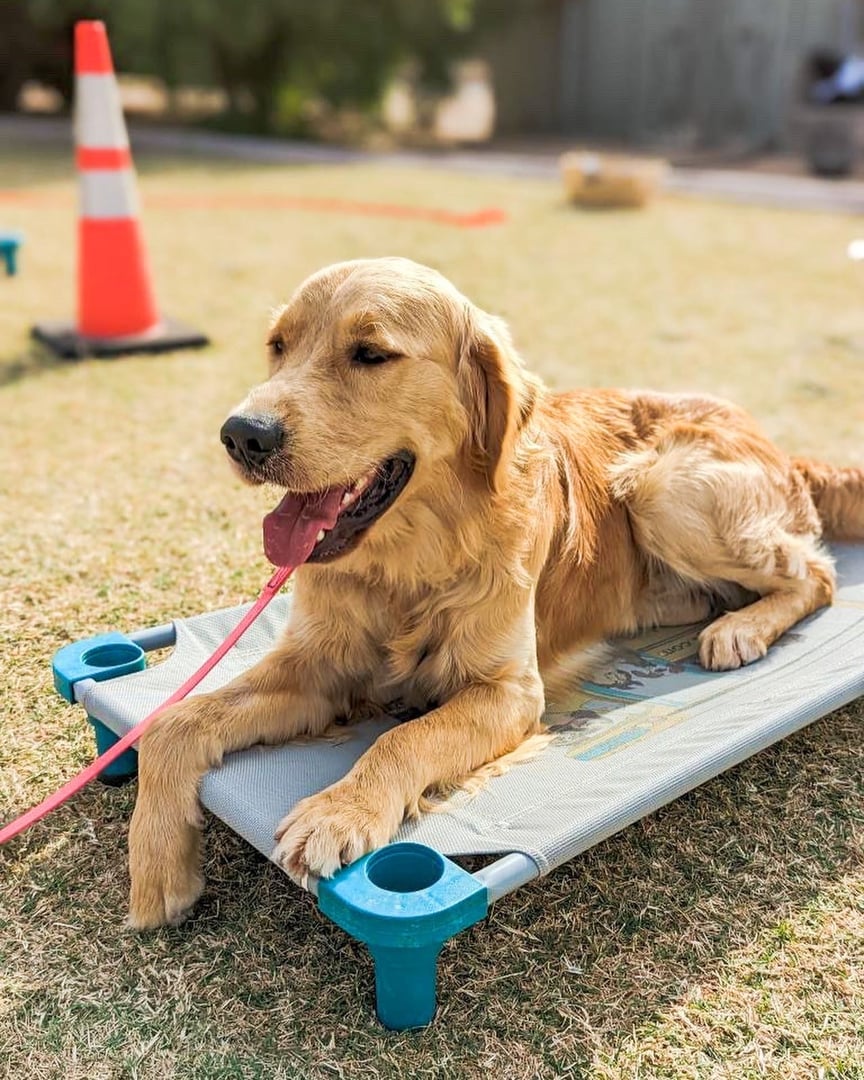
Start with a place: a mat far enough from the entry that your dog can see the door without reaching it. Teach a down-stay there with no guest involved, first for seconds, then for the length of a mail delivery. Basic obedience has to already exist too; a dog that will not sit or lie down on cue in a quiet kitchen will not do it with a stranger in the frame, and that foundation is what Foundation Camp and our group classes build first. A dog allowed to mob the door Tuesday and yanked back Saturday is managed like an employee whose boss changes the rules every shift: nothing sticks.
What is the slow, obedience-anchored way to introduce your dog to a guest?
A calm hello is built in stages, and skipping from a dog aware someone arrived straight to a dog being petted is where most greetings fall apart. Once place holds under mild distraction, the sequence looks like this:
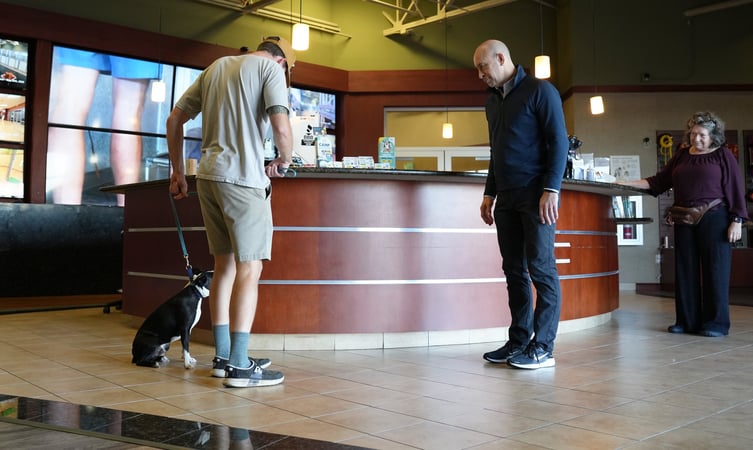
- The guest enters while your dog is on leash or settled in its spot, away from the threshold.
- The guest ignores the dog completely: no baby talk, no eye contact, no reaching down.
- You wait for your dog to settle, four feet on the floor and normal breathing, before releasing it.
- Only then does the guest crouch sideways, never looming over the head, and let the dog approach.
- Contact stays brief, a few seconds of calm attention, then the dog returns to place.
- For a nervous or reactive dog, repeat at a distance it can handle, closing the gap across visits.
Families usually skip that last step because it feels rude to keep a dog across the room with a guest standing right there. It is worth the awkwardness. Prada, an American Bully who came through Foundation Camp reactive to strangers and prone to jumping on greeting, is a documented Partners Dogs success story: by the end of her stay she was steadier at the door, greeting with four paws on the floor instead of jumping.
When should you read the room and remove your dog instead of forcing it?
Not every dog is a candidate for greeting practice on a given day, and pretending otherwise is how a nervous dog ends up in a bad moment. Watch for these stress signals: whale eye, a frozen stillness, lip licking with no food around, a tucked tail, or a low growl. None of that is a dog being difficult; it is a dog telling you it is over threshold, and a dog over threshold just survives the moment.
When you see those signs, the right move is less exposure, not more: walk your dog to a back bedroom, behind a baby gate, or into a crate before the guest is through the door. That is not a training failure; it is read-the-room advocacy for a dog that cannot advocate for itself. A dog that already growls, snaps, or carries a bite history around visitors needs more than practice: that belongs in structured work like Behavior Camp, where a trainer builds the desensitization ladder your dog needs. Our fear-aggression behavior guide covers these signals further.
What should your guests do, and what is your job during the greeting?
Your dog is reading your guest's body language and your own nervous system at once, so both sides of the doorway have a job. Coach guests before they knock, not after: no crouching over the dog's head, no reaching for a pat before the dog offers itself, no high-pitched voice that winds a nervous dog up further. A guest who stands sideways, keeps hands low, and waits does more in ten seconds than an hour of after-the-fact correction.
Your job is the leash, the release timing, and your own tension. Dogs read a tight leash and a held breath as confirmation something is wrong; a handler who breathes normally and rewards the calm moment gives the dog something steadier to copy. If jumping is the only piece left, our same-day leash and station fix covers that, and if the issue reads more like fear of unfamiliar people, telling stranger reactivity apart from over-arousal is worth reading next.
When does guest reactivity become a job for board-and-train in North Scottsdale?
A dog that startles at the doorbell is a manners problem; a dog that lunges, snaps, or shuts down hard at every visitor is a different job entirely. For families in Grayhawk, DC Ranch, and Troon, that job is aggression rehab, not a weekend of practice, and Behavior Camp is the board-and-train built for it: a structured stay at our Scottsdale or Cave Creek campus working territorial aggression, fear-based reactivity, and resource guarding under trainers who see this pattern constantly.
Thor, a Cane Corso documented in our success stories, came in reactive to strangers with prey drive layered on top of it; over the stay his trainer built and repeated a handoff protocol so a controlled introduction would hold with a different handler, not just the trainer who built it. That is what board-and-train buys over an article: repetition, supervision, and a trainer catching the moment before a dog tips over threshold. Behavior Camp's intake stays close to open, guest-reactivity cases included, even when a bite already shows up in the dog's history.
Get specific help
See if your dog needs Behavior Camp, not just more practice
If your dog’s reaction to guests includes growling, snapping, or shutting down in fear, the protocol above will not fix it alone. Behavior Camp is our board-and-train for reactive dogs across North Scottsdale and Cave Creek. Current pricing is on our pricing page.
Frequently Asked Questions
Do I need special equipment before I start practicing guest greetings?
A place mat and a proper flat leash are worth having first, plus a collar or harness that will not slip. Current gear options are on our shop page.
How many practice visits does it take before a nervous dog settles at the door?
There is no fixed number, and any answer promising one is guessing. Some dogs settle within a handful of visits; a dog with real fear of strangers can take weeks of short, controlled reps.
Is it reasonable to ask guests to ignore my dog on arrival?
Yes, and most guests are relieved to hear a simple instruction instead of guessing: give her a minute and do not reach down right away.
What if I am the only adult home to manage both the door and the dog?
Set the dog up before you open the door, not during it. A leash looped over a doorknob, or a dog already on place with release cued to one word, gives you one task instead of two.
Does a dog that only barks need the same protocol as one that lunges or nips?
The place-and-release structure is the starting point either way, but a dog that lunges or has nipped needs a slower pace and often a muzzle-conditioned safety net.
“If I am planning to have people in my home, I can have Huxley stay in a ‘place’ command or have him go to his crate (which NEVER would have happened before).”Jessica S., Cave Creek
Keep reading