
In short
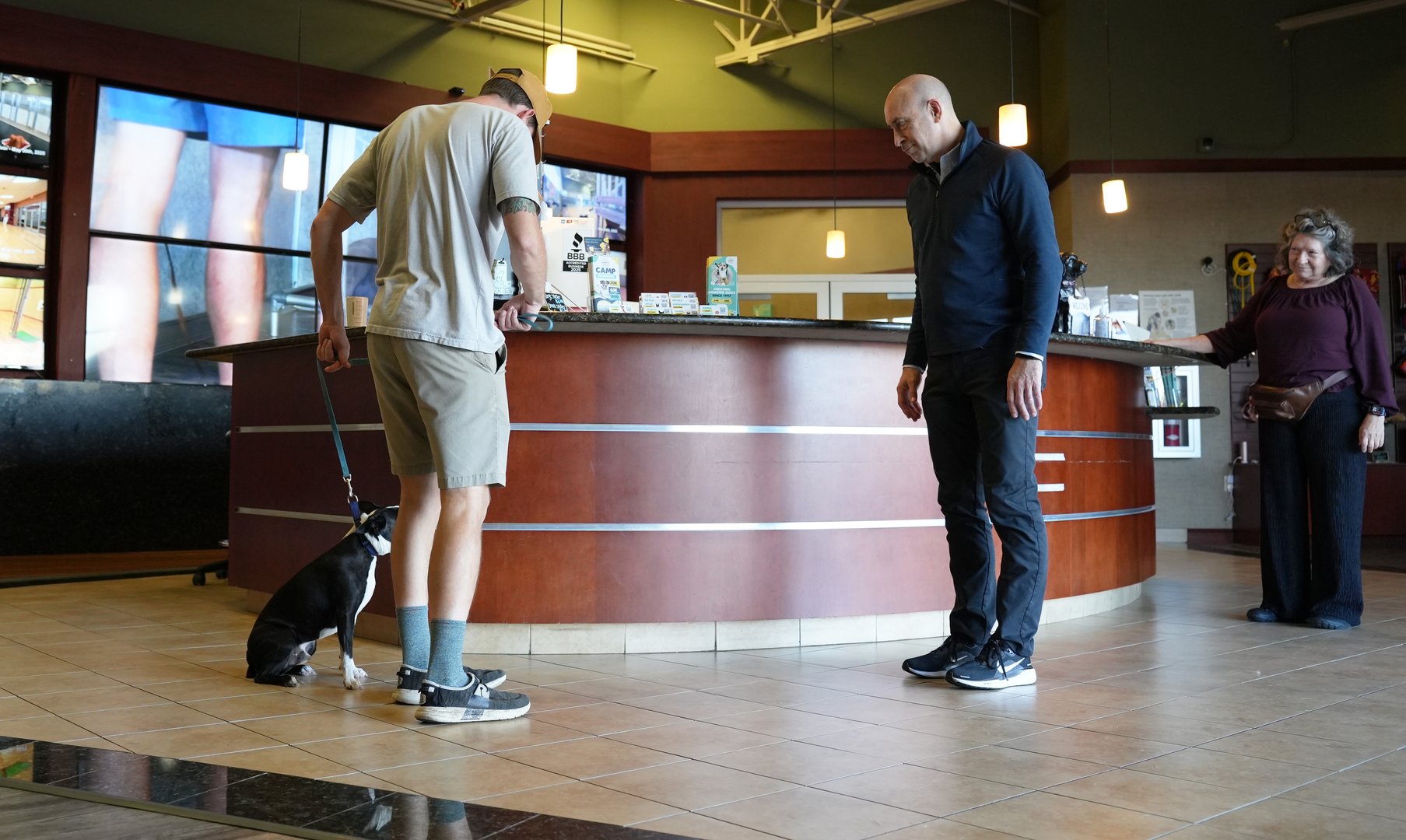
To stop a dog from jumping on guests, manage the first thirty seconds of every arrival today (leash on, a station or gate, guests who wait for the release) while you teach a sit or place-cot greeting your dog can hold, then proof that greeting against unfamiliar guests, kids, and delivery drivers until it becomes automatic. Jumping is an arousal and reinforcement problem, not a dominance problem, so the fix is rewarding a calmer behavior on repeat, not punishing a dog for being happy to see people.
This guide walks through the whole fix in order: the management steps to use today, the trained greeting to build over the next few weeks, and the proofing that makes it hold up with guests, kids, and delivery drivers. Jump to whichever stage matches where you and your dog are right now, whether that means stopping tonight's jump or polishing a greeting that already mostly works.
Why Do Dogs Jump on Guests?
Almost every Scottsdale or Cave Creek family who calls us about a jumping dog tells a version of the same story. The dog is not aggressive or defensive, just thrilled: that joy turns into knees on drinks, muddy paws on a kid's shirt, and an owner apologizing at the door before the guest is even inside. If you are searching for how to stop dog jumping on people, the first thing worth knowing is what jumping is, because the wrong theory leads to the wrong fix.
Jumping is an arousal behavior with a reinforcement history behind it, not a dominance display. A dog jumps, gets a face full of attention, even a raised voice or a shove counts as attention to an aroused dog, and learns that jumping is what starts the interaction. Every version of that pattern is covered in more depth in our jumping on people guide, but the short version is this: the dog is not testing who is in charge. The dog has simply been rewarded, thousands of times, for launching at people the second they walk in.
This is why "just ignore it" so often fails on its own. Ignoring only works when nothing else in the room reinforces the jump, and a living room full of guests rarely holds to that standard. A laughing kid, a guest who says "oh it's fine," or even a second person walking in mid-correction is enough reinforcement to keep the behavior alive. Ignoring is a legitimate tool, but it needs a plan around it, not a wish that it works in isolation.
The Same-Day Fix: Leash, Station, and a Gated Entry
Before any training holds up at the door, you need a way to get through today's doorbell without a repeat of yesterday's. Management is not a training method, it is the guardrail that keeps the next thirty seconds from reinforcing the exact behavior you are trying to remove. None of this requires new equipment beyond a leash and a gate, and it works the same evening you start it.
- Leash on before the door opens. Clip the leash the moment you know someone is arriving, even indoors. A leash does not fix the jump, it gives you a way to prevent it from being practiced.
- A station or a gated buffer. A baby gate, an exercise pen, or a separate room gives your dog physical distance from the door while the greeting is loud and unpredictable. This is management, not punishment: the goal is to remove the setup for failure, not to isolate the dog as a consequence.
- Guests wait for the release. Ask arriving guests to stand still and ignore the dog, no petting, no baby talk, until you say it is okay. A guest who crouches down and says "hi puppy" the second the door opens undoes a week of practice in one visit.
- Treats staged at the door. Keep a jar of high-value treats within reach of the entry so you can mark and reward the instant your dog offers four feet on the floor, rather than fumbling to the kitchen while the moment passes.
A gated entry does double duty here. The same barrier that buys you time to manage a jump also closes the gap that lets a dog shoot out an open door, the pattern covered in our door bolting guide. If your dog does both, mobs guests and tries to slip past them into the yard or street, treat the gate as non-negotiable until both behaviors are further along.
How to Teach a Greeting Your Dog Can Hold
Management buys time. It does not teach your dog a new answer to "someone is at the door," and that is where actual training starts. The goal is a specific, practiced behavior (usually a sit) that holds up when the room is loud and full of new people, not just in a quiet kitchen with no distractions.
Start away from the door entirely. Practice a rock-solid sit or down with a release word in a low-distraction room, then slowly raise the difficulty: a knock on a table, then a knock on the wall, then the actual doorbell sound played from a phone, rewarding calm each step before moving closer to the moment itself. This is the Teaching stage, building the skill in isolation before asking for it under pressure. Reinforcing comes next, practicing that same sit with a known, low-key visitor like a neighbor or a family member who is willing to run the drill slowly with you a dozen times in a week rather than once.
If your dog is generally wound up around people even outside of greetings, work through our overexcitement guide alongside this one. A dog who cannot settle in general will struggle to hold a greeting sit specifically, and the two issues usually improve together. For families who want a trained eye on where their dog stands before building a plan, a PD360 Assessment gives you that starting point in a single session rather than guessing.
Using a Place Cot to Make Calm the Default
For a lot of dogs, a sit at the door is a hard ask when the room is loud and full of new smells. A dedicated place cot, a raised bed your dog is taught to go to and hold until released, gives a jumpy dog a job to do instead of a command to resist. "Place" is easier to hold under excitement than "sit" because it is a location, not a posture, and a dog on a cot several feet from the door has physical distance built into the behavior itself.
Teach place the same way you teach the greeting sit: build the skill with no distraction first, reward generously for staying put, and only then start layering in everyday triggers like a knock or an opening door. Once your dog reliably goes to their cot on cue in a quiet house, move the cot within sight of the entry and practice sending them there before you open the door, rather than after the jumping has already started. Over time, the cot becomes the default answer to "someone is here," the same way a leash becomes the default answer to "we are going for a walk."
Next step
Get a trained read on where your dog stands
A PD360 Assessment gives you a straight answer on whether a greeting sit, a place cot, or more structured coaching is the fastest path to calm arrivals, and the fee credits toward same-day camp enrollment if you decide to start right away.
Proofing the Greeting Against Guests, Kids, and Delivery Drivers
A greeting that only holds up with your calmest friend has not been tested yet. Proofing means testing the behavior against the actual chaos it needs to survive: a stranger, a kid who wants to hug the dog immediately, a delivery driver who knocks and leaves without ever coming inside. This is the stage most families skip, and it is the reason a dog who "does great with grandma" still mobs the mail carrier.
Build proofing in layers rather than jumping straight to the hardest case:
- Known adults first. Neighbors or friends who will follow your instructions and wait for the release cue.
- Kids next, with adult supervision on both ends. Coach the visiting child the same way you coach an adult guest: stand still, no crouching, wait for the dog to settle before saying hello.
- Unpredictable arrivals last. A knock-and-leave delivery, a doorbell rung by a stranger, a group of trick-or-treaters. These do not offer the slow, cooperative pace a trained friend does, so run them only once the greeting is solid with people who are working with you.
Keep the leash and the gate in play during this whole stage, even after your dog looks reliable. A dog who has never bolted through an open door for a delivery driver can still try it the first time an unfamiliar arrival catches them off guard, which is exactly the failure mode covered in our door bolting guide above. Removing the safety net too early is the single most common reason a "trained" greeting falls apart the first time it meets a stranger.
Big Dogs, Small Kids, and Older Relatives: The Safety Line
Not every jumping dog is the same risk. Size and strength change the math, and a training plan that is a minor annoyance with a twenty-pound dog can knock over a toddler or an older relative with unsteady balance. Factor this in before you commit to a training-only timeline.
A few situations where management should stay in place longer than usual, or where you should bring in professional help rather than trial-and-error at home:
- Large or strong-breed dogs greeting small children. Even a well-meaning jump can knock a child down. Keep the gate or leash as the default around kids until the greeting is fully proofed, not just improving.
- Dogs greeting elderly relatives. A jump that a healthy adult shrugs off can knock over someone with balance issues. Manage this pairing directly rather than hoping the dog reads the room.
- Multiple dogs jumping as a pack. One dog jumping is a training problem. Two or three dogs mobbing a guest at once is a management problem first, since the dogs are also feeding off each other's excitement.
If your household fits any of these and progress feels slow or physically risky to manage alone, one-on-one Private Lessons build the plan around your situation: your dog, your guests, and your home layout, not a generic script. Partners Dogs holds 4.8 stars across more than 2,000 client reviews, including plenty from families who worked through this exact jumping problem; you can read those client reviews before you book anything.
Where Group Classes and Foundation Camp Fit In
Everything above works at home, and plenty of families get there with consistency alone. But a jumping problem is, underneath it, an impulse-control and default-behavior problem, and both respond well to structured practice around everyday distraction. Weekly Group Classes give your dog scheduled reps at holding a sit or a place around other dogs and unfamiliar people, the same kind of controlled chaos a guest brings through your front door.
If you would rather hand the foundation work to instructors entirely, or if the jumping is one symptom of a dog who needs a broader obedience reset, Foundation Camp (our 14-night board and train) is worth a look. It builds the sit, the place, and the impulse control from the ground up in a structured environment, then hands you the tools to maintain it at home. Not sure which path fits your dog and your schedule? The quick program quiz is a fast, no-pressure way to see where to start.
Whichever route you choose, the same four stages apply: Teaching the behavior in isolation, Reinforcing it with familiar people, Proofing it against unpredictable arrivals, and Maintenance, the ongoing practice that keeps a trained greeting from quietly fading once the excitement of "we finally fixed it" wears off.
Frequently asked questions
Why does my dog still jump on guests even after I tell them not to?
Because a verbal correction alone does not remove the reward the dog gets from jumping, and it often adds attention on top of it. A dog needs a trained, rewarded alternative behavior, like a sit or a place cot, plus management that prevents the jump from being practiced in the first place. Correction without a replacement behavior tends to produce a dog who is confused or anxious at the door rather than one who greets calmly.
Is jumping a sign my dog thinks they are dominant?
No. Jumping is an arousal and reinforcement behavior, not a dominance display. Dogs jump because it has worked in the past to get attention, and the fix is rewarding a calmer greeting behavior on repeat rather than trying to establish rank at the front door.
How long does it take to stop a dog from jumping on guests?
Most families see the greeting sit or place hold up with familiar people within a couple of weeks of daily practice. Proofing it against unfamiliar guests, kids, and delivery drivers usually takes longer, since each new type of arrival is its own round of practice. Consistency in the management steps between training sessions matters more than any single session.
What if my dog only jumps on certain people, like kids or new guests?
That is common and usually points to arousal level rather than a different behavior entirely. Kids move unpredictably and get more excited themselves, which raises a dog's arousal faster than a calm adult does. Higher-arousal visitors (kids, strangers, other excited guests) count as a harder proofing step, so keep the leash or gate in place around them longer than you do with calmer visitors.
Should I use a place cot or just teach a sit for greetings?
Both work, and many households end up using each in different situations. A sit is faster to ask for and works well close to the guest once your dog is calm. A place cot is often easier for an excitable dog to hold because it puts physical distance between the dog and the door and gives the dog a location to settle into rather than just a posture to maintain.
My dog is too big and strong for me to manage during greetings. What should I do?
Lean on management, a leash and a gate, more heavily and for longer while you work on training, especially around children or older relatives. If handling your dog safely during greetings feels physically difficult on your own, one-on-one Private Lessons let a trainer build a plan around your dog's specific size and strength rather than a generic approach.
Ready for calmer arrivals
Build a greeting that holds up when guests show up
Foundation Camp builds the sit, the place, and the impulse control your dog needs to greet people calmly, then hands you the tools to keep it that way at home.
Keep reading
/Programs/Transform%20Camp/Safer%20home%20(1).jpeg?width=800&height=450&name=Safer%20home%20(1).jpeg)