Our position
Choose a private lesson when the behavior is isolated and needs focused reps without an audience, and choose a group class when the dog is social and the behavior only shows up around distraction and other dogs.
A family from Tempe pulls into the Scottsdale campus for a PD360 Assessment with a two-year-old Labrador who is easy in every way except one: he throws his whole body at anyone who walks through the door. He is not aggressive, not fearful, not reactive to other dogs on leash. He is thrilled to see people, and that single behavior is the only thing the family wants fixed. The trainer does not open with a program brochure; she asks a narrower question: does this dog need practice around distraction, or does he need someone to isolate the greeting and drill it until it holds. Fifty-plus trainers across both campuses run that triage on intake day, holding roughly a 1:10 ratio in every class.
Most families searching for help with one behavior problem get sold a full program before anyone asks what the dog's day looks like. This piece answers the narrower question: which format fixes one behavior, and how to tell which one your dog needs.
"Chase came to do a private lesson today. He pointed out so many Small things I can change that are going to make a big difference." Virginia C., Scottsdale.
The real fork is distraction versus repetition, not how serious the behavior looks
The deciding factor is not how serious the behavior looks; it is whether the behavior needs distraction to show up or needs focused repetition to fade. A dog who jumps on every visitor because he is overjoyed has a social, arousal-driven habit; a quiet room never tests the trigger, another body walking toward him. A dog who pulls the same way in the driveway, on the trail, and in the parking lot has a mechanical habit that shows up whether or not anyone else is around.
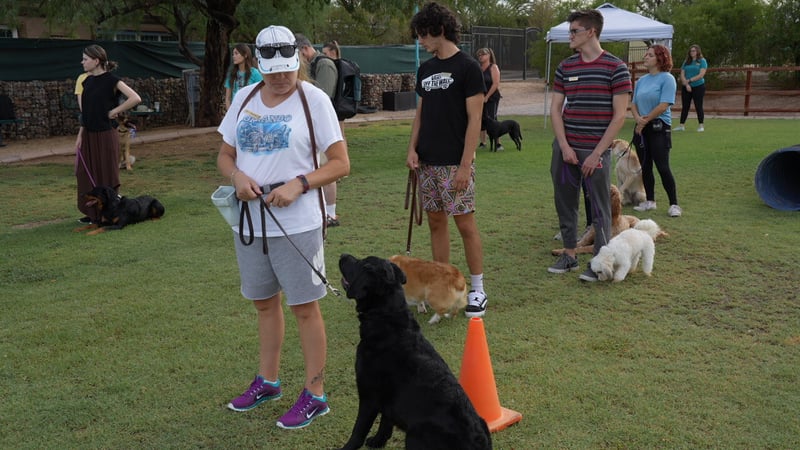
Group classes are built around controlled distraction, the right tool when a behavior needs that environment to be trained honestly. A private lesson is built around undivided attention: one trainer, one dog, a curriculum built around one goal. Neither format is a lesser version of the other.
A group class fits a dog that jumps on people out of excitement
Yes: when the dog is genuinely social and the jumping is fueled by other dogs and new people being nearby, a group class gives the distraction-proofing reps a quiet private session cannot. A social dog who jumps because greetings are the most exciting five seconds of his day needs to practice holding position while other dogs pass and a stranger crouches down. That is the environment a group class builds on purpose, raising distraction as the dog earns it.
The same principle shows up in board-and-train work, just compressed. In the Foundation Camp story of Odin, a Pitbull mix, jumping on people was a primary concern at intake, made worse by a smaller dog in the home who jumped and got away with it. Odin's plan paired leash handling with socialization and structured group exposure, the same logic a group class applies over more sessions.
A group class is not the right call for a dog whose jumping comes with a bite history or genuine fear behind it; that belongs in a private lesson first.
A private lesson fits a dog that pulls the same way every walk
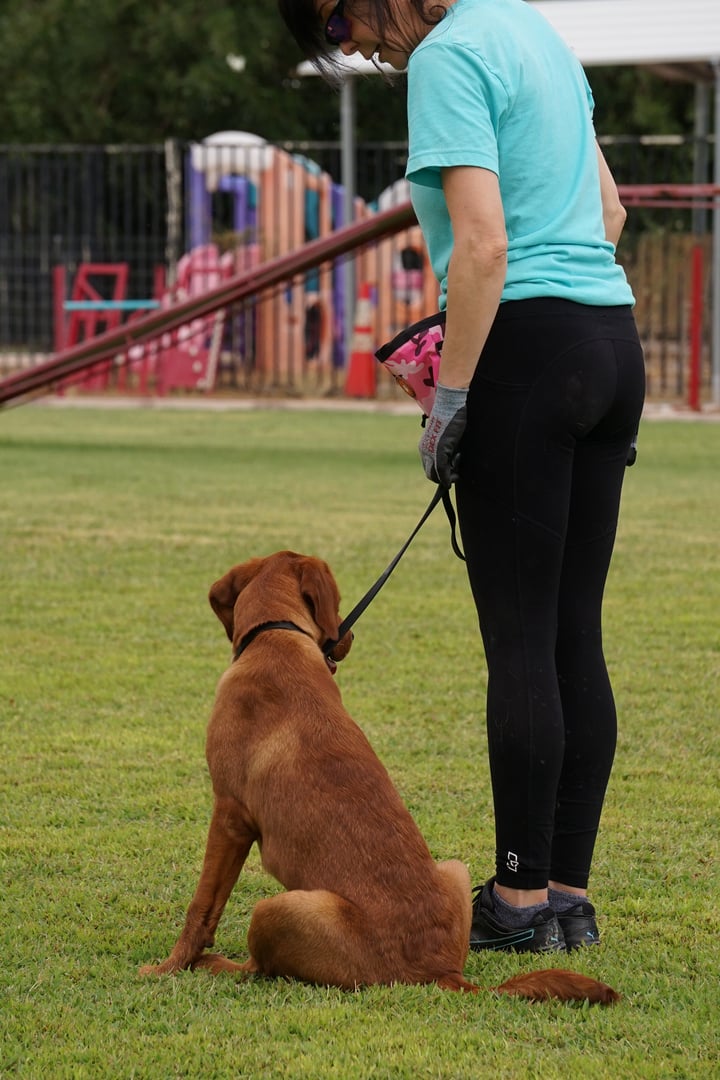
Yes: leash pulling is a mechanical habit between one dog and one handler, and a private lesson lets the trainer isolate exactly where the handler's timing breaks down without a class full of other leashes to manage. Pulling needs no crowd; it needs a leash and a destination. A trainer running a private lesson watches the handler's hand and the dog's shoulder the instant before he leans in, then corrects that rep, timing a twelve-dog class cannot offer.
Private lessons also fit a dog whose pulling worsens around other leashed dogs. If it turns into full reactivity near another dog, see our guide on loose leash walking mechanics and leash reactivity first.
| Behavior pattern | Better starting format | Why | Next step if it does not resolve |
|---|---|---|---|
| Jumping on people, social and excitement-driven | Group class | Needs distraction to prove the fix holds | A private lesson to isolate the greeting before rejoining class |
| Leash pulling, same pattern every walk | Private lesson | Mechanical habit; needs focused, corrected reps | Group class once the mechanics hold, to proof it around other dogs |
| Jumping or pulling layered with a bite history or fear | Private lesson, then a full evaluation | A room full of dogs is not a safe first test for a reactivity-adjacent problem | A PD360 Assessment to score beyond the one symptom |
| Behavior only appears with other dogs present | Group class | The trigger is social context, which a quiet private session cannot recreate | A behavior-specific evaluation if progress stalls |
Make it concrete
Not sure which format your dog needs
If the trigger behind the behavior is not obvious yet, a PD360 Assessment scores it directly instead of guessing between a class and a lesson. The result tells you which format to book first.
How fast does each format change one behavior?
Neither format has a fixed timeline, because speed depends on repetition count, not calendar weeks; a private lesson can bank dozens of focused reps in one session, while a group class spreads fewer reps across more variety. A one-hour private lesson dedicated to one routine can run the same correction ten or fifteen times, with the trainer adjusting technique after each rep. A weekly group class gives a dog maybe three or four turns at that week's skill.
A private lesson compresses reps into less time and more control. A group class trades rep density for something a private session cannot manufacture: a room of other dogs and handlers, the environment that proves a distraction-driven behavior is fixed.
What's the best dog training option for one behavior problem in Tempe or Chandler?
The best option for a Tempe or Chandler family is whichever format matches the behavior's trigger, not whichever is closer to home. Families from Tempe and Chandler already drive to Scottsdale or Cave Creek for camps and PD360 Assessments; the question is not distance, it is whether one destination offers both formats under one trainer's eye.
A Chandler family with a socially excitable dog gets more from a weekly group class. A Tempe family whose problem is mechanical, like pulling toward every smell, gets more from a focused private lesson.
How much does it cost to fix one behavior with a group class or private lesson from Tempe or Chandler?
Current rates are posted on the pricing page rather than restated here (in-school, in-home, and online private lessons all price differently, and a stale number in a blog post is worse than none). A private lesson is priced per session; a group class is priced as part of an ongoing weekly series. Comparing one against the other without weighing that difference compares two different products, not two prices for the same product.
Is it worth driving from Tempe or Chandler for a private lesson instead of a local group class?
It is worth the drive when the behavior is isolated and a nearer group class cannot offer the same focused, one-on-one correction timing; it is not worth the drive when a local group class already gives the dog the distraction practice it needs. A family whose dog's only issue is jumping on guests, and who is otherwise social and easygoing, may find plenty of value in a well-run class closer to home. A family whose issue is a stubborn leash-pulling habit may find the drive worth it, because a private lesson delivers undivided attention on that mechanic.
The honest test is whether the local option was built by trainers, not a franchise running a generic script. Our guide on why dogs still pull and jump after training covers the usual reason a cheaper option leaves it unresolved.
Reactivity and bite history change the starting format
A dog should start in private lessons first, then move into a group class, when the single behavior comes bundled with something a room full of dogs cannot safely test on day one: reactivity, fear, or a bite history. A dog with a documented history of snapping at strangers should never test that behavior first in a class of twelve dogs. Private lessons let a trainer confirm the behavior holds under mild pressure first.
A typical staged move runs in roughly this order:
- A private lesson, or a short series, isolates the behavior and confirms the dog can hold it with zero distraction.
- The behavior gets tested with mild, controlled distraction, still one-on-one.
- Only once the behavior holds under that mild pressure does the dog join a group class, where distraction finishes the job.
For a behavior tangled with resource guarding or territorial aggression, a PD360 Assessment is the right next step before either format, since it scores the dog across a full curriculum, not one symptom.
Key takeaways
Group classes fit social, distraction-driven behaviors. Private lessons fit isolated, mechanical behaviors and give a trainer undivided time on the exact rep that goes wrong. A dog with reactivity or a bite history starts in private lessons and moves into group class once the behavior holds under mild pressure. A PD360 Assessment is the right first step whenever more than one behavior is layered into the complaint.
Book your visit
Fix the one behavior with a lesson built around your dog
For an isolated, mechanical habit like leash pulling, a private lesson gets a trainer watching your dog's exact rep, on your schedule and at your home if that is easier. Families driving in from Tempe or Chandler can also book in-school if that fits the week better.
Frequently Asked Questions
Can a trainer move our dog from private lessons into a group class partway through the plan, or do we start over?
A trainer can move a dog from private lessons into a group class without starting over; skills built one-on-one carry into the group setting. The trainer confirms the behavior holds under mild distraction first, then places the dog at the class level matching where the lessons left off.
Is a private lesson still worth booking if only one person in the household can make it to every session?
Yes. A private lesson is built around the dog and whichever handler shows up, and that person leaves able to coach the rest of the household.
Does a rescue dog with an unknown history need private lessons instead of a group class for one behavior?
Not automatically. A rescue dog with no signs of reactivity or fear can start in a group class like any social dog; the deciding factor is the behavior's trigger, not the word rescue.
Is a private lesson or a group class the better fit for an older dog with one long-standing habit, not a puppy?
Age matters less than how long the habit has been rehearsed and what triggers it. A well-worn mechanical habit like counter surfing responds well to a private lesson; greeting-related distraction still benefits from a group class.
Does a single private lesson include any follow-up, or is it just the one visit?
A private lesson is its own session with a custom plan built around the dog's goal. Families can book additional sessions or move into a group class afterward; some behaviors resolve in one session, others need a short series.
Keep reading