In short
Online dog training lessons work well for homework review, mechanics correction, and follow-through after Foundation Camp, and current rates are on the pricing page, with the same trainers who teach on campus. They are the wrong tool for threshold reactivity, resource guarding, or any bite-risk case. Those still need a trainer physically in the room.
Families outside the Scottsdale, Cave Creek, North Phoenix, and East Valley service radius, or juggling a schedule that never lines up with a campus slot, tend to ask the same question before they book: is video coaching legitimate training, or the compromise you accept when the better option is not available. The answer splits by goal. Some of what a dog needs lands cleanly through a screen, and some of it does not, so pretending otherwise wastes the session, and the fee that comes with it.
Are Online Dog Training Lessons Worth It, or Just Cheaper?
The assumption is straightforward: a trainer on a screen must be a cheaper trainer. That assumption does not match how private lessons at Partners Dogs work. Online, in-school, and in-home sessions are staffed by the same trainers working from the same plan, with current rates for each format on the pricing page. Online is a delivery channel, not a separate curriculum: no drive time, no facility overhead, the same 30 to 45 minutes of live, one-on-one coaching.
Every plan, including the online track, starts with an in-person PD360 assessment, priced lower for a second dog, with current rates on the pricing page. The plan gets built around the dog in the room, not a template pulled off a shelf. Online is the delivery format, not a downgrade: the same trainers, the same plan, coached over video instead of in a training hall.
| Format | Best for | Where it happens |
|---|---|---|
| In-school | Fast skill-building with fewer distractions than home | Scottsdale or Cave Creek campus |
| In-home | Problems that only show up in your rooms, yard, or routine | Your home, within the service radius |
| Online | Homework review, mechanics, and follow-through outside the service radius | Live video, anywhere with a signal |
Current rates for every format, including the discount for a second dog, are on the pricing page.
What a Camera Catches That You Cannot See Yourself
Most owners cannot watch their own hands and their dog at the same time. A trainer on a video call can, and that is most of what the fee buys. A trainer watching live can catch the half-second where a cue, a hand, or a leash breaks the behavior down, the mistake most owners cannot see happening to themselves.
- A marker word, "yes" or a clicker, landing a beat late, so the dog gets rewarded for the wrong part of the movement.
- A hand drifting toward the treat pouch before the dog finishes the behavior, which teaches the dog to watch the hand instead of listening for the cue.
- Leash tension that tightens the instant before a reaction, which reads to the dog as permission rather than a correction.
- Body position crowding or blocking a dog without the owner noticing they are doing it.
- A setup with too much happening in the frame: kids, other pets, or open doors competing for the dog's attention.
Families describe this kind of correction landing within a session or two, whether the coaching happens on campus or over a screen.
"The time with her shows us how best to work with our dog, how to support him consistently, and what we are doing wrong and how to fix it."
That level of specific feedback is exactly what a private lesson session is built to catch.
Goals Video Coaching Handles Well
Video coaching earns its price on goals that live in mechanics and consistency rather than in a dog's nervous system. If the problem is timing, handling, or getting every person in the house cueing the same way, a camera sees enough to fix it.
- Homework review after Foundation Camp or a round of group classes, checking that the family is running cues the way the dog learned them.
- A dog who will not settle or listen around normal household activity, see building reliable listening in everyday life.
- Begging and pushy behavior at mealtimes, see stopping dog begging, which is almost entirely a family-consistency problem.
- Loose-leash mechanics indoors and in the yard, before the dog walks anywhere with real distractions.
- Place and settle work, and polishing obedience a dog already knows but performs inconsistently.
"She helped our issue of pulling on the leash and even worked on a few more things with us as well."
That is mechanics work, correctable once someone points out what the hands are doing wrong, and it travels fine over video.
Goals That Still Need a Trainer in the Room
Some goals cannot wait for a screen to catch up. Anything with real bite risk, or a dog who reacts before you can get a leash tight, needs a person who can physically manage the moment.
- Threshold reactivity toward people or dogs, where a trainer needs to control distance and timing in real time.
- Resource guarding or any case with a bite history, which routes through a PD360 assessment into Behavior Camp or Transform Camp rather than a private lesson plan.
- Muzzle conditioning or any handling that requires physical safety equipment.
- Off-leash recall training around live distractions such as joggers, loose dogs, or traffic, where a trainer in the environment can manage the risk a camera cannot.
- A dog who needs to be physically blocked, redirected, or removed from a situation rather than cued out of it.
None of this rules a family out of ever using online sessions. It rules out starting there. The same PD360 assessment mentioned above is what sorts a mechanics problem from a safety problem before anyone books the wrong format.
Match the format to the goal
See Which Lesson Format Fits Your Dog
A PD360 assessment scopes what your dog needs before anyone recommends a format. Most families land on private lessons, on campus, at home, or over video.
Setting Up a Session So the Hour Is Not Wasted
A trainer can only coach what the camera can see. Five minutes of setup before the call starts is worth more than an extra ten minutes of coaching once it is rolling.
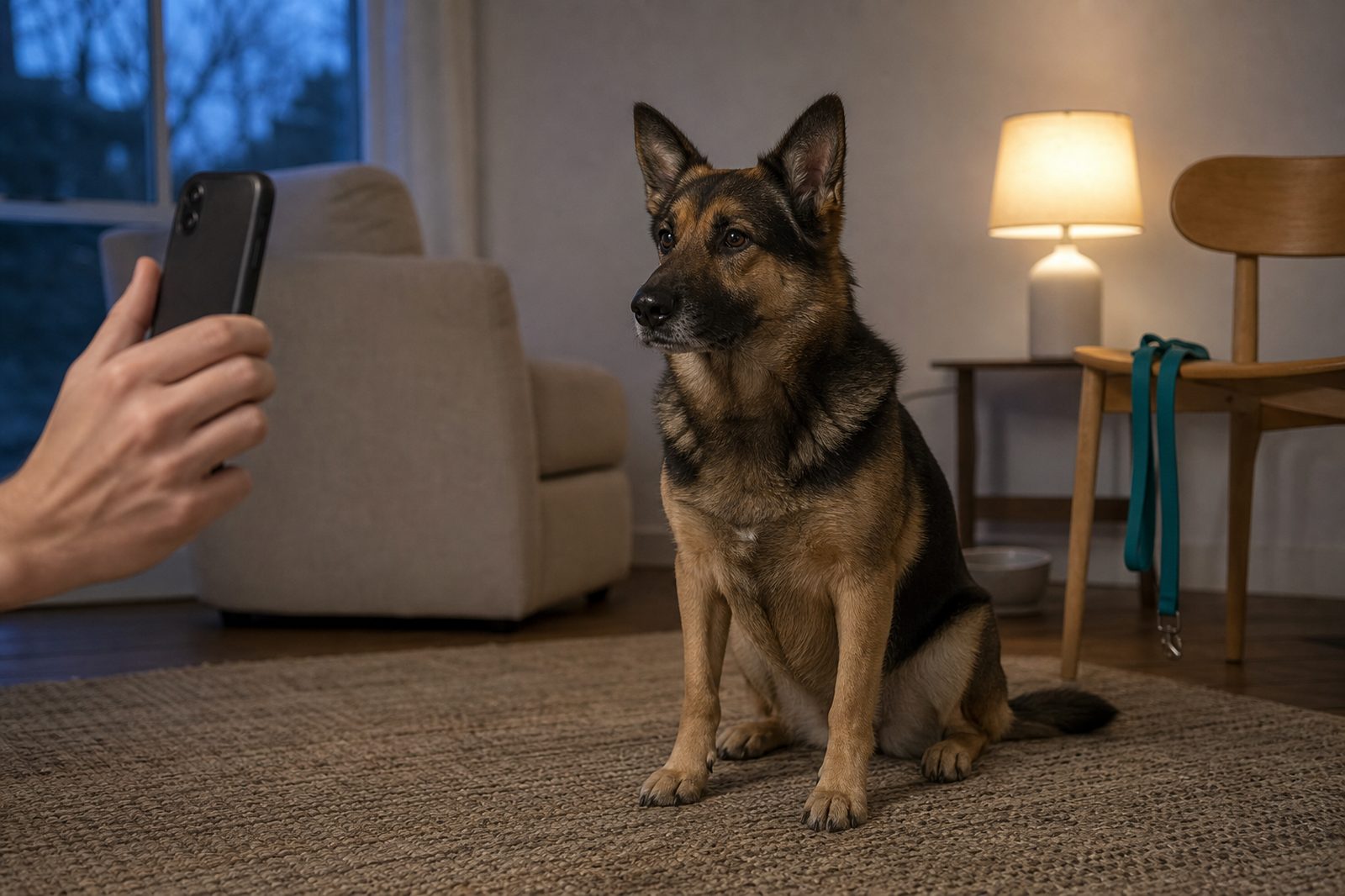
- Put the phone or laptop on a stand or lean it against something steady, not handheld, so the picture does not shake every time the dog moves.
- Frame the whole dog and enough floor around it to show leash, feet, and hands, not just a close-up of the dog's face.
- Run the session in the room or yard where the problem actually happens, not the quietest corner of the house.
- Have the leash, treats, marker word, and any tool already in hand before the call starts.
- Put one person on camera at a time so the trainer can coach one set of hands cleanly, then rotate to the next.
- Record the session, or ask the trainer to, so the homework demonstration is there to rewatch during the week.
When a Self-Paced Course Is Enough
A live session is not the only option, and it is not always the right one. If a dog has no safety concerns and the owner can already read what the dog's body is telling them, a self-paced video course may be all the structure the plan needs. A pre-recorded course fits a healthy adult dog polishing basic manners, a confident handler who wants a curriculum to follow rather than live correction, or a family testing the waters before spending anything further. What it cannot do is watch the specific dog in the specific room and flag the mistake nobody caught. The moment homework stalls two weeks running, or the same correction keeps not landing, that is the signal a live session is worth the price a recorded one cannot deliver.
For a dog that just needs practice around routine distraction rather than one-on-one correction, group classes stay the cheaper live option, structured and in person, without the per-session private lesson rate.
Holding Camp Gains After Handback
A dog comes home from Foundation Camp already knowing the skill. What comes home less certain is whether the family runs it the same way the trainer did for fourteen nights. The skills a dog builds in camp are only as durable as the coaching a family gets once the dog is back in the living room.
"We have been reinforcing skills that her learned at camp and we feel like he is so easy to redirect when zoomies kick in or if he is showing any defiant puppy behavior."
Online sessions cover the same ground: a trainer watches the family run the cues at home, catches where the routine has drifted from what camp taught, and resets it before a habit sets in the wrong direction.
Frequently Asked Questions
Are online dog training lessons worth it?
Yes, for homework review, mechanics correction, and keeping a family consistent after camp or group classes. Online sessions are staffed by the same trainers who teach on campus, with current rates on the pricing page, and every plan starts with an in-person PD360 assessment so the trainer knows what the dog needs before recommending a format.
What happens during an online dog training session?
A trainer joins a live video call and watches the dog work through the same drills used in person, correcting timing, handling, and setup in real time. The family leaves with specific homework to run before the next session, the same structure used in an in-school or in-home lesson.
Can online lessons help with leash reactivity or aggression?
Usually not as the first step. Serious reactivity, resource guarding, and any bite history are evaluated through a PD360 assessment and typically move into Behavior Camp or Transform Camp, where a trainer can manage the dog directly. Private lessons, online or otherwise, work well as the follow-up once that immersive work is done.
How much does an online dog training session cost compared to in-person?
Online sessions cost less than in-school sessions, which cost less than in-home sessions, and all three are staffed by the same trainers. Every plan starts with a PD360 assessment, priced lower for a second dog. Current rates for every format are on the pricing page.
Is a self-paced video course enough instead of live coaching?
For a healthy adult dog with no safety concerns and an owner who already reads dog body language well, a self-paced course can cover basic manners. Once homework stalls or the same mistake keeps repeating, a live session is worth the price difference because a trainer can see exactly where the mechanics are breaking down.
Can online sessions follow up after Foundation Camp or group classes?
Yes. Online sessions are commonly used to check homework, correct drift in a family's handling, and keep the skills a dog built in camp or class sharp, without a return trip to the Scottsdale or Cave Creek campus.
Book the format that fits
Start With the Assessment, Then Pick In-Person or Online
A PD360 assessment sets the plan, then most families book online sessions for homework review and hands-on formats for anything safety-related.
Keep reading