What to know
Four paws down is the whole rule. The 4 on the floor protocol withholds everything your dog wants the instant a single paw leaves the ground (attention, eye contact, leash slack, the door opening) and hands all of it back the instant all four paws return. Most families see the front door calm down within two to three weeks of consistent reps, longer if the jump has been rehearsed for years or if one household member keeps sneaking in a reward for it.
Is jumping just a sign your dog is happy to see you?
No, jumping is a habit your dog rehearses because it keeps working. The myth is comfortable: he is only excited, he loves people, he will grow out of it. What happens next is less flattering. At some point, jumping got your dog exactly what he wanted: a hand on his head, eye contact, someone bending down to meet him halfway. Dogs repeat what pays off. A puppy who gets attention for launching at your knees learns the same lesson an adolescent dog learns for launching at a stranger's chest, and by the time an overwhelmed new-dog family calls Partners Dogs, the habit has usually been paid in full a few hundred times already. That is not a character flaw. It is math.
What is the 4 on the floor protocol, and how does it work?
The 4 on the floor protocol is a greeting rule with one gate. Praise, a treat, the leash going slack, the front door opening: anything the dog wants during a greeting is available only when all four paws are on the ground, and disappears the instant one paw lifts. There is no scolding built into the base rule, only a gate that opens and closes based on paw position. Partners Dogs' PD360 Assessment scores greetings and the off cue separately from a plain sit or down, because a dog can already sit well in a quiet room and still fail the moment a stranger walks in with real energy. In our curriculum it moves through stages like every other skill: Teaching at home with no distraction, Reinforcing with familiar visitors who know the rule, Proofing at a real front door with a real doorbell, and Maintenance, the occasional slip corrected the same day instead of ignored for a month.
At the exact moment your dog jumps, do you wait or correct?
It depends on where your dog is starting from, not on one rule that fits every dog. For a puppy or a dog on rep one, waiting is usually the right first move, and it is where this whole method starts. Turn away, say nothing, and mark the instant paws return to the floor. That reward-based timing is where almost every dog should begin, and it builds the relationship the rest of the training rides on. The trouble shows up with a dog whose jumping has already been rehearsed for months or years, especially in a busy household where someone always breaks and pets him anyway. Withholding a reward stops working as fast once the behavior is self-reinforcing, because the dog still gets the payoff (the contact, the chaos) even when you hold your ground. That is where a calm, fair, well-timed correction closes the loop faster than silence alone. It is worth being honest that a hands-off plan is not free of consequences either, ignoring a jump is itself a form of withholding, just a slower one. The exact tool and timing get calibrated per dog, which is what a PD360 Assessment or a private lesson is for, not a call to make from a blog post. Our full approach to that balance is laid out on our methodology page.
What are the exact steps to run four on the floor at home?
Seven small, repeatable moves build the whole habit. None of them requires special equipment beyond a leash, and all of them are meant to be run in short, boring reps rather than one dramatic session.
- Leash your dog before the door opens, not after. A leash in hand means you control access to the visitor instead of negotiating with a dog already airborne.
- Brief any visitor before they walk in. Ask them to ignore all four paws leaving the ground, no eye contact, no hands, until you say otherwise.
- Mark the exact instant all four paws touch down. A calm word or a clicker at the moment of landing teaches which position pays, not which mood pays.
- Deliver the reward at floor level, not at chest height. A treat lifted near your dog's face pulls his front end up with it and undoes the rep.
- Ask for a two-second sit before any contact happens. That buffer matters most with dogs who launch again the second a hand appears.
- Run real reps, not just drills. Practice with an actual doorbell or an actual friend arriving; a dog who only rehearses with quiet family members has not actually proofed anything.
- Fold in the furniture rule between door reps. Paws-off-the-couch-unless-invited uses the same logic as paws-down-for-attention, and running both rules the same week keeps the dog from treating one room as an exception.
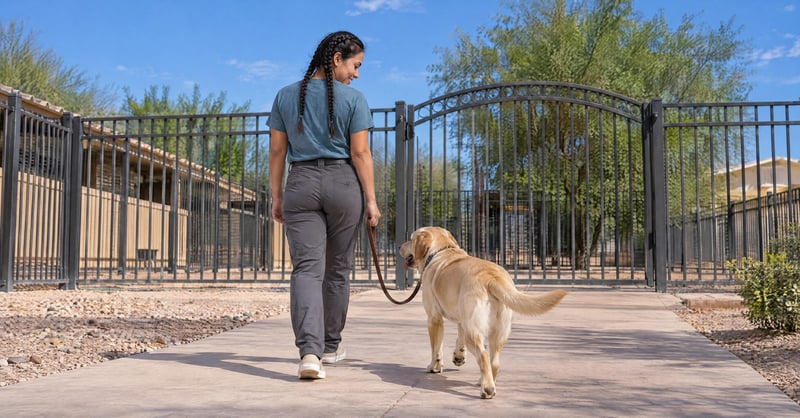
Arizona adds one wrinkle worth planning around. Maricopa County's leash law caps leashes at six feet the moment you step off your own property, so the outdoor version of this protocol, greeting a neighbor near a Paradise Valley wash or trailhead, should be practiced on a short leash from day one.
Your first step is small
Know where this skill fits next
Four on the floor works best alongside real dogs, real strangers, and a trainer watching your timing, not just your dog's. Group Classes build greeting reps into the curriculum from the first session, with current schedules and rates on the pricing page.
Why does rewarding excited jumping make the greeting worse over time?
Because an occasional reward is more addictive than a consistent one. A dog rewarded for jumping every time eventually stops trying once the reward stops coming. A dog rewarded only sometimes (one visitor pets him, the next ignores him, grandma always caves) learns to try harder and longer, because the payoff might still be one more jump away. That is the trap most families fall into without meaning to: one person runs a clean four-on-the-floor rule while another can't resist petting an excited dog, and the inconsistent schedule keeps the habit alive longer than a plan that never worked at all would have. The furniture connection matters here too. A dog who launches onto the couch the moment you sit down is rehearsing the same launch-for-contact pattern he uses at the door, and undoing one without the other leaves a loophole he will find. Families who get this right describe the same shift. One Partners Dogs review put it plainly: “He came home with better manners and over all was just a calmer more reasonable pup.” That is from Katie C., Cave Creek.
What is the best puppy training in Paradise Valley for a dog that mobs the door?
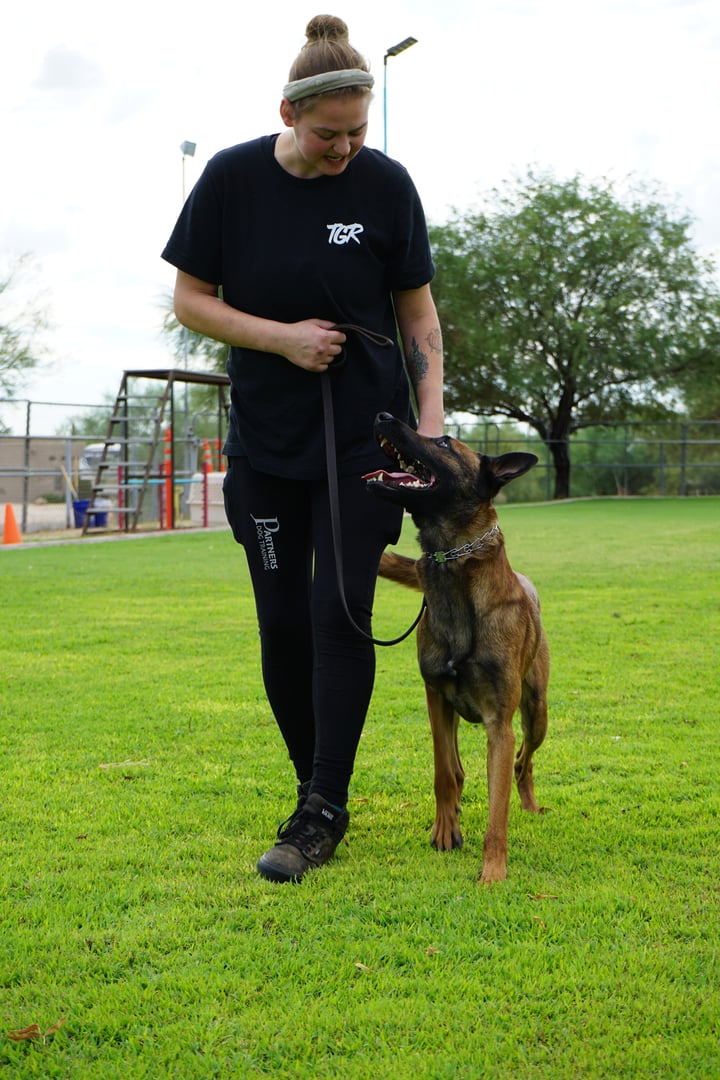
The best option is one that runs real greeting reps with real strangers, not just drills in an empty room. Paradise Valley families tucked between Camelback Mountain and the McDowell Mountains are close enough to both Partners Dogs campuses that a weekly class beats a once-a-month drive, and greetings are exactly the skill that falls apart without repetition. A puppy curriculum that only covers sit, down, and loose leash walking but never stages an actual doorbell moment is teaching half the picture. Ours puts new dogs, new people, and a little manufactured chaos in front of your dog on purpose, with a trainer close enough to catch the moment before it turns into a habit.
Are group classes near the 85253 zip enough on their own?
For most young or lightly rehearsed jumpers, yes. For a habit running for years or across multiple dogs in one house, usually not by themselves. Group classes near the 85253 zip give a dog structured reps with unfamiliar people and dogs under supervision, the single hardest environment to fake at home. But a jumping habit that has had years to set, especially with more than one dog reinforcing each other, sometimes needs more density of practice than one class a week supplies. Odin, a Pitbull mix whose owner named jumping as the primary concern going into Odin's Foundation Camp, is a case in point. His jumping was made worse at home by a smaller dog who jumped and got away with it, and his trainers made jumping the intake priority from day one, with structured dog-to-dog socialization added in week two as his handling improved. That is why our team sometimes recommends a camp or a run of private lessons first, with group classes carrying the skill forward afterward. See the jumping on people behavior page for how we score and stage this problem across every program.
Key takeaways
Four paws on the floor is the only position that earns a reward. PD360 scores greetings and the off cue separately from a plain sit, so training one does not automatically fix the other. An occasional, inconsistent reward keeps a jumping habit alive longer than one given every time. The furniture rule and the front-door rule are the same rule in two rooms. Group classes build real-stranger reps well, but a habit rehearsed for years, especially with more than one dog in the house, often needs the added density of a camp or private lessons first.
Frequently Asked Questions
Does the 4 on the floor protocol work for adult dogs, or only puppies?
It works for both, though the timeline differs. A puppy on rep one typically settles into the rule within a couple of weeks. An adult dog with years of rehearsed jumping can learn the same rule, it just takes more reps and more consistent follow-through from every person in the house.
What is the best puppy training option in the 85253 zip code for a dog that jumps on guests?
Look for a program close enough to attend weekly, since greetings are a repetition skill that degrades between long gaps, and one that stages real strangers and doorbell moments rather than only quiet-room obedience. Families in the 85253 zip are within easy reach of both the Scottsdale and Cave Creek campuses, with current schedules and rates on the pricing page.
Is puppy training in Paradise Valley too busy to book during peak season?
Group class sizes stay set to keep the trainer-to-dog ratio workable, so a popular season means a short wait for the next open slot, not a crowded room once you are in it. Calling ahead for the next available session is the more reliable approach any time of year.
What do I do if a visitor ignores my instructions and pets my dog while he is jumping?
Manage the visitor before the moment happens, not mid-greeting. Ask them to keep hands down and eyes elsewhere until your dog's paws are on the floor, and if they will not follow that, use the leash to create distance instead of relying on a stranger's cooperation you cannot control.
How many repetitions before four on the floor becomes automatic at the door?
There is no fixed number, since it depends on how long the habit has been rehearsed and how consistent every person in the household is. Many families notice a real shift within two to three weeks of daily, honest practice, with occasional slips corrected the same day rather than left to slide.
Come see the campus
Get greetings right before the next visitor shows up
A dog that has jumped on people for years will not fix itself before your next dinner guest arrives. Check the Group Classes schedule for the next open session, or start with a call if your dog needs a faster start.
Keep reading