First, the answer
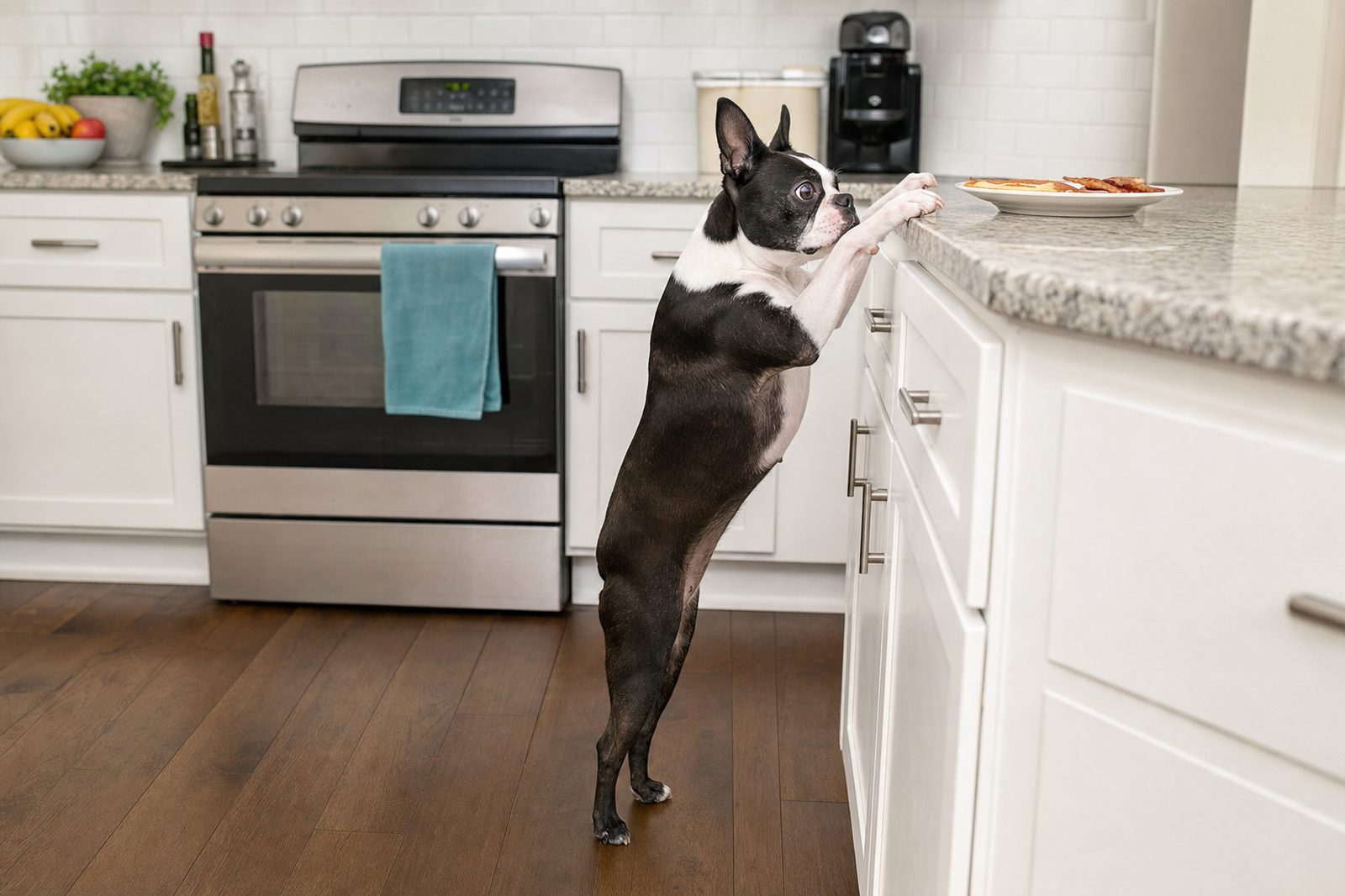
Stop dog counter surfing by breaking the outcome link: clear the counters so they stop paying, then install a trained Place as the incompatible default. Punishment after the fact teaches the dog to surf behind your back, not to stop surfing.
- Counter surfing is self-rewarding: every successful steal is a paycheck, and one paycheck funds the next hundred attempts.
- A correction the dog cannot connect to the act only teaches sneakiness. Dogs steal more, and more quietly, when unwatched.
- Management comes first: clear counters, lidded trash, whole household on the same rules. Management is not punishment.
- Install an incompatible default (Place), proof it through the five D's, then let fair correction enter only after the dog knows the alternative.
Punishment fails on counter surfing because your dog usually steals when you are gone, and a correction the dog cannot connect to the act only teaches it to surf behind your back. Counter surfing stops when counters stop paying and the dog has a better job: a trained Place.
The plan runs on the full four quadrants of operant conditioning: positive reinforcement first and always, fair correction as a real tool with real rules. That order matters more on this behavior than on almost any other.
Why does your dog counter surf in the first place?
The short version: it pays. Every successful steal is a paycheck, and one paycheck funds the next hundred attempts.
Your dog is a scavenger by design. Noses were built to find food, and the kitchen smells like a job site. The first time your dog reached up and scored a piece of chicken, three links in the behavior chain locked together: the smell of food was the trigger, dopamine was the chemical release, surfing was the response, and the chicken was the outcome. That outcome told your dog the whole chain was worth repeating.
Here is the part that makes this behavior so stubborn. The paycheck does not have to land every time. A dog that scores one sandwich out of fifty surfs still believes the next try could be the one. Your counter is a slot machine that never closes, and gamblers do not quit slot machines.
Dogs also learn to surf when you are not watching. In a study of 40 dogs, researchers found that when a person was watching, dogs took food from two containers equally, but when the watcher looked away, the dogs chose the container with the muted bells so they could steal quietly (New Scientist, 2010). The study backs what kitchen owners already know: dogs take food more often when nobody is watching. Your dog is not doing it to defy you. It is doing it because it works, and it works best when you are not there.
Why doesn't punishing your dog stop counter surfing?
The short version: your dog connects a correction to what it was doing the moment it landed, and by the time you arrive, it is doing something else.
A dog's associations run on a short window. The correction has to land on the act for the dog to link the two. You come home, find the wrapper, and scold the dog. The dog was standing at the door wagging when you scolded it. That is the association your dog just filed: owner arrives, owner is angry. Not: I stole an hour ago.
So the dog learns the only lesson the setup can teach: do not surf while the human is watching. The dog never touches the counter in front of you and raids it the minute you leave the room. Your punishment did not reduce the surfing. It improved the dog's timing.
Now the honest part, stated plainly in Partners' own terms.
We correct dogs at Partners. Fair, minimal, well-timed correction is a legitimate, necessary tool, and anyone who tells you we never correct is describing a different company. Dogs in our DaySchool run this same accounting every day: the default gets paid, the surf buys nothing, and a trainer keeps the books honest. But correction is the wrong tool before the dog knows the alternative, and the right tool after it. Correcting a dog for surfing when no Place has been taught hands the dog a "stop" with no trained answer for "do what instead." That is noise, not training.
Every successful steal is a paycheck. A correction after the fact is a fine for a crime the dog does not remember committing.
The sequence is the whole method: the dog learns the replacement first, through reinforcement. Only then can a fair correction point the dog back to something it already understands.
Can counter surfing actually hurt your dog?
The short version: yes. Stolen food can poison your dog or block its gut. That makes it a safety problem, not a manners problem.
This is where the paycheck gets expensive. A 5-year-old Lab named Lucy died after counter-surfing keto-friendly bread baked with xylitol, a sweetener that is highly toxic to dogs (Preventive Vet). Chocolate, grapes, onions, and sugar-free baked goods sit on real counters in real kitchens every day. Dogs also scarf stolen items so fast they can choke, or the item can lodge in the gut and become an obstruction.
The urgency is real, and it changes nothing about the method. Danger does not make punishment work. It makes management non-negotiable, because a managed kitchen cannot pay the dog at all.
What is the honest first step to stop dog counter surfing?
The short version: break the outcome link. Counters that never pay stop getting surfed.
Management is the honest first step, and management is not punishment. It is prevention. Before your dog learns anything new, you take the paycheck off the table. Every rehearsal that ends in an empty counter weakens the chain. Every rehearsal that ends in a steak strengthens it.
Clear the counters like you mean it. Food goes in the fridge, the pantry, or a latched cabinet, not pushed to the back of the counter. Wipe crumbs and food smells off the surface. Trash goes under the sink or behind a latched door. Cooling pans, pizza boxes, butter dishes, the kid's half-eaten sandwich: these are paychecks sitting in the open.
Cover the times you cannot supervise. Crate the dog, close the kitchen door, or use a baby gate while you cook. When you leave the house, the kitchen gets secured or the dog gets contained. Dogs do most of their surfing unwatched, so supervision gaps are where habits get built.
Get the whole household on the plan. One person leaving a sandwich out resets the clock. One successful steal funds the next month of attempts, and the dog does not care who left it. Consistency is the training, and it has to include everybody.
How do you teach your dog what to do instead of surfing?
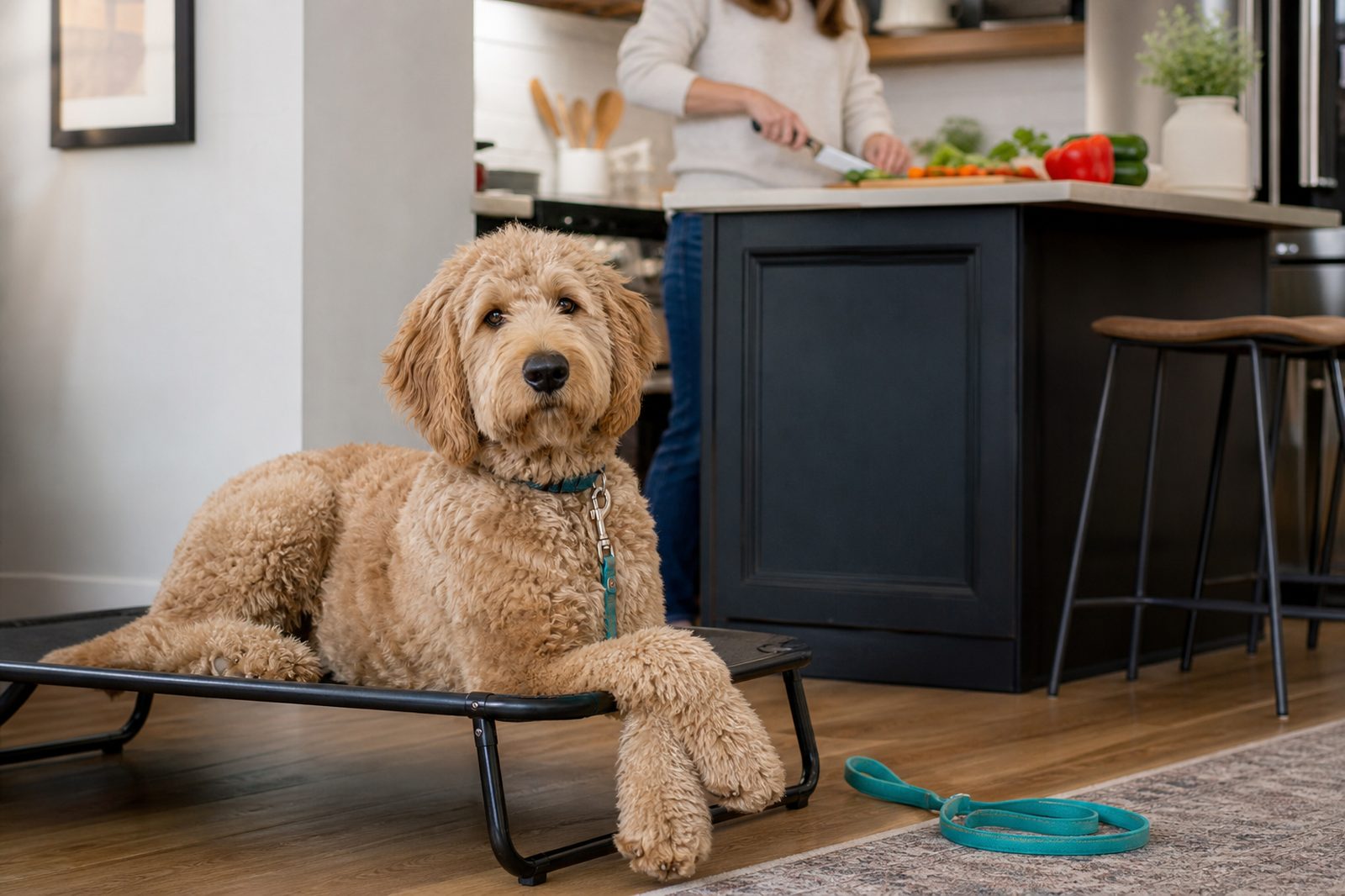
The short version: install an incompatible default. A dog holding Place cannot be surfing the counter at the same time.
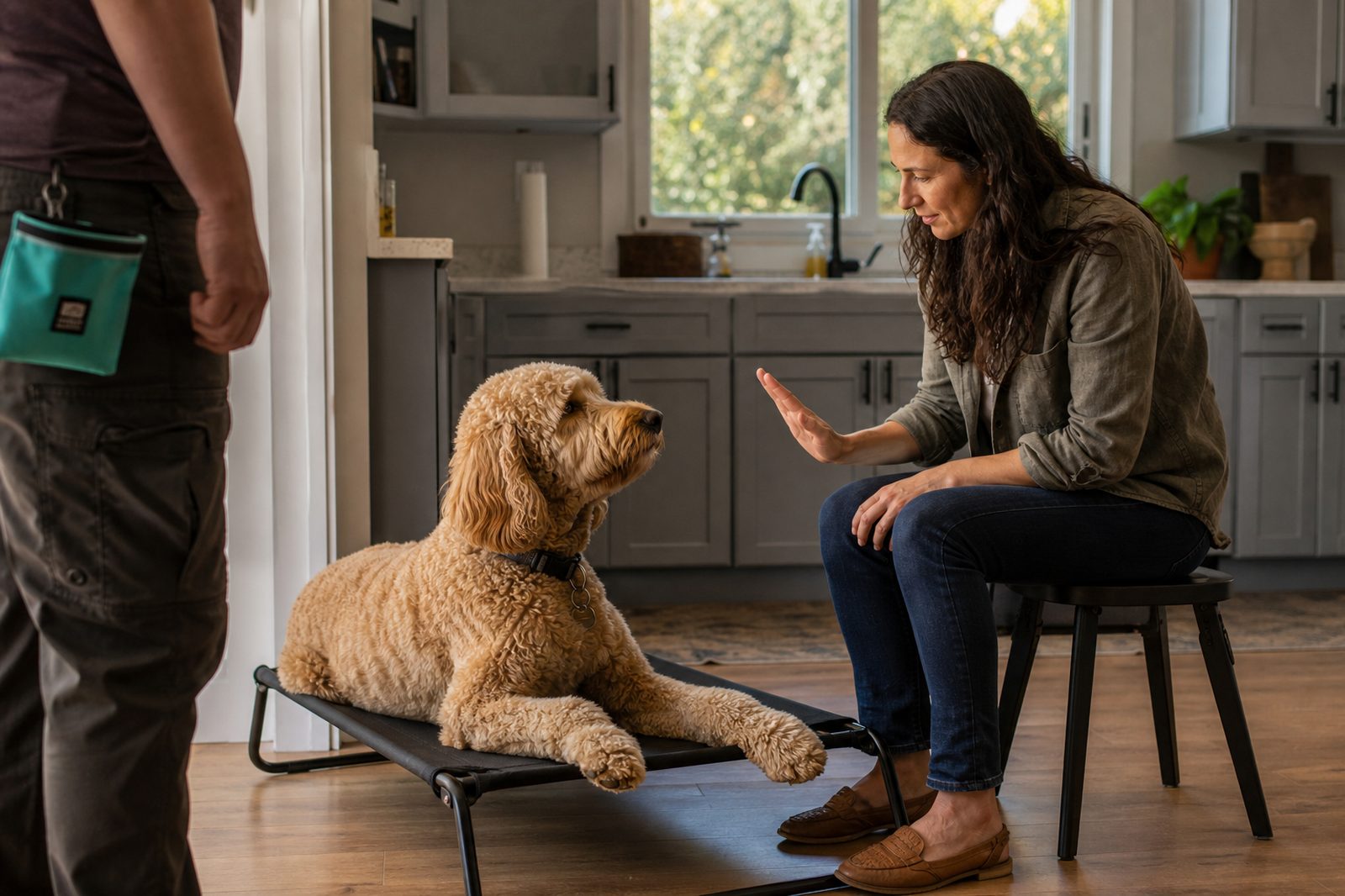
Place is not a trick. It is a default response, a trained answer the dog offers when the kitchen gets busy. Here is the protocol, in order. This is the Teach and Reinforce phase at work: mark, pay, repeat, then proof it before you trust it.
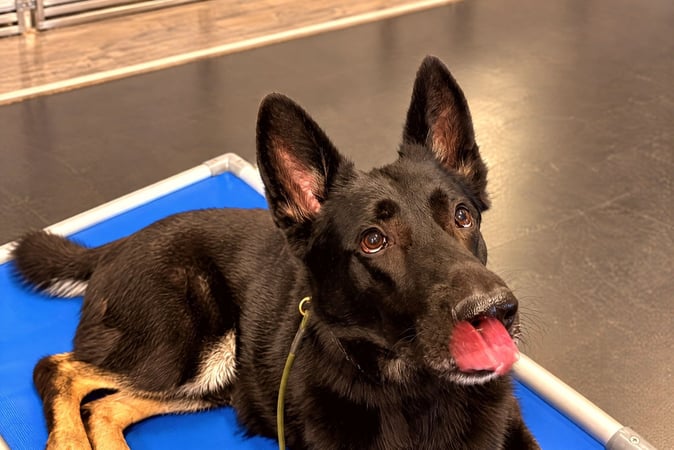
- Pay the mat for existing. Put a mat or cot near the kitchen. Every glance, sniff, or paw on it earns your marker word and a treat. The mat becomes a paycheck zone.
- Name it "Place." Say the word as the dog steps onto the mat, mark, and treat. Add a release word like "Free" so the dog learns Place ends only when you say so.
- Build duration before distraction. Quiet kitchen, no food out. Pay the dog for staying, with short reps and big pay. Always end on a win.
- Add the five D's in order. Proofing runs duration, distraction, distance, direction, difficulty. Distraction comes before distance: toss a low-value item across the kitchen before you ever ask for a stay while the turkey rests.
- Run real-life reps while you cook. Mat near the kitchen, dog on Place, treats tossed on the mat for holding it while you chop and stir. Pay the replacement in the exact context where the old behavior used to pay.
- Stage fair tests, never traps. Once Place is solid, run supervised reps with a low-value item on the counter while you pay the win. The dog always has a way to succeed. Setups engineered to make the dog fail are against our Hard Lines.
Capture the offered behavior, too. A dog that walks to its mat unprompted while you cook just made the best decision of its day. That one gets the biggest paycheck you have.
When should correction enter the picture?
The short version: only after the dog knows Place cold. A fair correction then points the dog back to something it already understands.
Correction is the wrong tool before the dog knows the alternative, and the right tool after. Here is what "after" looks like.
Your dog has been through Teach and Reinforce on Place. It holds the mat through cooking, through the kids, through food smells. One evening you catch it mid-surf, paws on the counter. That is the one moment a correction can land on the act: you are there, and the behavior is happening. One minimal interrupt at the lowest level the dog notices, a tap on the shoulder. Then redirect: "Place." The dog knows exactly what that means. It goes, you pay it.
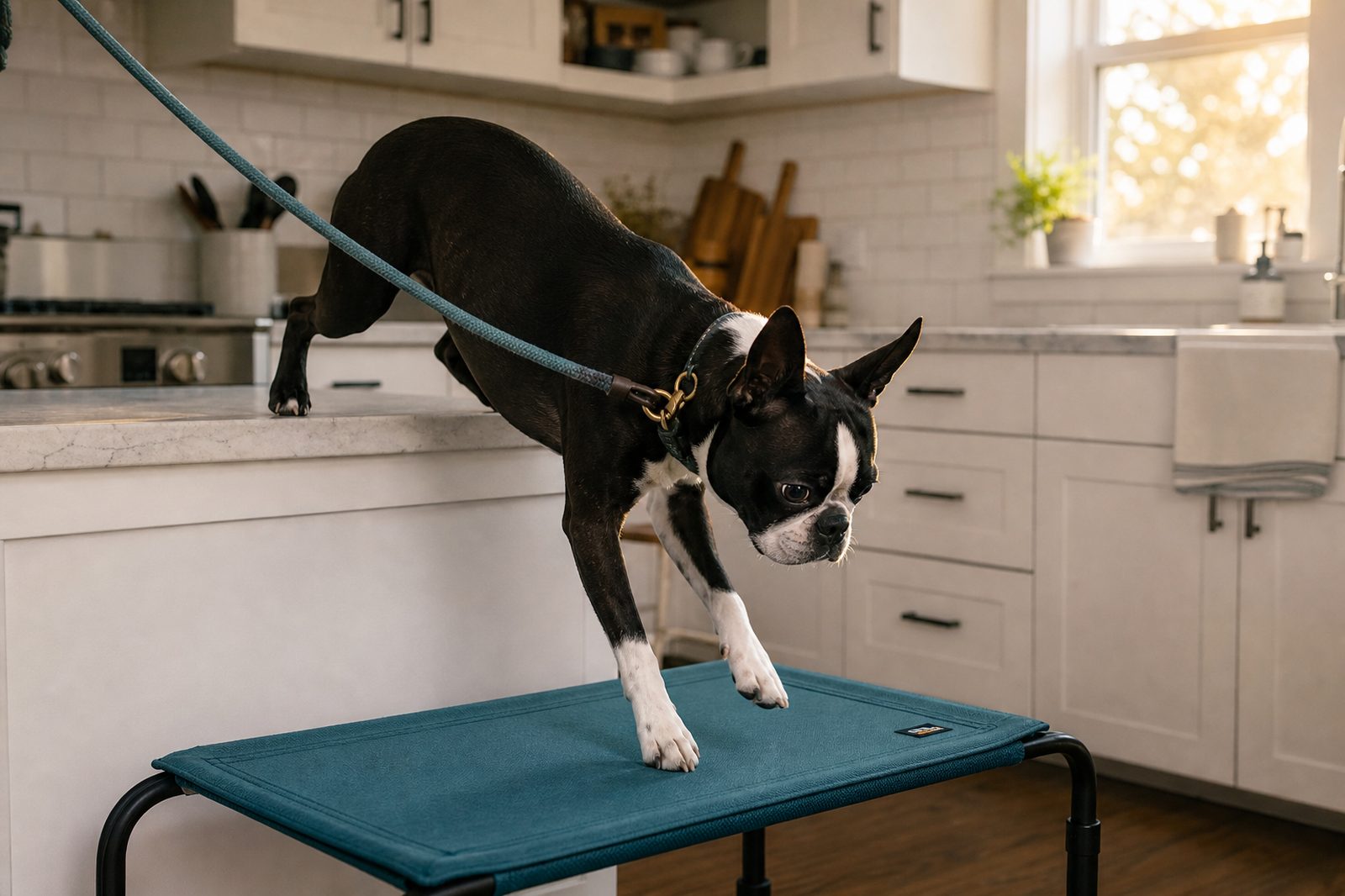
Fair correction is information. The dog was taught the answer first, so the correction points back to training.
Be honest about the limits. If your dog only surfs when you are gone, there is no correction plan to write. You are not there when the behavior happens. The answer is management: secure the kitchen, contain the dog, keep the counters clear.
The full position on where correction honestly sits is argued line by line in our AVSAB humane-training response: positive reinforcement is the primary method and the base of every program, fair correction is legitimate and necessary, and it is never the starting point.
Begin with the assessment
Book a PD360 Assessment
The in-person evaluation where a senior trainer reads your dog across nine dimensions and tells you honestly whether your counter-surfing case fits Private Lessons.
Mistakes that keep the surfing going
- Scolding the evidence. You find the wrapper, you yell at the dog. The dog learns nothing about the counter and something about you. Every after-the-fact scene is a deposit in the sneak account.
- Punishing only when you catch them. The dog does not stop surfing. It gets better at surfing unseen. The study backs it: unwatched dogs chose the silent container and stole quietly.
- Assuming the dog "knows better." Your dog is not counter-surfing out of spite or defiance. It is cashing a paycheck. If your mental model of the dog includes payback motives, read our piece on what dominance actually looks like in pet dogs and trade the grudge for a plan.
- Letting management leak. One household member leaves the cooling pan out "just for a minute." One successful steal funds the next month of attempts. The chain grades on outcomes, not effort.
- Skipping the default and going straight to correction. Correcting a dog that was never taught Place is yelling directions at someone with no map. Correction only comes after the dog has been taught and proofed.
- Setting traps to "teach a lesson." Greasing the counter or rigging a scary surprise is a hot-stove setup engineered to make the dog fail. Our Hard Lines prohibit them. The dog deserves a plan it can win.
By the numbers
One method for kitchen problems: teach the default and proof it before any correction enters. Serving Phoenix Valley families since 1997.
Key takeaways
Key takeaways
- Counter surfing is self-rewarding. Every successful steal is a paycheck, and one paycheck funds the next hundred attempts.
- Punishment after the fact teaches sneakiness, not obedience. The dog learns to surf when you are gone, not to stop surfing.
- Management is the honest first step, and management is not punishment. Counters that never pay stop getting surfed.
- Install an incompatible default: Place. A dog holding its mat cannot be on your counter at the same time.
- Fair correction enters only after the alternative is understood, at the lowest level the dog notices. Correction is the wrong tool before, the right tool after.
- Stolen food can poison, choke, or obstruct. The urgency is real, and it makes management non-negotiable.
Frequently Asked Questions
Should I punish my dog for counter surfing?
Not the way most people mean it. Yelling or scolding after the fact teaches your dog to surf when you are gone. Fair correction is legitimate, but only after your dog has been taught the alternative (Place). Before the dog knows the answer, correction is noise. After that, it is information.
My dog only steals food when I am not home. What actually works?
Management. No correction plan covers a behavior that happens unwatched. Secure the kitchen or contain the dog when you leave, and get the whole household keeping the same rules. A study of 40 dogs found a dog steals food from the counter more, and more quietly, when nobody is watching.
Can counter surfing hurt my dog?
Yes. A Lab named Lucy died after counter-surfing bread baked with xylitol, a sweetener highly toxic to dogs. Chocolate, grapes, and onions are also common on counters. Dogs also scarf stolen food so fast they can choke or block their gut. If your dog ate something suspicious, call your vet first.
How long will it take to stop the counter surfing?
It depends on how long the habit has been rehearsed and how consistent the household is. With real management and a trained Place, many dogs improve noticeably within weeks. A dog that has surfed for years needs longer, because every old paycheck keeps the chain alive.
What is the first step to stop counter surfing?
Book a PD360 Assessment. A senior trainer evaluates your dog across nine dimensions at our Scottsdale or Cave Creek campus, then tells you honestly whether your case fits Private Lessons, where a trainer works with you and your dog in your own kitchen.
Route by fit
Private Lessons, in Your Kitchen
Counter surfing is a home problem, so it gets fixed at home. A trainer works one-on-one with you and your dog on management, Place, and proofing where the surfing actually happens.
Where to go from here
Your dog is not broken and it is not defying you. It found a slot machine that pays in chicken, and nobody installed a better job. Clear the counters, teach Place, proof it until it holds through a real dinner. And if the manners gap runs wider than one habit (the jumping, the pulling, the selective hearing alongside the surfing), that's the dog Foundation Camp was built for: a 14-night stay that installs the whole obedience foundation, Place included, with the PD360 Assessment deciding the route. Correction enters only after the dog knows the answer. That order is how we build every behavior: mentor and student, figuring it out together.
Scottsdale: 8642 E Shea Blvd, 85260. Cave Creek: 4640 E Forest Pleasant Pl, 85331. Serving the Phoenix Valley.