In short
The AVSAB humane training position says only reward-based methods should be used for dog training and that aversive tools should never be used in any context. We disagree with the blanket ban: AVSAB's own 2021 paper admits its survey evidence cannot separate causation from correlation, and some dogs need more than treats and management.
- AVSAB's 2021 statement recommends only reward-based training, and its 2025 board statement says aversive methods "should not be used under any circumstances."
- AVSAB's own 2021 document admits its survey evidence cannot prove causation.
- AVSAB rescinded an older document that allowed aversive tools in some situations.
- A conditioned training tool communicates. Abuse is unconditioned pain with no teaching behind it.
- Partners Dogs: positive reinforcement as the base, fair minimal correction in the picture.
We read AVSAB's statements, quote them fairly, and answer each claim with evidence and 28 years of results using our omni-technical methodology. For a shorter, more even-handed read of the same statement, see What AVSAB Gets Right (and Misses) on Dog Training.
What does AVSAB's humane training position actually say?
We quote AVSAB before we answer AVSAB.
AVSAB's 2025 board statement (position statements page, retrieved 2026-09-16) restates its 2021 paper:
- "This statement clearly recommends that only reward-based training methods be used for all aspects of dog training and behavior modification."
- "Aversive methods (including but not limited to electronic collars, prong collars, choke chains, leash corrections, and other forms of physical or psychological punishment) should not be used under any circumstances."
- "AVSAB does not support the use of aversives in any context, regardless of the tools used or the trainer's level of experience."
- The board confirms it rescinded an older document "suggesting that the use of aversive tools may be appropriate in certain situations."
Separately, the FAQ in AVSAB's 2021 statement advises clients against hiring a trainer who discusses "dominance," "leader of the pack," or "alpha" theories. The 2025 board statement adds that AVSAB's goal is "not to certify or promote individual trainers or credentialing bodies."
Is reward-based training enough?
Reward-based training is the base of everything we do. Fair, minimal, well-timed correction is part of the rest.
We teach with positive reinforcement first. When a dog knows the right answer and chooses the wrong one anyway, fair correction enters: minimal, well-timed, at the lowest perceivable level. Our Hard Lines prohibit abuse and dogma, not correction.
AVSAB calls reward-based methods "both safer and more effective" for "all aspects of dog training." But positive-only pressure turns aversive itself when the dog or the Pet Parent grows frustrated. A 90-pound adolescent rehearsing a lunge-bark pattern needs the pattern rebuilt through the five D's, with fair correction where the plan calls for it. That lunge-bark pattern has a name: reactivity. (our complete guide to reactive dog training)
"A blanket ban erases the difference between abuse and conditioned communication."
First step
The PD360 Assessment
Tracked across nine dimensions, so your dog's program is built on measured fact, not method labels.
Are prong collars abuse?
A conditioned tool communicates. Abuse is pain with no teaching behind it.
AVSAB calls prong collars tools that "involve pain," to be avoided in "any use," and its 2025 statement bans aversives "under any circumstances."
A prong collar that is conditioned, fitted and introduced in the Teach phase applies brief, even pressure the moment the dog decides: it releases the instant the dog responds. Abuse is unconditioned tools, correction as the entire plan, no taught alternative, anger in the handler's hands. Our Hard Lines draw that line.
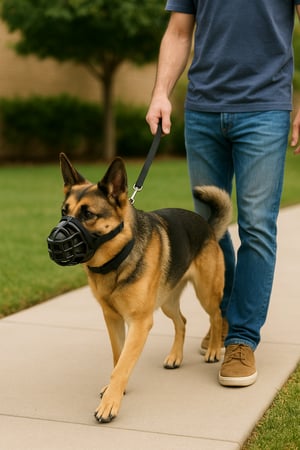
What conditioning looks like in practice: in the first session, the tool goes on at a level the dog barely notices, and the trainer pays the dog for responding to the lightest signal. Over several sessions the dog learns that the signal predicts guidance, not surprise, and the handler learns to read the dog's thresholds before anything matters. Only then does the tool enter real training. That is the difference between communication and confrontation, and no photograph of a collar can tell you which one you are looking at.
The alternative to an effective tool is often worse, in our experience. Take an older Pet Parent walking a medium or large dog on a harness: the harness spreads pulling force across the chest, so the dog may pull harder. One squirrel puts an older handler at risk of a serious fall. Effective tool use plus training can keep that person upright and that dog in its home. (Do Harnesses Encourage Pulling? What Trainers Know)
AVSAB defines management as avoiding situations that lead to the unwanted behavior. Management is safety. Management is not punishment. A crate manages. A gate manages. Neither teaches the dog what to do instead.

Balanced dog training vs force free: what the research shows
The research AVSAB cites is weaker than the certainty of its conclusions, and its own document says so.
Start with the biggest admission (2021 Humane Dog Training paper, retrieved 2026-09-16): "Survey studies cannot differentiate between causation and correlation." AVSAB lists two possible explanations: aversives cause problem behaviors, or owners of dogs with problem behaviors reach for aversive tools.
- Hiby et al. (2004): obedience highest with reward-only, lowest with aversive-only; the combined (balanced) approach scored in the middle.
- China et al. (2020): in 63 dogs with off-lead problems, the share of commands disobeyed did not differ significantly among the three groups (E-Collar, the same trainers without E-Collars, and positive-reinforcement trainers). The positive-reinforcement group responded better to "Come" and "Sit" after one instruction, responded faster and needed fewer commands, and the authors found no evidence that E-Collar training is necessary. The reward-based group was recruited later and matched to the E-Collar group rather than randomly allocated, and the authors note the results may reflect differences in training style between the trainer groups rather than the E-Collar itself (doi 10.3389/fvets.2020.00508).
- De Castro et al. (2020): in 92 companion dogs recruited from existing training schools, dogs in the high-aversive group showed more stress-related behaviors, higher post-training cortisol increases and a more "pessimistic" cognitive bias result than dogs from reward-based schools. The dogs came from existing schools rather than being assigned, so it shows association, not proof of harm (doi 10.1371/journal.pone.0225023).
The International Association of Canine Professionals disagrees: its certificants promise humane tool use and forbid letting a preferred method take precedence when the dog's response shows otherwise (IACP Certificant Code of Ethics, retrieved 2026-09-16).
Do dogs have a dominance hierarchy?
Dogs do form social hierarchies, minus the cartoon alpha-roll version.
AVSAB's 2021 FAQ advises clients against hiring any trainer who discusses "dominance" or "alpha" theories. Dogs negotiate who eats first and who gets the couch. That negotiation is real and shifts with context. Pretending it does not exist does not help the Pet Parent whose younger dog guards the couch from the older dog. What does not exist is the cartoon: the alpha roll, the "dominance down." Our Hard Lines prohibit dominance-theater handling too.
A trainer who cannot use the word dominance at all will struggle to describe the social structure running in a multi-dog home. It is hard to work on a relationship you cannot name.
Why accept medication but ban training tools?
Read the labels and do the risk math yourself.
AVSAB's 2021 statement says treatment plans for serious behavior concerns include "environmental management, behavior modification, and, in some cases, medication." Reconcile (fluoxetine) is an FDA-approved medication for canine separation anxiety, used together with a behavior modification plan (DailyMed Reconcile label, retrieved 2026-09-16). Its most serious listed side effect is seizures, "which in rare and severe cases can result in death." Field studies: calm, lethargy, or depression in 32.9% versus 10.4% on placebo; decreased appetite 26.9% versus 6.2%; vomiting 17.1% versus 13.3%; diarrhea 9.7% versus 8.1%; weight loss of 5% or more in 29.6% versus 13% of controls. The label states it is "not recommended for the treatment of aggression."
Trazodone, another commonly used behavior medication, lists sedation, vomiting, and behavioral disinhibition among reported adverse events in a published JAVMA study of 56 dogs (JAVMA 2008, retrieved 2026-09-16).
Medication has a legitimate place, and starting, stopping or changing any medication is a decision for your veterinarian, not for an article. Every intervention carries trade-offs, and the label rates above show it. If a tool is too risky "under any circumstances" while these medications sit inside the recommended plan, the standard is not applied evenly.
The claim vs the fuller picture
| The claim (AVSAB, quoted) | The fuller picture |
|---|---|
| "Only reward-based training methods be used for all aspects of dog training and behavior modification." | Positive reinforcement is our base. Positive-only pressure turns aversive under frustration; fair, minimal, well-timed correction belongs in the picture. |
| Aversive methods "should not be used under any circumstances," "in any context." | In our experience the alternative to a tool is often worse: an older handler with a large dog on a harness faces a fall risk that conditioned tool use plus training can reduce. |
| Survey studies link aversive methods to aggression and anxiety. | AVSAB's own document admits surveys "cannot differentiate between causation and correlation." |
| Treatment plans may include "in some cases, medication." | The Reconcile label (a medication for separation anxiety) lists lethargy, appetite loss, weight loss, and rare fatal seizures, with vomiting and diarrhea at rates close to placebo. |
From here
Start with the assessment
Start with a PD360 Assessment: your dog's plan built on measured fact, not method labels, tracked across nine dimensions. The assessment is recommended before every camp and required before Behavior Camp and Transform Camp. For dogs with behavior patterns to rebuild (reactivity, fear, guarding), Behavior Camp is our 21-night boarded stay, rebuilding behavior patterns around the clock with the full method, not half of it.
Myth vs fact
| Myth | Fact |
|---|---|
| Banning prong collars protects dogs. | Abuse is unconditioned pain with no teaching. A conditioned collar is brief pressure that releases. |
| Studies prove aversive training causes aggression. | AVSAB's own statement admits surveys "cannot differentiate between causation and correlation." |
| Reward-based methods work for every dog and every problem. | The base of every good program, including ours. But positive-only pressure turns aversive under frustration. |
| Medication is the safe alternative to training tools. | Medication labels list side effects too: the Reconcile label documents lethargy, appetite loss, weight loss, and rare seizures. Any medication decision belongs to your veterinarian. |
By the numbers
Mistakes that make it worse
- Choosing a trainer by ideology instead of outcomes. Hiring for the label on the website instead of asking what changed.
- Confusing a tool ban with a welfare standard. A trainer who bans prong collars has told you about their policy. A trainer who shows you tracked behaviors has told you about their results.
- Treating management as a behavior plan. Avoiding every trigger forever is not a trained dog. Management buys safety while training does the work.
- Skipping the routine check. Exercise, crate time, the daily schedule and what the dog gets to rehearse all shape behavior before any plan does. Start there, and with a PD360 Assessment. If the behavior is sudden, new and out of character, have your vet take a look.
Key takeaways
Key takeaways
- AVSAB's position bans all aversive methods "under any circumstances" while admitting its survey evidence cannot prove causation.
- Positive reinforcement is our base. Fair, minimal, well-timed correction after teaching belongs in the full picture.
- A conditioned tool communicates. Abuse is unconditioned pain with no teaching behind it.
- In our experience the alternative to an effective tool is often worse: for an older handler with a large dog, a harness is a fall risk that proper tool use plus training can reduce.
- Medication labels document side effects, and any medication decision belongs to your veterinarian.
- Choose trainers by tracked outcomes, not ideology: the PD360's tracked behaviors let results speak louder than labels.
Frequently Asked Questions
What is AVSAB's humane training position?
AVSAB (the American Veterinary Society of Animal Behavior) states that only reward-based methods should be used for all dog training and behavior modification. It also states that aversive methods, including prong collars, E-Collars and leash corrections, should never be used under any circumstances.
Is using a prong collar on my dog abuse?
A prong collar is not abuse by itself. Abuse is unconditioned pain with no teaching behind it. A fitted, conditioned prong collar applies brief, even pressure the moment the dog decides and releases on response. Judge the hands behind the tool.
What is balanced dog training, and how is it different from force-free?
Balanced training uses all four quadrants of operant conditioning: positive reinforcement as the base, plus fair, minimal, well-timed correction after the dog understands the alternative and chooses wrong anyway. Force-free training restricts itself to rewards and management, with no correction option available.
My dog has a serious behavior problem. What is the first step?
Start with the PD360 Assessment. It tracks behaviors across nine dimensions through four learning phases, so your trainer builds the plan from measured fact instead of method labels. It also flags sudden, new and out of character changes that are worth having your vet look at.
I live in the Phoenix Valley. Where can I get a clear read on my dog's behavior?
Book a PD360 Assessment at either Partners Dogs campus: Scottsdale at 8642 E Shea Blvd, 85260, or Cave Creek at 4640 E Forest Pleasant Pl, 85331. We have served the Phoenix Valley since December 1997, so you get a measured read on your dog.
Where to go from here
The training world will keep arguing about labels. Your dog does not care about labels. It cares whether the pattern changes, whether the home gets calmer, and whether it still gets to live in that home. That is what we measure, and that is what we are accountable for.
For most Pet Parents, this is not a thought experiment. It is the 7 a.m. walk on the Scottsdale sidewalk, the lunge at every passing dog, the quiet question of whether the pattern can change before the landlord's patience runs out. Bring the dog and the question. We will read both with you.
Scottsdale: 8642 E Shea Blvd, 85260. Cave Creek: 4640 E Forest Pleasant Pl, 85331. Serving the Phoenix Valley.