The gist of it
A 1 to 10 dog-to-trainer ratio (not a lower price) is what actually keeps daycare and DaySchool safe, calm, and structured for dogs in Paradise Valley and the surrounding 85253 area.
“Each dog is evaluated before they are approved for doggie daycare and there are multiple trainers all day, so you can be confident that your dog is in good hands.”
Megan M., Cave Creek
That reads like a small thing until you put a number behind it. The evaluation and the multiple trainers are not marketing language, they are a staffing ratio doing its job before a family notices. A lower daycare rate almost never buys that; a tighter ratio does.
A daycare ratio measures active supervision, not names on a payroll
A staff-to-dog ratio counts how many dogs one trained person is actively watching at a given moment, not how many employees are on the clock in the building. At Partners Dogs, that number is 1 to 10 in DaySchool: one trainer reading body language and redirecting arousal for ten dogs at most. Price sits downstream of that number, because none of it matters if the person on the floor is too stretched to see a fight forming in the corner. A useful gut check: some facilities count every employee on payroll, front desk and bathers included, against total dogs on site, a friendly number with little to do with real supervision.
A tight ratio changes outcomes more than the price tag does
A tight ratio buys earlier intervention, and earlier intervention is the difference between a normal correction and an incident report. Dog body language telegraphs stress before a fight breaks out: stiffening, fixed staring, a tail going from loose to high, one dog cornering another near a fence line. A trainer watching ten dogs catches that telegraph; one watching twenty or thirty, common at large open-play chains, is usually mid-conversation elsewhere when the signal appears. The volume model is convenient, not dishonest, and an easygoing dog with no reactivity history can do fine there for an afternoon. The tradeoff shows up with dogs who need more than a passive room, where a headcount-built facility rarely has the depth to also run structured education.
What happens to dogs when ratios climb well past 1 to 10?
Once a ratio climbs high enough that one person is watching a crowd instead of a group, supervision shifts from watching individual dogs to watching the room, and that difference matters more than it sounds. Watching a room catches obvious chaos: a brawl, a dog cowering in a corner, a gate left open. It does not catch a dog rehearsing over-arousal for the fortieth time, or a bully cornering the same nervous dog every visit. None of that looks like an emergency, and all of it gets practiced into a habit a family later pays a trainer to undo.
How does ratio affect a reactive, nervous, or newly rescued dog?
For a reactive or newly rescued dog, ratio is not a comfort feature, it is the mechanism that keeps a bad afternoon from becoming a training setback. A dog working through leash reactivity, fence fighting, or general anxiety needs a specific kind of handler: one who groups dogs deliberately by size, energy, and temperament, and who pulls him for a break before arousal tips into a reaction. That takes a person who is not also managing fifteen other dogs at once. One-on-one attention at home is real, but a dog that only practices calm behavior around one handler has not generalized that skill. Structured groups with a real ratio are where a dog rehearses being calm around variety, the skill that transfers to a trailhead or a vet lobby.
See the difference
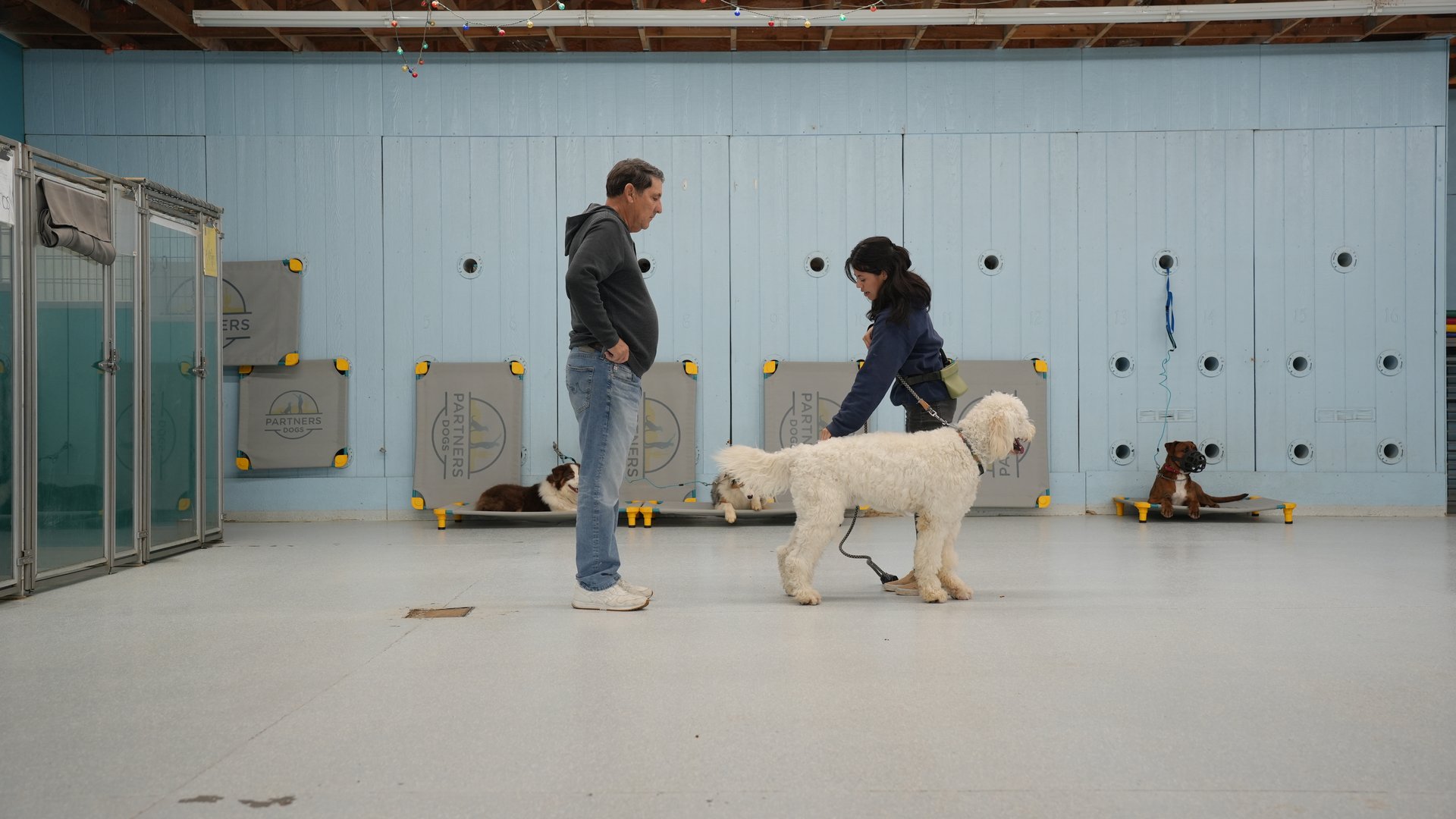
See what a real ratio looks like on the floor
Come watch a DaySchool day in person. Ratio is easy to claim, easy to verify once you're in the room.
The best Paradise Valley daycare can show you its ratio in the room
The best dog daycare for a Paradise Valley or 85253 family is the one that can show you its ratio in the room, not just state it on a website. Paradise Valley sits between Phoenix and Scottsdale, and most families here are choosing between a nearby open-play franchise and a trainer-run campus a little further out. A settled, low-arousal adult with no reactivity history can do fine in either setting. A dog who resource-guards, overstimulates in group play, or is still working on impulse control needs the tighter ratio. Partners Dogs runs both campuses, Scottsdale and Cave Creek, on the same 1 to 10 standard.
Is DaySchool worth it for a Paradise Valley family, or is home enough?
DaySchool is worth it when a dog needs structured socialization, reinforcement, or supervised exercise on days a family cannot provide all three at home, and it is genuinely optional when a dog is settled and gets enough structure elsewhere. The value is not tired-out play by itself, a yard and a dog walker can produce that. The value is a trainer-run room reinforcing the same skills a dog is learning in classes or camp. For families juggling triple-digit summer afternoons and a full workday, it also solves a logistics problem: no shaded yard, no midday walk in 110-degree heat, reason enough even for a dog who would otherwise be fine at home.
Daycare cost in Paradise Valley buys different things at different price points
Dog daycare pricing across the Paradise Valley and 85253 area varies by facility and package size, and current rates for Partners Dogs DaySchool are posted on the pricing page rather than restated here. The more useful comparison skips the number on two rate cards and looks at what each rate actually buys. A lower per-day rate at a high-volume open-play facility buys hours of supervised space. A DaySchool day at a 1 to 10 ratio buys that plus active coaching, temperament-based grouping, and reinforcement of the same commands used in classes and camp.
What should you ask before booking daycare or DaySchool in Paradise Valley?
A short list of direct questions tells you more than any brochure will.
- How many dogs is one staff member actively supervising in the play room right now, not on payroll today?
- How are dogs grouped, by arrival order, size, or temperament and energy level?
- What training does staff receive before supervising open play alone?
- What happens when a dog shows early signs of stress or over-arousal, and who is watching for that?
- Can I visit and observe a play session before I enroll my dog?
A facility confident in its ratio answers all five without hesitation. A vague answer to the first is the clearest red flag on the list.
Key takeaways
- Ratio measures active supervision per dog, not staff on the clock.
- A 1 to 10 ratio catches stress signals before they become fights; as the ratio climbs, supervision shifts from watching individual dogs to watching the room.
- Reactive and newly rescued dogs depend on tight ratios most.
- Partners Dogs runs 1 to 10 at both campuses, Scottsdale and Cave Creek.
- The honest cost comparison is what each rate buys, not the number on the card.
Frequently Asked Questions
Is there one official safe ratio number for dog daycare?
No single published standard sets one universal ratio for every daycare. What matters is that a facility can state its own number and back it up in the room, which is why asking directly is more useful than searching for an industry-wide rule.
Can a small senior dog and a boisterous young dog share the same daycare group safely?
Only with deliberate grouping by size, energy, and temperament, not arrival time. A tight ratio makes that grouping possible because a trainer has the bandwidth to separate mismatched pairs and rotate dogs as needed.
Does a facility's ratio hold on its busiest Saturdays, or only on paper?
Worth asking directly, since a ratio quoted online can slip on peak days if staffing does not scale with demand. Ask whether weekend staffing matches weekday, and ask to visit on a busy day rather than a quiet one.
Is a low staff ratio still safe if the play group itself is too large?
Not necessarily. Ratio and group size are related but separate. A calm, well-matched group of ten dogs with one trainer is manageable, while a chaotic mixed-energy group the same size can overwhelm one handler. Ask how groups get formed, not just how many staff are assigned.
What does the evaluation before DaySchool or daycare actually check for?
A pre-enrollment evaluation looks at how a dog responds to other dogs, handling, and new environments, informing how it gets grouped once enrolled. Families wanting a more formal read on behavior can start with a PD360 Assessment instead of or alongside a standard daycare evaluation.
Start the conversation
Watch a DaySchool day before you book one
A ratio is easy to state and just as easy to verify once you are standing in the room. See a real DaySchool day at 1 to 10, Scottsdale or Cave Creek.
Keep reading