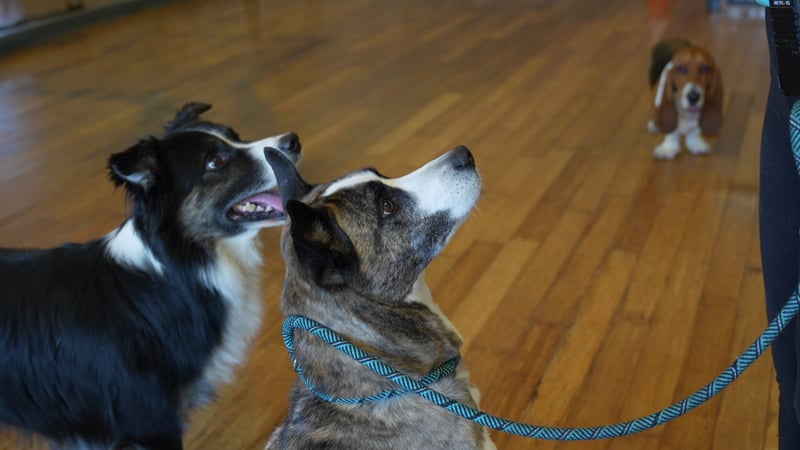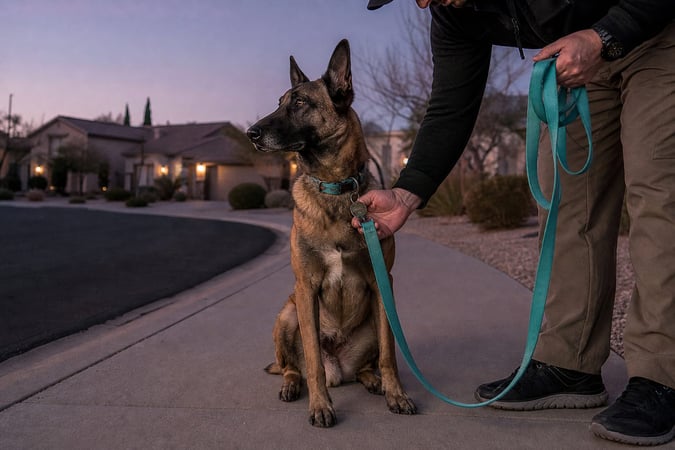

Four stages, not stricter corrections, are what calm an anxious dog: Teaching, Reinforcing, Proofing, and Maintenance replace a dog's guesswork about what happens next with a pattern it can rely on. Structure reduces dog anxiety because uncertainty, not a lack of affection, is usually the real stressor. A dog that knows the household rules and its own job in a given moment stops running on high alert.
Partners Dogs has trained more than 70,000 dogs since 1997. Every dog that comes through a Partners Dogs training program today moves through the same four stages: Teaching, Reinforcing, Proofing, and Maintenance. That stage ladder is the structure this article is about, and it is the reason a chaotic, anxious dog usually settles once the guesswork gets replaced with a plan.
Why Does My Dog Seem Anxious All the Time?
A dog that does not know the household rules is doing a harder job than a dog that does. It has to guess whether the doorbell means a stranger or a friend, and whether jumping is about to get attention or a redirect. Even the crate becomes a coin flip in the dog's mind: safe place to land, or something closer to a punishment. A dog running on that much guesswork is a dog running on alert, whether or not the behavior looks like textbook anxiety to a person watching. The American Kennel Club makes a version of the same point in its guidance on canine routines, noting that dogs living with consistent daily patterns tend to show fewer stress behaviors and settle with more confidence than dogs whose days change shape constantly.
An under-structured dog does not always look "anxious" in the obvious sense. Watch for:
- Pacing or circling with no clear destination
- Hypervigilance at windows, doors, or new sounds
- Clinginess or panic when a person leaves the room
- Destructive chewing or digging that starts the moment structure disappears
- Barking or whining with no obvious trigger
Arizona adds its own seasonal spike to that list. Monsoon thunder, gusting outflow winds, and the fireworks that follow rattle even a well-adjusted dog every July and August. The effect is loudest around Cave Creek, where trail dogs coming off an evening hike at Spur Cross Ranch or Cave Creek Regional Park are already keyed up before the first rumble hits. A dog with a reliable place spot and a known routine tends to ride that stretch out; a dog already running on guesswork the rest of the year gets hit hardest right when the storms roll in.
Some of these same signs show up in dogs who read as hyperactive rather than anxious. Our guide to hyperactive and unsettled dogs covers that overlap in more detail. The signs differ dog to dog. The underlying cause, in a lot of cases, does not.
Does Structure Reduce Dog Anxiety?
Yes, and the mechanism is simpler than most training debates make it sound. Structure reduces dog anxiety mainly by removing the guesswork a dog is otherwise stuck carrying around all day. A frightened dog does not relax faster under more pressure, and no reputable program builds structure that way. But structure itself is not pressure. A dog with a "go to your place" habit, a predictable feeding and walk schedule, and a house that treats jumping the same way every time is not being corrected into calm. It is being given a job it already knows how to do, on repeat, until the job stops requiring thought. Confidence follows repetition. Repetition needs consistency to exist at all.
The bigger risk we see across 70,000+ dogs runs the other direction. A dog with no rules, no defaults, and no job to do in a given moment does not stay relaxed by default. It stays on alert, because nobody ever told it what happens next. Over-coddling produces more behavioral issues than almost anything else we treat. Confidence comes from knowing the boundaries and the default behavior, not from the absence of either.
Nine scores, one plan
See Exactly Where Your Dog's Anxiety Comes From
A PD360 Assessment scores your dog across nine behavior categories and hands you a written starting point built for your dog, not a generic routine.
What Does Structure Look Like Day to Day?
Structure at home is a handful of repeated defaults, not a schedule locked to the minute. A place cot by the door gives a dog somewhere specific to go when the doorbell rings, instead of a decision to make on the fly. A consistent release word before the leash comes off removes the daily negotiation at the front gate. Feeding, walks, and settle time landing in roughly the same order each day give a dog a sequence it can predict, even if the clock times shift week to week.
A few defaults do most of the work:
- One place to go when someone knocks or the doorbell rings
- A consistent release cue before greetings, meals, and leash-off time
- The same response to jumping, counter surfing, or door bolting from every person in the house, not four different reactions from four different people
- A predictable settle period built into the day, rather than only activity that ends in a crash
Dogs already showing signs of general anxiety need this more, not less. A dog whose baseline stress runs high has less margin left over for a household that changes the rules by the day.
When Does a Dog Need Less Structure, Not More?
Not every anxious moment calls for a full behavior program. A stable, well-socialized adult dog adjusting to a move, a new baby or a week of house guests will often settle on its own once the household routine resettles. That dog does not need board-and-train structure. It needs a few weeks of the same feeding time, the same walk route, and a person who is not visibly stressed about the move themselves.
The dogs who need more formal structure are the ones whose anxiety has already generalized: dogs that stay wound up across more than one environment, dogs that have started guarding resources or space, or dogs with a bite history a family cannot safely manage alone at home. That is a different problem than a dog adjusting to a new crib in the nursery, and it deserves an honest answer instead of a program sold to every household regardless of fit.
How Partners Dogs Builds Structure Into Every Stage
The four-stage ladder is what a single household routine cannot fully replicate on its own. Teaching starts positive, building a behavior with rewards and no pressure at all. Reinforcing repeats it until it is automatic. Proofing tests it against distractions: other dogs, new people, a full parking lot, a doorbell that will not stop. Maintenance keeps it alive for the rest of the dog's life. A family can run the Teaching stage at home without much trouble. Proofing a behavior against genuine distraction, with multiple handlers and controlled trigger exposure, is harder to manufacture inside one house running one routine.
Foundation Camp is where that ladder runs at full depth. A dog in the program spends its days inside a structured rhythm, at our Cave Creek or Scottsdale campus, built by a team of trainers rather than one person managing everything, with progress tracked stage by stage through a PD360 Pet Progress Tracking System record parents can read. That is the applied version of structure reducing dog anxiety, run by people who do it daily instead of a household improvising a first attempt.
"Very caring and instructive staff. The lessons learned by our dog were quite obvious when we brought her back home: calmness, obedience and less anxious."
Daniel G., Scottsdale
Reviews like that one are not the exception. Partners Dogs holds a 4.8-star rating across 2,000+ reviews, see the full set of Partners Dogs reviews for the pattern in parents' own words. Structure is the framework every stage of training runs on, from a puppy's first sit to a dog relearning trust after a rough start.
Frequently Asked Questions
Does giving my dog more structure mean using more corrections?
No. Structure is about consistency, not correction volume. A dog gets calmer when the same behavior gets the same response every time, whether that response is a reward, a redirect, or no reaction at all. Corrections can be part of a balanced program, but the anxiety relief that comes from structure is about predictability, not about how often a dog gets corrected.
How fast will my dog calm down once I add structure at home?
Most families notice a shift within one to two weeks of consistent defaults: a place spot, a release cue, and the same response to jumping from everyone in the house. A dog whose anxiety has generalized across multiple situations, or a dog with a bite history, usually needs a structured behavior program like Behavior Camp rather than a home routine alone to see lasting change.
Can a puppy have too much structure?
Yes, if the structure turns into rigid, exact-clock-time rules with no flexibility built in. The goal is a predictable sequence and consistent defaults, not a schedule so strict that any change to it becomes its own source of stress. A puppy benefits from knowing what generally comes next, not from a routine that never bends.
What is the difference between structure and strict obedience?
Structure is the framework: the household rules, defaults, and sequence a dog can predict. Obedience is one tool inside that framework. A dog can have strong structure with very little formal obedience, and a dog with sharp obedience skills can still be anxious if the household around those skills keeps changing.
Does every anxious dog need Foundation Camp?
No. A stable dog adjusting to a new apartment, a house guest, or a change in schedule often settles on its own once the home routine resettles, and everyday under-structured anxiety often responds well to Foundation Camp's stage system. Dogs whose anxiety has already generalized across environments, dogs guarding resources or space, or dogs a family cannot safely manage at home alone need a program built for that level, like Behavior Camp.
Structure, built by a team
Give Your Dog the Stage System Instead of a Guessing Game
Foundation Camp runs your dog through Teaching, Reinforcing, Proofing, and Maintenance under one structured daily rhythm, so the calm holds once your dog comes home.
Keep reading