No spin version
If your dog gets sick during boarding, the trainer on the floor tells a manager right away, the manager pulls the emergency vet authorization you signed at drop-off, and your dog is on the way to a Phoenix metro emergency hospital before anyone waits on a callback from you. You do not make the call to treat from a departure gate or a hotel room, because you already made it on the intake form, and the facility's job afterward is speed and documentation. What actually varies between boarding options is whether enough trained people are awake in the building at 2 a.m. to run that plan.
What happens if your dog gets sick during boarding?
Here is the actual checklist, in order: notice, notify, authorize, treat, document, and update you, and none of those steps waits on the one before it to be perfect. A dog who skips a meal or seems off after a nap gets logged and watched closer. A dog who is limping, straining to go, or breathing hard at rest gets a trainer's eyes on it quickly and a call up the chain the same day. That line between watch it and call now does not depend on one attendant's guess.
Most boarding illness is boring on purpose: a change in water, a new environment, stress from being away from the couch. These resolve with bland food, rest, and a phone call letting you know. The checklist exists so the rare case that is not boring (a bloated abdomen, a seizure, a dog that will not get up) moves at emergency speed.
Who decides whether your dog goes to the emergency vet?
A trained staff member decides, not a single attendant guessing alone, and the decision to treat is separated from the decision to reach you. Whoever first notices something raises it to the person running that shift, who has standing authority to move the dog toward veterinary care immediately instead of waiting on a callback. Reaching you happens alongside that, never as a gate the emergency has to pass through first.
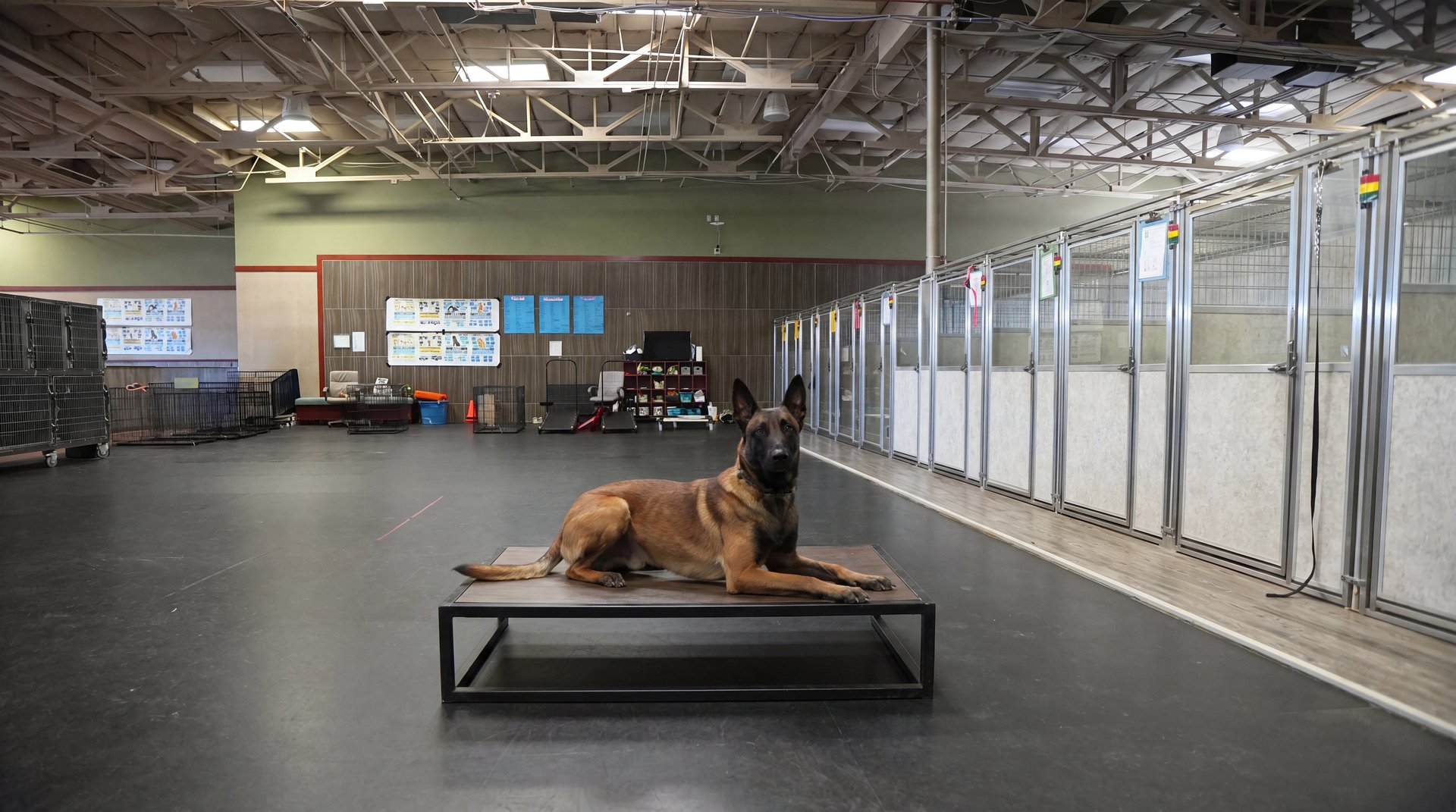
That structure depends on more than one person being accountable for a dog's care, not a single attendant left to make every call alone. Across the Scottsdale and Cave Creek campuses, Partners Dogs runs with 50+ trainers on staff and a clear chain from whoever notices something to whoever has authority to act, so no one is left guessing by themselves.
What is a standing vet authorization, and why sign one before drop-off?
A standing vet authorization is the signature on your intake paperwork that lets a facility start emergency treatment for your dog without waiting to reach you first. You list your regular vet, note any conditions or medications, and give written permission to treat and to use the nearest emergency hospital if your own vet cannot be reached in time.
A boarding intake worth trusting asks for that vet information and a signed authorization before a dog is checked in, along with written medication and dosing notes. That paperwork is what turns "we could not reach you" from a crisis into a footnote. If yours is a year or two old, update it before your next trip, especially with a new prescription or a new vet since the last stay.
Can a boarding facility take your dog to the emergency vet without reaching you first?
Yes, under the authorization you sign, and this is the detail most first-time boarding parents miss: transport does not wait for your text back. If a dog shows signs that will not wait (difficulty breathing, collapse, a seizure, a distended abdomen, blood where there should not be blood) staff move the dog to the nearest appropriate emergency hospital and call you from the road, not from the kennel before leaving it.
Phoenix metro is well served for this. Maricopa County maintains a running list of 24-hour and emergency veterinary services across the county, and any boarding facility worth using has a working relationship with at least one of them and an after-hours transport plan that does not depend on one person's car being free. A facility that cannot say, in one sentence, which hospital it uses and how a dog gets there at midnight has only written that sentence, not built the plan.
What if you are on a plane or unreachable when it happens?
Treatment starts on the authorization already on file, and updates queue up for the moment your phone reconnects, so being unreachable for a few hours changes nothing about your dog's care. This is the scenario that keeps anxious travelers awake: a connecting flight through Sky Harbor, a retreat with no signal, a cruise with satellite Wi-Fi that drops for hours. The plan is built to run with you unreachable, because that gap is exactly when it has to work.
What you can do beforehand is make that gap smaller: confirm your emergency contact answers their phone, and give them standing permission to make the calls you would. Your dog does not get worse because you are thirty thousand feet up, and neither should the plan.
What makes boarding the safest choice for an anxious traveler in the Phoenix metro?
Staffing depth is the answer that matters, more than location or square footage: a Phoenix metro boarding stay is only as safe as the trained people awake when something goes wrong. Scottsdale, Cave Creek, and the surrounding suburbs are not short on boarding options, but plenty run thin overnight: one person covering a building that might hold sixty dogs.
An anxious traveler's fear is rarely whether the dog will have fun. It is whether anyone will notice in time, and that gets answered by ratios and coverage. Ask any facility you are considering (in Scottsdale, North Phoenix, or Paradise Valley) how many staff are physically present overnight and what triggers a call to you versus a call to a vet; this list of questions to ask about structured boarding in Phoenix is a good starting checklist.
Is boarding safer than an in-home sitter for a medically fragile dog?
An in-home sitter has one real advantage worth naming honestly: your dog stays in a familiar house, and if something goes wrong, that sitter can drive straight to your own regular vet in your own car. For a dog genuinely calmer at home, or one whose vet already holds a full chart history, that matters.
The trade-off shows up the moment that sitter becomes a single point of failure: sick, in a fender-bender, or asleep through a symptom that develops overnight, with no backup watching your dog at all. This is also why some facilities will still take a dog other kennels have turned away, precisely because a staffed floor can absorb a harder case that one sitter cannot. A facility built for this replaces one person's judgment with a staffed floor and an escalation ladder that keeps running after the trainer who checked on your dog at 9 p.m. is off shift by midnight. For a dog on medication or simply older and more fragile, that redundancy usually beats the familiar couch.
Who pays for emergency vet care during a boarding stay?
You do, the same as if your dog got sick at home, since the authorization you sign covers permission to treat, not a transfer of the bill. A boarding facility is not an insurer; it is the party positioned to get your dog seen fast and documented for you and your own vet afterward. Payment gets sorted with the emergency hospital directly, usually after your dog is stable.
Here, a vet who already knows your dog's history moves faster than a hospital meeting your dog for the first time. Current rates for boarding and any add-on care are always worth checking on the pricing page before you book.
The next step is small
See exactly how your dog is assessed before a single night away
Before you book a boarding stay, see how your specific dog actually handles a new environment and a full day away. One assessment day, no commitment attached, gives you a straight read instead of a guess.
One Cave Creek family used an in-home sitter for years before trying boarding with two anxious dogs. As Ramona V., Cave Creek, described it afterward, the daily updates "kept us up to date on their daily activities," and, in her words, "we were able to relax and enjoy our trip." That is what a staffed plan buys an anxious traveler: proof, every day, that everything is fine.
Frequently Asked Questions
What makes Partners Dogs boarding the safest option for a Peoria family traveling out of town?
Staffing and structure are the safety factor, more than distance. A Peoria family driving to Cave Creek is choosing 50+ trainers across two campuses and a trainer-run floor over a closer option with a much thinner team. The extra drive time buys a system built to catch a problem quickly, not just proximity.
I am flying out of Sky Harbor and will be unreachable for hours. How do Glendale families stay in the loop?
Treatment does not pause for your flight. The standing authorization you sign at drop-off lets staff move on a real emergency immediately, and updates queue up for the moment you land and reconnect. Confirm beforehand that your listed emergency contact will actually answer the phone, since that person is your practical backup while you are in the air.
Why do some Tempe families drive past closer boarding options to board with Partners Dogs?
The reason is usually the same: wanting to see the training floor and staffing depth in person before trusting a facility with a medically sensitive or senior dog. That extra drive is an easy trade for families an hour or more from Scottsdale or Cave Creek, especially with a dog on medication.
Does a PD360 Assessment change how staff handle a health issue during boarding?
It changes what staff already know going in. A dog with a PD360 Assessment on file has a baseline for how it handles stress and a full day away, so a trainer noticing something off can tell faster whether it is normal adjustment or worth escalating. PD360 is optional for boarding, but it removes guesswork for a dog with any known sensitivity.
What happens to my dog's medication schedule if a vet changes a dose mid-stay?
The new instructions go into your dog's daily notes and get followed for the rest of the stay, the same way the original dosing instructions you gave at drop-off are followed. You are updated on the change, and anything unclear gets a call to you or the vet before the next dose, not a guess by whoever is on shift.
Key takeaways
- A signed standing vet authorization at drop-off lets a facility start emergency treatment without waiting to reach you first.
- The decision to treat and the decision to reach you happen in parallel, not one gated behind the other.
- Maricopa County publishes a running list of 24-hour emergency veterinary services across the Phoenix metro.
- 50+ trainers across two campuses and a clear escalation chain mean no one is left deciding alone.
- You cover the cost of emergency care either way; the facility's job is speed and documentation.
Meet the team behind the plan
Book a boarding stay with a staffed plan already in place
See the suites and the two campuses your dog could stay at, then talk with the team that runs the emergency plan every night, not just on paper.
Keep reading