In short
You teach your dog tricks the same way you teach any other behavior: lure the movement with food, mark the instant he gets it right, and reward immediately. Start with an easy trick like spin, lean on the obedience cues he already knows, and keep sessions short and upbeat. Our trainers use the same approach with every dog we train, including dogs from the Anthem area.
Why Tricks Are Worth Your Time
Tricks look like entertainment, but they do real work for your dog's brain and your relationship. Learning how to teach your dog tricks is one of the most useful things you can add to a normal training routine, right alongside sit, down, and stay.
- They give your dog a job. A hobby, essentially. Most dogs find trick work more fun than straight obedience, and the mental benefits are close to identical.
- They build the relationship. You and your dog are solving something together, which is different from you asking and your dog complying.
- They redirect energy. A dog with nothing to do finds something to do, and it is usually destructive. Trick sessions are a productive place to put that drive.
- They teach your dog that communication pays. A dog who learns that offering behavior and checking in with you leads to good things becomes easier to live with in every other context.
Every dog can learn tricks if he is motivated and willing to work for you. For most dogs the real reward is not the treat. It is that you are clearly pleased with them.
How to Teach Your Dog to Spin
Spin is a great starting trick because it also teaches your dog left and right. Once he spins one direction reliably, you can teach a reverse the other way.
Use food to lure your dog into a circle. Start by asking for a small turn to the side and build toward a full rotation. The key detail is that the lure should stay glued to your dog's nose. Hold it too far out in front and he loses the thread and gives up on the turn.
How to Teach Your Dog to Roll Over
Roll over is a classic and it is more demanding than it looks. Dogs do not always want to expose their belly, so some take a while to commit.
- Keep your dog's nose on the lure. Draw it toward his shoulder blade in the direction you want him to roll, so he naturally shifts and flops onto his side. Mark that with a clear yes and pay him.
- Once he is comfortable shifting onto his side, lure a little further to expose the belly, and eventually all the way over. Reward every step of progress, not just the finished trick.
How to Teach Your Dog to Play Dead
Play dead asks for more than the first two tricks combined. Your dog has to stand, drop, and get back up on cue, so it takes luring, bridging, and real practice.
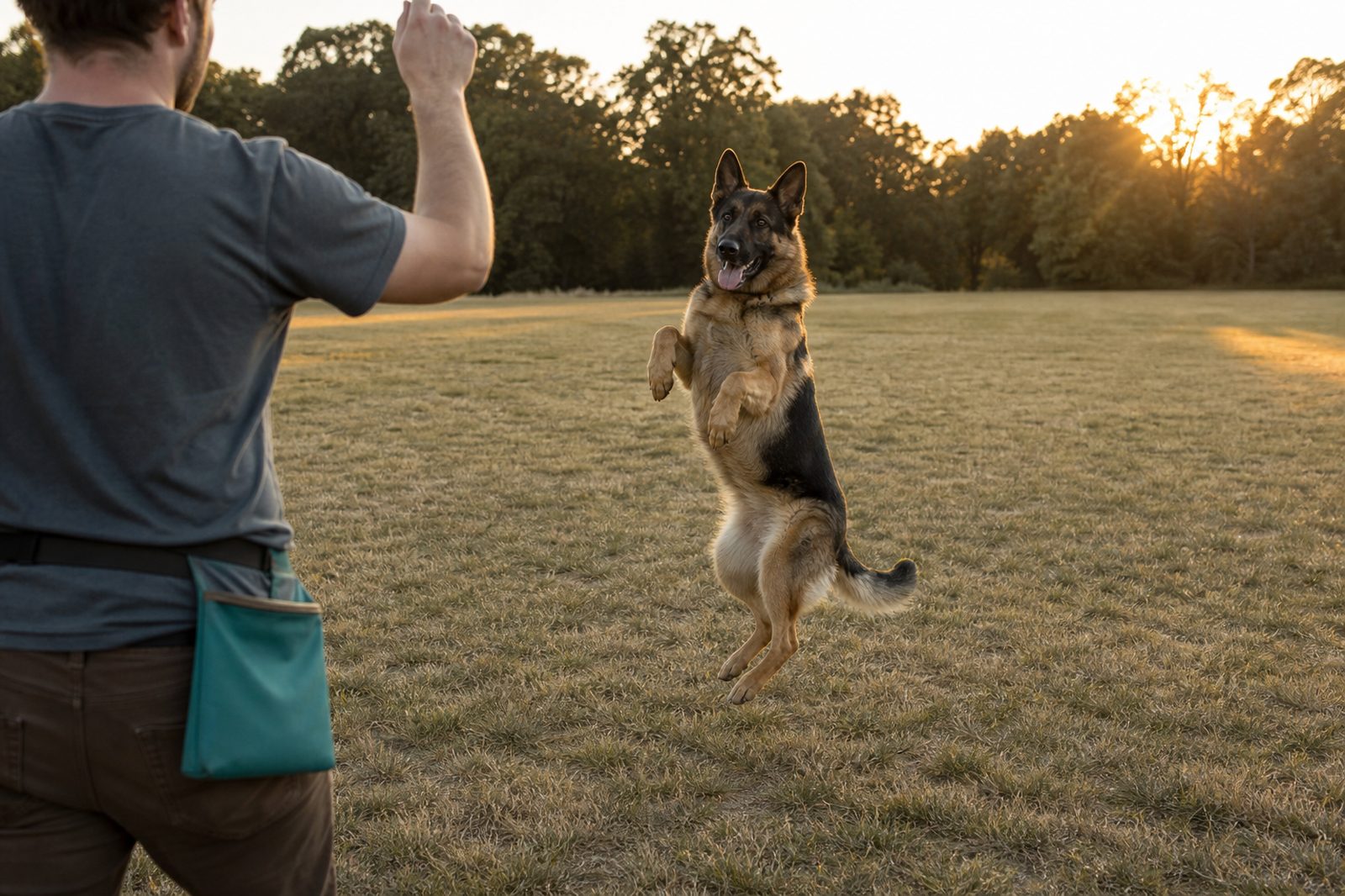
Start by luring your dog to lift his front paws off the ground into a sitting-up position, sometimes called sit pretty. Then, from a down, lure him onto his side or his back to expose the belly. Mark it with a yes and reward immediately. Once he understands the movement, add your cue word, and add a clear release word so he knows when the trick is over and he can get up.
Next step
Want a Faster Read on Where Your Dog Stands?
If trick sessions keep stalling before the reward lands, a quick outside look often finds the gap faster than another round of trial and error.
Five Habits That Make Tricks Stick
- Teach in small steps. If your dog is stuck, break the trick into smaller pieces and teach those first. In training we call this bridging. Each small step builds on the last, and the whole trick clicks once the pieces come together.
- Use the obedience you already have. Everyday commands are bridges too. A dog who already knows down has a real head start on roll over, and a dog with a solid set of foundation cues from Foundation Camp has even more to build on.
- Pay well for new work. Use high value food when you are asking for something unfamiliar. Over time you want verbal praise to carry the behavior, but food is how you get the learning started. It works as a lure first and a reward second.
- Mark the moment. A verbal marker like yes, or a training clicker, tells your dog exactly which split second earned the reward. Without it you are asking him to guess.
- Keep it light. Tricks should not feel like work for either of you. Praise generously and stop the session while your dog still wants more.
Timing Is the Whole Game
Reward immediately, verbally or with food, the instant your dog does what you asked. Wait even a couple of seconds and he loses the connection between the behavior and the payoff. This is the single most common reason trick training stalls at home.
Dogs come with quirks and personalities of their own, and those quirks are often the best source of new tricks. If your dog already does something funny on his own, put a word on it and you have a trick. If you would rather learn this alongside other owners and get eyes on your timing, our Group Classes give you hands-on coaching while your dog works around other dogs, which is exactly where most home training falls apart. For one-on-one coaching on your own schedule instead, Private Lessons work through the same timing issues without the group setting.
More Tricks to Try
Once your dog has a couple of tricks down, the same lure-mark-reward process will get you all of these.
- Shake or high five
- Speak
- Peekaboo
- Bow
- Back up
- Crawl
- Leg weaves
- Jump through a hoop
- Be shy
Teach slowly, keep it positive, and enjoy the process. We train dogs 20 weeks and older at our Scottsdale and Cave Creek campuses, and if you want a second pair of eyes on a trick that will not click, that is exactly what a session with one of our trainers is for.
Frequently asked questions
What is the easiest trick to teach a dog first?
Spin and shake are usually the easiest starting tricks because they build on a movement your dog already makes naturally, so the lure has less new ground to cover. Both also teach the mechanics, luring, marking, and rewarding, that make every trick after them faster to learn.
How long does it take to teach a dog a new trick?
It depends on the trick and the dog, and there is no fixed timeline. Easier tricks like spin or shake tend to come together faster because they build on a movement your dog already makes. Harder tricks like play dead take longer because they chain several smaller steps together.
Do I need treats to teach my dog tricks?
Yes, at least at the start. Food is what makes the lure work and gives you a fast, clear way to mark the right moment. Over time you fade the food and let verbal praise carry the behavior, but trying to skip treats early just slows the whole process down.
Why does my dog do a trick at home but not around other dogs or in a new place?
That is a generalization problem, not a stubborn dog. A behavior learned in one quiet room has to be practiced again in new locations and around distractions before it holds up everywhere. Practicing around other dogs and handlers, the way a structured group setting does, is usually what closes that gap.
What age can my dog start learning tricks?
There is no strict age cutoff for basic trick work at home once a dog is settled and food motivated. Our structured programs at Partners Dogs work with dogs 20 weeks and older.
Keep building
Turn Trick Time Into Real Progress
The same obedience foundation that makes tricks click faster also makes everyday life easier. Foundation Camp builds it in one focused stay, and Group Classes keep it sharp with your dog working around real distractions.
Keep reading