Quick answer
28 nights. 4 staged weeks. 6 private lessons. 12 Pet Parenting classes. 24 DayCamp days that keep running after pickup. That is the full arc of Transform Camp, gated by a PD360 Assessment that maps the specific triggers behind the aggression and staffed by one senior trainer from Day One through the in-home follow-up.
Transform Camp is Partners Dogs' most intensive board-and-train, built for dogs whose aggression or bite history has already gotten them turned away somewhere else. The 28 nights run at both Arizona campuses, Scottsdale and Cave Creek, and the walkthrough below follows the order a family actually experiences it: assessment, decompression, threshold work, proofing, and the transition home.
Day One: Assessment Findings Become the Plan
Nothing in Transform Camp starts until a PD360 Assessment confirms the stay is safe to run. A senior trainer works through your dog's specific history: what sets off the reaction, how it has escalated, and who has been affected and where. Vaccinations get confirmed at the same visit, and the trainer sets a plain-language goal for what four weeks can realistically change. Not every dog is accepted into the program.
Severity shapes the plan. Territorial aggression at a front door needs a different staging order than aggression aimed at specific people, and a dog whose problem is mostly barrier frustration at a fence line or gate gets staged differently again. It is the same standard families describe when they hand a dog over for the first time: The head trainer came next to me and told me to hand the leash to her as we walked together. As soon as I handed the leash to her, she and the dog started walking together and went into the back room as if the dog never noticed the transition,
wrote Miki P., Scottsdale.
Everything the 28 Nights Include
The assessment findings turn into a written plan, and every family gets the same core package on top of it. The list looks identical whether your dog boards at Scottsdale or Cave Creek:
- The PD360 Assessment itself and the custom plan it produces.
- Six private lessons, one of them an in-home follow-up after pickup.
- 12 Pet Parenting group classes for supervised practice around other dogs and people.
- 24 DayCamp days that continue the reinforcement after the boarded stay ends.
- A video demo and two working demos so you can see the change and learn to read it.
- A transition lesson on campus, the last stop before your dog rides home.
| Stretch | Nights | Focus | Who is involved |
|---|---|---|---|
| Day one | Night 1 | Assessment findings become the written plan | Senior trainer, intake team |
| Week one | Nights 1-7 | Decompression, baseline handling, safety structure | Senior trainer only |
| Weeks two and three | Nights 8-21 | Threshold work, controlled exposure | Senior trainer, staged helpers |
| Week four | Nights 22-28 | Proofing, video demo, two working demos | Senior trainer plus your family |
| After pickup | Roughly weeks 5-16 | Transition lesson, in-home follow-up, DayCamp days, Pet Parenting classes | Trainer, your household |
Week One: Decompression, Baseline Handling, and Safety Structure
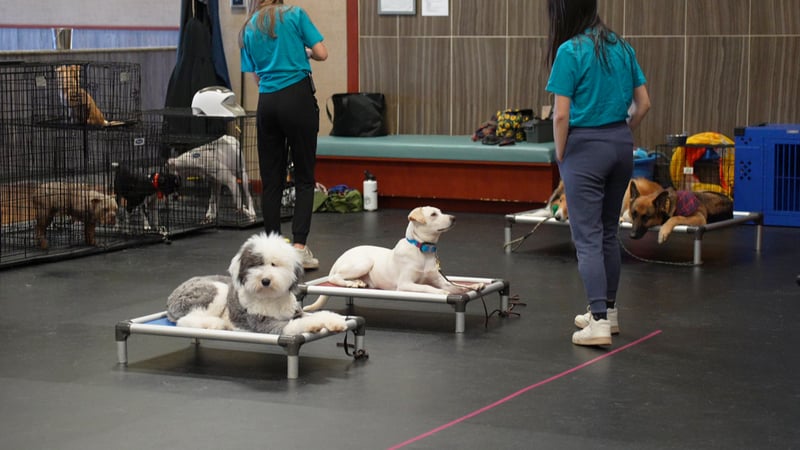
Week one asks less of the dog than week four will, on purpose, because the first goal is simply getting the dog to stop bracing for a fight long enough to be trained. A dog with a bite history walks into a facility that is not home, does not know the smell of it, and has not yet decided to trust the person holding the leash. Senior trainers keep the first several nights low-key on purpose: consistent handling, a predictable schedule, and no open group play.
Controlled, one-at-a-time exposure replaces anything resembling a dog park. For cases that call for it, a muzzle-conditioning pass is part of the safety structure: a tool the dog is taught to accept calmly, not a punishment.
Baseline obedience gets rebuilt here too: place, crate, and a release cue the dog listens to under mild pressure. None of it looks dramatic from the outside. It is the floor everything in weeks two and three stands on.
Weeks Two and Three: Threshold Work and Controlled Exposure
This is where the trigger work happens, at a distance the dog can handle without going over threshold. If the case is territorial, the trigger might be someone approaching a gate. If it is aimed at specific people, the trigger might be a stranger's hand reaching toward the dog's head. Every session starts at a distance where the dog can still think, then closes that distance by inches, never by feet, as the dog shows it can hold a job instead of reacting: a place command, a heel, a hand target.
Trainers log wins and setbacks every day, and the plan for week four gets adjusted based on what weeks two and three show in the room, not what the intake paperwork predicted. A dog that is further along than expected moves into harder exposures sooner. A dog that needs more repetition gets it, even if that means week four opens with less proofing than the family was told to expect at Day One.
Week Four: Proofing, Demos, and Preparing the Household
Proofing means testing the training under conditions that look like real life, not the quiet training floor from week one. The video demo comes first, filmed so you can watch your dog's handling from outside the room before you are standing in it yourself. Then come the two working demos, where you or your family step onto the field with the trainer and practice the exact cues that will matter at home: releasing your dog from a place command, walking past a triggering distance, handling a hand-off at a doorway.
None of this guarantees a finished dog. Partners Dogs gives a plain prognosis at the PD360 stage and holds to it through week four: some dogs transform fully, others improve significantly with lifelong management built in, and a few have limits training cannot move past. Families are told which category their dog is heading toward before pickup day, not after.
Start here
Find Out If Your Dog Is a Transform Camp Case
A PD360 Assessment maps the specific triggers behind the aggression and tells you in plain terms whether the 28 nights are the right fit, or whether a shorter program covers it.
What the Family Does During the Four Weeks
Your dog is boarded, but the four weeks are not something that happens to your family from a distance. Senior trainers handle the dog day to day, but you are expected to show up for the two working demos, watch the video demo when it arrives, and start reading through the material for the 12 Pet Parenting classes before your dog is even home. The homework during camp belongs to the family, not the dog: learning the same handling language your dog is learning, so week four does not land on a household that spent 28 nights waiting instead of preparing.
Families describe the same balance of limited access and real visibility across Partners Dogs' board-and-train stays. We received daily updates, pictures, videos and training information,
wrote Devon F., Cave Creek, of her dog's stay. Reading those updates closely, not just skimming them for reassurance, is the actual homework, since it is what keeps the transition lesson from starting the family at zero.
The Transition Lesson and the In-Home Follow-Up
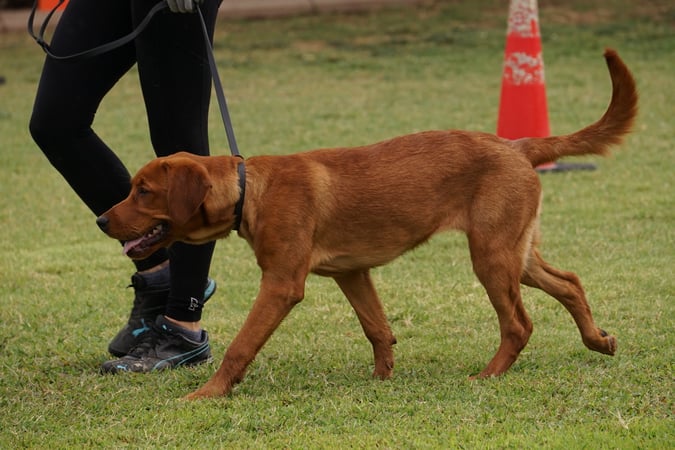
The transition lesson happens on campus, and the in-home follow-up happens somewhere the campus cannot reach: your own front door. A dog that holds a boundary on a training field does not automatically hold it at a doorway with a different floor texture, a different sound when the bell rings, and no orange training cones marking the setup. The transition lesson hands the family the plan in the environment the dog already trusts. The in-home follow-up checks that same plan against your actual rooms, routines, and walk route, then adjusts what does not translate.
Families describe the same effect after the videos and materials keep arriving once the dog is home. All of their support materials and videos help us reinforce his new training at home,
wrote Ka'ryn C., Scottsdale, after her own family's board-and-train stay. The point of the in-home visit is the same: the plan does not stop working the day your dog gets in the car.
The 24 DayCamp Days and 12 Classes That Come After
None of the follow-up is billed separately. The 24 DayCamp reinforcement days and 12 Pet Parenting classes are already part of the same price that covers the 28 boarded nights, not an add-on families discover later. Current rates for the full package are on the pricing page, since they get re-checked at every publish.
The reason the follow-up exists at all is the same reason Partners Dogs is upfront about not promising a finished dog on day 28: severe cases need ongoing management, not a one-time fix. The families who stay engaged through the DayCamp days and the classes are mostly describing this exact stretch when they talk about what worked, the weeks after pickup where the plan either holds or gets skipped.
What the First Month Home Usually Feels Like
The dog does not forget the plan in the first month home, the household does. Twenty-eight nights of consistent handling changes a dog faster than four weeks of watching videos changes a family's habits. The dog learned to wait at the threshold before the door opens. A tired parent, home late from work, opens the door without asking for it once, and the dog notices the gap before anyone else does.
That gap is exactly why the 24 DayCamp days, the 12 classes, and the in-home follow-up exist instead of the program ending at pickup. A family that uses all three tends to keep what the 28 nights built. A family that treats pickup day as the finish line tends to watch the old behavior creep back in within a few weeks, not because the dog relapsed on its own, but because the structure around it thinned out first.
Frequently Asked Questions
How often will I hear from the trainer during the 28 nights?
You receive progress updates through the stay, and the program builds in a video demo plus two working demos so you see the change under controlled conditions instead of waiting for a single report at pickup. The exact cadence between those built-in touchpoints depends on the trainer working your dog's specific case.
Who actually works with my dog during Transform Camp?
Aggression and severe fear cases are handled by senior trainers only, the same trainer assigned from the PD360 Assessment through pickup. Your dog does not rotate between staff members during the 28 nights, and exposure to other dogs stays controlled and one at a time rather than open group play.
What happens during the video demo and the two working demos?
The video demo lets you watch your dog's handling from outside the room before you are standing in it yourself. The two working demos put you or your family on the field with the trainer to practice the same cues under supervision before pickup, so the skills do not have to be explained from scratch once you are home.
What is the difference between the transition lesson and the in-home follow-up?
The transition lesson is on campus, in the last days of the stay, and it is where the trainer teaches your family the handling plan for the first time. The in-home follow-up is a separate visit, later, at your house, where the trainer walks your specific doorways and routines with you and adjusts anything that does not hold up outside the training field.
What does the first month home usually look like after Transform Camp?
Most of the structure holds if the family keeps using the same cues and consequences the trainer used, and it starts to slip where the household reverts to old habits faster than the dog reverts to old behavior. The 24 DayCamp days and 12 Pet Parenting classes exist specifically to catch that gap before it becomes a setback, not as an add-on sold after the fact.
When you are ready
Give Your Dog the 28 Nights
Transform Camp starts with the same PD360 Assessment described above, then moves straight into the plan built for your dog's specific case.
Keep reading