
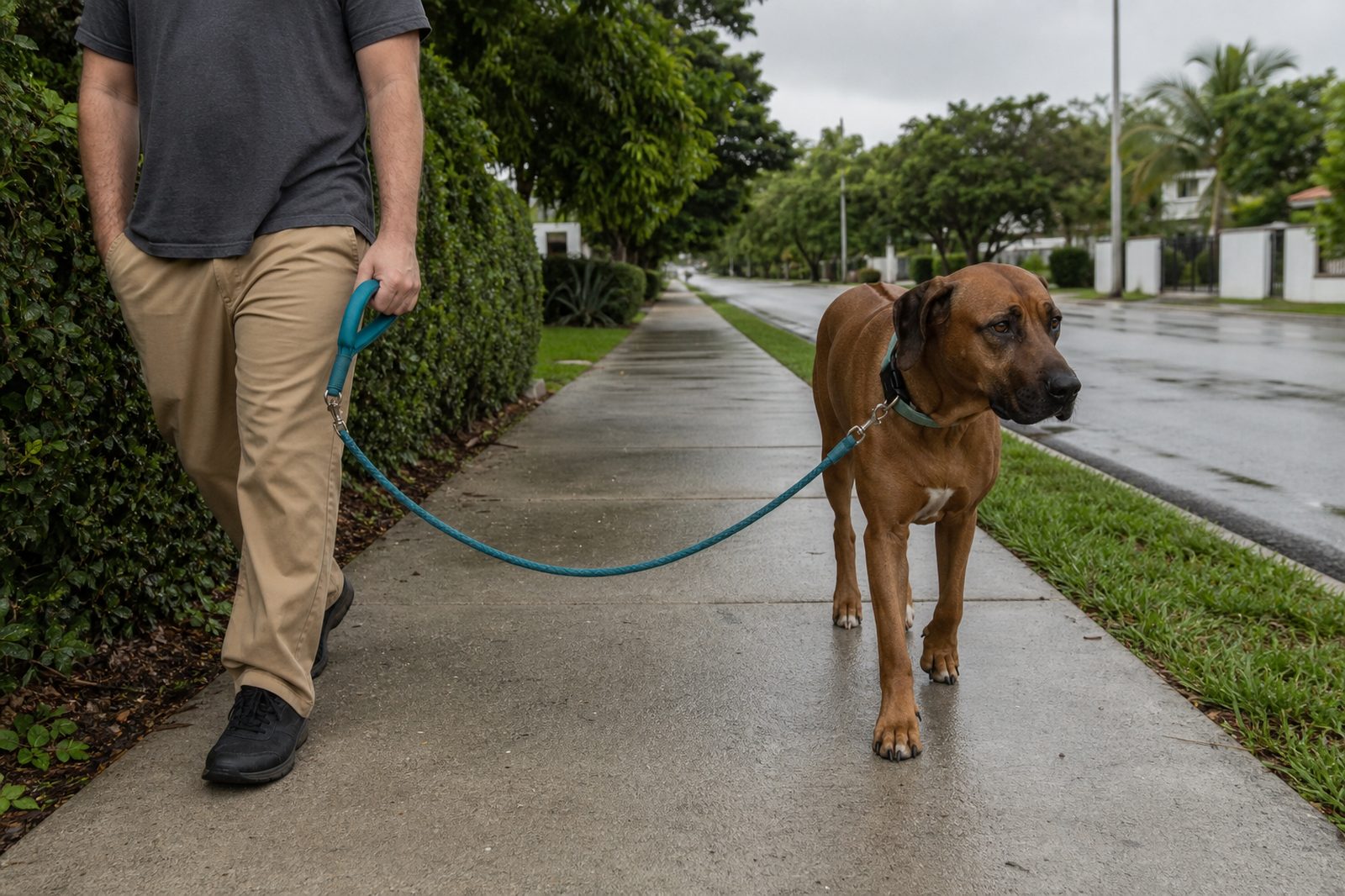
Does a prong collar apply more pressure than a flat collar?
Yes, at the point where a prong’s link touches skin, pressure is measurably higher than under a flat collar carrying the same pull, because the same force lands on far less contact area. What that leaves out is time: a properly fitted prong delivers that pressure for a fraction of a second and releases the moment the dog stops pulling, while a flat collar or front-clip harness under a dog leaning into it applies lower pressure continuously, across the front of the throat, for the whole walk. Fit and instruction decide which outcome a dog actually gets.
The usual assumption runs in a straight line from how a tool looks to how much it hurts: a collar covered in metal points must be worse than a plain buckle collar, because it looks worse. That line skips the actual physics. A prong collar does concentrate force at a small number of contact points, but whether that adds up to more total pressure on a dog’s neck than a flat collar depends on how long the pressure lasts and where it lands, not on how many spikes are visible from across a parking lot. The fuller version involves force divided by area, a self-limiting mechanical stop, and how long that pressure sits on a dog’s neck, three variables most collar debates never separate.
How Does a Prong Collar Physically Work?
A prong collar is a loop of interlocking metal links, each ending in a blunt prong that curves inward toward the neck. When the leash goes taut, the loop tightens slightly and the prongs press inward around the full circumference, not only the front. The moment the leash goes slack, the pressure releases with it.
The mechanical detail that matters most: adjacent links meet and stop the loop from closing further once the prongs reach the neck. A slip collar or check chain has no such stop and can keep tightening as long as a dog keeps pulling. A prong collar cannot. That built-in ceiling is the physics claim worth stating plainly, separate from any claim about whether it hurts less, which is the contested part.
Is the Prong Collar vs Flat Collar Pressure Math Right?
Yes. Force divided by area is pressure, and a prong collar does concentrate more of it onto less surface than a flat collar’s webbing does. The most detailed public version of this math comes from the training blog eileenanddogs.com: a 5-pound pull spread across a flat collar’s roughly 14 square inches of neck contact works out to about 0.36 psi, while that same 5 pounds concentrated onto an 18-prong collar’s roughly 0.09 square inches of metal-to-skin contact works out to about 56 psi. Loosen the fit and the gap narrows but does not close: their looser-fit scenario put flat-collar pressure at 1.44 psi against 71.4 psi for the prong.
Those figures assume one dog, one pull force, and one prong count. Treat them as an illustration of the physics, not a fixed fact about every prong collar sold. The physics itself is not in dispute. What is incomplete is treating peak psi at a single instant as the whole story.
What Does the PSI Math Leave Out?
Total pressure on a dog’s neck is peak force times how long it lasts, and the psi comparison above only measures the first half of that equation. A dog leaning into a flat collar or front-clip harness for the length of a walk applies lower pressure, but applies it continuously, for minutes at a stretch, concentrated on the front of the throat where the trachea sits closest to the surface. A properly fitted prong is built around the opposite pattern: a brief correction measured in a fraction of a second, released the instant the dog responds, spread around the neck’s full circumference instead of stacked on the tracheal front. One veterinary-reviewed consumer resource makes the same location point: supporters describe pressure spread around the circumference, critics note most owners are not trained in correct fit, and both are separate from the psi-magnitude math above.
Peak psi at a prong’s contact points is higher than under a flat collar; that arithmetic is correct. Duration and location are where flat collars and front-clip harnesses lose across an ordinary walk with a dog that pulls hard the whole way. A reader weighing both is comparing fairly. A reader who stops at the psi number is not.
Get the fit confirmed
See Correct Fit Before You Decide
An instructor can show you sizing and placement, and what a correction should actually feel like under your own hand, on your dog. All of it happens before any tool goes home with you.
Who Actually Fits This Right, and What Does AVSAB Say?
AVSAB’s 2021 Position Statement on Humane Dog Training names prong collars specifically as a tool that involves pain and states aversive methods should not be used, with no stated exceptions. We do not dispute that is what the statement says.
What decides the outcome on an actual dog is who is doing the fitting, not a position statement. Our instructors size and demonstrate correct placement in person, on the dog in front of them, not a package insert or a first guess at home. That is one piece of a program that has run since 1997 across 70,000+ dogs, staffed by a multi-trainer team on purpose-built Scottsdale and Cave Creek campuses, where the person sizing a collar has done it under supervision hundreds of times before doing it alone. Every dog that leaves with one on has gone through a conditioning process first: introduced at rest, paired with reward, checked against a calm dog before it is ever asked to hold up under leash pressure. That process is the credibility, not a credential and not a position statement.
Is a Prong Collar Humane?
The honest answer is narrower than yes or no: a properly fitted prong used for brief, released corrections is a different physical event than a flat collar or front-clip harness under sustained pulling, not a categorically painless one and not a risk-free one with a poor fit. “Prong collars don’t hurt” is not a claim we make. Neither is “prongs are safer, full stop.” Front-clip harnesses and head halters get marketed as gentle alternatives, and they still work partly through discomfort and restriction: a chest strap that tightens under the front legs and a fitted noseband that turns the head both apply pressure to change behavior. Calling one quadrant humane while treating another as though it does not apply is the inconsistency worth naming, not anyone’s sincerity.
Even purely positive-marketed training uses more than one quadrant: withholding attention, ending play, a timeout, and taking away a toy are all negative punishment by the discipline’s own definition. They just rarely get marketed that way. We are balanced because we use anything and everything at our disposal, weighted heavily toward reward, and we would rather say that plainly than dress up a correction as something else.
When Is a Flat Collar or Front-Clip Harness the Better Choice?
A light puller, a young dog still building leash skills, or a dog with no lunging or redirected-bite risk is often better served by a flat collar or front-clip harness and consistent training, not a prong. The physics above matters most for a dog whose pulling is strong and sustained enough that the flat-collar alternative is producing exactly the ongoing pressure this piece is concerned about: low-grade throat pressure spread across a week of walks. A prong is a tool for that dog, not a default for every dog that glances at a passing bicycle.
This is also where equipment stops being able to do the whole job on its own. A dog pulls because pulling gets rewarded: it moves the dog toward a smell, a person, or a patch of shade faster than walking politely does. See the full breakdown in our pulling-on-leash guide: better equipment can improve comfort and control, but the dog still has to learn where the reinforcement happens.
What Does Correct Fit and Use Look Like on North Phoenix Trails?
Under unincorporated Maricopa County’s leash rule, a dog off its owner’s property must stay on a leash no longer than six feet and under direct control, so a strong puller on a busy trailhead near Desert Ridge or a greenbelt loop toward Cave Creek Regional Park stays under constant management pressure for the entire walk. That is where fit stops being a detail and starts being the whole outcome: a collar sized wrong either drags instead of self-limiting or never fully releases between corrections, and a dog with no conditioning to the tool reacts to it as a surprise instead of information.
"Did a great job and would very highly recommend. Took their time, explained everything."
Leonard S., Cave Creek
That explanation is where our private lessons earn their keep: sizing the collar, showing where it should sit, and walking a new owner through what a correction should feel like before it ever goes on a dog. An instructor fits and demonstrates correct use in person, on your dog, on your route, instead of leaving a package insert to do the job. That standard is not just something we say about ourselves: it shows up in the same kind of fitting sessions described across our 4.8-star rating from 2,000+ reviews.
Material choice matters too. Chrome, black stainless, and Curogan wear differently in desert heat, and we cover that separately in our prong collar materials guide rather than repeat it here. A shop visit for a properly fitted collar, plus a fabric martingale cover for sensitive coats, rounds out the physical side of getting this right.
Frequently Asked Questions
Do prong collars create more pressure per square inch than flat collars?
Yes, for the same amount of pull force. A widely cited calculation from the training blog eileenanddogs.com put a flat collar at roughly 0.36 psi under a 5-pound pull and a properly sized prong collar at roughly 56 psi under that same pull, because the force lands on far less contact area at each prong point. Treat those numbers as an illustration of the physics, not a universal fact about every prong collar, since fit and pull force change the math.
Why doesn't a prong collar keep tightening the way a slip collar can?
The links are built so adjacent links physically stop the loop from closing further once the prongs reach the neck. A slip collar or check chain has no equivalent stop and can keep tightening for as long as a dog keeps pulling. That built-in ceiling is a meaningful mechanical difference, separate from any claim about which one hurts less.
Does a prong collar spread pressure around the whole neck instead of the front of the throat?
That is the design intent, and it is a distinct geometric claim from the pressure-magnitude question above. A properly fitted prong presses inward around the full circumference at once; a flat collar or slip lead under a pulling dog concentrates pressure on the front of the neck, where the trachea sits closest to the surface. Fit determines whether a prong achieves that even distribution or rides crooked instead.
What does AVSAB's position statement say about prong collars?
AVSAB's 2021 Position Statement on Humane Dog Training names prong collars specifically as a tool that involves pain, with no stated exceptions. We do not dispute that is what the statement says. What we control is who fits the collar: our instructors size and demonstrate correct placement in person, on your dog, backed by a conditioning process and a multi-trainer team that has done this across 70,000+ dogs since 1997, not a package insert or a first-time guess.
When is a flat collar or front-clip harness the better choice instead of a prong?
For a light puller, a young dog still building leash skills, or a dog with no lunging or redirected-bite risk, a flat collar or front-clip harness paired with consistent training is often enough on its own. A prong is a tool for a dog whose pulling is strong and sustained enough that the flat-collar alternative is producing steady pressure across a walk, not a default for every dog on a leash.
One session settles it
Get the Right Tool, Fitted Right
Whether a prong, a flat collar, or a front-clip harness turns out to be right for your dog, we will size it and show you correct use. Then we start training that makes the tool less necessary over time.
Keep reading