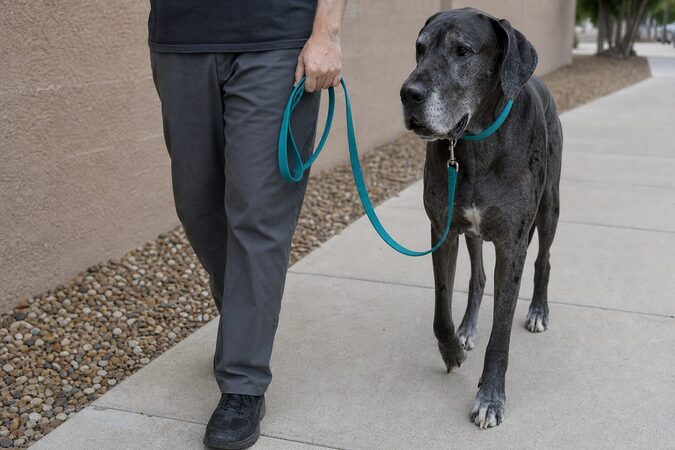
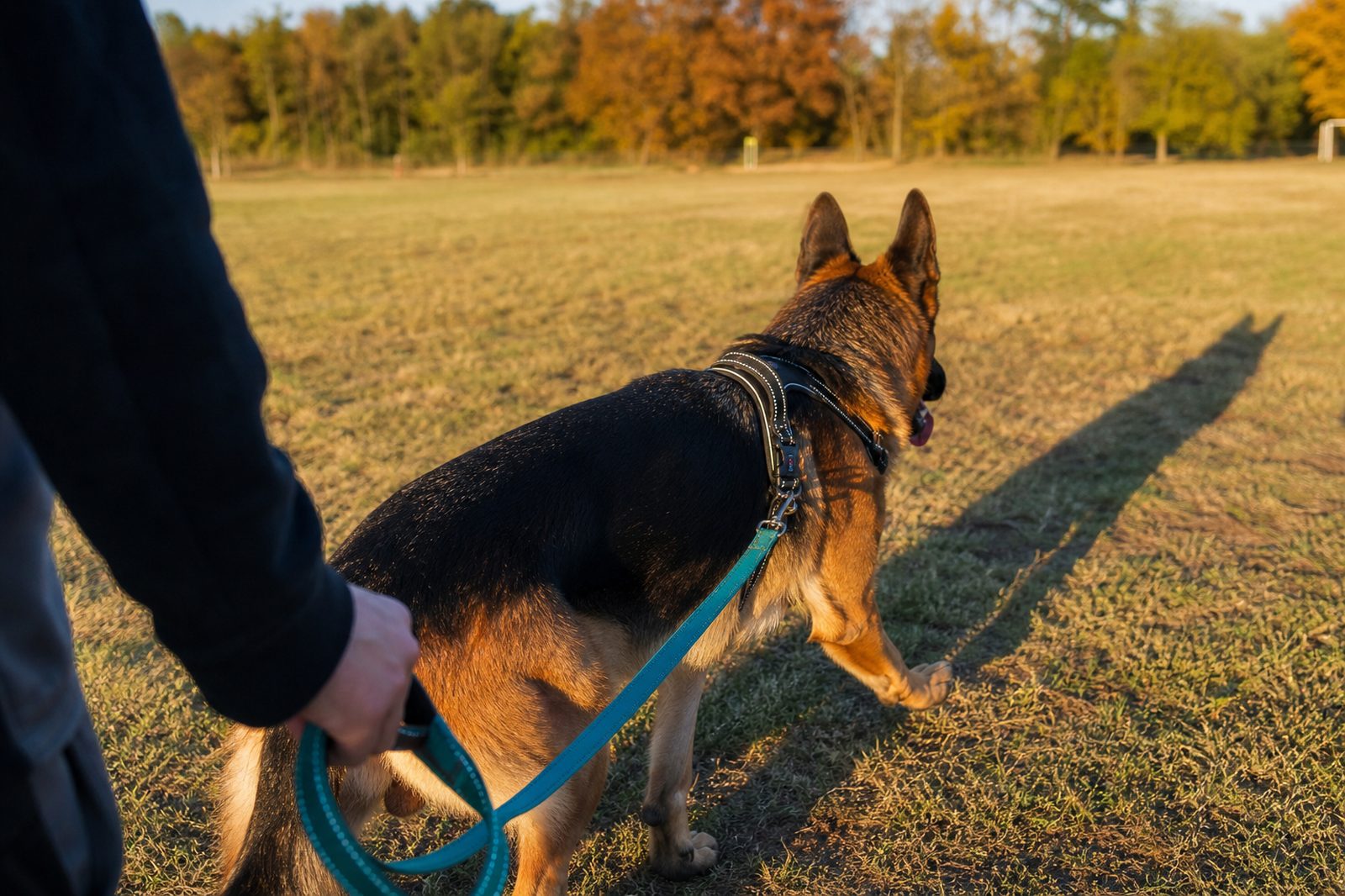
Two or three seconds of concentrated pressure, repeated a handful of times, against thirty or more minutes of steady strain for the length of the walk: that is the real prong collar vs harness comparison. A prong collar wins on peak pressure at the moment of a correction; a harness usually loses on the total force that adds up over a full route.
Picture a reactive-dog owner sitting in a parked car in the trailhead lot near Pinnacle Peak after a lesson, a prong collar turned over in one hand and a phone in the other, thumb hovering over a search bar that already reads "are prong collars cruel." A trainer just explained why this tool might work better than the harness sitting on the passenger seat. It still looks like a medieval device. The dog is asleep in the back, worn out from the lesson, completely unbothered by the question the owner is about to spend the next hour turning over alone.
That question deserves a full answer, not a reassurance. The complete version has two parts, and most articles on this topic only give one of them.
What Does AVSAB Say About Prong Collars?
The American Veterinary Society of Animal Behavior's 2021 position statement on humane dog training opposes aversive tools, prong collars named specifically, arguing reward-based methods are safer and at least as effective. We are not going to pretend that statement does not exist: prong collars misused, on the wrong dog, by an untrained hand, cause exactly the harm AVSAB describes. A properly sized collar and a trainer who conditions the dog to it before a live trigger is what keeps that harm from happening: that is the process our Scottsdale team runs on every fitting. It is also the reason "applies more force" is not by itself the right question to ask about a collar versus a harness on a walk.
Do Prong Collars Really Concentrate More Force at One Point?
Yes. At the moment of a correction, a prong collar concentrates pressure onto a small contact area, and that concentration is the entire mechanism, not a hidden side effect. Our full pressure-distribution breakdown covers the mechanics behind that; the short version here is how it stacks up against a harness. The shape of the tool makes this unavoidable: a handful of blunt points against a small patch of skin, instead of a flat band spread across several inches. A prong collar delivers a brief, localized, unmistakable sensation, and a harness spreads a much lighter sensation across a wider area.
A peer-reviewed study exists on this exact question. Carter and colleagues published a 2020 paper in Veterinary Record measuring pressure on a simulated neck model under a firm pull, a strong pull, and a sharp jerk, across several collar types. This article does not rank specific collar types against each other by that study's numbers. What the study does establish clearly: how loose or tight a collar sits changes the pressure distribution significantly. A loose collar concentrates force onto fewer contact points and raises the local pressure at each one. Fit, not the collar type alone, is the variable that decides how much pressure a dog feels.
So Which One Applies More Force Over a Full Walk?
Peak pressure at one instant and total force delivered across a forty-minute walk are two different measurements, and a harness usually wins the second one even though a prong collar wins the first. Picture a sixty-five-pound dog leaning into a front harness for the length of a loop around the Tom's Thumb trailhead, testing every passing car and every dog on the trail. That dog applies sustained tension against its own chest and the handler's arm for the full route, sometimes twenty or thirty minutes straight. Compare that to a dog wearing a properly fitted prong collar that gets two or three brief corrections in the first block, stops rehearsing the pulling, and walks loose the rest of the way.
Total force is roughly the pressure at each moment multiplied by how long it is applied, summed across the walk. A few seconds of concentrated pressure, repeated a handful of times, adds up to less cumulative force than thirty continuous minutes of a dog straining into fabric across its chest. That is what twenty-eight years of fitting both tools on actual dogs supports: a tool a dog stops testing quickly asks less of its body over a walk than a tool it keeps leaning into the whole way home. Neither number is the whole story alone.
| Measurement | Prong collar | Harness (front or back clip) |
|---|---|---|
| Peak pressure at the moment of pull | Higher, concentrated on a small contact area | Lower, spread across chest and shoulders |
| Duration per contact | One to three seconds per correction | Continuous for as long as the dog leans in |
| Typical total force across a full walk with an unresolved puller | Lower, corrections taper off after the first block | Higher, sustained strain the entire route |
| Where it depends most on fit | Sizing, correct number of links, placed high behind the ears | Chest strap position, whether it rides forward under the legs |
The bottom row reflects professional observation from thousands of fittings, not a lab measurement. No published study has weighed total cumulative force across a full walk for either tool.
Why Do Harnesses Make Strong Pullers Pull Harder?
Dogs have a built-in opposition reflex: steady pressure against the chest makes most dogs push back into it instead of yielding to it. A back-clip harness sits directly across the strongest part of a dog's body and hands that dog exactly the surface it needs to lean into, the same way a sled dog leans into a harness on purpose. A front-clip harness reduces this somewhat by redirecting the dog sideways instead of letting it pull straight, and it is a useful tool for a lot of dogs. Multiple trainer sources agree on the same limitation, though: strong, determined pullers compensate for a front clip within a few walks and go back to leaning, just at a slight angle.
Every harness on the market works this way by design: it distributes force so nothing ever spikes high enough to bother the dog, which also removes the one signal, mild discomfort, that would otherwise tell the dog to stop leaning. A dog under a harness gets no clear feedback that pulling toward the trigger is not working, so the behavior keeps getting rehearsed, block after block.
Not sure which tool fits your dog
A Trainer Can Tell You in One Lesson
Bring your dog's current gear to a private lesson at our Scottsdale training center and a trainer will show you, on your dog, whether a fitted prong collar or a better harness fit is the right next step.
When Is a Harness the Right Call?
A dog that does not pull does not need a prong collar, full stop. A well-fitted harness is right for a stable dog that already walks loose, a puppy still building leash skills before a pulling pattern forms, or a handler who cannot get in-person fitting on a new tool. The comparison in this article is for a narrower case: an established puller, often reactive, whose current gear is not stopping the behavior.
That is exactly the case where fit and supervision decide the outcome, not the tool alone. Every prong collar we put on a dog gets sized on that dog in person, conditioned to the sensation before it ever meets a live trigger, and checked by a trainer who has run this process across thousands of dogs since 1997, not handed over with a size chart and a hope. A harness sold off a shelf gets none of that oversight, which is part of why an unsupervised harness can still let a strong puller rehearse the exact behavior it was bought to stop.
What Does a Properly Fitted Prong Collar Look Like?
Every safety claim made above depends on correct fit, and correct fit is not something a dog owner should guess from a size chart at home. A prong collar sits high on the neck, directly behind the ears, snug enough that it cannot slip down onto the softer part of the throat, with the right number of links for the dog's actual neck size rather than whatever came in the package. That single loose-versus-tight variable is the one the 2020 Veterinary Record study flagged as changing pressure distribution the most. A collar sized wrong, worn too low, or left loose enough to shift concentrates force in exactly the way that turns a brief correction into a lasting problem.
This is the part a comparison article cannot show and a fitting appointment can: a trainer sizing the collar on the dog in front of them, showing an owner where it sits and why, and conditioning the dog to the sensation before it ever meets a live trigger. That process is the safety mechanism behind everything in this article: done in person at our Scottsdale training center, not far from the Pinnacle Peak and Tom's Thumb trailheads, rather than shipped in a box and strapped on blind. A private lesson built around tool fitting is a faster, more direct next step for a single dog with a pulling problem than a full program enrollment. Chrome-plated, stainless, and curogan prong collars are all sized and fitted this way rather than sold as a guess, and Partners Dogs carries all three lines in the shop for owners who already know what fits after that appointment. This pattern sits under our leash reactivity resources, worth a look if pulling is only one piece of a bigger walk problem. Partners Dogs has fitted tools like these on dogs from both locations since 1997, work reflected in a 4.8-star rating across 2,000+ reviews on our reviews page.
"Both of my puppies went to camp and learned so much. They are not tugging, pulling or lunging anymore and the support is invaluable."
Karen E., Scottsdale
Key takeaways
- A prong collar concentrates higher peak pressure into a two- or three-second correction; a harness spreads lower pressure but can sustain it for the length of a walk.
- Fit, not tool type alone, is the variable a 2020 Veterinary Record study found changes pressure distribution the most.
- The dog's built-in opposition reflex means steady pressure against the chest from a harness often makes a strong puller lean harder, not less.
- A dog that already walks on a loose leash does not need a prong collar; the comparison in this article matters for an established puller whose current gear is not working.
- No published study has measured total cumulative force across a full walk for either tool; the total-force comparison here reflects professional fitting observation, not lab data.
Frequently Asked Questions
Does a prong collar hurt more than a harness?
At the instant of a correction, a prong collar concentrates more pressure than a harness does, because that concentrated sensation is how it communicates with the dog. Over the length of a walk, a harness a dog pulls into continuously often delivers more total force and more sustained discomfort, because that pressure never stops long enough to give the dog a reason to change what it is doing. Neither answer is complete on its own.
Can a harness make a strong-pulling dog worse over time?
It can reinforce the pulling habit rather than fix it. Dogs have a built-in opposition reflex, so steady pressure across the chest from a back-clip harness gives a strong puller exactly the surface it needs to lean into, the same way a sled dog leans on purpose. A front-clip harness reduces this somewhat, but determined pullers often compensate within a few walks and go back to leaning at a slight angle.
What is the correct way to fit a prong collar?
A prong collar should sit high on the neck, directly behind the ears rather than resting low near the throat, snug enough that it cannot slide down or shift during a walk, with the correct number of links added or removed for that specific dog's neck size. A collar that is too loose concentrates pressure onto fewer contact points and can raise the local pressure at each one, which is the opposite of what a correctly fitted collar is meant to do.
Should I use a harness instead of a prong collar for my reactive dog?
If the dog is not currently pulling hard against the leash, a well-fitted harness is often the right, simpler choice and there is no reason to introduce a prong collar. If a dog leans into a harness for the length of every walk and the pulling has not improved with training, that ongoing strain is usually worse for the dog than a handful of brief, correctly fitted corrections that stop the behavior early. The right tool depends on what the specific dog is doing on leash, not a blanket rule either way.
Can I put a prong collar on my dog myself without training?
It is possible, but it removes the exact safeguard that makes the tool safe: correct fit and a conditioning process before the dog ever meets a live trigger while wearing it. A trainer sizing the collar in person, showing where it should sit, and introducing the sensation gradually is what keeps a prong collar working the way it is meant to instead of becoming the misuse story that gives the tool its bad reputation.
Who offers dog training in Scottsdale for a reactive dog's leash pulling?
Partners Dogs runs private lessons out of a Scottsdale training center built around exactly this problem: fitting the right leash tool to a reactive dog and coaching the handler through it, rather than shipping a collar or harness in a box and hoping it fits. For a dog whose current gear is not stopping the pulling, that in-person fitting is worth more than another size chart.
Get it fitted, not guessed
Have Your Dog's Leash Tool Sized and Taught by a Trainer
A private lesson at our Scottsdale training center fits the right tool to your dog's actual size and pulling pattern, then teaches you both how to use it before you ever need it near a trigger.
Keep reading