In short
Puppy fear periods are normal developmental windows, most often 8-11 weeks and again at 6-14 months, when puppies startle more easily and may suddenly fear familiar things. Each lasts about 2-3 weeks.
- Two common windows: 8-11 weeks, then 6-14 months. Timing shifts by breed and individual, and some puppies pass through so quietly you barely notice.
- A 2025 study of 4,497 dogs found adverse events in the first six months carry the most weight for adult fear and aggression. The effect scales with repeated adversity, not single everyday startles.
- Comforting a scared puppy does not reinforce fear. Calm support helps recovery. Frantic coddling teaches the panic response instead.
- During a fear period, drop to Teach-stage work: lower criteria, add distance, reward brave choices, let the puppy set the pace. Never flood.
- Keep socializing inside trusted, healthy circles. A fear period changes the shape of socialization, not the need for it.
If you are a Scottsdale or Cave Creek Pet Parent whose confident puppy woke up scared of the trash can, this guide is for you. Nobody expects the dog that owned the world on Tuesday to fear the trash can on Wednesday. It covers what puppy fear periods are, when they hit, what the newest research actually found, and the exact do-and-don't list our trainers run during these windows. For the framework behind every term below, see our methodology.
What is a puppy fear period?
A puppy fear period is a developmental window when your puppy's startle response turns up and familiar things can suddenly look dangerous.
This is a normal part of growing up. During these windows puppies become more sensitive to their surroundings and more likely to read people, objects, and sounds as threats. The triggers can be brand new things, or things the puppy walked past yesterday without a glance: a trash can on the curb or a person in a hat.
There is a survival logic underneath it. Behaviorist Patricia McConnell has described it plainly: in nature, this is when puppies leave the den and start exploring the world on their own. A puppy with no caution at that age is a puppy that does not survive. Caution is doing its job.
Watch for the signs: sudden avoidance of familiar things, extra barking, startling at noises, tucked tail, shaking, freezing in place, or clinging to you. What sets a fear period apart from general nervousness is the sudden onset. The brave puppy from Tuesday is the worried puppy on Wednesday. During these windows, fear is the working hypothesis. When a trainer runs a PD360 Assessment on a young puppy, the age gets checked before anything else: a dog in a fear window gets a different plan than a dog that is not. Outside them, reactivity runs on more fuels than fear alone: frustration, over-arousal, and self-rewarding chemical loops all drive it.
When do puppy fear periods happen?
Expect two windows: 8-11 weeks, then again between 6 and 14 months. Each usually runs two to three weeks.
The first fear period lands right when most puppies come home. Eight weeks is the standard go-home age, so your new puppy is adjusting to a new house, new people, and new rules while its caution dial is turned all the way up. That overlap is why the first weeks home need thoughtful exposure, not a firehose of new experiences.
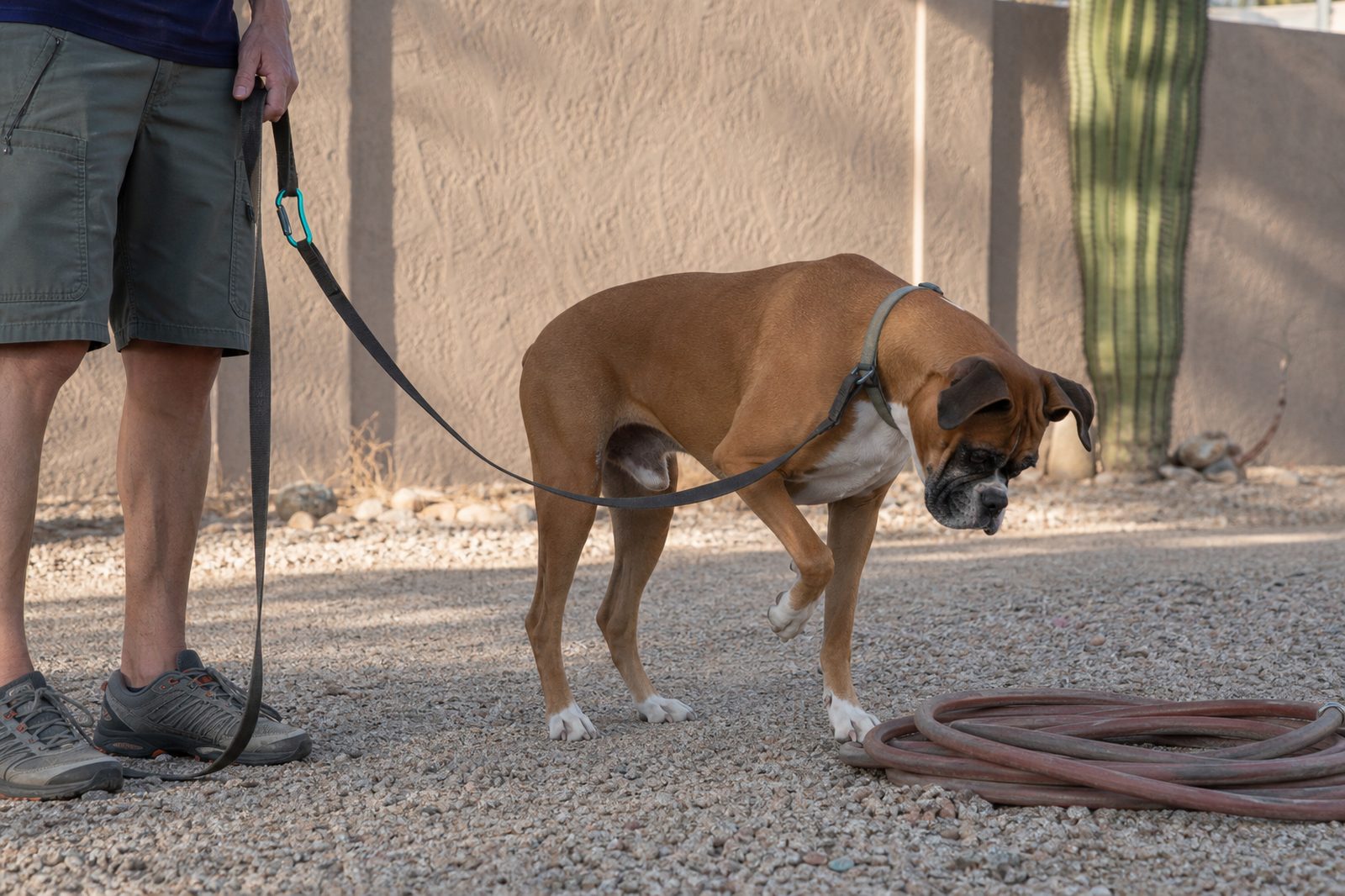
The second fear period lands in adolescence and catches owners off guard, because the dog now looks grown. Small breeds tend to hit it earlier, larger breeds later. It can feel like everything you taught fell apart overnight. The confident, engaged puppy from last week now freezes at a garden hose. That is the window at work, and it passes.
Timing varies by breed and by individual dog. Some puppies show both windows clearly. Others pass through so quietly you never notice, which is more common in dogs bred for steady temperaments. Assistance Dogs International noted in 2026 that well-bred assistance dogs often move through fear periods with reactions so mild their raisers miss them entirely.
What does the new research actually say?
Early adversity matters more than the old lore suggested, and single everyday scares matter less than the panic posts claim. The pattern decides, not the moment.
In October 2025, a Harvard-led team published a study of 4,497 companion dogs in Scientific Reports. The finding was clean: traumatic experiences during the first six months had the biggest impact on adult fear and aggression, lining up with a sensitive period when the nervous system is most plastic. Hecht, whose lab ran the study, put it directly: there is a critical period of development when the nervous system is more sensitive, and impacts during that time can have bigger effects.
Read the fine print before you panic. Two details matter.
First, the effect scaled with the number and frequency of stressors. The more adverse events, and the more often they happened, the stronger the link to adult fear and aggression. One bad moment followed by good patterns is not what moves the needle. Repeated bad patterns are.
Second, look at what the study counted as adversity: harsh punishments like beatings and alpha rolls, being attacked by another dog, getting hit by a car, living on the streets, chronic neglect. A startle at a trash can is not in that category. The internet mythology says one scary moment during a fear period ruins a dog forever. The research says repeated, serious adversity in the first six months leaves a mark. Those are different claims.
So the honest read runs both directions. Real trauma during these windows is serious and earns help from one of our trainers fast: an attack, harsh punishment, a genuinely terrifying event. Everyday startles earn calm management and good patterns afterward. When a puppy has one bad experience, the fix the research supports is several pleasant, low-intensity exposures to the same kind of thing, enough good reps to outweigh the one bad rep. Patterns compound in both directions.
What should you do during a puppy fear period?
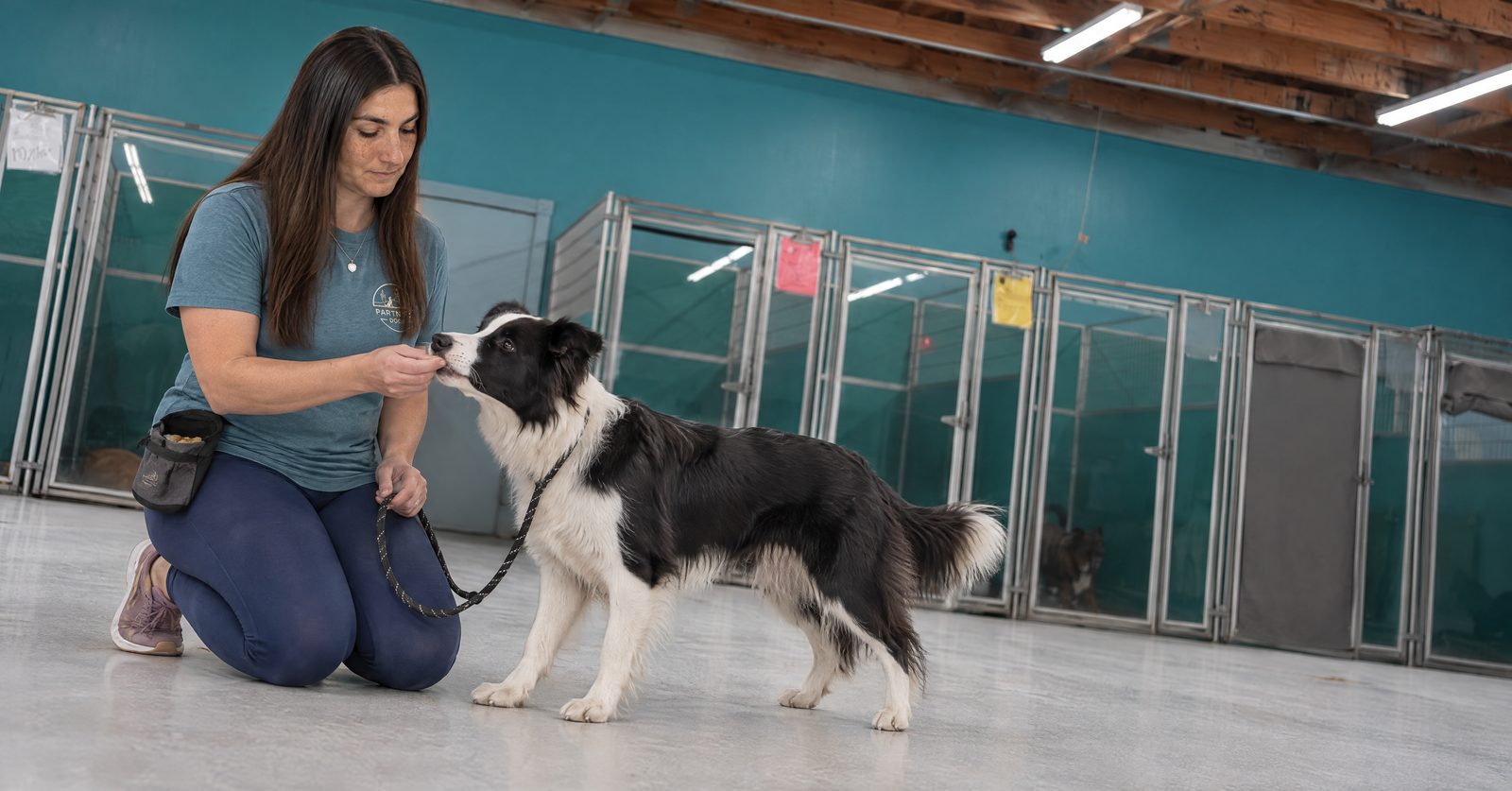
Drop back to Teach-stage work: quiet setups, low distraction, short sessions, and pay every brave choice.
A fear period is not the time to push forward. Confidence is a pattern you build, one brave rep at a time. Run these in order:
- Name the window. Check the age against the two windows. If it fits, expect two to three weeks of extra caution, and plan your outings around it instead of through it.
- Lower the criteria. Add distance from anything iffy. Shorten sessions. Turn the volume down on the whole week. A shorter, easier session the puppy wins beats a long one it survives.
- Reward brave choices. Mark and pay curiosity, approach, and recovery. The puppy glances at the scary thing and looks back at you: that gets paid. Every rep. In the Teach stage, the pay rate stays high.
- Let the puppy set the pace. Watching from a distance counts as work. Approach is always optional, and the escape route stays open. A puppy that chooses to investigate learns the world is survivable. A puppy that gets dragged learns it is not.
- Pair the scary thing with good things at low intensity. This is desensitization, run as classical conditioning: the scary thing appears at a distance, treats appear; the scary thing leaves, treats stop. The puppy's feelings about the trigger change before you ask anything of the behavior. In our classes, this is the work between the exercises: easy reps, high pay rate, a trainer adjusting the distance for each puppy.
- Keep the household patterns steady. Same routine, same cues, same calm rhythm from everyone in the house. Dogs work in patterns, and a steady pattern is the fastest way to tell a worried puppy the world is still predictable.
- Manage the full-strength version. Cross the street. Skip the loud event this weekend. Avoidance during a fear period is management. Management is not punishment.
What should you not do during a fear period?
Do not flood, force, frantic-coddle, or punish. Every one of those teaches the puppy the wrong lesson.
- Flooding. Dragging the puppy to the scary thing to "show him it's fine" is the fastest way to prove the opposite.
- Forcing. Holding the puppy in place while it panics, or luring it toward the thing it fears. Choice is the whole game during a fear period. Remove the choice and you remove the learning.
- Frantic coddling. This is the one people get backwards. Calm comfort does not reinforce fear: fear is an emotion, and you cannot make an emotion stronger by adding something kind. A veterinary review of fear protocols states it plainly: a negative emotion cannot be rendered more negative by adding something positive. What does cause damage is the frantic production, scooping the puppy up in a panic, high-pitched wailing at every startle. That marks the scary thing as a five-alarm event and rehearses the panic response. Comfort the emotion calmly. Reward the recovery.
- Punishing fear responses. Leash pops for barking at the scary thing. Yelling at a cowering puppy. Punishment stacks fear on fear, and the puppy now fears the trigger and you.
- Marathon sessions. An hour-long outing during a fear period builds nothing that ten focused minutes do not build better.
- Training in anger or frustration. The Hard Lines hold on puppies too. If you are frustrated, end the session.
- Skipping the vet when new fear is out of character. Fear that never lifts after a month or spreads to everything starts with routine, management and a PD360 Assessment, but new fear in an adult dog that is out of character calls for your vet. Pain and illness can drive behavior that looks like a training problem.
A note on correction, since we are a balanced training company: correction has a legitimate place in training. It is not here. Correcting a frightened puppy teaches the puppy to fear the scary thing and your reaction. We correct dogs at Partners. We do not correct fear.
Can you keep socializing during a fear period?
Yes. Socialization does not pause for a fear period. It changes shape.
Our position: socialize early, inside trusted, healthy circles you control. Known healthy dogs and calm people, in quiet settings where you set the distance and the duration. A random dog-park crowd is a lottery, and a fear period is the wrong week to buy a ticket.
During a fear period, keep the outings but lower the criteria: more distance from new things and shorter sessions, with the puppy deciding the pace. The socialization window itself runs from about 3 weeks to 12-14 weeks, which means the first fear period sits inside it. That is exactly why the early weeks need thoughtfully chosen exposure: less than everything, more than nothing. Fewer reps, better reps.
This is the exact work our Pre-School Puppy classes are built around: confidence, socialization, and desensitizing to sights and sounds, in groups of six dogs or fewer with master trainers. The Puppy track covers ages 5-12 months, which runs straight through the second fear period window. If your adolescent dog is suddenly spooked by the world, that classroom is the right address. For the full argument on how socialization should actually work, see our socialization position piece.
By the numbers
Myth vs. fact: puppy fear periods
| Myth | Fact |
|---|---|
| One bad scare during a fear period ruins a dog forever. | Research ties adult fear and aggression to repeated early adversity, not single everyday startles. A fright followed by calm, good patterns recovers. Patterns decide, not moments. |
| Comforting a scared puppy rewards the fear. | Fear is an emotion, and comfort does not make it stronger. Calm support helps the puppy recover. Frantic coddling is the problem: it rehearses the panic response instead of the recovery. |
| Stop all socialization during a fear period. | Keep going inside trusted, healthy circles, but lower the criteria: more distance, shorter sessions, the puppy sets the pace. A fear period changes the shape of socialization, not the need for it. |
| Fear periods happen once, around 8 weeks. | Two common windows: 8-11 weeks and 6-14 months. Timing shifts by breed and individual, and some puppies pass through so quietly you barely notice. |
What fits your dog
Match the program to the dog
Confidence now, assessment if it spreads. If fear keeps growing, generalizes, or comes with aggression, a PD360 Assessment reads your dog across nine dimensions and routes the case. For fitting adolescent confidence work inside the window, Pre-School Puppy runs confidence reps in small groups with master trainers.
Key takeaways
Key takeaways
- Puppy fear periods are normal developmental windows: 8-11 weeks, then 6-14 months, each lasting about 2-3 weeks (AKC; Rover).
- The 2025 Harvard study of 4,497 dogs found first-six-months adversity carries the most weight for adult fear and aggression, with effects scaling by number and frequency of stressors, not single everyday startles.
- Comforting a scared puppy does not reinforce fear. Calm support helps; frantic coddling rehearses panic.
- During a fear period, drop to Teach-stage work: lower criteria, add distance, reward brave choices, let the puppy set the pace. Never flood.
- Keep socializing inside trusted, healthy circles: known healthy dogs, calm people, quiet settings.
- Fear that generalizes, freezes a puppy for days, or comes with aggression is not a wait-it-out situation. That earns an assessment.
Where to go from here
A fear period is a few weeks of extra caution in a lifetime of confidence, provided the weeks get handled right. Lower the criteria and pay the brave choices. Keep the circles trusted. You and your puppy are figuring it out together, and the trainer's job is to stand beside you both until you do not need one. If your puppy is in the 5-12 month window, Pre-School Puppy was built for exactly this stretch. If the fear is outgrowing the window, start with the assessment.
Scottsdale: 8642 E Shea Blvd, 85260. Cave Creek: 4640 E Forest Pleasant Pl, 85331. Serving the Phoenix Valley.
Frequently Asked Questions
How long do puppy fear periods last?
Each fear period usually runs two to three weeks. The first lands around 8-11 weeks, the second between 6 and 14 months, with timing that shifts by breed and individual dog. Mark the calendar when the sudden skittishness starts. If it stretches past a month or keeps spreading to new triggers, that earns a PD360 Assessment, not more waiting.
Will comforting my scared puppy make the fear worse?
No. Fear is an emotion, and comfort does not make it stronger. Calm support, a steady voice, and treats for brave choices all help your puppy recover. What does cause trouble is frantic coddling: scooping the puppy up in a panic at every startle teaches the panic response, not the recovery.
Can I keep socializing my puppy during a fear period?
Yes. Keep going inside trusted, healthy circles you control: known healthy dogs, calm people, quiet settings. Lower the criteria: more distance, shorter sessions, new things at the puppy's pace. A fear period changes the shape of socialization, not the need for it.
My 9-month-old dog is suddenly terrified of monsoon storms. Is this a fear period?
Possibly. The second fear period lands between 6 and 14 months, right on top of Arizona's June-through-September monsoon season, so a dog that used to sleep through thunder can suddenly start shaking. Work it like any fear: distance and a calm household rhythm, with rewards for calm choices. If storm panic does not lift between storms, get one of our trainers involved.
What is the first step if my puppy's fear keeps getting worse?
Book a PD360 Assessment. A senior trainer evaluates your puppy across nine dimensions, reads whether this is a normal fear period, an under-socialized dog, or a medic issue for your vet, then matches the case to the program. Fear that generalizes to everything, freezes a puppy for days, or comes with aggression is not a wait-it-out situation.