Short version
Rattlesnake season in Arizona runs March through October, but the calls start in February. That one-month head start is your whole advantage: snake-proof the yard in February, train the dog in March, and stay sharp through September, the busiest bite month of the year.
- Arizona rattlesnake season: March through October, per Arizona Game & Fish. Removal calls start in early February. February is the month to install fencing, before prime activity begins in March.
- Snake-proof fencing is the gold standard: 36 inches high (30 minimum), quarter-inch mesh, buried below grade, no gaps larger than a quarter inch. Nothing sold as a repellent has strong evidence behind it.
- Rattlesnakes cannot climb a smooth block wall. Height is the wrong variable. Sealing the gates and gaps is what matters.
- About half of snake bites happen in and around the house. Dogs meet snakes in their own yards, usually at dawn or dusk, and usually get bitten on the nose.
Rattlesnake season in Arizona means March through October on paper, but February in your backyard. February is when rattlesnakes start staging at their den entrances and removal crews take their first calls. For a Scottsdale or Cave Creek Pet Parent, that makes February the most important month of the year: your window to snake-proof the yard before the season peaks. This guide gives you the month-by-month timeline, the fence specs that actually work, the attractants to eliminate, and the dog routine that keeps the season boring. Boring is the whole goal: a season where your dog never meets a snake, and where a trained dog answers the meeting with a turn and a run instead of a strike.
When does rattlesnake season run in Arizona each year?
The short version: March through October, with February as the setup month and September as the danger month.
Arizona Game & Fish puts the main window at March through October in the warm desert. Around early May, heat pushes snakes toward nighttime movement. The August monsoon cools things down, daytime activity returns, and September becomes the busiest month for snakebite calls.
The honest complication: snakes do not carry calendars. Everything is temperature-driven, and rattlesnakes are most active in the 75 to 85 degree range. That is why February sees staging at den entrances and a warm November can stretch the tail.
February deserves its own note. In early February, rattlesnakes move toward their den entrances, and the first removal calls come from garages, sheds, and storage closets. By late February, calls shift to pool pumps, courtyards, and rock-pile erosion control. The snakes are not hunting yet. They are warming up near home base, and home base can be your garage or pool equipment.
| Month | What the snakes are doing | Your move |
|---|---|---|
| February | Staging at den entrances. First removal calls: garages, sheds, pool pumps, courtyards. | Install or repair snake fencing now. This is the sweet spot. |
| March | Short trips out: hunting, mating, drinking. Peak activity mid-morning. Bite counts still low. | Book avoidance training before the season fills up. |
| April | Dens empty out. Very high activity. Random yard encounters begin. | Audit the yard: wood piles, brush, debris, water leaks. |
| May | Heat pushes snakes toward nighttime movement, usually around early May. | Dawn and dusk vigilance for dogs. Add outdoor lighting. |
| June-July | Scorching days. Snakes hide by day, move by night. | Night potty breaks on leash, with a light. Check the pool pump area. |
| August | Monsoon cools temperatures. Daytime activity returns. | Stay sharp. Do not relax just because summer felt quiet. |
| September | Busiest bite month of the year. Roughly a fifth of Maricopa County's snakebite calls land here. | Peak caution on walks and in the yard. |
| October | Winding down, but still active. | Good month for a training refresher and a fence inspection. |
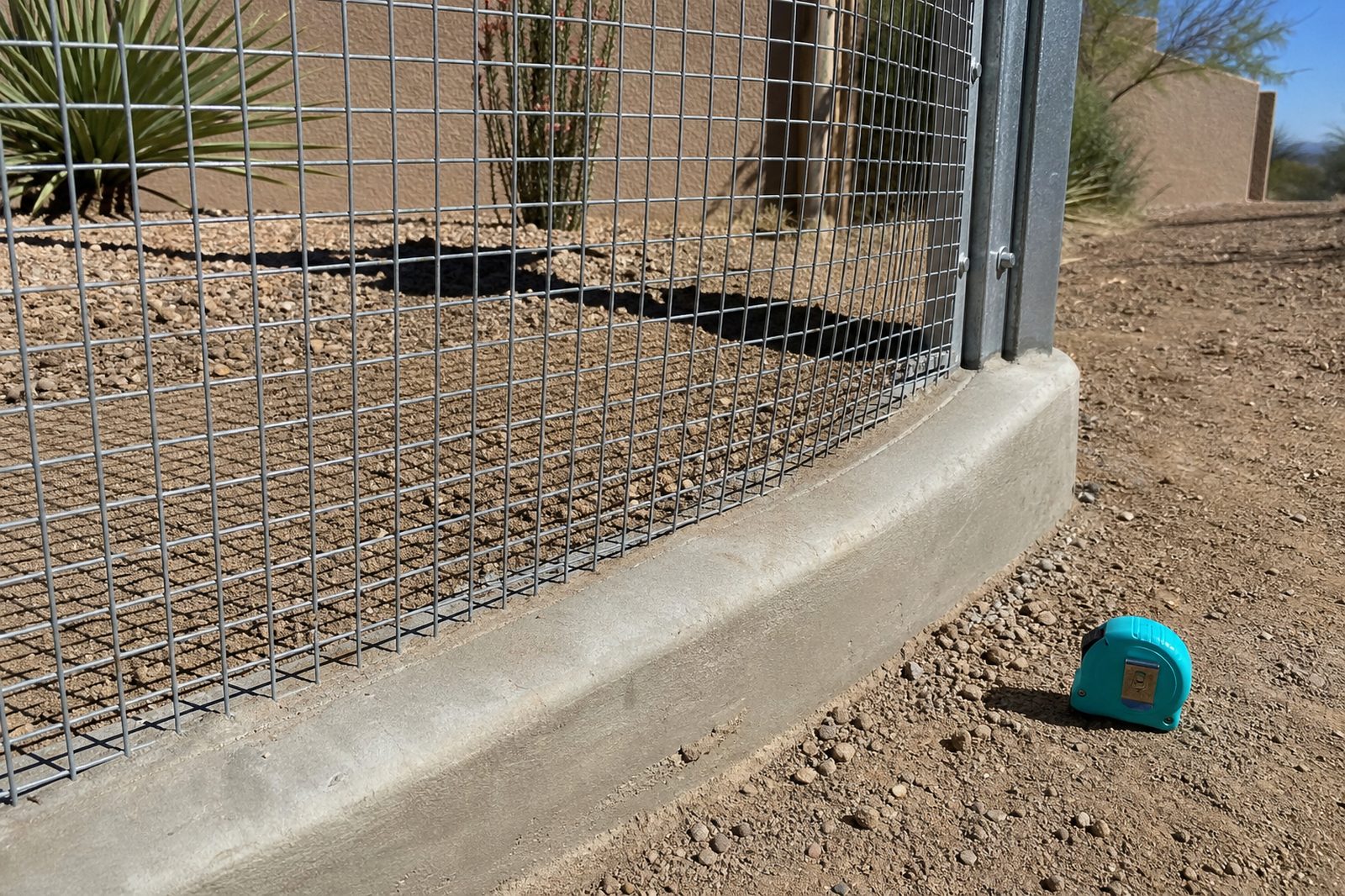
What does a snake-proof fence actually need?
The short version: 36 inches high, quarter-inch mesh, buried, sealed. Everything else is detail.
The University of Arizona calls snake-proof fencing the gold standard. It is the one method with real evidence behind it. The specs below come from removal crews who get called back when inferior fencing fails.
| Spec | The standard | Why |
|---|---|---|
| Height | 36 inches recommended, 30 inches minimum | Anything less likely leaves the yard unprotected |
| Mesh | Quarter-inch (or less) galvanized hardware cloth | Baby rattlesnakes fit through half-inch mesh |
| Bottom | Buried below grade, or sealed to concrete | Fencing that just sits on dirt develops access points from wind, wear, and rodent activity |
| Attachment | Screws, not zip-ties | Zip-ties break down in Arizona sun in a year or two |
| Ends | Anchored into block walls with concrete anchors | Snakes travel along walls; the ends matter as much as the middle |
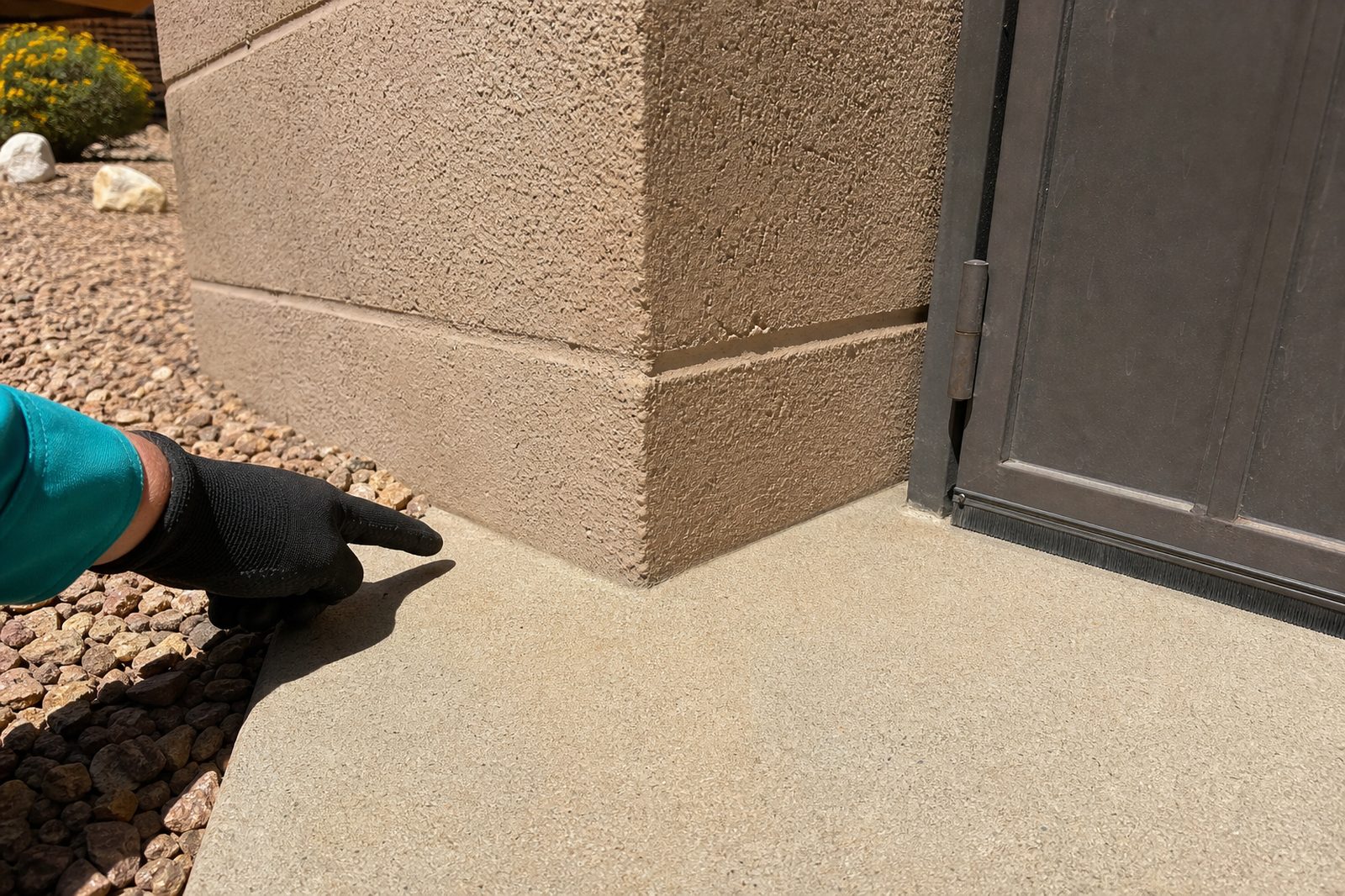
| Gates | Concrete curb within a quarter inch of the gate bottom; sides sealed | Gates are the most common failure point |
| Drain blocks | Sealed with the same mesh | One of the most common ways snakes get in |
| Final check | No gaps larger than a quarter inch, anywhere | Baby rattlesnakes are thin; if the mesh is bigger than a quarter inch, they get through |
Gates are the most common failure point: pour a concrete curb under the gate, sealed to within a quarter inch of its bottom, with door sweeps or fiberglass edging on the sides.
February is the month to do it, before the March rush. Think of February like the August before the school year: you buy the supplies before the bell rings, not after. The fence goes up before the March rush, not during it.
That is the second layer: avoidance as a conditioned default response. A fence is management. Training installs the response. In an avoidance session, the instructor times a low-level e-collar stim to the exact moment the dog notices the snake - scent, sound, or sight - and the dog's own flight response gets rehearsed until turning away is the default. The collar doesn't train the dog. The trainer beside you does. For how it works and where the evidence ends, read our rattlesnake avoidance training guide.
Start here
Book rattlesnake avoidance at Partners
About 15 to 20 minutes at Scottsdale or Cave Creek. The fence keeps snakes out. Training keeps your dog from investigating the one that gets in.
What attracts rattlesnakes to your yard?
The short version: food, water, and hiding spots. Take away all three and most snakes pass your yard by.
Rattlesnakes show up for food, water, and shelter. A yard with a pack rat problem is a yard with a snake problem waiting to happen. This is management before training, the order our trainers work in mid-lesson: change the yard first, then condition the dog inside the safer space.
- Wood piles, brush piles, rock piles, debris. Shelter. Clear them or move them away from the house. Rip rap and rock-pile erosion control are February call magnets.
- Rodents. Pack rats den in brush piles and draw hunting snakes. Secure trash cans. Keep the yard tidy enough that rodents have nowhere to live.
- Water. Pools, fountains, bird baths, dripping irrigation. Snakes drink here and ambush the rodents that do too. Fix leaks and seal cracks around water features.
- Overgrowth against the fence. Vegetation touching the fence line gives snakes cover at the barrier and can become a foothold. Keep a clear strip along the fence.
About half of snake bites happen in and around the house. The yard is the main arena, not the trailhead. It is the same pattern as car crashes: most happen within a few miles of home, because that is where you spend your time. Most snake meetings happen in your own yard, for the same reason.
Do snake repellents work?
The short version: no. Spend the money on the fence instead.
Every spring the products come back: mothballs, sulfur powder, ultrasonic stakes, essential-oil sprays. The University of Arizona is blunt about the whole category. Products that claim to repel snakes are largely ineffective, and there is no strong evidence they work. Rattlesnake Solutions puts it shorter: none of the anti-snake products being sold works.
| Myth | Fact |
|---|---|
| Mothballs scattered around the yard keep snakes away. | A home remedy with no strong evidence behind it, per the University of Arizona. |
| Ultrasonic stakes drive snakes off. | No strong evidence they work, per the University of Arizona. |
| A sprayed or powdered perimeter is enough protection. | Passive deterrents cannot guarantee anything. A nearby rock pile or a neighbor's overgrowth can bring snake traffic no perimeter spray stops. |
| If I do not see snakes, the yard is fine. | Most of the time you will not see the snake. Rattlesnakes rely on camouflage. Absence of sightings is not absence of snakes. |
Physical prevention wins because it does not depend on the snake's choices. A fence works whether the snake is hungry or just passing through. A repellent asks the snake to cooperate. Snakes do not cooperate.
Does your block wall stop rattlesnakes?
The short version: a smooth block wall stops them. The "6-foot wall" rule you read in a forum is not verified anywhere.
Some forum threads claim you need a six-foot wall to keep rattlesnakes out. We looked for a source behind that claim. There isn't one.
Here is what is verified. Rattlesnake Solutions tested every rattlesnake species in their service area, adults down to newborns, against an approximation of a standard Phoenix-area block wall. Rattlesnakes can climb trees, rough stone, and rough surfaces, but going up a smooth surface is not something they are capable of. A smooth block wall stops them at normal height.
Height is the wrong variable. What matters is smoothness (rough texture or ledges give footholds), the bottom (a gap under the wall is an open door), and the gates (a tall wall with a half-inch gap under the side gate protects nothing).
Walk your wall's perimeter. Look for gaps at the bottom, loose sections, and gate clearances you could fit a finger through. Fix those, and the wall you already own does the job.
How do you protect your dog during rattlesnake season?
The short version: manage the yard, manage the routine, and train the avoidance.
A dog leads with its nose, and most bites in dogs land on the nose or face. Dogs meet snakes in their own backyards as often as on trails, and the University of Arizona flags dawn and dusk as the highest-risk hours. Build the season around that.
- Snake-proof the yard in February. Fencing first. It is the only layer that works while you sleep.
- Clear the attractants. Wood piles, brush, rodent habitat, standing water, leaks. Run the audit above every spring.
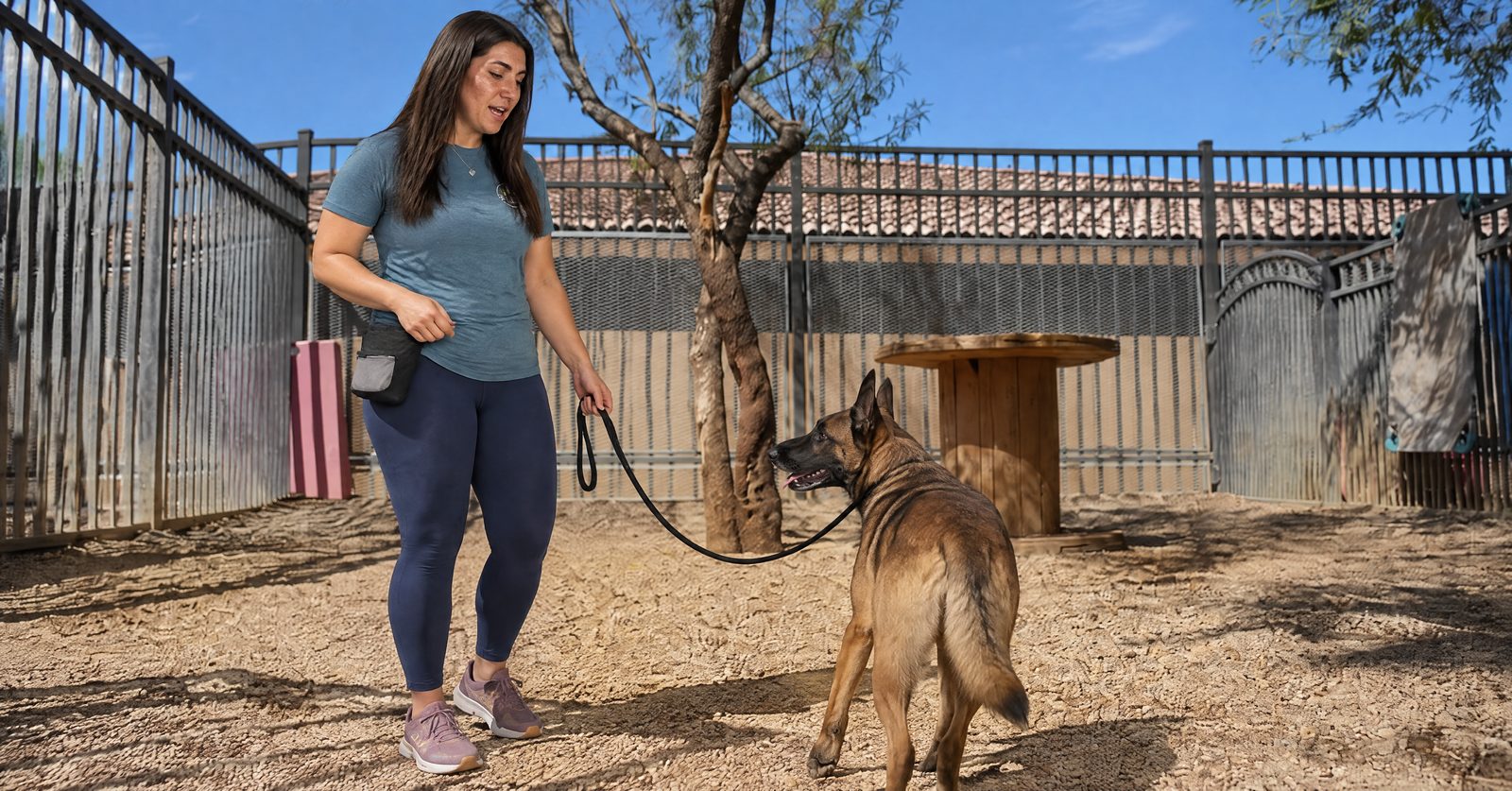
- Control the dawn and dusk routine. In peak months, the dog goes out on leash or into a cleared, fenced area. No unsupervised roaming at the hours snakes hunt.
- Train the avoidance. Avoidance training installs the default response: the dog smells or hears a rattlesnake and moves away on its own. The session runs about 15 to 20 minutes at either campus - live rattlesnakes behind double-mesh cages, a rehearsed flight response, and a dog that walks past the next snake instead of investigating it. The mechanism is operant conditioning under controlled conditions: the trainer reads the dog's arousal in real time, the turn-and-run gets marked and paid, and repetition installs it as the default before the dog ever meets a snake at speed. Book before the March surge, and refresh once or twice a year.
- Walk smart. Stay on marked trails - the McDowell Sonoran Preserve and Spur Cross are real snake country in March. Keep the dog close. Do not let it nose into brush, rock crevices, or wash banks.
If you find a rattlesnake in the yard: back off, bring the dog and kids inside, and call a professional. The Arizona Poison Center reports that up to 70 percent of reptile bites they manage were provoked, meaning someone was trying to kill, capture, or harass the animal. The Phoenix Herpetological Society runs a rattlesnake hotline at 480-513-4377, and professional removal runs a modest per-call fee. Cheap next to an emergency vet bill.
Know the law before you act. Rattlesnakes are protected wildlife in Arizona. You may kill one only when it presents a clear and immediate danger to people or pets. A snake that startled you from across the yard does not qualify, and several species carry extra protection. The legal move and the smart move are the same: call someone trained to remove it.
If the worst happens and your dog is bitten, our dog snakebite emergency guide covers exactly what to do. The short version: get to a vet immediately, keep the dog calm and still, and do not cut the wound, try to suck out venom, or use ice or a tourniquet.
On the rattlesnake vaccine: its license is conditional and its efficacy is not fully demonstrated, so it is not a substitute for fencing and training. Talk to your vet.
Avoidance as a conditioned default response, with management doing the heavy lifting at home: that is the method. Our methodology flagship lays out the framework.
Match the program to the dog
Book rattlesnake avoidance at Partners
About 15 to 20 minutes at Scottsdale or Cave Creek. The fence keeps snakes out. Training keeps your dog from investigating the one that gets in.
By the numbers
Mistakes that make it worse
- Trying to move or kill the snake yourself. Up to 70 percent of reptile bites managed by the Arizona Poison Center were provoked. Call the hotline instead.
- Buying repellents instead of fencing. Mothballs, ultrasonic stakes, and sprays have no strong evidence behind them. The fence does.
- Installing a half-measure fence. Half-inch mesh, zip-ties, a fence sitting on dirt, unsealed gates. Removal crews get called to yards with all of these.
- Letting the dog roam at dawn and dusk. That is when snakes hunt and when dogs meet them. Leash and light, or a cleared fenced area.
- Assuming the wall is enough. Walls fail at gates, drain blocks, and gaps at the bottom. Audit the perimeter every spring.
Key takeaways
Key takeaways
- Rattlesnake season in Arizona runs March through October, but February is when removal calls start and fencing goes in.
- Snake-proof fencing is the gold standard: 36 inches high, quarter-inch mesh, buried below grade, no gaps larger than a quarter inch.
- Repellents have no strong evidence. The "6-foot wall" rule is forum folklore. Smooth block walls already stop rattlesnakes; seal the gates and gaps.
- Dogs meet snakes in their own yards, usually at dawn or dusk, usually on the nose. Manage the routine and train the avoidance.
- Found one? Back off, call a professional, and know the law. Never handle it yourself.
Frequently Asked Questions
When is the best month to snake-proof my yard in Arizona?
February. Rattlesnakes start staging at their den entrances that month and removal calls begin, but prime activity does not start until early March. Install the barrier in February and it is up before the March surge. A spring audit of gates, drain blocks, and gaps keeps it working all season.
What is the first step to protect my dog from rattlesnakes?
Two layers. Snake-proof the yard with proper fencing: 36-inch quarter-inch mesh, buried and with sealed gates. Then book rattlesnake avoidance training: about 15 to 20 minutes at Partners Scottsdale or Cave Creek. The fence is management. The training installs the default response for the snake that still gets in.
Can a rattlesnake climb over my block wall?
Not a smooth one. Rattlesnake Solutions tested every species in their service area against a standard Phoenix-area block wall, and none could climb the smooth surface. They climb rough surfaces like trees and rock, so a wall with rough texture or ledges is different. Check smoothness, seal the bottom, and fix the gates.
Should I get the rattlesnake vaccine for my dog instead of training?
It is not an either-or, and the vaccine is not a substitute. Its license is conditional and its efficacy has not been fully demonstrated. Our vaccine guide lays out what Arizona vets actually say. Talk to your vet about whether it fits your dog, and keep the fencing and training as your primary layers.
What are the first steps after a rattlesnake bites my dog?
Get to a veterinarian immediately and keep your dog calm and still. Do not cut the wound, attempt to suck out venom, or use ice or a tourniquet. With quick treatment, 94 percent of pets survive. A typical Arizona vet bill runs into the thousands. Our emergency guide walks through the full protocol.
Where to go from here
February is the month that decides how your season goes. Walk the yard, check the fence line, and get the barrier up before March. Then get the dog trained, because the fence is management and the avoidance is the response. Our team runs rattlesnake avoidance at both campuses from March through October, and the calendar fills once the season starts.
Scottsdale: 8642 E Shea Blvd, 85260. Cave Creek: 4640 E Forest Pleasant Pl, 85331. Serving the Phoenix Valley.