In short
July is too hot for Valley trails, so Pet Parents head for elevation: Flagstaff (7,000 ft, July highs near 82°F), Sedona (4,300 ft, near 93°F), and Payson (5,000 ft, near 91°F). Hike before 7am, carry extra water, keep the leash on.
- Phoenix trails close to dogs at 100°F; Scottsdale's rule is stricter: over 90°F at any point in the hike is too hot for your dog.
- Elevation is the real escape: Flagstaff averages around 82°F in July, roughly 24 degrees cooler than Phoenix.
- Verified dog-friendly July hikes: Fatmans Loop and Elden Lookout near Flagstaff, Little Horse Trail in Sedona, Horton Creek Trail near Payson.
- Up north the leash stays on: leash rules apply on federal land, waste gets packed out, and fire closures get checked before you leave.
- Start by 7am, carry water for two, turn around when half of it is gone, and bail at the first sign of overheating.
In July, the smart move is not a tougher dog. It is a higher trailhead. Phoenix averages around 106°F in July, and at that temperature the Valley's trails are either closed to dogs or dangerous to them. The Phoenicians who hike with their dogs all summer drive north instead: to Flagstaff's pines, Sedona's red rocks, and Payson's creek canyons.
Why does July sideline most Valley trails?
Because the numbers stop being negotiable. The City of Phoenix prohibits dogs on every city trail when the temperature hits 100°F, and violating it can mean a Class One Misdemeanor with a fine reaching into the thousands and six months in jail (Arizona Humane Society). Scottsdale's rule is tighter: if it is over 90°F at any point in your hike, it is too hot for your dog (City of Scottsdale). In July, Phoenix averages around 106°F, so the Valley is effectively closed for daytime hiking with dogs.
The physics back the rules. When the air hits 90°F, trail and rock surfaces can reach 135°F (Scottsdale Fire Department, via Signals AZ). Dogs do not sweat the way you do. They dump heat through panting and, to a minor degree, through their paw pads. On a 135°F surface, a dog absorbs heat through its feet while panting hot air, and the math runs the wrong way fast. Old dogs and obese dogs overheat fastest, and medical conditions or medication move the line lower. Short-skulled breeds like Boxers, Bulldogs, and Pugs are the most vulnerable of all.
None of this means the summer is lost. It means the trailhead moves. Note that the trails at Camelback and Piestewa Peak stay off-limits to dogs year-round under a separate rule: read why Camelback and Piestewa Peak are off-limits to dogs before you plan anything near them.
How much cooler is it up north, really?
Cooler enough to matter. Elevation is doing the work. Flagstaff sits at about 7,000 feet with an average July high of 82°F (National Weather Service), roughly 24 degrees cooler than Phoenix. Payson sits near 5,000 feet with July highs around 91°F (WeatherSpark). Sedona, at about 4,300 feet, averages around 93°F in July (WeatherSpark): cooler than Phoenix by a real margin, but still hot enough that timing matters.
| Destination | Elevation | July avg high | Drive from Phoenix | Dog-hike pick |
|---|---|---|---|---|
| Flagstaff | ~7,000 ft | ~82°F | ~2 hrs (145 mi) | Fatmans Loop, Elden Lookout |
| Payson | ~5,000 ft | ~91°F | ~90 min (89 mi) | Horton Creek Trail |
| Sedona | ~4,300 ft | ~93°F | ~2 hrs (115 mi) | Little Horse Trail |
Elevation buys margin, not immunity: 93°F in Sedona at 2pm is still 93°F. Every town here demands a morning start, and the 90°F guidance does not care about your zip code.
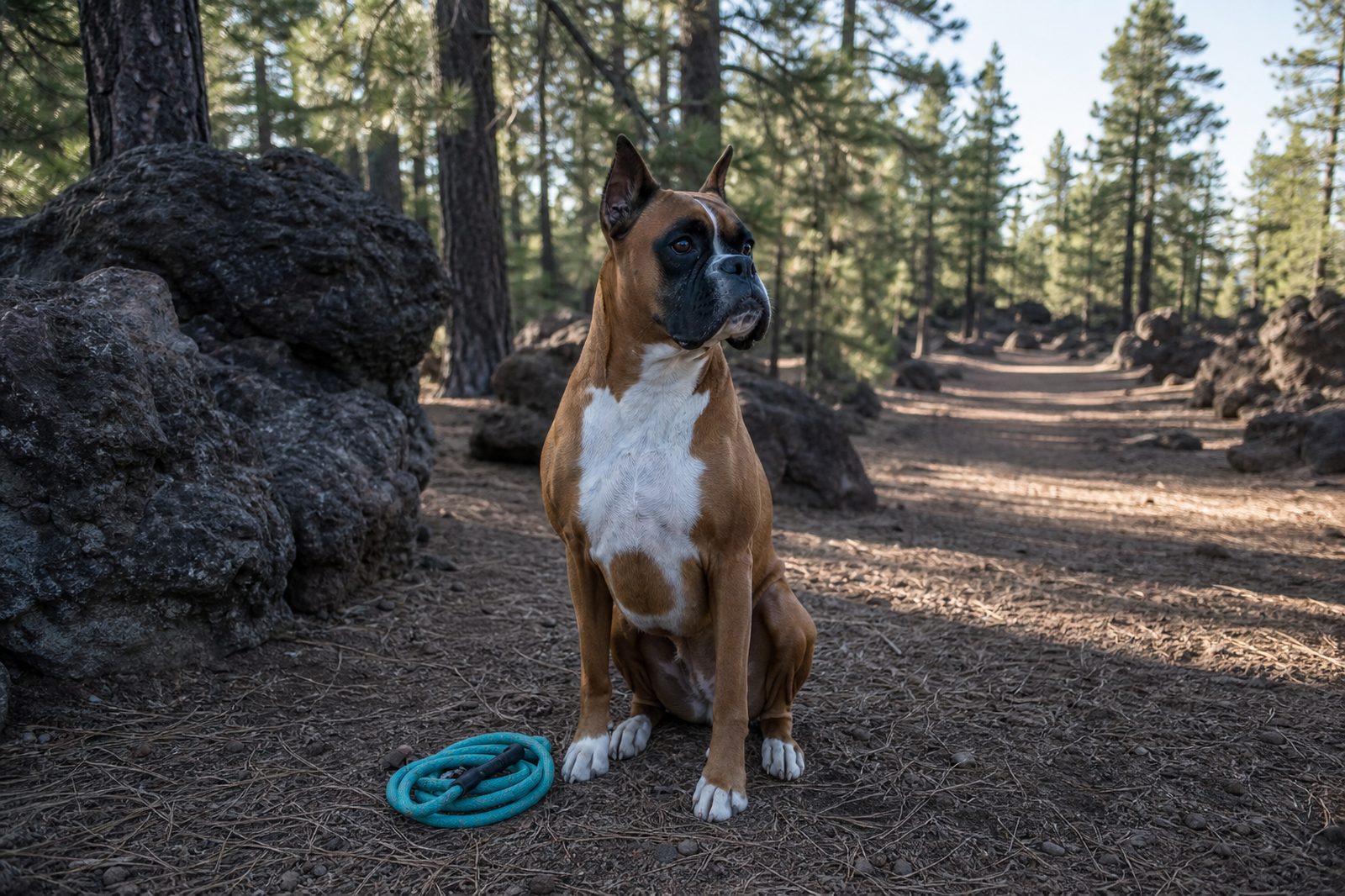
Where do Phoenicians hike with dogs near Flagstaff?
Flagstaff is the July headquarters: pines and real shade. The Mount Elden Dry Lake Hills trail system on the east side of town is where most Phoenicians land. Fatmans Loop Trail (yes, spelled Fatmans, no apostrophe) is the easy one: a mostly gentle walk through ponderosa pine and volcanic rock formations, starting at a trailhead already at 6,876 feet. Dogs must be on a leash at all times here, and the Forest Service is blunt about waste: if your dog goes, you bag it and carry it out. No leaving the bag "for later."
If you and your dog want a workout, the same trailhead feeds the Elden Lookout Trail: two miles and 2,404 feet of gain to the summit of Mount Elden. That is a serious climb, and in July the smart play is a dawn start, done by ten, for fit and conditioned dogs only. Everyone else takes the loop and the views.
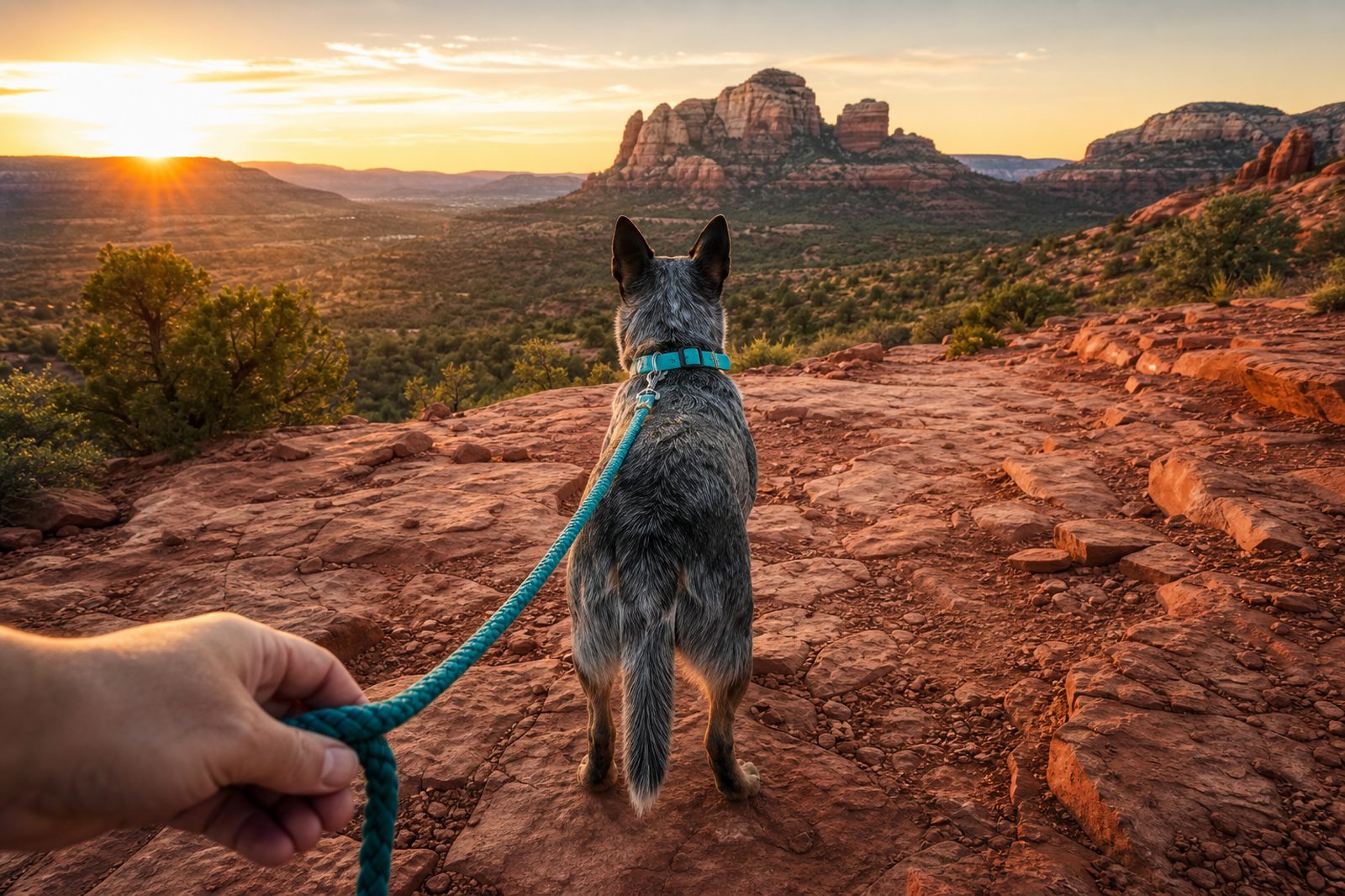
Can you hike with a dog in Sedona in July?
Yes, on the right trail at the right hour. Sedona's red rock country is dog-friendly, and the Little Horse Trail is the July pick: an easy to moderate out-and-back, about 2.1 miles one way with views of Bell Rock and Courthouse Butte, plus an optional spur to Chicken Point that brings the round trip to roughly 3.4 to 3.6 miles. Leashed dogs are welcome, and you will need a Red Rock Pass (or America the Beautiful pass) to park at the trailhead.
The catch is the thermometer. Sedona's July average high is around 93°F, and exposed red rock radiates heat. This is a sunrise hike or it is not a hike. Be parked and moving by 7am, done by 10, and skip it on days the forecast pushes past the mid-90s. There is no reliable water on the trail, so every drop your dog drinks comes out of your pack.
Where do dogs hike around Payson in summer?
Payson is the water option. The Horton Creek Trail (#285) in the Tonto National Forest follows Horton Creek through ponderosa pines: creek crossings and waterfall pools, with leashed dogs welcome to cool off in the creek. The full trail is about an 8.6-mile out-and-back, but the honest July version is shorter: the first two to three miles along the creek are easy and shaded, and you turn around whenever the day says so. The trailhead sits near 5,200 feet by the Upper Tonto Creek Campground, and you will need a Tonto Day Pass to park.
July is also monsoon season in Rim Country. The storms arrive as fast afternoon thunderstorms with flash-flood potential in creek canyons. The rule is simple: be off the creek and back at the car by early afternoon. Never hike a creek canyon under building clouds, and check the Forest Service alerts for fire closures before you leave. A trail that was open last weekend may not be open this one.
What are the leash rules on northern Arizona trails?
The leash stays on. Everywhere on this list. In Coconino County, dogs must be restrained by a leash no longer than six feet on public property, and that includes federal and state land. The Forest Service trailheads put it plainer: dogs on a leash at all times, waste bagged and carried out. Our full breakdown of trail etiquette with dogs in the McDowell Sonoran Preserve covers the same habits that keep northern trails open to dogs: short leash around other hikers, horses, and wildlife; yield the trail; pack out everything.
Two practical notes for July. First, monsoon-season crowds concentrate at the popular trailheads, and a dog on a six-foot leash is the difference between a good morning and an incident. The dogs that handle those tight, aroused trailhead crowds calmly are the ones that proofed the skill first: in our Group Classes, trainers stage passing-dog setups at distances they choose for your dog, long before the pair ever meets a real trailhead. Second, the rangers who enforce the leash rules enforce the fire rules too: no smoking, no campfires outside designated areas during restrictions, and check the current fire danger level before you go.
First step
Book a PD360 Assessment
A senior trainer reads your dog across nine dimensions and builds the plan: trail manners, heat sense, and the recall that holds when it matters.
What does a July hiking morning look like?
Done by 11, home with a tired dog and a story. One action per step:
- Check two things the night before. The forecast for the trailhead town, and the Forest Service alerts for closures and fire restrictions. July closures from wildfire activity are normal, and they change fast.
- Be on the trail by 7am. A 7am start puts the hard work behind you before the heat builds.
- Carry water for two. Plan on roughly 8 ounces of water per 20 pounds of dog per hour of hiking, with a quart per three miles as a planning floor. Offer water every 15 to 20 minutes; do not wait for the dog to ask.
- Run the surface test. Press the back of your hand to the ground for several seconds. If it burns you, it is cooking your dog's pads, and the hike is off.
- Turn around when half the water is gone. The return trip always takes water.
- Watch the sky as well as the thermometer. Monsoon storms build fast after noon. If clouds stack over the rims, get out of creek canyons and off exposed ridges.
- Check the dog when you get back. Paws, pads, ears, and a full coat sweep. Summer trails mean foxtails: read the foxtail post-hike check before anything near an eye or ear sends you to the vet.
For the full packing list behind this protocol, see our desert hiking gear checklist for dogs. It covers the water math, the first-aid kit, and what to do when a bootie twists mid-trail.
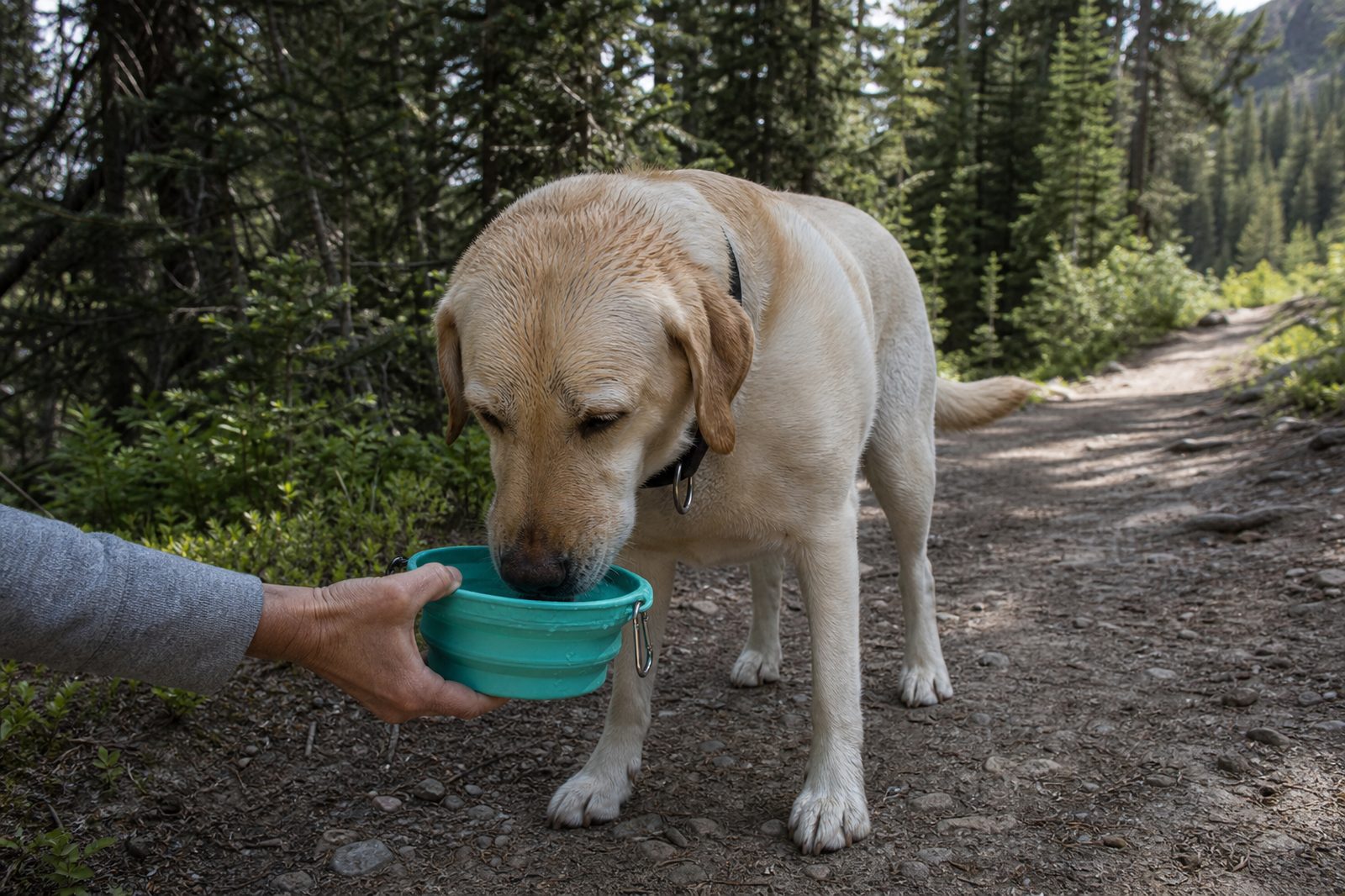
When do you call the hike off?
Before the dog tells you to. By the time a dog is in trouble, you are already behind. The early signs of overheating: heavy panting or trouble breathing, a bright red tongue and gums with thick saliva, vomiting, unsteadiness, and lethargy. Heatstroke looks worse: blue or gray membranes, rapid collapse, seizure. Heatstroke means the dog's core temperature has spiked past 105.8°F, and it is a medical emergency. Cool the dog immediately with water, get cool packs on the groin, neck, and where the legs meet the body, and get to a veterinarian. No article replaces the vet.
Some dogs should not be on a July trail at any elevation. Old dogs and obese dogs overheat fastest, and medical conditions or medication move the line lower. Short-skulled breeds like Boxers, Bulldogs, and Pugs sit July out. That is a reason to pick a different day. Our guide on what temperature is too hot to walk your dog walks through the limits in detail, and Arizona's heat laws for dogs covers what the law expects of you.
Your dog will run itself into heatstroke trying to keep up with you. Reading the dog is your job, not theirs.
Dogs broadcast heat stress before they collapse: frantic panting, a tongue hanging flat and wide, seeking shade and lying down unasked. Heat is the trigger; panting, shade-seeking, and lying down are the response. For the framework behind reading your dog, see our methodology. Learning to read that chain in your own dog is one of the first things a senior trainer does in a PD360 Assessment: a full day reading your dog across nine dimensions, and you leave knowing what its early signals actually look like.
By the numbers
Myth vs. fact: Summer hiking with dogs
| Myth | Fact |
|---|---|
| At 7,000 feet the heat rules do not apply. | Flagstaff still tops 90°F on a few summer days, and the 90°F guidance is about the dog, not the zip code. Morning starts apply at every elevation. |
| If the dog drinks enough water, midday is fine. | Dogs cool through panting and paw pads, not sweat. On hot ground a dog absorbs heat through its feet while panting hot air, and water cannot undo that math. |
| A cooling vest means we can hike all day. | Evaporative vests lose their edge in monsoon humidity, and no vest changes the surface temperature under the paws. A vest buys comfort, not a free pass. |
| Only flat-faced breeds overheat. | Any dog can overheat when pushed too hard; old and obese dogs get there first. Brachycephalic breeds are the most vulnerable, not the only ones. |
Mistakes that make it worse
- Starting at noon. The drive up does not reset the clock. Afternoon highs hit mid-afternoon at elevation too, and a noon start puts the hardest miles in the hottest hours.
- Trusting shade. Canyon shade drops the sunburn, not the air temperature. 93°F air in Sedona shade is still 93°F air.
- Letting the dog drink from every creek. Natural water can carry parasites like Giardia. Let the dog cool off in the creek; the drinking water comes from your pack.
- Skipping the post-hike check. Foxtails migrate. Anything near an eye or in an ear goes to the vet.
- Assuming dogs are welcome everywhere up north. Some trails and parks restrict dogs. Check the specific trail's page before you drive two hours.
Key takeaways
Key takeaways
- July in the Valley is a 106°F average and a 100°F trail closure for dogs: the season belongs to the high country.
- Flagstaff (~82°F July highs) is the coolest escape; Payson (~91°F) adds water; Sedona (~93°F) demands a sunrise start.
- Four verified July hikes: Fatmans Loop and Elden Lookout (Flagstaff), Little Horse Trail (Sedona), Horton Creek Trail (Payson).
- Leash on at all times up north, waste packed out, fire closures checked before you leave.
- The protocol: on trail by 7am, water for two, turn around at half water, off the creek by early afternoon in monsoon season.
- Heatstroke signs mean cool the dog immediately and get to a veterinarian. At-risk dogs sit July out.
Frequently Asked Questions
Can I hike with my dog near Phoenix in July?
Yes, if you leave the Valley floor. City of Phoenix trails close to dogs at 100°F, and Scottsdale says over 90°F at any point in the hike is too hot. In July that rules out daytime Valley hiking. The working options are high-elevation escapes: Flagstaff, Sedona, and Payson, with early-morning starts.
Are dogs allowed on Camelback Mountain in the summer?
No. Dogs are prohibited on Camelback Mountain and Piestewa Peak trails year-round. That is a standing park rule, separate from the summer heat closures. Nearby South Mountain welcomes leashed dogs when temperatures allow.
What temperature is too hot for a dog to hike?
Scottsdale's guidance: over 90°F at any point in the hike is too hot for your dog. Phoenix closes its trails to dogs at 100°F. At 90°F air, surfaces can hit 135°F, and dogs cool only through panting and paw pads. Old and obese dogs hit their limit sooner; medication and short skulls move the line lower.
Do I need a pass to hike with my dog near Sedona or Payson?
Yes at the trailheads on this list. Sedona's Little Horse Trailhead requires a Red Rock Pass or America the Beautiful pass to park. Horton Creek near Payson requires a Tonto Day Pass. Buy the pass before you go; trailhead kiosks can be out of stock or card-only.
What should I bring for a July hike with my dog?
More water than you think: roughly 8 ounces per 20 pounds of dog per hour, with a quart per three miles as a planning floor. Add a collapsible bowl, a basic first-aid kit, booties for hot surfaces, bags for waste, and a leash no longer than six feet. The full list is in our desert hiking gear checklist for dogs.
Where to go from here
July does not have to mean a bored dog and a guilty Pet Parent. Pick the town, pick the trail, start at dawn, and respect the thermometer. Your job is to bring the dog home in the same shape you brought them up. If the summer schedule keeps winning, or your dog's July manners need real work, a PD360 Assessment is the first step: a senior trainer reads your dog for a full day and lays out the plan from there.
Next step
Book a PD360 Assessment
A senior trainer reads your dog across nine dimensions and builds the plan: trail manners, heat sense, and the recall that holds when it matters.
Scottsdale: 8642 E Shea Blvd, 85260. Cave Creek: 4640 E Forest Pleasant Pl, 85331. Serving the Phoenix Valley.