Short version
A desert hiking kit for your dog is water and a bowl, a six-foot leash and harness, conditioned booties, an emergency kit with tweezers, food and treats, waste bags, and ID.
- Pack water by the numbers: about 8 ounces per 20 pounds of body weight per hour of moderate hiking, more in heat, offered every 15 to 20 minutes. At least one quart per three miles.
- The McDowell Sonoran Preserve rule is the call: over 90 degrees at any point in your hike means the dog stays home. Handheld leash, six feet max, at all times.
- Booties are a tool. Measure every paw, condition the dog at home weeks ahead, and check mid-hike for twisting and rubbing.
- Cooling gear, honestly: a thin, light-colored evaporative vest helps in dry air and needs re-wetting. No clinical trials back the claims, and a dry vest comes off.
- Tweezers earn their slot for foxtails and cactus spines. Run the post-hike check every time: paws, nose, eyes, ears, coat sweep.
If you are a Scottsdale or Cave Creek Pet Parent who hikes with your dog, the desert changes the gear math. Heat is the constant risk, cactus and foxtails are the local hazards, and the gap between a good hike and a vet visit is usually planning. This checklist is built for Valley trails. For the framework behind the conditioning protocol, see our methodology.
What does your dog absolutely need on a desert hike?
Water and a bowl, a six-foot leash and harness, conditioned booties, an emergency kit with tweezers, food and treats, waste bags, and ID.
Run this list before every hike:
- Water. The whole plan, really. Pack it per the water math below and offer it every 15 to 20 minutes.
- A bowl or water bottle with a drinking spout. Collapsible bowls weigh nothing and ride in a side pocket.
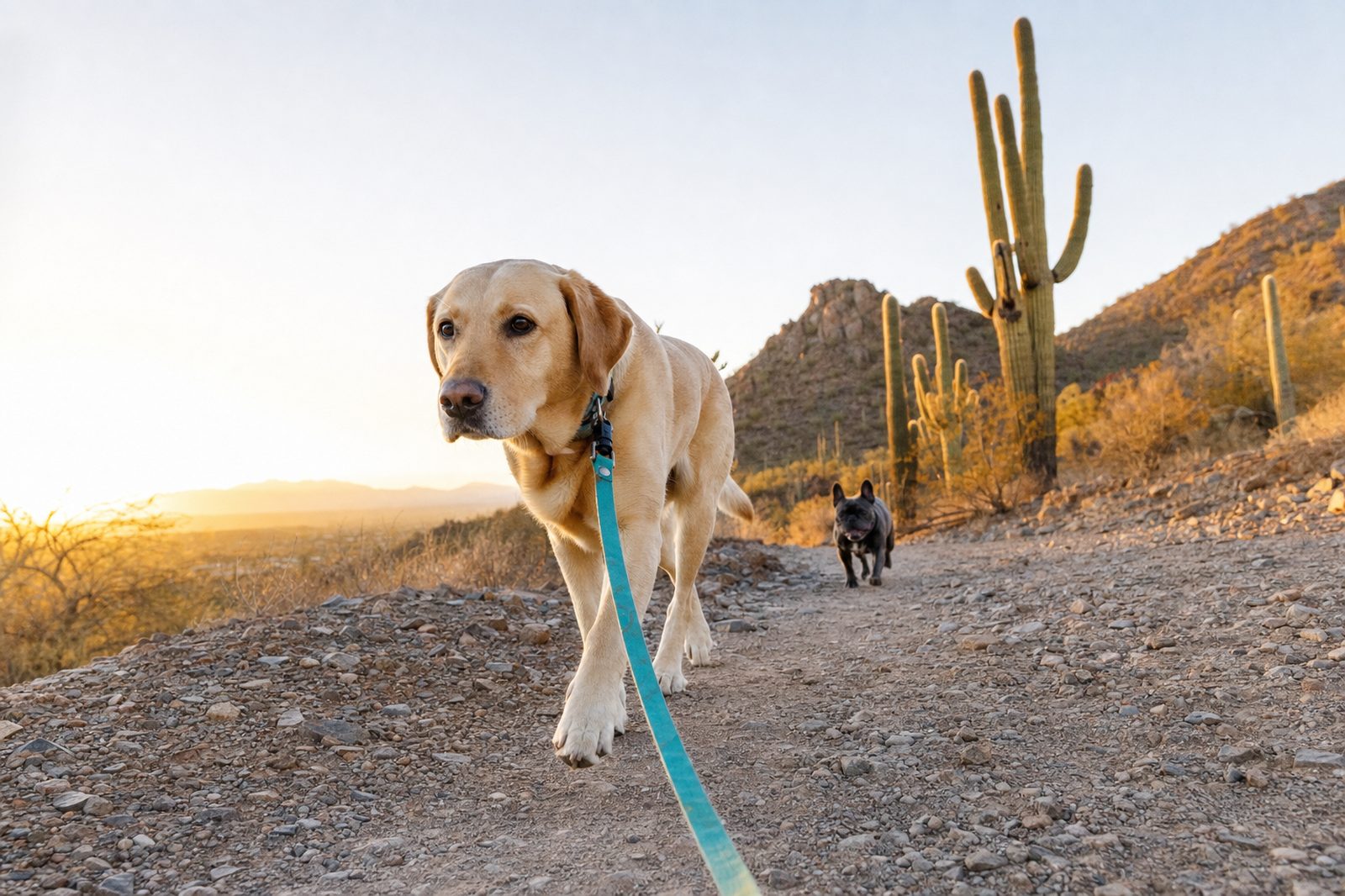
- Leash, six feet or shorter, plus a harness. The McDowell Sonoran Preserve requires a handheld leash no longer than six feet at all times (City of Scottsdale, retrieved 2026-09-16). Skip retractable leashes around rattlesnakes and passing dogs.
- Booties. Conditioned at home first, fitted to measured paws.
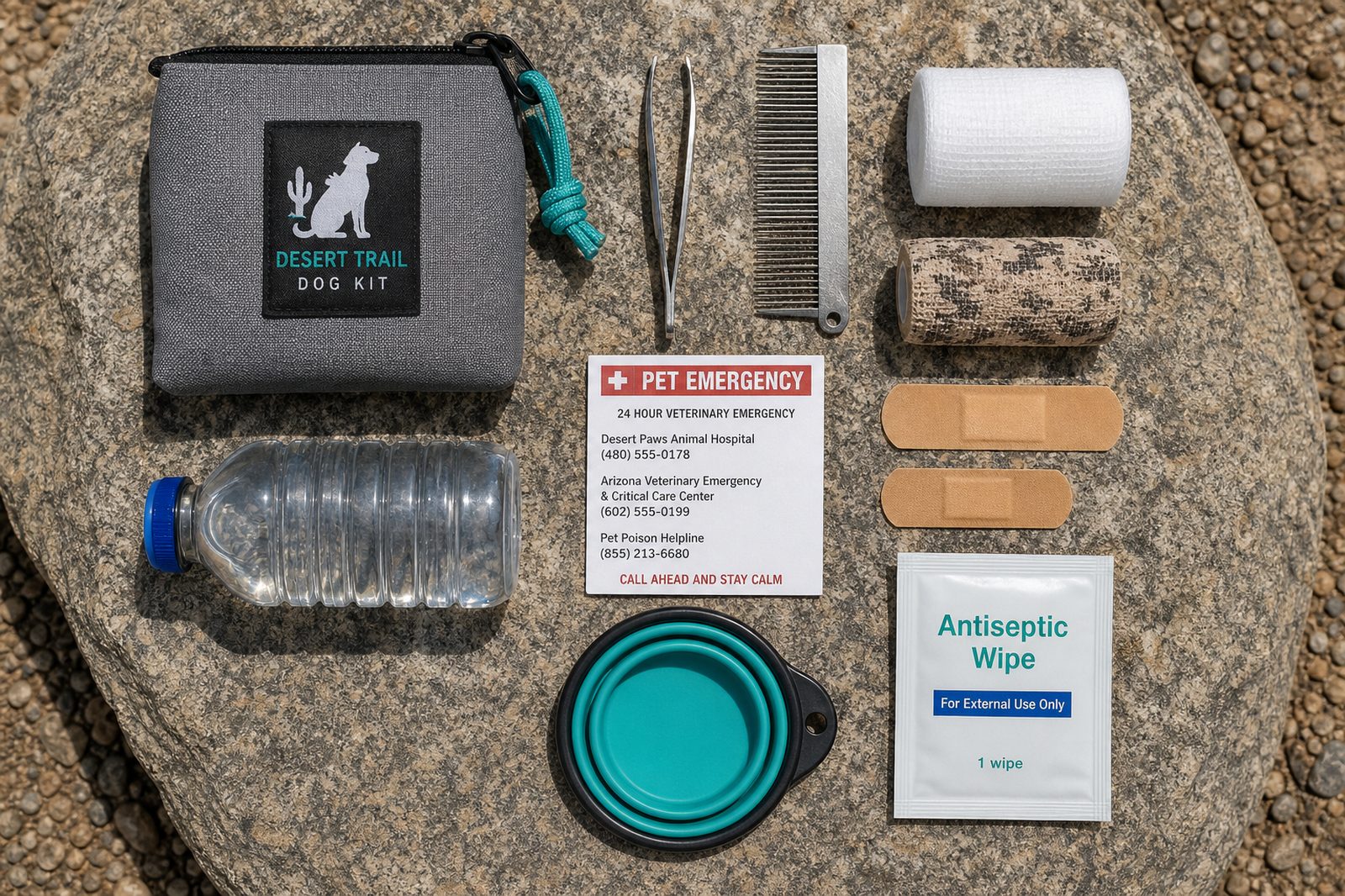
- Emergency kit. Gauze, bandages, antiseptic wipes, tweezers, your vet's number, and the nearest emergency clinic number. Tweezers are the desert MVP: foxtails and cactus spines.
- Food and high-value treats. Treats pay for recall around wildlife. This is operant conditioning at its simplest: the check-in gets paid before the coyote gets interesting.
- Waste bags and a pack-out holder. Loose or bagged waste left on the trail is prohibited in the Preserve. Pack it out, every bag.
- ID tag and current microchip registration. Trails are how dogs get separated from owners.
- Cooling vest (optional). A thin, light-colored evaporative vest helps in dry air on sensible outings.
- Your own timing plan. The dog's gear starts with your start time. Trails before 8 a.m., done before the heat builds. Our heat rules guide has the full timing breakdown.
A dog backpack lets the dog carry its own water. Condition it like any new gear and keep the load under 15 percent of body weight, the common trainer guideline (via animal behaviorist Andrea Arden, WebMD, retrieved 2026-09-16).
How much water should you pack for your dog?
Use the numbers: about 8 ounces per 20 pounds of body weight per hour of moderate hiking, more in heat, and at least one quart per three miles.
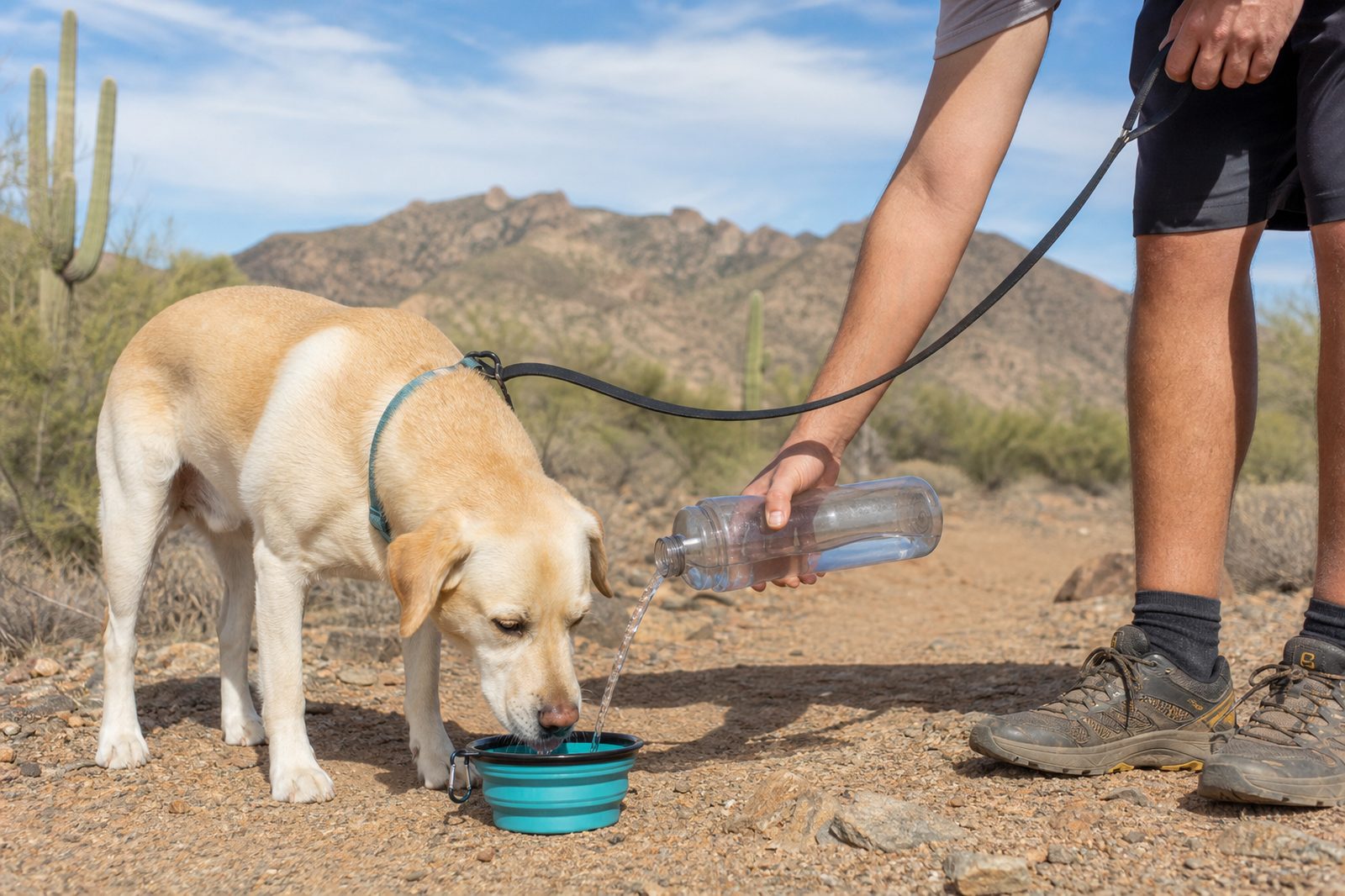
Petco's hiking guide puts the starting point at roughly 8 ounces of water per 20 pounds of body weight per hour of moderate activity, with more needed in heat or at elevation, offered every 15 to 20 minutes (Petco, retrieved 2026-09-16). A 60-pound dog on a two-hour morning hike works out to about 48 ounces, plus yours. Preventive Vet offers a simpler route-planning rule: at least one quart of water for every three miles of hiking (Preventive Vet, retrieved 2026-09-16).
The Preserve adds the turnaround rule: bring ample water and turn around when it is half gone (City of Scottsdale, retrieved 2026-09-16). Think of it like a fuel gauge. Half gone is your low-fuel light, and the trail back is the drive to the station. Our trainers run this math out loud on trail consults: 60-pound dog, two hours, 48 ounces plus yours. No guessing. And never let your dog drink from streams, ponds, or standing water: natural water carries parasites like giardia (Petco, retrieved 2026-09-16).
What goes in a desert trail emergency kit?
Gauze, bandages, antiseptic wipes, tweezers, emergency numbers, and water you are willing to pour on the dog. Pack for foxtails, cactus, and heat.
| Item | Why it earns the slot |
|---|---|
| Tweezers + fine comb | Foxtails and cactus spines. Pull plainly visible surface foxtails with tweezers near the base. Near an eye, in an ear, or causing swelling: vet (our foxtail post-hike check guide and cholla removal guide). |
| Gauze, bandages, antiseptic wipes | Torn pads and scrapes from granite and gravel. Clean it, wrap it, hike out. |
| Emergency vet + your vet's number | On paper, not just in your phone. Heat emergencies need a destination before you drive. |
| Extra water | A dog in heat distress gets cooled with water on the groin, the neck, and where the legs meet the body, then goes straight to a veterinarian (City of Scottsdale, retrieved 2026-09-16). |
Know the signs that turn a kit into an emergency. Heavy panting with no recovery, thick drool, bright red tongue and gums, wobbling, or a dog that lies down and will not get up: the hike ends. Our heatstroke signs guide covers the full sequence and what to do before you reach the vet. This article never replaces veterinary care.
Should your dog hike in booties?
Yes, on desert rock and gravel. Booties protect pads from sharp granite, hot ground, and cactus spines, but only if they fit and only if the dog was conditioned to them first.
The honest caveats, from our pavement and booties guide:
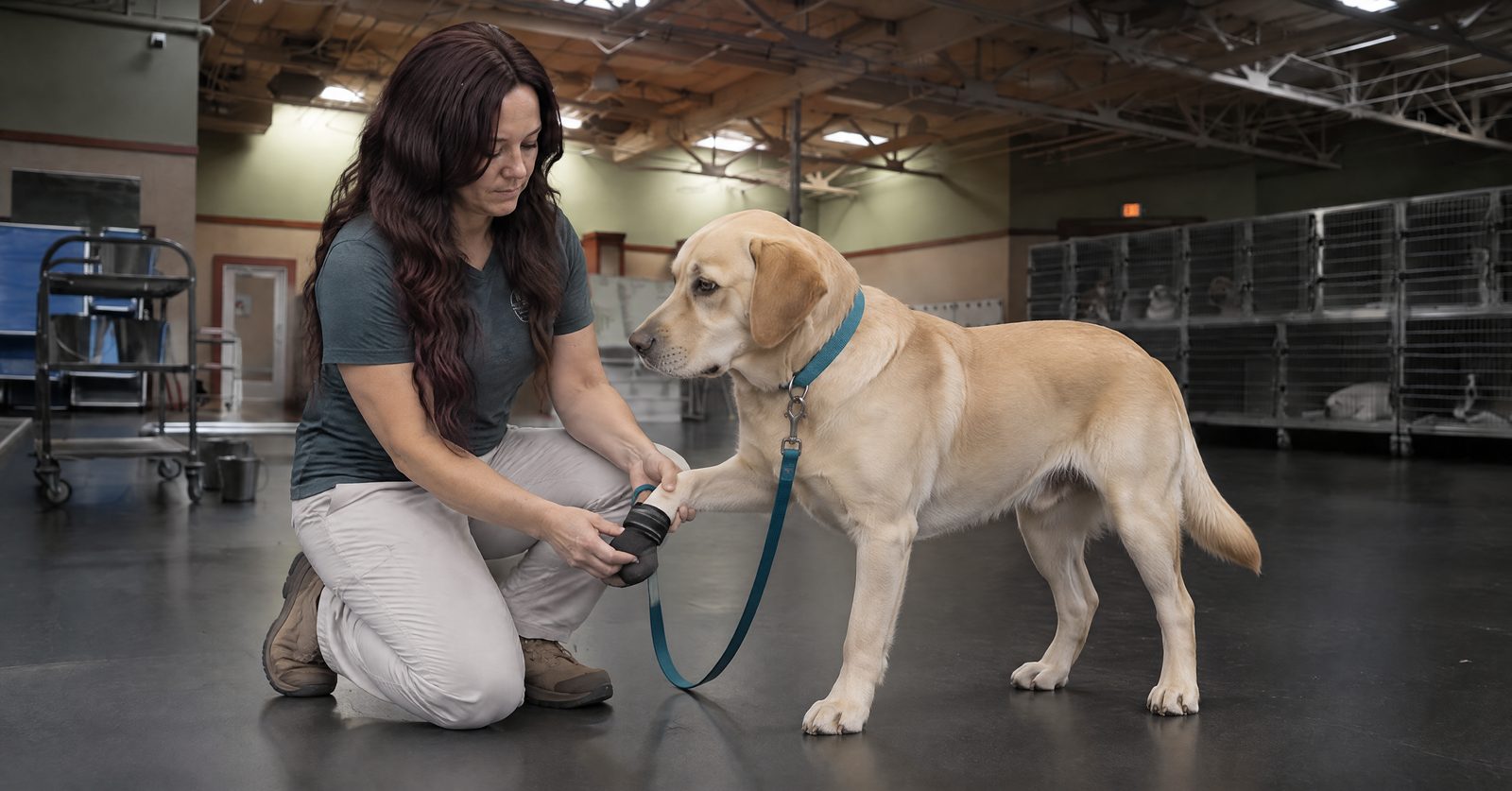
- Measure every paw. Front paws are usually wider than rear paws on the same dog. Size to the paw, not the breed chart.
- Snug, not tight. One finger under the closure. Too loose twists off mid-hike. Too tight cuts circulation.
- Condition before the trail. Booties meet the dog in the living room weeks ahead: short sessions, rewards, building duration. A dog that meets booties at the trailhead learns panic.
- Check mid-hike. Heat and movement shift fit. Check at the turnaround and catch a twisted bootie before it rubs a blister.
- Watch for rubbing. New limping after the booties went on is a fit problem. Fix the fit. Do not finish the route on damaged pads.
No brand picks, on purpose. Buy summer-appropriate booties built for heat and rough ground, not insulated winter boots, and treat paw wax as a backup layer, never the whole plan. The full selection guide and conditioning protocol are in our booties guide.
Does cooling gear belong in your hiking pack?
A thin, light-colored evaporative vest can buy comfort on a sensible desert outing. It does not make a hot hike safe, and no clinical trial has tested these products.
Say the honest thing out loud. Nobody ran a clinical trial on dog cooling gear. What exists is the physics of evaporation plus consistent owner and tester reports: wet mesh against the body pulls heat away in dry air, needs re-wetting every few hours, and stops helping the moment it dries. A dried-out vest comes off.
The Valley wrinkle: the same vest helps in dry desert air and works worse when monsoon humidity moves in from July through September, because evaporation needs dry air. Our cooling gear guide covers each type, its limits, and what to use during humid weeks.
The Preserve's own prevention list calls cool vests and trail booties available and useful (City of Scottsdale, retrieved 2026-09-16). Useful is not armor. Timing, water, and watching your dog are the plan. The vest is the accessory.
Your first step
Book a PD360 Assessment
The gear is the easy half. If your dog is pulling on leash, ignoring recall, or freezing at the trailhead, a senior trainer reads your dog across nine dimensions and names the gap before the trail finds it.
When should you leave your dog home?
Leave the dog home if the forecast tops 90 degrees at any point in the hike.
The City of Scottsdale's rule for the McDowell Sonoran Preserve is plain: over 90 degrees at any time in your hike means it is too hot for your dog (City of Scottsdale, retrieved 2026-09-16). Note the wording: at any time, not at the start. A 78-degree sunrise becomes a 95-degree ridge by 10 a.m., and the dog pays for the second half.
Our norm is to finish by 8 a.m. when it is warm, and desert hiking season runs roughly October through April. Flat-faced breeds like Boxers, Bulldogs, and Pugs run higher heat risk, as do old, obese, and medicated dogs (same source). A dog that slows down, lies down, or will not keep walking is done. End the hike.
How do you get your dog ready for the gear?
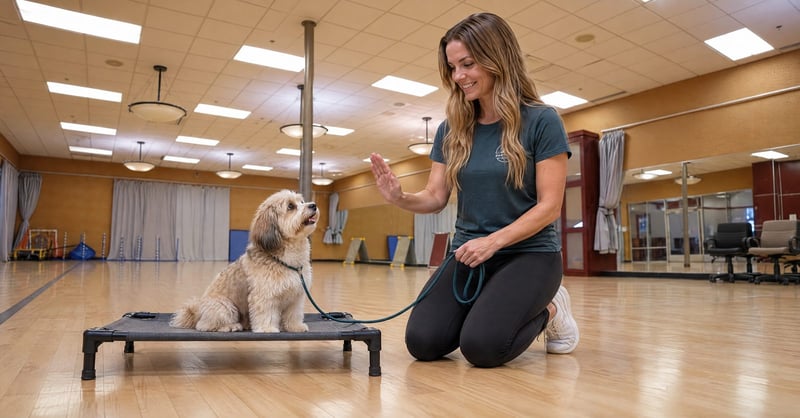
Condition every piece of gear at home before the trail.
The protocol runs Teach first, trail second. Seven steps, one action each:
- Gear appears, treats appear. Set the item on the floor. Treat for noticing and sniffing. Item goes away, treats stop.
- Touch, then treat. Pick up a paw, touch it with the bootie, treat. Drape the pack, treat. Fit the vest loosely, treat.
- On, jackpot, off. One bootie on one paw, several treats, off. Pack on, treats, off. Two or three minutes total.
- All of it, indoors, then something fun. Booties and pack on, then play, a known trick, or dinner.
- Build duration over days. Five minutes indoors becomes ten, becomes a backyard session. Time before difficulty.
- First trail outing: cool morning, short route, high-value rewards. The gear should be the only new thing.
- Proof it like any skill. Different surfaces, different times of day. If the dog freezes, back up one step.
"The trailhead is not where your dog meets its gear for the first time. That meeting happens in your living room, or it does not happen at all."
Never correct a dog for reacting to gear it was never conditioned to. A dog that freezes in booties was handed a conditioning problem, and conditioning problems get fixed before the tool is needed. That is the same ethic we apply to every tool in training: the gear is the student's aid, not the handler's shortcut, and the human stays in the loop.
By the numbers
All sources retrieved 2026-09-16.
Myth vs. fact: desert hiking gear for dogs
| Myth | Fact |
|---|---|
| One water bottle is plenty for a morning hike. | A 60-pound dog on a two-hour hike needs about 48 ounces, plus yours. Run the numbers and bring more than you think. |
| Booties will toughen the dog up if you push through. | Freezing or limping in booties is a conditioning or fit problem. Push through and you get rubbed pads and a dog that hates the gear. |
| A cooling vest lets you hike later into the day. | A vest buys comfort on a sensible outing. It does not change the air temperature or excuse a midday hike. |
| Desert trails are fine as long as it is under 90 when you start. | The rule is over 90 at any point in the hike. A cool sunrise turns into a hot ridge by mid-morning. Check the hourly forecast, not the current temp. |
Mistakes that make it worse
- Guessing at water. "Plenty" is not a number. Run the per-pound math and the per-mile math, then carry extra.
- Debuting gear at the trailhead. Unconditioned booties on a new hiker teaches panic. Condition at home, weeks ahead.
- Leaving waste bags behind. Bagged waste left on the trail is prohibited in the Preserve. Carry a pack-out holder and use it.
- Letting the dog drink desert water. Standing water carries parasites. Your dog drinks what you carried.
- Ignoring the slowdown. A dog that slows, lies down, or will not keep walking is telling you the heat is winning. End the hike.
- Skipping the post-hike check. Foxtails work deeper on the drive home. Paws, nose, eyes, ears, and coat sweep before the car.
Key takeaways
Key takeaways
- Pack water by the math: about 8 ounces per 20 pounds per hour, at least a quart per three miles, offered every 15 to 20 minutes. Turn around at half water.
- Over 90 degrees at any point in the hike means the dog stays home. Finish by 8 a.m. when it is warm; hike desert season, October through April.
- Leash six feet or shorter, harness, waste bags with a pack-out holder, ID plus current microchip registration.
- Booties work when they fit and were conditioned at home. Measure every paw, check mid-hike, watch for rubbing.
- Cooling vests help in dry air and need re-wetting. No clinical trials back them; a dry vest comes off.
- Carry tweezers and emergency numbers, and run the foxtail check after every hike.
Frequently Asked Questions
What is the single most important item on a dog hiking checklist?
Water. About 8 ounces per 20 pounds of body weight per hour of moderate hiking, at least a quart per three miles, offered every 15 to 20 minutes. Everything else is secondary to hydration.
Are booties required for desert hiking with dogs?
Not required, but they are the best paw protection on sharp granite, gravel, and hot ground. Measure every paw, condition the dog at home weeks before the hike, and check for twisting and rubbing mid-hike. Paw wax is a backup layer, not a replacement.
How do I know if it is too hot to hike with my dog?
The Preserve sets the line: over 90 degrees at any point in the hike, the dog stays home. Watch the dog too. Heavy panting with no recovery, thick drool, bright red gums, wobbling, or lying down and refusing to move means the hike ends now.
Should my dog carry its own backpack on hikes?
It can, once conditioned. Short indoor sessions with treats, building duration over days. Keep the load under 15 percent of body weight, and never let the first loaded outing be a hard hike.
What do I do after the hike to protect my dog?
Run the post-hike check before the drive home: paws and toes, nose, eyes, ears, armpits, belly, and a full coat sweep for foxtails and cactus spines. Pull plainly visible surface foxtails with tweezers. Near an eye, in an ear, or causing swelling: vet.
Where to go from here
Print the checklist, run the water math for your dog, condition the booties this week, and plan the hike for a cool morning in desert season. The dogs that handle desert trails best are the ones whose owners packed like the desert mattered, and whose owners trained the recall, the leave-it, and the check-in before the trail ever asked for them.
Choose by case, not by tool
Book a PD360 Assessment
The gear is the easy half. If your dog is pulling on leash, ignoring recall, or freezing at the trailhead, a senior trainer reads your dog across nine dimensions and names the gap before the trail finds it.
Scottsdale: 8642 E Shea Blvd, 85260. Cave Creek: 4640 E Forest Pleasant Pl, 85331. Serving the Phoenix Valley.