The gist
Cholla cactus is the jumping cactus of the Sonoran Desert: its joints break off at the slightest touch and latch onto paws with barbed spines that grip like fish hooks.
- Comb the whole cholla joint off the paw first with a wide-tooth comb. Never pull it with your bare hands. Then needle-nose pliers on the chunk, tweezers on single spines, checking between the toes.
- Cholla in the mouth, tongue, or near the eyes is a vet visit. Dogs that bite at a paw joint drive it into their mouths, and mouth removal usually takes sedation.
- See your vet for multiple spines, spreading redness or swelling, pus, hives, or a limp that worsens over a day or two. Arizona vets say to call when spine counts are high: pain control may be needed.
- Prevention beats the comb: leash on desert trails, comb in the pack, and the same post-hike paw check you run for foxtails.
The short answer: comb the cholla joint off the paw, never grab it with your hand, and treat any cholla in the mouth as a vet visit. The barbed spines resist coming out the way a fish hook does, so technique matters more than strength.
If you are a Scottsdale or Cave Creek Pet Parent who hikes desert trails with your dog, you know the plant. Cholla grows along the trails at McDowell Sonoran Preserve and all through Cave Creek, and the fallen joints on the ground are the ones that get dogs. This guide covers the removal protocol for paws, why the mouth is a different problem, and when the vet takes over. It sits in the same post-hike check family as our foxtail guide: same habit, different hazard.
Why does cholla hit dogs so hard?
The short version: the joints detach on contact and the spines are barbed, so the cactus lands on the dog and stays on the dog.
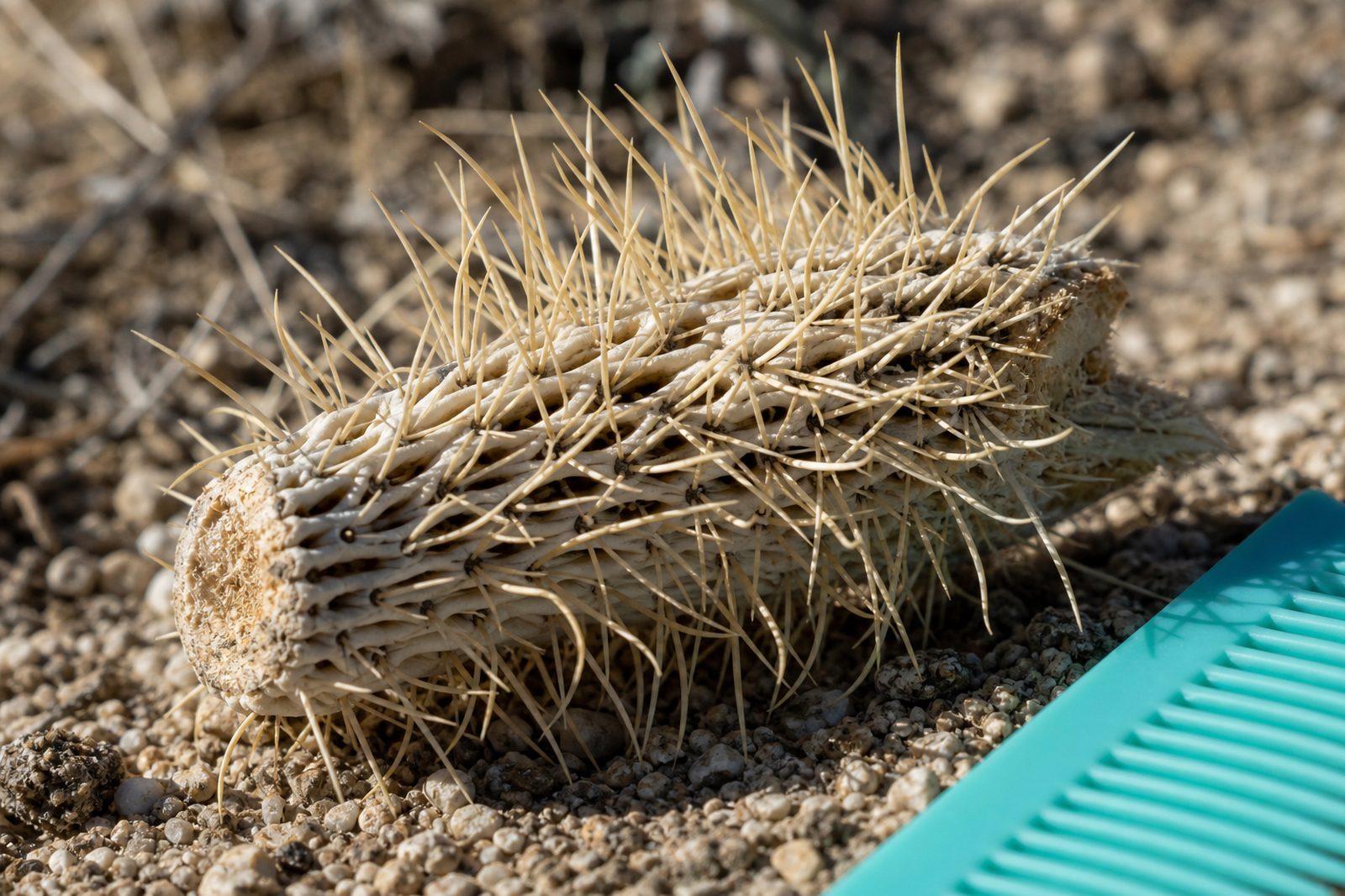
The one hikers call jumping cholla does not actually jump. Its segmented joints break loose at the slightest brush. The ground around a mature plant is often covered with fallen joints, so the dog never has to touch the standing cactus. One step onto a joint and the dog is wearing it.
The spines are the second problem. University of Illinois researchers found that barbed cholla spines behave like porcupine quills: they slide into tissue easily and hold fast, because the barbs snag on muscle fibers. A Scottsdale wildlife center veterinary technician who removed hundreds of cholla spines from a rescued coyote pup in June 2026 put it plainly: "It's like a fish hook."
The USGS warning is one sentence: "Don't walk your dog or bring young children near cholla!" Where you cannot avoid it, you manage it (our methodology).
The comb is the hero of this story. Your bare hand is the casualty.
How do you remove cholla from a dog's paw?
The short version: hold the dog still, comb the whole joint off, then pluck what remains with pliers and tweezers. In that order.
- Stop the dog and hold it still. Leash up, sit the dog down. A shaking paw flings the joint toward faces. A chewing dog drives spines into its mouth. A dog with a trained sit-stay turns this into a two-minute job: that stay is one of the first defaults our trainers install, because emergencies never wait for training.
- Keep your hands off the cactus. Your fingers will end up wearing the joint next. PBS SoCal's desert-safety guidance is to pry the section off with a foreign object, never your free hand, and never shake it off the limb.
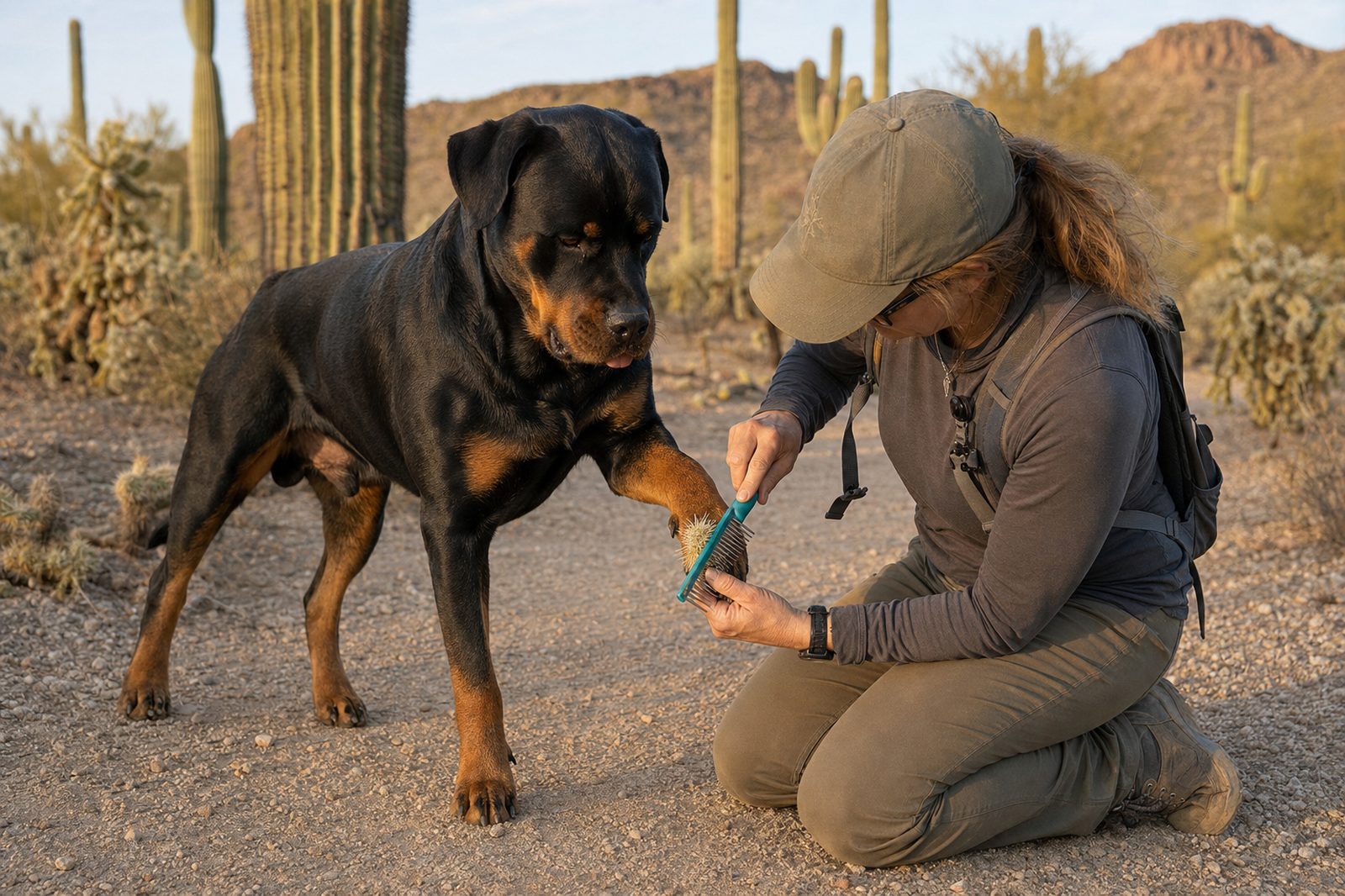
- Comb the joint off the paw. Slide a wide-tooth comb under the joint and pry it away in one smooth motion. The comb is the standard tool desert hikers carry for this job, and Arizona veterinary guidance (Alta Vista Veterinary Hospital, via the Arizona Veterinary Medical Association) names the comb for cactus-spine removal on animals. A clean stick works in a pinch. Skip the cactus skeleton: old spines are often still attached.
- Pull the remaining chunk with needle-nose pliers. Grip the cactus body, not the spines, and pull straight back along the entry angle. Chunk first, singles second: the chunk holds the most barbs.
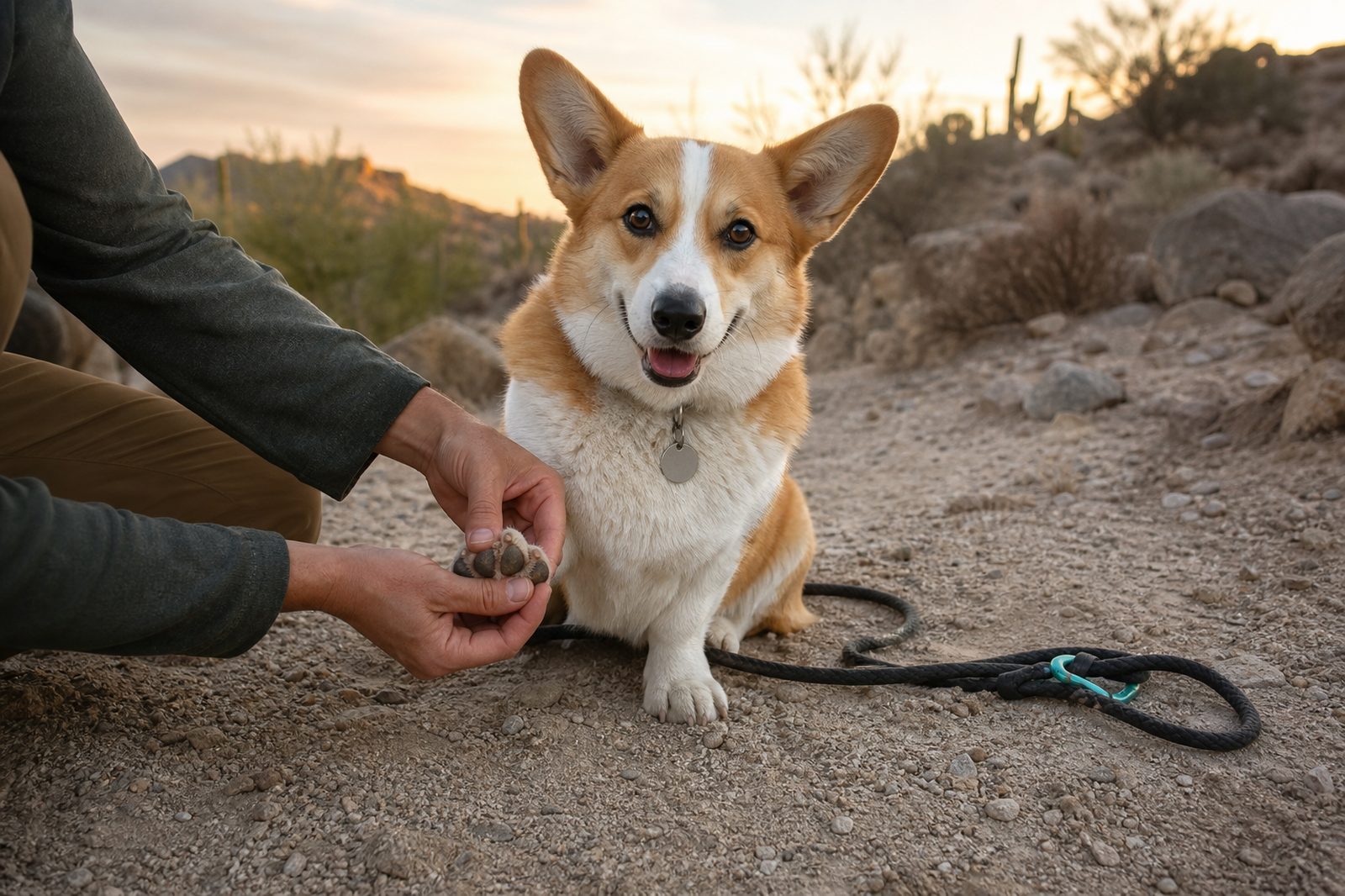
- Tweeze the single spines. Fine-tipped tweezers at the base of each spine, steady pull along the entry angle. Then check between the toes. Spines hide in the webbing, and a dog still chewing one toe after you "got them all" has one you missed.
- Wash the paw with mild soap and water. You made a set of puncture wounds. Clean them and watch the paw for two days.
Where to start
Need Help With Your Dog's Behavior?
Book an assessment to find the right training plan.
Comb or tweezers: which tool do you use first?
The short version: comb for the chunk, pliers for the body, tweezers for the singles. The tool matches the stage.
| Tool | Use it for | Why it wins that job |
|---|---|---|
| Wide-tooth comb | The whole attached joint | Slides under the joint and pries it off in one motion. Keeps your hand clear. The tool Arizona hikers and vets both name first. |
| Needle-nose pliers | Remaining chunk of cactus body | Grips the body firmly for a straight pull along the entry angle. A 30-year Arizona veterinarian recommends pliers or tweezers for cactus thorns on dogs. |
| Fine-tipped tweezers | Individual spines, between the toes | Precision on single barbed spines. The last pass after the chunk is gone. |
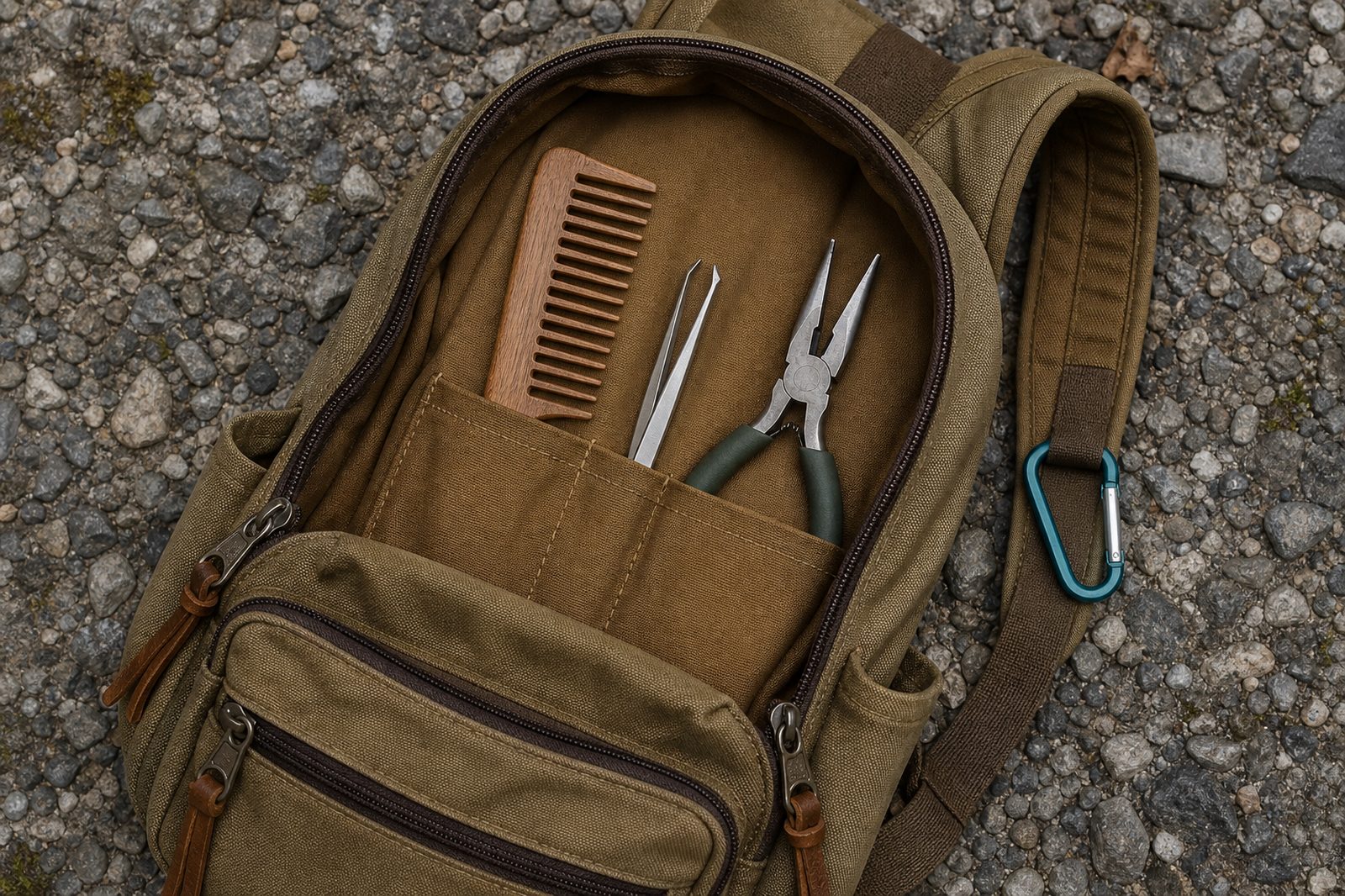
Carry the comb on every desert hike. It weighs nothing and it is the difference between a two-minute fix and a vet visit. Our desert hiking gear checklist covers the rest of the kit.
What if the cholla is in your dog's mouth?
The short version: do not dig around in there. Keep the dog from chewing or pawing at it, and go to the vet. Mouth cholla usually needs sedation.
Most mouth cases start at the paw. The dog gets a joint on the paw, bends down to bite it off, and now it is on the tongue, lips, or gums. Arizona veterinary guidance is direct: animals should not be allowed to chew on the spines themselves. The chewing does not remove the cactus. It relocates it somewhere you cannot reach.
The mouth is a vet problem because a dog in pain will bite, and a mouthful of barbed spines is maximum pain. You cannot hold the mouth open, see what you are doing, and pull barbed spines all at once without getting bitten or driving spines deeper. The Southwest Wildlife Conservation Center case shows the professional version: their technician sedated the coyote pup, then spent about two and a half hours plucking spines from the nose, tongue, tail, paws, and face with small metal clamps. Sedation makes thorough removal possible without a fight.
On the way to the vet: keep the dog calm and still, stop it from pawing at its face or rubbing its muzzle on the ground, and do not offer food or water. Call ahead so the clinic is ready. If your dog is muzzle-trained, a muzzle protects your hands during transport. Muzzle comfort is one of the cooperative-care skills our trainers rehearse with dogs that need it, built slowly with food well before it ever matters. If your dog is not muzzle-trained, do not wrestle one on over a mouthful of spines. Drive.
When does a cholla hit become a vet visit?
The short version: mouth or eyes means the vet now. Paw hits mean the vet when the spine count is high or the paw is not improving.
Arizona veterinary guidance draws the line at volume: multiple spines means contacting your veterinarian, because pain control may be needed to get them out. A few spines in one paw is a home job. A paw that looks like a pincushion is a sedation and pain-medication job.
Go to the vet for any of these:
- Cholla in or around the mouth, tongue, lips, gums, nose, or eyes. Eye-area spines can cause infection. Mouth removal usually needs sedation.
- Multiple spines, or a dog that will not let you near the paw. Pain control turns an impossible extraction into a routine one.
- Spreading redness, swelling, warmth, or pus. Puncture wounds get infected. Infected punctures do not wait.
- Hives or swelling hours after the hit. Some dogs react this way. Call your vet the way you would for any allergic reaction.
- A limp that worsens over 24 to 48 hours, or chewing that will not stop. Something is still in there.
A veterinarian with 20 years of small-animal practice notes that professional treatment can involve sedation, a thorough search for remaining spines, and medication for inflammation. That is the full-service version of your comb and tweezers. Keep your emergency vet's number saved the same way you would for a rattlesnake bite.
What about the barbs that break off under the skin?
The short version: tiny shallow fragments often work their way out. Anything deep, visible, or still bothering the dog needs tweezers or a vet.
A veterinarian with over 30 years of experience gives the rule most Arizona vets follow: a broken barb beneath the skin typically works its way out on its own. Her key contrast: cactus barbs are not porcupine quills. Quills keep migrating inward through tissue. Cholla barbs do not.
The limit: cholla spine tips have small hooks that keep them from falling out, and the sheath over each spine sometimes stays in the wound. So "it will work itself out" covers tiny shallow fragments, not spines you can see or a paw the dog will not leave alone.
What helps: a desert-practice veterinarian recommends soaking the paw in warm salt water, one teaspoon of salt per pint of water, when a dog has been chewing a cactus-hit paw. Leave punctures open to the air instead of wrapping them tight, and watch for the infection signs above. While you watch, check the weight-bearing: a paw the dog still will not put down after cleaning is a vet call, not a wait. Fragment visible, tweeze it. Not visible and the dog is unbothered, let the body work and keep watching.
Mistakes that drive cholla deeper
- Grabbing the joint with your fingers. You now have a cholla problem on your hand and a dog problem on the paw. The comb exists so this never happens.
- Letting the dog shake it off. A shaken joint flings toward faces, yours and the dog's. Hold the dog still first.
- Letting the dog chew it off its own paw. The number one way a paw case becomes a mouth case. Arizona vets say it directly: do not let the animal chew on the spines.
- Tweezing before combing. Picking at singles while the joint is still attached leaves the main load of barbs in place. Chunk first, singles second.
- Pulling at an angle. Barbed spines exit along the line they entered. Pull across that line and the barbs dig in. Straight back, steady pressure.
- Waiting on a mouth hit. Mouth cholla does not improve with time. Every minute of chewing drives spines deeper and makes sedation removal harder.
How do you keep cholla off your dog?
The short version: leash, eyes up, comb in the pack, and the post-hike paw check every time.
Cholla country is most of the desert around Scottsdale and Cave Creek. Avoidance is partial, so Pet Parents manage instead. Walk the dog on a leash on desert trails. The USGS warning is aimed at exactly this: dogs run off-trail, brush the plants, and pick up joints. A leashed dog steps where you step. That is the same order of operations our trainers work to mid-lesson, management first to control the situation, then conditioning to change the behavior.
Learn the plant. Jumping cholla looks fuzzy from a distance: dense clusters of segmented, straw-colored joints bristling with spines. The dangerous part is often on the ground. Fallen joints scatter around the base the same color as the dirt. Scan the ground ahead on the trail.
Build the kit and the habit. Comb, tweezers, and pliers live in the daypack next to the water. After every hike, run the paw check: pads, between every toe, up the legs. It is the same inspection you run for foxtails, and it catches fragments while they are shallow. For trail choices with less cactus exposure, see our dog-friendly hiking trails guide.
At home, walk the yard the way you would for snake-proofing: fallen joints blow in on the wind and hide in gravel. Pick them up with the pliers, not your hands. Our desert leave-it protocol builds the same habit for the rest of the desert's hazards: the dog checks in with you before investigating anything that bristles.
Key takeaways
Key takeaways
- Cholla joints detach on contact and latch on with barbed spines that grip like fish hooks. The fallen joints on the ground are the ones that get dogs.
- Paw protocol: hold the dog still, comb the whole joint off first, then pliers for the chunk and tweezers for singles. Check between the toes. Never use your bare hands.
- Cholla in the mouth, tongue, or near the eyes is a vet visit, usually needing sedation. Do not dig around in the mouth yourself.
- Multiple spines, spreading redness or swelling, pus, hives, or a worsening limp over 24 to 48 hours: vet.
- Tiny shallow fragments often work their way out. Porcupine quills are the ones that migrate inward. Deep or visible spines still need tweezers or a vet.
- Prevention: leash on desert trails, comb and tweezers in the pack, post-hike paw checks every time, yard sweeps for fallen joints.
From here
Need Expert Training?
Match the program to the dog to build real world manners.
Frequently Asked Questions
Can I just pull cholla out of my dog's paw with my fingers?
No. The barbed joint will latch onto your hand next, turning a one-paw problem into a two-victim problem. Slide a wide-tooth comb under the joint and pry it off, then use pliers and tweezers.
Should I use a comb or tweezers first?
The comb comes first, always. It removes the whole joint in one motion. Pliers take the remaining chunk. Tweezers are the last pass, for individual spines and the ones hiding between the toes.
My dog has cholla in its mouth. Can I pull it out myself?
Do not try. A dog in mouth pain will bite, and you cannot see well enough to pull barbed spines without driving some deeper. Keep the dog calm, stop it from pawing at its face, and go to the vet. Mouth removals usually need sedation.
Will the broken spines work their way out on their own?
Tiny shallow fragments often do, according to a veterinarian with 30-plus years of experience. Cholla barbs do not migrate inward the way porcupine quills do. But spines you can see or feel, and any paw the dog keeps chewing, still need tweezers or a vet visit.
Is cholla cactus poisonous to dogs?
Cholla is not considered poisonous. The danger is mechanical: barbed spines, puncture wounds, and the infections punctures can bring. A few dogs develop swelling or hives in the hours after a hit. If you see that, call your vet the way you would for any allergic reaction.
Where to go from here
The protocol fits in a daypack: a wide-tooth comb, fine-tipped tweezers, needle-nose pliers, and the post-hike paw check. Learn it once and a cholla hit becomes a two-minute trail stop instead of an emergency.
For the rest of the desert hazards on the same trails, read our foxtail post-hike guide and the rattlesnake season timeline.
Scottsdale: 8642 E Shea Blvd, 85260. Cave Creek: 4640 E Forest Pleasant Pl, 85331. Serving the Phoenix Valley.