Before anything else
Four tracks run in parallel for a working trainer: a third-party credential that needs 36 CEUs every three years just to stay active, in-house case review that no CEU tracker ever counts, and floor hours logged toward advancing inside Partners Dogs University, with our case for advancing resting on roughly 1,000 to 2,000 supervised hours. A certificate on the wall is the entry point on all four tracks, never the finish line.
Does a dog trainer's education end the day a certificate arrives in the mail? Ask that question inside any serious training program and the answer is the same everywhere: no, and the trainers who stop there are usually the ones who plateau at exactly the skill level they had on day one. Continuing education for a professional dog trainer runs on four tracks: hours a third-party body requires to keep letters valid, workshops that build one specific hands-on skill, case review conducted with other instructors on real dogs, and floor hours logged, inside our own program, toward advancing past a first certificate. Those four tracks do not look the same on paper, and conflating them is how a trainer ends up current on paperwork and behind on the floor.
Ruth L., a Cave Creek client, described what that layered approach looks like from the client's side of it: "Very nice group of people and very educated trainers. We took class with Will for nose work and Debbie for agility. We engaged to Will for in-home training as well which proved to be very helpful for trading humans and our two whippets." Two named specialists, two different disciplines, one trainer also picking up in-home work on the side. That is what ongoing skill-building looks like once it leaves a spreadsheet and shows up on the floor.
What counts as continuing education for a professional dog trainer?
Six specific activities count across those four tracks, and only some show up as CEUs on a tracking spreadsheet. Certifying bodies count coursework toward renewal. Fewer of them count everything that keeps a trainer sharp.
- Recertification coursework. Lecture-based or online content approved against a credential's own test domains.
- Hands-on skills workshops. Leash handling, body handling, and cue timing practiced under supervision, not read about.
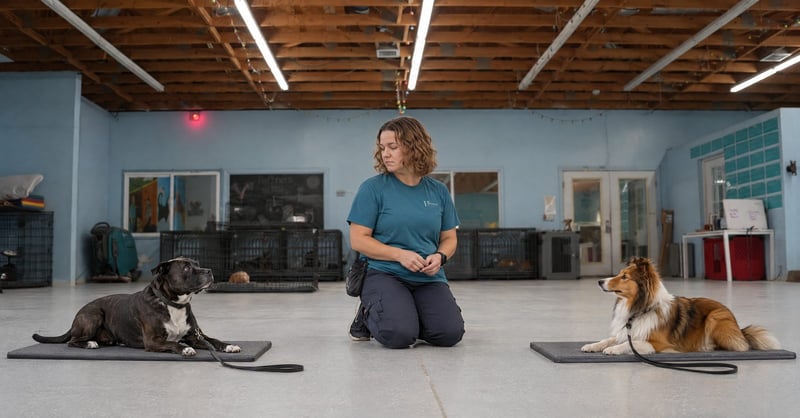
- In-house case review. Instructors walking through a real dog's file together: what worked, what stalled, and why.
- Cross-training across behavior categories. Deliberate exposure to resource guarding, separation anxiety, and reactivity instead of specializing in one lane early.
- New-tool conditioning workshops. Structured practice introducing a dog to new equipment or a new environment, the same discipline behind our snake avoidance conditioning work.
- Logged floor hours. Supervised time with dogs that counts toward advancing inside our own program, separate from any outside credential.
Most trainers who plateau are current on the first item and coasting on the rest. A career built around dogs, the kind we talk through with people exploring Partners Dogs University here, runs on all six at once, not whichever one has a deadline attached.
How often do trainers have to recertify, and what does that cycle require?
Most third-party credentials run on a three- to five-year clock, and the hour count is fixed no matter how good a trainer already is. The Certification Council for Professional Dog Trainers requires CPDT-KA and CPDT-KSA holders to earn continuing education or retake the exam every three years, with 36 CEUs due inside that window. CBCC-KA, its behavior-consulting credential, runs on a five-year cycle at the same 36-CEU count. CCPDT's own recertification page is specific about what qualifies: courses, authored articles, books, and video productions all count if they relate to the credential's test content, and an approved presenter needs credentials or education in the topic, never a familiar name on a flyer alone.
| Credential or path | Renewal cycle | What keeps it active |
|---|---|---|
| CPDT-KA | Every 3 years | 36 CEUs tied to the knowledge exam's content, or a retake |
| CPDT-KSA | Every 3 years | 36 CEUs, with a minimum drawn from hands-on Skills CEU categories |
| CBCC-KA | Every 5 years | 36 CEUs tied to behavior-consulting content, or a retake |
| Partners Dogs University advancement | Ongoing, not cyclical | Logged floor hours: our case for advancing rests on roughly 1,000 to 2,000 supervised hours, not a published title schedule |
The difference in structure matters more than it looks. A CEU clock resets every three or five years, and a trainer can clear it by attending events without ever touching a dog with a new problem. Advancing inside Partners Dogs University does not work that way: the hours are logged on real dogs, under supervision, and the bar only moves in one direction. Neither model is wrong on its own. A third-party credential shows a trainer studied material a testing body considers current; logged floor hours show a trainer has done the work often enough to be trusted with more of it.
Do hands-on skills workshops count toward continuing education, or only classroom hours?
Both count, and the credentialing bodies say so directly. CCPDT allows Skills CEUs toward CPDT-KSA renewal specifically because a knowledge exam and a hands-on skills exam test different things, and a trainer holding both needs both kinds of practice to stay current. A workshop that has a trainer running leash mechanics, body handling for a dog that startles at touch, or precise marker timing under time pressure builds a different muscle than reading a chapter on the same subject.
New-tool conditioning workshops sit in that same hands-on category. Introducing a dog to an unfamiliar object, sound, or scent under controlled conditions and reading its response in real time is a skill that only builds through repetition with real dogs, not a slide deck. Our own snake avoidance conditioning work runs on exactly that discipline: a trainer reads arousal and avoidance responses live, near a wash or a Sonoran trail edge, and adjusts on the spot. Instructors who help teach it often go through the conditioning process with a dog of their own first, the same way a trainer learning to run a camp floor benefits from having sat through group classes as a client before ever running one.
Start the conversation
See what that standard means for your own dog's program
The case-review rhythm and logged floor hours described above are not a slide deck exercise: they are the standard every instructor on our floor works toward before they run a class or a session alone. A short quiz matches your household to the right starting point based on your dog's age, history, and what you are working toward.
What does in-house case review add that an online CEU course cannot replicate?
A CEU course teaches a general principle; case review tests whether a trainer can apply it to one specific dog's file. Take Bruno, a Bull Terrier who came through Behavior Camp carrying four problems layered on top of each other rather than one clean case: resource guarding, sibling aggression, leash reactivity, and territorial behavior at the door. His file shows the order they were worked in: a muzzle introduced as standing equipment on day four and kept in rotation through day twenty-one, leash reactivity named directly on day twelve, territorial behavior at greetings worked on day thirteen and again on day nineteen, and resource guarding, the case's presenting problem, not named as the day's primary focus until day seventeen.
Reading that sequence after the fact, in a room with other instructors, is a different exercise than reading a case study in a textbook. It forces a trainer to ask why the order mattered: why obedience and equipment introduction came first, why leash reactivity waited until day twelve, why resource guarding waited until day seventeen instead of running first. An online course can teach the theory behind each of those decisions. Only a file from the floor, reviewed with colleagues who were in the room, teaches the sequencing.
How does cross-training across behavior categories change what a trainer can handle?
A trainer who has only ever worked leash reactivity will misread a resource-guarding case as reactivity, and the reverse mistake happens just as often. Behavior categories overlap in how they look from the outside: a dog stiffening near a bowl and a dog stiffening at a doorway can present almost identically to someone who has only trained one of the two. Cross-training deliberately rotates a trainer through resource guarding, separation anxiety, territorial behavior, and leash reactivity cases rather than letting early specialization narrow what a trainer is comfortable taking on. Our advanced trainer tracks for working professionals are built around that rotation on top of whatever a trainer already holds from an outside body.
This is also where the floor-hours model does something a CEU clock cannot: it forces exposure. A trainer accumulating CEUs can choose eight consecutive workshops on the same topic and technically satisfy a renewal. A trainer logging hours toward advancement inside Partners Dogs University works whatever dog is on the schedule that week, which means the categories rotate whether a trainer prefers them to or not. Neither path is a shortcut. Both are genuine investments in a working life built around dogs, the kind of career people ask us about directly once they see the career side of it up close.
Turn this into a plan
Build continuing education into a whole career, past the first intake
A third-party credential already on the wall, or nothing yet on it: Partners Dogs University lays out the coursework, the supervised hours, and the case-review rhythm that keeps a trainer improving long after the first certificate.
Key takeaways
CPDT-KA and CPDT-KSA renew every three years on 36 CEUs; CBCC-KA renews every five years on the same 36-CEU count. CCPDT counts more than lecture attendance toward renewal: hands-on Skills CEUs, authored articles, books, and video productions. Partners Dogs University runs on logged floor hours instead of a CEU clock: our case for advancing rests on roughly 1,000 to 2,000 supervised hours, not a published title schedule. In-house case review, like the sequencing behind Bruno's Behavior Camp arc, teaches how theory gets applied to one real dog's file. Cross-training across behavior categories, not early specialization, is what keeps a trainer from misreading one problem as another.
Frequently Asked Questions
Do CEUs earned for one certifying body transfer to a different credential?
Rarely, and not automatically. Each body evaluates CE content against its own test domains, so a workshop approved for one credential's renewal may not qualify for another's without a separate application. A trainer holding more than one credential typically tracks CE hours for each one separately.
Can a trainer lose recertification standing by skipping a cycle?
Yes. Most credentialing bodies require CE hours or a retake within a fixed window, and missing that window generally lapses the credential rather than pausing it. Reinstatement usually means retesting rather than picking up where the hours left off.
Does completing continuing education automatically move a trainer up in title or pay at Partners Dogs?
Not automatically, no. Title advancement inside Partners Dogs University is tied to logged, supervised floor hours on real dogs rather than a CE hour count, so a trainer moves up when the hours and the case work behind them are there, not on a renewal calendar.
Keep reading