The gist
A group class at Partners Dogs runs $65 to drop in once, $169 for four classes in a month, or $279 for eight. Every plan buys the same 45-minute class, capped at six dogs, at both the Scottsdale and Cave Creek campuses. Enrollment stays open year-round, so there is no start date to wait for.
Most people looking into dog training classes in Scottsdale do not want a lecture on curriculum philosophy first. They want the number, then the fine print. This guide lays out what a group class at Partners Dogs costs in Scottsdale and Cave Creek, the math on when a monthly pack beats paying drop-in, and the 45-minute format and grade system underneath the price tag, the same pricing and format behind a 4.8-star average across 2,000+ reviews.
What a Group Class Costs, All Three Ways
There are exactly three ways to pay for a group class: $65 for a single drop-in session, $169 for four classes in a calendar month, or $279 for eight. All three buy the identical class, at any of the eight grade levels, at either campus. Nothing about the training changes based on which plan is on file, only the price per session does.
| Plan | Best for | Price | Cost per class | Commitment |
|---|---|---|---|---|
| Drop-in | Trying a class, or attending once in a while | $65 per session | $65.00 | None, pay per class |
| Four-class pack | A once-a-week class routine | $169 a month | $42.25 | Four classes, one month |
| Eight-class pack | Two classes a week, faster reps toward the next grade | $279 a month | $34.88 | Eight classes, one month |
Prices shown reflect 2026 rates and can change; see the current pricing page for today's numbers.
None of the three plans locks a dog into one grade level or one location. A four-class pack bought this month can cover a Kindergarten session at Scottsdale and a make-up class at Cave Creek in the same week, since both campuses run the same curriculum on the same pricing. For how classes stack up against camps, DaySchool, and boarding, the full pricing page lays out every program side by side.
The Break-Even Point Between Drop-In and a Monthly Pack
The four-class pack only beats paying drop-in once a dog attends three classes in a month, not four. Two drop-in classes cost $130, still cheaper than the $169 pack. A third class pushes drop-in to $195, thirty dollars more than the pack, and by then a fourth class is essentially free. That is the entire decision: two classes a month, pay drop-in; three or more, buy the pack.
The eight-class pack needs a faster pace to earn its price. Stacking a four-class pack with drop-in sessions for anything beyond it stays cheaper through five classes a month ($169 plus one $65 drop-in equals $234, against $279 for the eight-pack). The eight-pack does not pull ahead until roughly six classes a month, close to twice a week, where it saves $20, and by eight classes it saves $150. Below that pace, the four-class pack plus the occasional drop-in remains the better math.
Worth saying plainly: for a family that can only make it to one class a month, the four-class pack is not a bargain, it is $104 spent on three classes that never happen. Drop-in is the honest answer at that pace, and nobody should feel talked out of it.
What 45 Minutes Buys: The Four Blocks of a Class
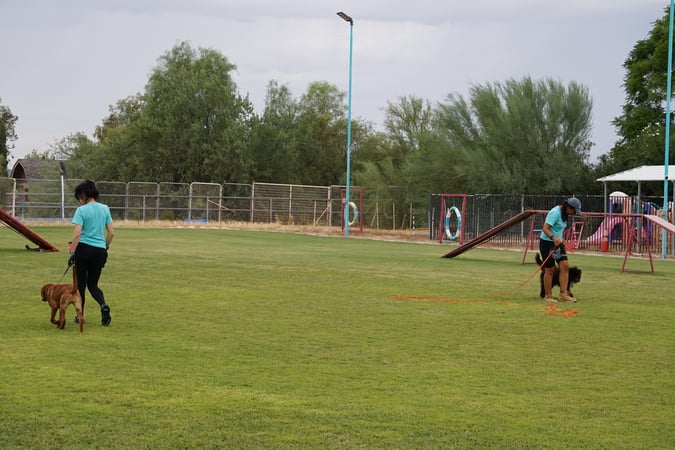
Every group class runs the same 45-minute shape, split into four blocks: a 20-minute interval, a 15-minute group block, a 5-minute AMRAP round, and a 5-minute demo. The order repeats every week at every grade level, so both dog and owner know what is coming before they arrive.
- Interval, 20 minutes. Small groups rotate through stations for focused reps, with a trainer working one-on-one inside each rotation. This is where a new skill takes shape.
- Group, 15 minutes. Whole-class work under real distraction, other dogs moving, other owners talking. This is the block that turns book knowledge into a dog who can hold a sit while another dog pulls on its leash a few feet away, instead of sliding into overexcitement.
- AMRAP, 5 minutes. As many reps as possible on one behavior, volume instead of variety, usually in the stretch where a dog is a little tired and has to work anyway.
- Demo, 5 minutes. Trainer feedback on the session and the one thing to practice before next week.
That interval-group-AMRAP-demo sequence is why 45 minutes at a group class outpaces an hour of unstructured practice in the backyard. A dog gets focused reps, real-world distraction, and rep volume in one sitting, with a trainer watching all three. A dog that will not listen once another dog appears is precisely the case the group block is built to train, through repeated exposure rather than one long session at home.
Class Size: Why Six Dogs or Fewer Is the Number That Matters
Every group class at Partners Dogs holds six dogs or fewer, taught by a master trainer. That cap is what makes the 20-minute interval block work at all. A trainer can reach every leash inside that window instead of managing a crowd, and a class of six still creates enough motion and noise to work as distraction for the group block.
One review captures what that ratio feels like from the outside: "Excellent instructor, nice class size. Kindergarten for Tori is just what she needs," wrote Will W., Cave Creek.
Compare every option
See Every Way to Pay for a Class
Whether that is one class this month or two a week, the live schedule shows open spots at both campuses so you can match a plan to how often you can show up.
Open Enrollment: Starting Any Week, Repeating a Level
Group classes run on open enrollment, so a dog can start the week you call, not the week a new term happens to open. That holds at the Scottsdale campus on the Shea corridor and the Cave Creek campus, which both draw families from as far as Paradise Valley and North Phoenix for the same schedule and pricing.
If a dog needs a few more weeks at a grade level before testing up, the plan is to repeat it, not restart from Pre-School. Pricing stays flat either way: the same $65 drop-in or the same monthly pack, whether that week is a repeat or a first attempt. A slower week never costs extra, and a fast one never costs less.
The Eight Grade Levels and Where Most Adult Dogs Start
The curriculum runs eight grade levels in order: Pre-School Puppy, Kindergarten, Elementary, Middle-School, High-School, College, Masters, and Dogtorate. Each level adds new behaviors on top of what came before. Skills already learned keep cycling through four stages: Teaching, Reinforcing, Proofing, and Maintenance, instead of getting dropped the moment a dog moves up a grade.
- Pre-School Puppy covers manners, socialization, and the first cues. It runs as separate puppy (5 to 12 months) and adult (12 months and up) tracks so a dog trains alongside peers at a similar stage.
- Kindergarten adds thresholds, heel, place, and a reliable stay. This is where most dogs land after finishing a board-and-train stay.
- Elementary layers in the four commands used daily at home and in public: Reset, Done, Leave It, and Off.
- Middle-School, High-School, and College come next in order. Each builds on distraction work, desensitization, and public-access skills.
- Masters and Dogtorate close the curriculum with off-leash reliability and mastery-depth behaviors.
Most adult dogs starting cold, with no camp or class history, place into Pre-School (Adult track) rather than the puppy track, and move up as skills are demonstrated rather than on a fixed calendar. Dogs coming out of a Partners board-and-train stay typically skip ahead to Kindergarten instead, since the foundation work is already done. A short call with the enrollment team settles the question either way, no PD360 Assessment required just to pick a grade level.
A review from a German Shepherd puppy's family points to the curriculum itself as the reason they chose group classes: "I chose Partner's group classes to train my German Shepherd puppy due to their exceptional expertise... and their results oriented canine training. Best in the valley," wrote Karen M., Cave Creek.
When a Private Lesson Is the Better Use of the Same Money
An eight-class pack and a single in-home private lesson land close to the same price, $279 either way, and that is where the honest comparison starts. A group class spends that money on eight sessions of reps, structure, and everyday distraction spread across a month. A private lesson spends it once, on a trainer's full attention aimed at one specific problem, in-school for $179 or in-home for $279, with an online option at $129.
Group classes are the better buy for general obedience, a puppy learning manners, or a dog that mostly needs mileage and structure. A private lesson earns its higher per-session price for a narrower job: a dog that cannot hold it together long enough to benefit from a group setting yet, or a household problem that needs troubleshooting in the actual room where it happens before group work would stick. One Scottsdale review describes exactly that kind of session: "He pointed out so many Small things I can change that are going to make a big difference," wrote Virginia C., Scottsdale.
Neither plan is the wrong answer. A dog can also do both, a private lesson to break through one sticking point, then group classes to keep the rest of the curriculum moving, the same mix many returning families run rather than picking one and never touching the other.
Frequently Asked Questions
How much does a group class cost at Partners Dogs?
Drop in for $65 a class, or buy a monthly pack: $169 for four classes or $279 for eight. Every option covers the identical 45-minute class at any grade level, at either the Scottsdale or Cave Creek campus.
Do I have to commit to a start date?
No. Group classes run on open enrollment, so a dog can start the week you call. Drop-in classes carry no schedule at all, and monthly packs simply begin whenever the first class is used.
How many dogs are in one class?
Six dogs or fewer per session, taught by a master trainer, which is what keeps the 20-minute one-on-one interval block realistic inside a 45-minute class.
Is the four-class pack worth it if I can only make it once a month?
No, and it is worth saying so directly. At one class a month, a $65 drop-in costs less than a $169 pack sitting mostly unused. The pack starts paying off at three classes in a month, and the eight-class pack needs roughly six.
Which grade level should my dog start in?
Puppies age 5 to 12 months typically start in Pre-School Puppy. Adult dogs with no prior training usually place into Pre-School's adult track, while dogs finishing a board-and-train stay often move straight to Kindergarten. A quick call with the enrollment team confirms placement either way.
When does a private lesson make more sense than a group class?
When one specific problem needs a trainer's full attention before group work would help, or the issue only shows up at home. Private lessons run $179 in-school, $279 in-home, or $129 online, and many families use one to break through a sticking point before returning to group classes.
Pick your plan
Show Up Knowing Exactly What You Owe
Drop in for one class, buy the pack that matches your week, or start with a private lesson if the problem is narrower than a group can fix. Enrollment is open now at both campuses.
Keep reading
/Resources/Review%20and%20Testimonials/Top%20of%20Page%20(1).jpeg?width=800&height=450&name=Top%20of%20Page%20(1).jpeg)