
Here is the short version
An online certification course is the right first move when you are still deciding whether dog training could be your career, since it lets you study the theory on your own schedule without leaving your current job. A supervised apprenticeship is what builds the skill once you are serious: reading a live dog's body language and correcting your handling in real time only happens with a mentor next to you on the floor. Partners Dogs University runs both halves as one track, pairing coursework with logged floor hours under working trainers at our Cave Creek and Scottsdale campuses.
What happens during a supervised apprenticeship?
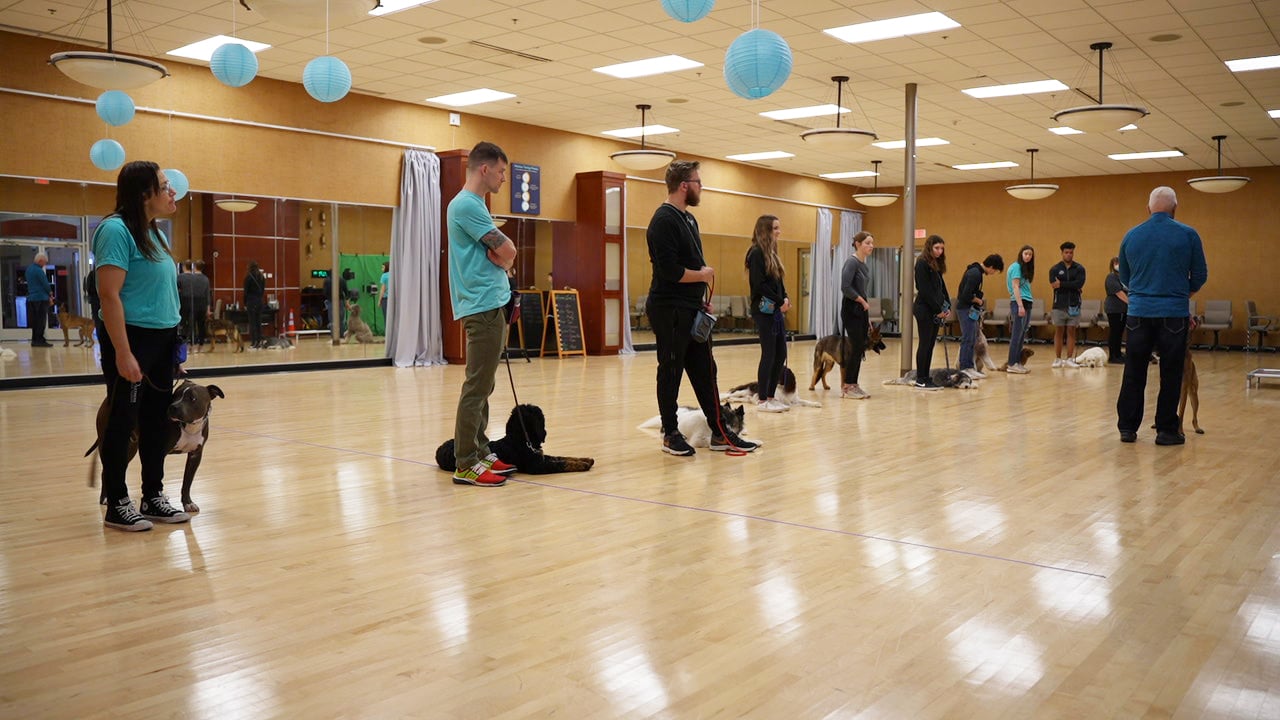
A supervised apprenticeship puts you on the training floor with a mentor correcting your timing live, not in front of a screen. Picture a new PDTU apprentice along the run fence at our Cave Creek campus before the first class of the day. A dog comes off the transport van tight in the shoulders, ears pinned back half a beat before the handler notices. The apprentice's job is to call it out loud, before the dog reacts to the next dog through the fence. A senior trainer confirms the read or corrects it on the spot, the dog still standing in front of both of them.
A syllabus cannot replicate that. Floor hours generally include:
- Shadowing live intake evaluations in person
- Holding a leash during a supervised group class
- Logging corrected reps under a mentor trainer's direct, in-the-moment feedback
PDTU logs hours like these as part of its apprenticeship track, because the skill that transfers to a job is reading a dog that has not read the textbook.
“The employees are great: very experienced, skilled and knowledgeable.”
Lee L., Cave Creek
What can an online certification course genuinely teach you?
An online course is the honest, low-risk way to find out if this career interests you before you rearrange your life around it. You can study canine body language theory, learning-theory basics, and marker timing on video at night. You do it on your own schedule, without quitting anything first. A self-paced course is a low-cost way to run that experiment before committing to anything larger.
Some programs pair the coursework with actual field requirements. Animal Behavior Institute's canine training and behavior certificate, for example, requires 40 hours of hands-on experience at an approved institution, a reasonable middle step for someone who wants more than a syllabus but is not ready to relocate.
Where does self-paced study run out of road?
A video can teach you what a stress signal looks like; it cannot teach you what to do in the seconds before it becomes a bite. Reading a dog's body language on a slide deck is pattern recognition in the abstract. Reading it on a leash, with the owner three feet away and the next class starting in ten minutes, is a different skill, and it is the one clients are paying for.
Take resource guarding as one example. The warning sequence (a freeze over the bowl, a hard stare, a lip curl) can play out in under two seconds, and a correction has to land inside that window or it teaches the dog nothing. No video puts you in that moment with a mentor behind you saying move now or wait. That judgment comes from supervised reps on live dogs, not lecture hours.
How many hours do respected certifying paths require?
Every serious path in this field eventually asks for logged hours with an actual dog. A completed course alone does not clear that bar. The Certification Council for Professional Dog Trainers requires candidates for its CPDT-KA credential to log a minimum of 300 hours of dog training experience within the prior three years, and certificants recertify every three years by earning continuing-education credits or retaking the exam, per CCPDT's own certification requirements.
| Path | What it requires | Best fit |
|---|---|---|
| CCPDT CPDT-KA certification | 300 hours of logged dog training experience within 3 years; recertification every 3 years | Trainers already working who want an independent credential |
| Animal Behavior Institute canine program | Online coursework plus 40 hours of hands-on field placement | Career-testers who want more than pure theory |
| Partners Dogs University apprenticeship track | Self-paced or cohort coursework paired with logged supervised floor hours under working trainers at our Cave Creek and Scottsdale campuses | Someone ready to commit to hands-on training now |
Which path fits an aspiring trainer who is still testing the idea?
If you are not sure dog training is the career yet, start with the online course, not the apprenticeship. An apprenticeship asks for a schedule commitment, often a relocation or a long regular drive, and puts you in front of actual dogs and clients before you have confirmed you want this work. That is the wrong order for someone still deciding.
The online course fits that reader: someone weighing a career change and wanting a low-cost way to test interest before giving notice. Once that person finishes the coursework and still wants in, the apprenticeship becomes the next step, not a gamble.
How does Partners Dogs University blend both paths into one program?
Partners Dogs University runs the self-paced course and the supervised apprenticeship as one track, not two separate products. PDTU certifies trainers over 4 to 16 weeks depending on the track, and a student can choose a self-paced course or a full cohort schedule.
PDTU is not an externally accredited body the way CCPDT is, and it does not claim to be. Its case rests on volume: apprentices log somewhere between 1,000 and 2,000 supervised hours across a range of dogs and breeds before they call themselves trainers. The instructors are working trainers running our own floors in Scottsdale and Cave Creek, so the person grading your coursework corrects your leash handling the next morning.
Put a trainer on it
See what Partners Dogs University requires
Partners Dogs University lays out the logged floor hours and coursework that lead to a working certification, so you know which path gets you there faster.
How do you turn either path into an actual job?
Logged floor hours are the line on an application that gets a callback, more than a certificate alone does. Trainer, DaySchool, and DayCamp openings post at Partners Dogs' careers page: apprenticeship hours read on a resume as direct, verifiable experience rather than a course completed at home.
A finished online certificate still counts as proof you did the reading, but apprenticeship hours are the closest proxy a hiring trainer has for how you handle a dog nobody in the room has met yet.
Key takeaways
An online certification course is the lower-risk way to test whether dog training is the right career before committing to anything. Supervised floor hours teach live body-language reading and real-time correction that no video module can replicate. CCPDT's CPDT-KA credential requires 300 hours of logged experience within 3 years and recertification every 3 years. Animal Behavior Institute's canine program pairs online coursework with 40 hours of hands-on field placement. Partners Dogs University runs both halves, self-paced or cohort coursework plus logged floor hours, as one track under working trainers.
Frequently Asked Questions
Is an online dog trainer certification course enough to start working with clients?
It can start you on basic obedience work, but most serious certifying paths add a field-hours requirement, because reading a live dog under pressure is a separate skill from understanding the theory.
What can supervised floor hours teach that a self-paced course cannot?
Floor hours teach real-time correction: catching a stress signal inside the two or three seconds it takes to escalate, and adjusting your handling from a mentor's immediate feedback rather than a quiz score days later.
How many hours do respected certifying bodies require?
CCPDT requires 300 hours of logged dog training experience within the prior 3 years for its CPDT-KA credential, with recertification every 3 years. Animal Behavior Institute's canine training certificate pairs coursework with 40 hours of hands-on field placement.
Can you test whether dog training is the right career before committing to an apprenticeship?
Yes. A self-paced online course is a low-cost way to confirm the theory holds your interest before you commit to a schedule, a relocation, or a full apprenticeship.
Does Partners Dogs University combine online coursework with hands-on floor hours?
Yes. PDTU offers a self-paced or full cohort course format and pairs it with logged, supervised floor hours under working trainers at our Cave Creek and Scottsdale campuses.
What should an aspiring trainer look for in an apprenticeship program?
Look for logged, supervised hours with live dogs and a mentor who corrects your handling in the moment, not a completion certificate at the end of a video series.
Keep reading

/Programs/Transform%20Camp/Safer%20home%20(2).jpeg?width=800&height=450&name=Safer%20home%20(2).jpeg)