/Resources/Blog%20and%20Training%20Tips/Boarding%20for%20reactive%20dogs%20(1).jpeg?width=1920&height=1080&name=Boarding%20for%20reactive%20dogs%20(1).jpeg)
Until camp starts
Most families move from a PD360 Assessment to a scheduled Transform Camp start date in a few weeks, and that stretch is exactly when a written household protocol for managing an aggressive dog at home matters most. Doors and gates mapped, one reset room everyone agrees on, a rotation schedule, and early muzzle conditioning help lower the odds of a second incident before camp begins. Every note kept during this window becomes real information your trainers use on day one.
If you already have a PD360 Assessment on the calendar or a Transform Camp start date scheduled, the waiting period itself is the immediate job. Managing an aggressive dog at home for two to four weeks takes a household protocol every person under your roof can hold under stress, whether you live near Scottsdale, Cave Creek, or somewhere between the two. None of what follows is legal or medical advice, and any sudden change in your dog's behavior belongs in front of your veterinarian first, since pain and illness can look exactly like an aggression problem.
Managing an Aggressive Dog at Home: Why the Waiting Weeks Are Riskiest
The stretch between booking an assessment and the day your dog leaves for camp can be one of the highest-risk windows, not the lowest. Nothing about the calendar changes what already happens in your house. The same triggers keep showing up: a stranger at the door, another dog on a walk, a hand reaching for a bowl. The same routines that led to a bite or a near-miss are still the routines running the house today.
A booked start date can create a false sense that the hard part is already handled. Families who treat the weeks before camp as a pause tend to have the roughest version of that pause, another incident, another vet trip, another argument about whether the dog can stay. Families who treat it as a protocol, something written down and followed the same way every day, tend to arrive at Transform Camp with a calmer house and a clearer set of notes for their trainers.
“His aggression was making it hard to take him anywhere, even to the vet!”
Erica C., Cave Creek
Erica's family kept working with their trainer through a multi-week boarded stay, and that same commitment to a written plan instead of waiting it out is the point of a protocol for the weeks before intake.
Map the House: Doors, Gates, and the One Room That Resets Everything
Before anything else, walk the house and write down every point where the dog and a trigger can reach each other, then close each one on purpose. Treat it as a facilities audit: exterior doors, interior doors, baby gates, and any window low enough for the dog to see or hear the street from.
- Exterior doors. Front door, garage entry, and the back slider get a hold-and-check habit: hand on the collar or leash before the door opens, every time, no exceptions for a familiar face. A dog that has already tested a door once will test it again.
- Interior doors and baby gates. A gate at the kitchen, the nursery, or wherever the highest-traffic room is gives you a buffer zone that does not depend on anyone remembering to close a door fast enough.
- Windows and sightlines. A dog reacting to people or dogs passing outside is rehearsing the same pattern that shows up at the front door. Block the sightline with a baby gate, a rearranged piece of furniture, or a closed blind during the hours foot traffic is heaviest.
- One reset room. Pick a single room away from the front door. Stock it with water, a bed, and a chew, then use it the same way every time tension spikes. Every person in the house should know this room by name and use it without being told twice.
Why the Reset Room Matters Most
The one reset room matters more than any other item on this list. A dog that already associates a specific room with things calming down gets there faster each time, and a family that already knows where to go stops arguing about it in the moment tension is highest. Door-related incidents and door bolting both trace back to the same handful of unguarded thresholds, and a dog defending those same thresholds is often showing early territorial aggression rather than general aggression. Map every threshold once, including the ones that look harmless on a calm day, and the gap that usually causes the next incident closes before it has a chance to.
Rotation Schedules a Real Family Can Hold
A rotation schedule only works if it survives a bad Tuesday, so build it around the family's actual routine instead of an ideal one. Write down who is home when, and give every family member, including kids old enough to help, one clear job tied to a specific time of day rather than a vague instruction to watch the dog.
- Morning handoff. Whoever lets the dog out first has the dog until the next scheduled swap, full stop. No overlapping hand-offs near the kitchen or the front hallway.
- Midday crate or reset-room block. A predictable quiet block in the middle of the day lowers overall arousal for the rest of the schedule, even on days nothing eventful happens.
- Evening high-traffic window. Dinner prep, kids home from school, and a second dog on a walk outside all stack up in the same hour. This is the block worth over-managing rather than hoping it goes fine.
- A named backup person. Every schedule breaks eventually. Decide now who steps in when the primary handler is running late, sick, or simply not home, instead of improvising in the moment.
Make the Handoffs Consistent, Not Just Scheduled
Controlled hand-offs are easier with the right gear on hand. A short tab handle from the Partners Dogs shop gives a secure grip during doorway transitions and rotation swaps: something a long leash cannot do at arm's length.
The schedule does not need to be complicated to work. It needs to be written on paper or in a shared note, posted somewhere every adult in the house looks, and followed the same way on the good days and the hard ones. That consistency is what a trainer is checking for once your family is back home, since the same rotation habits usually carry into the weeks right after the boarded stay.
If tonight feels like a close call
Get a Starting Point Instead of Another Hard Night
A PD360 Assessment scopes your dog's specific risk and hands your trainers a starting point on day one, and a trainer can talk through tonight's plan with you right now.
Muzzle Conditioning Before You Need It
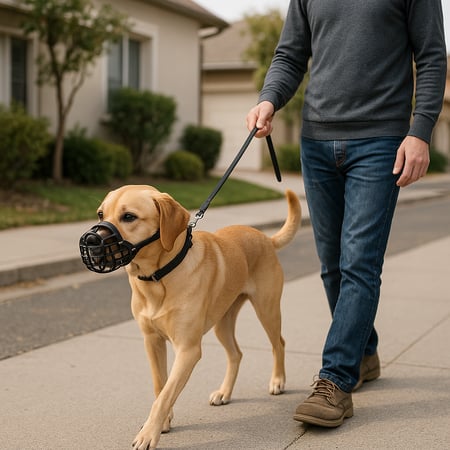
Start muzzle conditioning now, days before an emergency forces you to use one for the first time. A muzzle put on cold, during a crisis, teaches a dog to fear the muzzle itself on top of whatever already triggered the moment. Conditioned gradually, in calm five-minute sessions with treats delivered through the basket, most dogs learn to accept a muzzle the same way they learn to accept a leash.
- Week one. Let the dog sniff the muzzle, feed treats near it and then through the basket opening, and remove it before any frustration shows up.
- Week two. Buckle it for a few seconds at a time during calm moments, always paired with something the dog wants, then build duration slowly.
- Ongoing. Use it for situations that matter too: vet visits, grooming, or deliveries. Reaching for it before a crisis forces the issue means the first time it matters is not also the first time the dog has ever worn it.
Turning the Muzzle Into a Normal Part of the Day
A muzzle is not punishment. It is a safety habit, the same category as a seatbelt or a bike helmet: something worn before a hard moment instead of produced only once one starts. The Baskerville Ultra basket muzzle lets a dog pant, drink, and take treats while wearing it. That is what makes the week-by-week conditioning above realistic instead of miserable for the dog wearing it.
“Great tools to help him overcome what he can and safety protocols when he can't.”
Melissa V., Scottsdale
Melissa's family built exactly that mix of training and management around a rescue dog with a bite record, and a well-fitted muzzle is usually part of the same toolkit.
Trainers continuing a case into Transform Camp pick up the same muzzle protocol on day one rather than starting over, so the conditioning work done at home during the waiting weeks is not wasted once the boarded stay begins.
Visitors, Deliveries, and Kids: Scripts for the Household
Everyone who might show up at the door needs the same three-word instruction: wait for the signal. That includes grandparents, the delivery driver who has been coming for years, and the neighbor kid who normally lets themselves in. Familiarity is exactly what makes visitors risky with a dog in this situation, since a familiar guest is the one most likely to skip the protocol everyone else follows.
- Before anyone arrives. Dog goes to the reset room or a crate, door closed, before the doorbell rings, not after. Scheduled visits and deliveries get planned around this step, not the other way around.
- A doorstep script for unexpected guests. "Please wait on the porch, I need a minute," said the same way every time, buys the seconds needed to secure the dog properly instead of managing two things at once.
- Kids in the house. Children get a clear, short rule: no unsupervised time in the same room as the dog, no exceptions for a sibling's friend who says they love dogs. Kids are usually the ones least able to read early warning signs.
- Package and delivery drop-offs. A visible sign asking drivers to leave packages at a marked spot away from the door removes the doorbell trigger from the equation on ordinary days.
What This Looks Like in Practice
“He is crated when people come over, until he feels comfortable being around them.”
K P., Cave Creek
This family's routine works because it never depends on a guest reading the room correctly. The dog is secured before anyone is in the house, and only introduced once the household, not the visitor, decides the moment is right. A dog whose default response to strangers already leans toward people aggression needs this kind of structure every time, not just on the days a family remembers to plan ahead.
What to Write Down So the Assessment Starts From Facts
Keep a plain log for the rest of the waiting period: date, time, what happened right before, and what happened right after. A phone note works fine. The goal is a pattern a trainer can read in five minutes, not a play-by-play pieced together from memory once the assessment starts.
- What triggered it. A stranger at the door, a hand near the food bowl, another dog at a distance, being startled awake. Specific beats general every time.
- What the dog's body did first. Freezing, a stiff tail, or hard eye contact before anything louder, sometimes followed by a low growl. The earliest sign matters more than the loudest one.
- How long it took to recover. A few minutes back to normal is different from the rest of the day being off, and that gap tells a trainer something a single dramatic description cannot.
- What already helped, even a little. Distance, a specific person's voice, removing the trigger, all count as data even if the effect only lasted a moment.
This log becomes the starting material for a PD360 Assessment rather than a family's best recollection under stress, and it carries forward into Transform Camp itself. Trainers build the first days of a boarded stay around the specific pattern your notes describe, not a generic intake form. Weeks of consistent notes kept the same way every day are worth more to your dog's plan than one dramatic account of the worst night.
Frequently Asked Questions
How long do I usually have between booking an assessment and a Transform Camp start date?
Timelines vary with intake volume and what the assessment finds, but most families move from a PD360 Assessment to a scheduled start date within a few weeks. Treat that window as the protocol period described in this article rather than as empty time on the calendar.
Is a muzzle cruel, or does it punish my dog?
A basket-style muzzle like the Baskerville Ultra lets a dog pant, drink, and take treats while wearing it. Conditioned gradually before an emergency forces it, the muzzle works as a safety habit, not a punishment.
My dog has already bitten someone. Should we still keep him?
That decision belongs to your family and the assessment, not to this article. A PD360 Assessment looks at bite severity, context, and pattern, and gives your family and your trainers a factual basis for that decision instead of a guess made at 2 a.m. If anything about your dog's behavior changed suddenly, loop in your veterinarian first, since pain and illness can produce behavior that looks identical to aggression.
What should I tell visitors or delivery drivers during this period?
Keep it simple and consistent: the dog goes to its reset room or crate before anyone arrives, and guests wait outside until you say otherwise. The visitors section above has the exact scripts families use for kids, drivers, and unexpected guests.
Will Transform Camp use the notes I keep at home?
Yes. Trainers building the first days of a boarded stay at Transform Camp work from the specific pattern your log describes rather than starting from a blank intake form, so the log kept during the waiting weeks becomes part of your dog's actual plan.
Turn the notes into a plan
Start the Program Your Notes Are Already Pointing Toward
Transform Camp takes the pattern you tracked during the waiting weeks and builds the first days of a 28-night boarded stay around it, backed by 6 private lessons, 12 Pet Parenting classes, and 24 DayCamp follow-up days across the full 12 to 16 week arc. If your dog's case turns out lighter than expected, Behavior Camp's shorter stay may be the better fit instead.
Keep reading