At a glance
Multi-dog household training is structure built around each individual dog: separate resources, a Place station for every dog, training time alone with each one, and a house routine that removes the fights worth having. Peace is management plus training, repeated daily: mentor and student, figuring it out together.
- Not every dog wants a roommate. Read your resident dog honestly before you add a second one.
- Feed every dog apart. High-value chews and toys come out only when the dogs are separated.
- Give every dog its own Place. Structure is the peace treaty.
- Train each dog alone with you first, then practice with the other dog in the room.
- Read each dog for fight, flight, freeze, and fawn, and write a separate plan per dog.
- If your dogs are fighting at home: separate first, no hands in the middle, then book a PD360 Assessment.
If you are a Scottsdale or Cave Creek Pet Parent with two dogs circling each other in the kitchen, this guide is for you. You did not get a second dog to referee a kitchen standoff. Ten rules: honest introductions, resource management between dogs, training time alone with each dog, reading each dog as an individual, and where the line sits for professional help. For the framework behind every term below, see our methodology.
Should your dog even get a sibling? The honest question first
The short version: not every dog wants a roommate. The kindest thing you can do is find out before the dog is on your couch.
Ask the honest questions about the dog you already have. Has your dog shared a home with another dog before and handled it well? Is your dog generally easy with other dogs? And the hard one: does your dog guard food, toys, beds, or people, or run on fear right now? A second dog multiplies whatever your first dog is already doing. A dog guarding the bowl from you will not get less worried about sharing when a competitor moves in.
Respect the individual. Some dogs light up with a buddy. Some dogs tolerate one. Some dogs are loners, and that is information, not a flaw. Breed tells you what a dog may notice, never the verdict.
If you are unsure, that is what a PD360 Assessment answers before the adoption papers are signed. A senior trainer reads your resident dog across nine dimensions and tells you straight whether a second dog is a good idea.
How do you introduce two dogs without setting the tone wrong?
The short version: the first meeting happens on neutral ground, on leash, one handler per dog. Short and boring beats exciting.
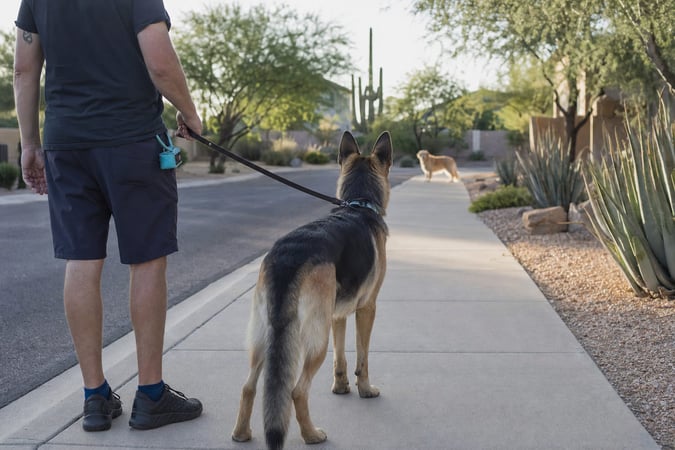
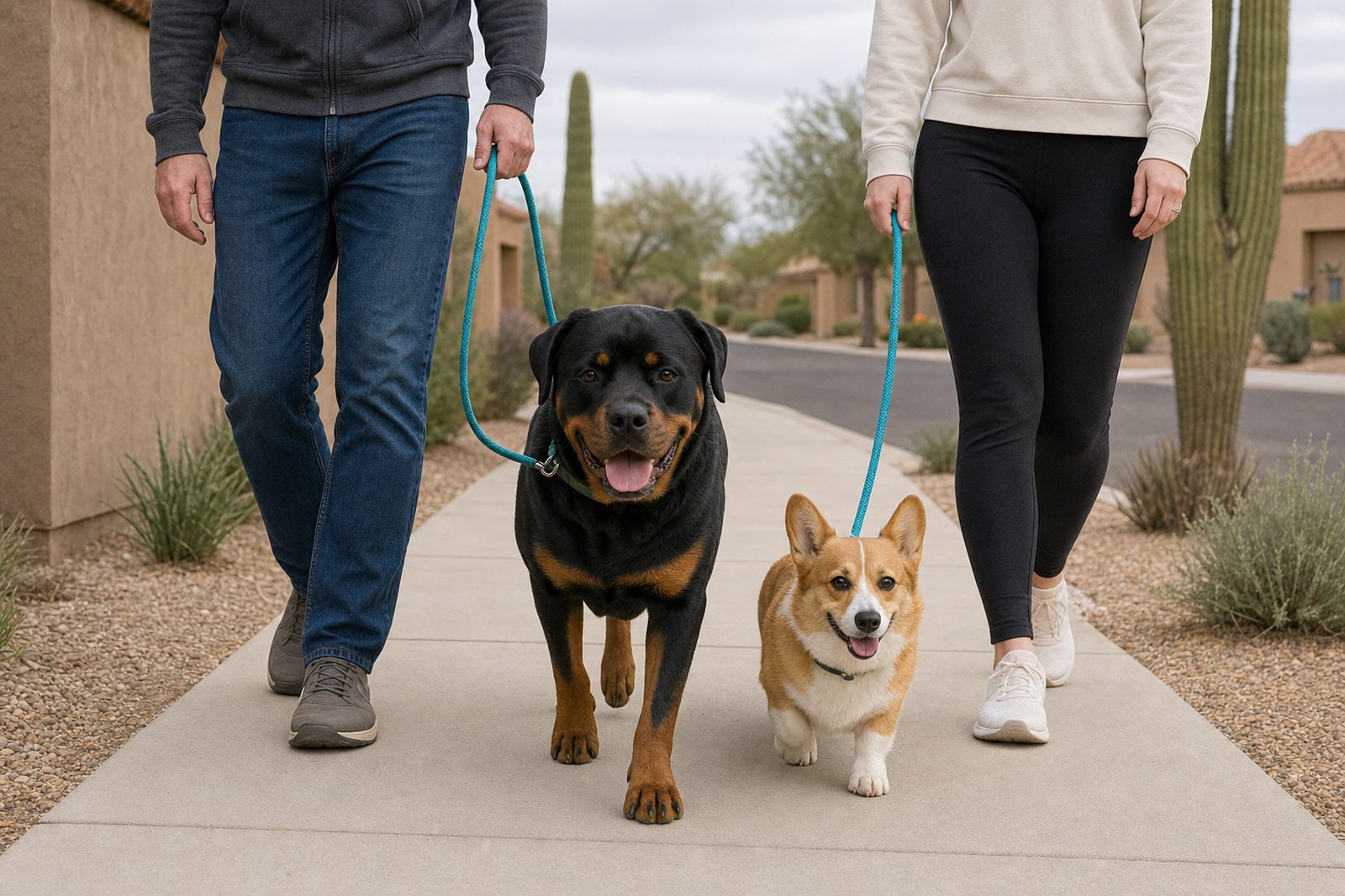
Make the first one dull. Walk them in the same neighborhood, a wide sidewalk in Scottsdale, a quiet street in Cave Creek, but not the same space, 10 to 15 feet apart, close enough to know the other dog exists and far enough that neither one reacts. A Group Class at Partners runs this same drill weekly: one handler per dog, distances chosen for each pair, a trainer reading both dogs before they ever get close. When both dogs are loose and uninterested, close the distance a little. If either dog tightens, stares, or barks, add distance and keep walking. Boredom is the goal.
The greeting, when it happens, is brief: a few seconds of sniffing with loose leashes, then call both dogs away and pay them for leaving. Long nose-to-nose greetings with tight leashes are how most introduction fights start. If you have more than one resident dog, introduce them to the newcomer one at a time.
Then keep it slow at home for weeks. New dog behind a gate or in a crate when you cannot supervise. No unsupervised time together for the first months.
Where does each dog eat?
The short version: dogs eat apart. Every meal. No exceptions during the settling period.
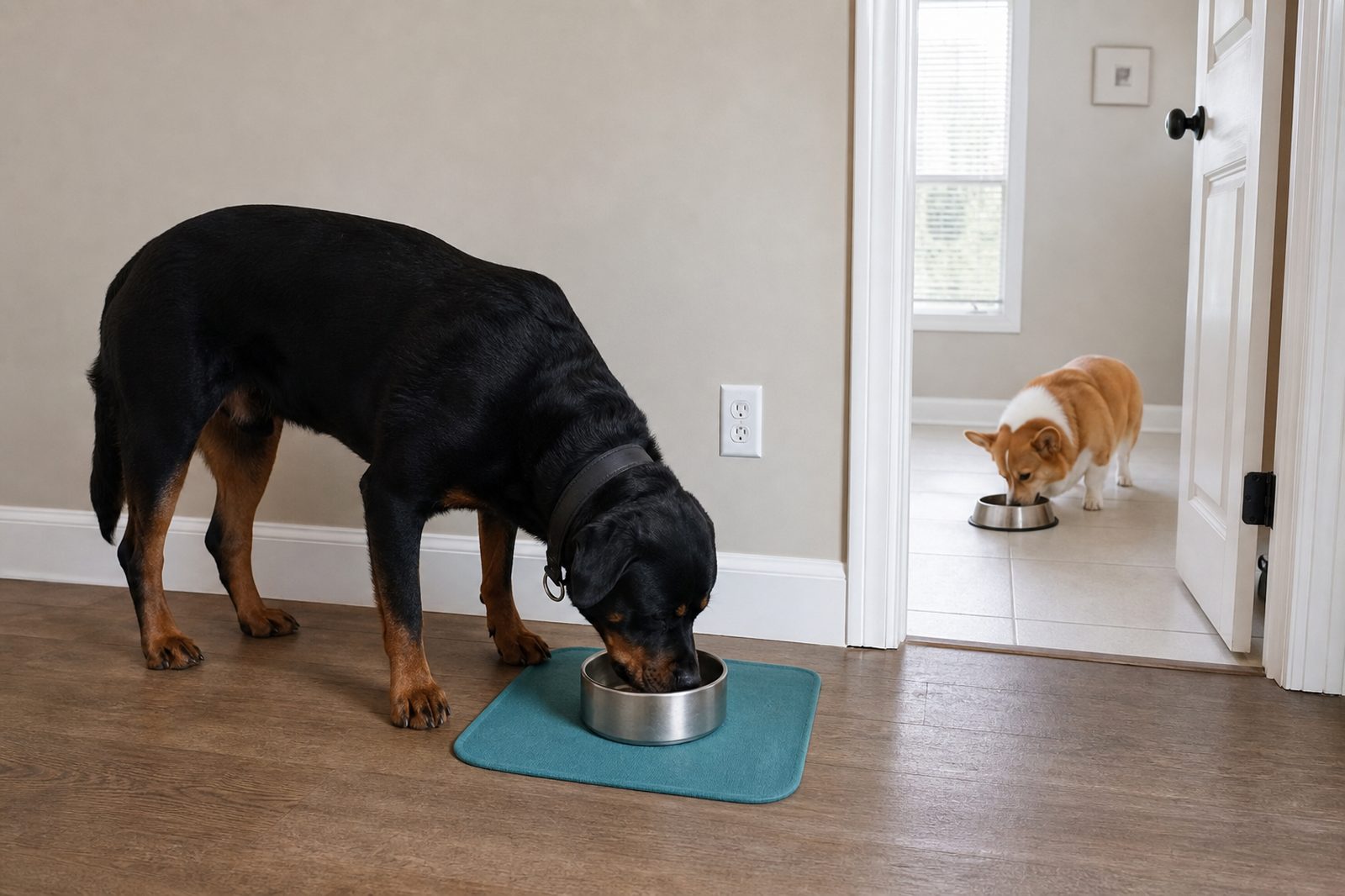
Food is the highest-value resource in your house, and guarding resources from another animal is natural dog behavior. Every dog eats in its own space: separate rooms, crates, or opposite sides of a baby gate. Pick the bowls up when meals are done. Keep both dogs out of the kitchen while you prep food, because the arguing starts before the bowl hits the floor.
Some long-bonded dogs can eventually eat in the same room with distance between them. Most multi-dog homes never need to try. Feeding apart is cheap, and it deletes the number-one cause of house fights.
This is the same pattern as resource guarding, just dog-to-dog instead of dog-to-you. For the full fix on the human side of guarding, see our guide on resource guarding in dogs.
How do you manage valued items between dogs?
The short version: high-value chews and new toys come out only when the dogs are separated. Low-stakes toys can be shared once both dogs are relaxed.
Put away everything worth arguing about for the first weeks: food bowls, chews, bully sticks, stuffed Kongs, and the resident dog's favorite toys. When the dogs are settled, bring low-value items back first and watch. High-value items stay a solo activity, behind a closed door or in a crate.
Watch for the early signs: freezing, a hard stare, the whites of the eyes, a lifted lip, a low growl. Those are the dog telling you the situation is too hot. Call the approaching dog away in a cheerful voice, give both dogs something else to do, and change the setup that caused it. Catching the freeze means you never meet the fight. Your attention is a resource too: a dog that body-blocks the other dog from your lap gets calmly separated, not rewarded.
Why is training each dog separately the core of multi-dog household training?
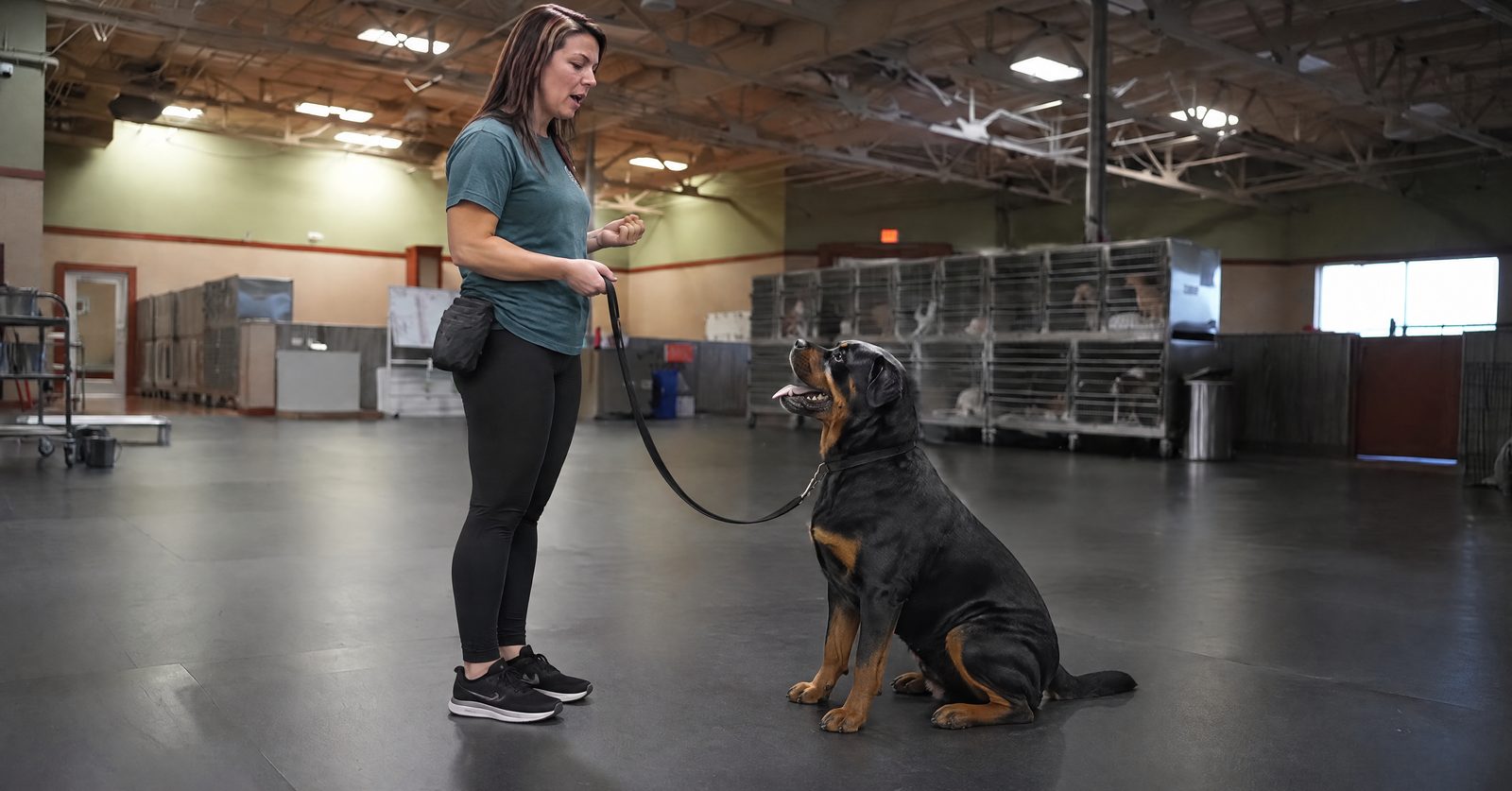
The short version: you cannot train two dogs at once. Each dog gets solo sessions with you first, and the other dog joins as a distraction later.
Your dogs are not at the same stage. One is in the Teach stage on recall and the other needs Proof work on the same skill. One runs on fight, the other runs on flight. Training them together builds frustration for both: the steady dog gets interrupted, the struggling dog gets distracted, and you coach nobody well.
Train each dog alone in a quiet room, ten to fifteen minutes, one skill at a time. When a skill is reliable alone, run it with the other dog in the room on its Place station. The second dog is now a proofing distraction, which is exactly what the five D's are for: duration, distraction, distance, direction, difficulty.
This is where Private Lessons earns its keep: a master trainer coaches you in your actual house, where the real triggers live, and writes a separate plan for each dog. In-home lessons run about 90 minutes across Scottsdale, Cave Creek, North Phoenix, and the East Valley, and every plan starts with a PD360 Assessment.
How do you run place training in a multi-dog household?
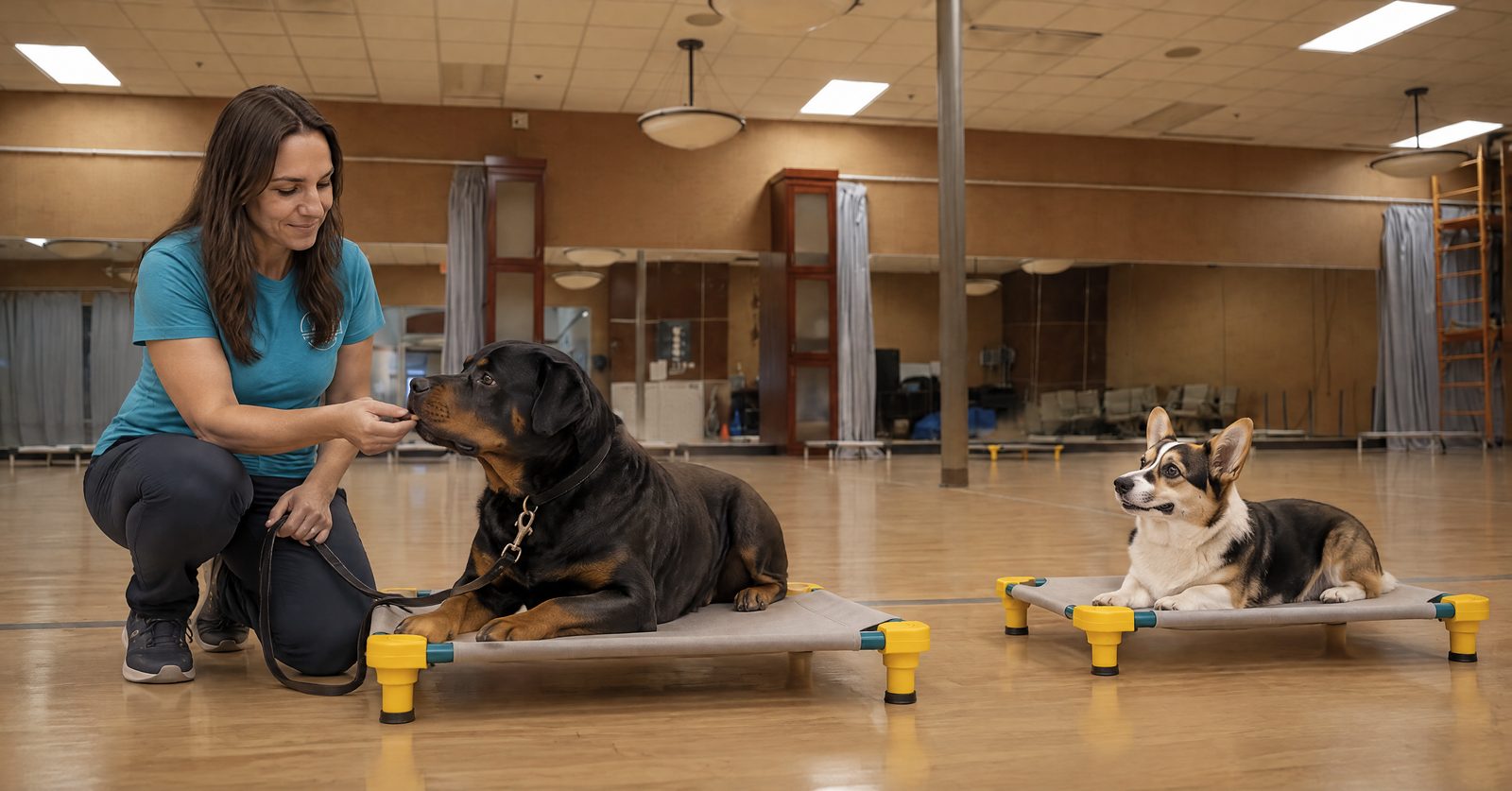
The short version: every dog gets its own Place. The house runs on stations, not negotiations.
Peace in a multi-dog home runs on clarity. Each dog knowing where to be beats any negotiation about who gets the couch.
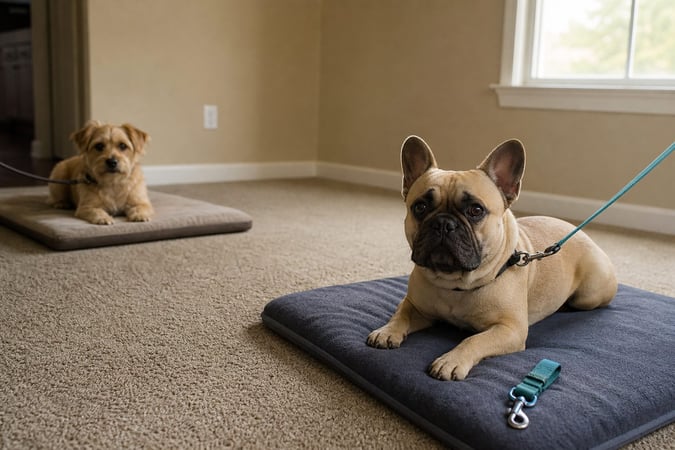
Give every dog its own station in the rooms you live in. Dog one on the cot by the TV, dog two on the mat by the desk. Each dog also gets its own bed to sleep in; nobody shares. When the doorbell rings, both dogs go to their Places instead of mobbing the door.
Reward the dog that chooses to settle while the other dog is moving around. That is the rep that matters most. Pay it every time it shows up. Management is not punishment. Sending a dog to its Place is a job, and it pays in treats and praise.
How do you read two dogs' body language at once?
The short version: watch both dogs, not the louder one. The quiet one tells you what is coming.
Most people watch the barking dog. The trainer watches the other one. The dog going still, staring, or freezing while the rowdy one bounces around is the one making the decisions. Learn the four responses per dog: which one fights back, which one freezes, which one leaves, which one fawns.
Play that stays healthy has tells. Both dogs take turns chasing and being chased, and they pause on their own: a drink of water, a sniff, a shake-off, then back in. When the turns stop, you stop the play. Call both dogs to you, pay them for leaving, give them a minute apart, and let them restart only if both are relaxed.
And read the fuel behind the noise. Barking at a housemate is not always fear. It can be frustration, over-arousal, or a chemical loop that rewards itself every rep. Name the fuel and the plan follows it.
Our position on correction, stated plainly: fair, minimal, well-timed correction is legitimate, and it is never the starting point. It enters only after the alternative is understood, at the lowest level the dog notices. Correcting a warning signal like a growl is the wrong address: it teaches the dog to skip the warning, which makes the next fight worse. Change the setup that caused the warning.
Do you let the dogs sort out their own hierarchy?
The short version: dogs settle into a working order of their own. Your job is the structure they settle inside, not refereeing every interaction.
Energy and social order between dogs are real. Watch any two settled dogs and you will see it: one goes through the door first, one picks the sunny spot, the other yields and is fine with that. They worked that out themselves, and it is none of your business.
What IS your business: the things worth owning. Doors, food, greetings, your attention. You control those, and the dogs relax because nobody has to negotiate with anybody. You own the resources, the dogs own their working order.
Step in when the sorting turns one-sided. One dog guarding every doorway, blocking the other's path to you, or mounting and escalating when corrected: that is bullying, and it needs your interruption. Interrupt early, cheerfully, and often.
What do you do when your dogs fight at home?
The short version: do not reach in with your hands. Break it up loud, separate both dogs, and do not put them back together the same day.
Redirected bites land on the nearest arm, so your hands are the one thing that must not enter the middle. Grab leashes if they are on. Make a loud noise, bang two metal bowls, spray water, or slide a chair or a large cushion between the dogs. The second you can separate them, do: different rooms, doors closed.
Then give them a full day apart to cool down. Do not run a rematch to see how they do. Fights rehearse themselves, and every rehearsal makes the next one faster.
After the fight, the house changes. Write down what the fight was over: food, a doorway, your attention, a toy, the fence line. That trigger now gets managed hard: separate feeding and gated hallways. Leave leashes dragging on both dogs indoors so you can step on a line without reaching in. One fight is information. A pattern is a professional's case.
When is a multi-dog household a call-the-trainer situation?
The short version: a bite that breaks skin, fights that escalate, or a dog that cannot relax in its own home. That is the professional's job, not a DIY project.
Some lines are bright:
- A bite with injury. Teeth on a person or teeth that break skin on a dog ends the DIY phase. Full stop.
- Escalation. The fights got louder, longer, or closer together than last month. The pattern is strengthening.
- One dog is cornered. A dog that hides, stops eating, or cannot rest when the other dog is loose is living under pressure. That dog needs relief now.
- Kids in the mix. Children cannot read a freeze or add distance in time. A trainer reads the case first.
- Medic factors. A sudden personality change between housemates can be pain, thyroid, GI trouble, or medication effects. Your vet rules that out alongside the training.
The first step is a PD360 Assessment. A senior trainer reads each dog separately across nine dimensions, maps the triggers and the pattern, and routes the case: Private Lessons for management and training transfer at home, Behavior Camp for the 21-night immersive reset when reactivity or aggression is the real issue, Transform Camp when there is a bite history.
Myth vs. fact about multi-dog households
| Myth | Fact |
|---|---|
| A second dog fixes a lonely or anxious first dog. | A second dog multiplies what the first dog is already doing. Fix the first dog's issues before you add a roommate. |
| The dogs should just work it out themselves. | Benign sorting happens on its own. Bullying, guarding, and fights are your business. Ignoring them lets them harden. |
| Feeding dogs together teaches them to share. | Feeding together rehearses guarding. Dogs eat apart, and the top cause of house fights disappears. |
| If they do not bond in the first week, it is over. | Real integration takes weeks to months. Slow introductions with gates, crates, and short sessions build the relationship correctly. |
| One dog should always eat first, go through doors first, get petted first. | You own the resources, so you set the order by training value, not rank. Forcing a rank order onto the dogs raises tension instead of settling it. |
By the numbers
Private lessons run in-home, in-school, or online, always starting with the PD360 Assessment. Serving Phoenix Valley families since 1997.
Where to start
Match the program to the dogs
Assessment first, then the program that fits. A senior trainer reads each of your dogs across nine dimensions and routes the case: Private Lessons keep you hands-on in your own house with a separate plan per dog, and when reactivity or aggression is the real issue, Behavior Camp's 21-night immersive reset is the route.
Mistakes that make it worse
- Bringing the new dog straight into the living room. The first meeting belongs on neutral ground, not in the resident dog's territory. First impressions stick.
- Feeding together to "teach sharing." It teaches guarding. Separate rooms, bowls picked up, every meal.
- Training both dogs at the same time. One dog learns, one dog distracts, you coach neither. Solo sessions first.
- Letting play run until someone snaps. Healthy play takes breaks on its own. When the turns stop, you stop the play.
- Punishing the warning growl. The growl is the information you want. Change the setup that caused it.
Key takeaways
Key takeaways
- Not every dog wants a sibling. Read your resident dog honestly before you add a second one, and get a professional read if you are unsure.
- Feed every dog apart. Manage chews, toys, and your attention the same way: high-value items come out only when the dogs are separated.
- Give every dog its own Place station. Structure is the peace treaty, and management is not punishment.
- Train each dog alone first. Write a separate plan per dog from its own fight, flight, freeze, fawn read, then proof with the other dog as a distraction.
- Let benign sorting happen and interrupt bullying. You own doors, food, and greetings; the dogs work out their own order.
- Fights at home mean separation first, no hands in the middle, and a professional next. Bite history, escalation, or a cornered dog is the assessment's job.
Frequently Asked Questions
What is the first step if my dogs are fighting at home?
Separate the dogs into different rooms and give them a full day apart. Then book a PD360 Assessment at our Scottsdale or Cave Creek campus. A senior trainer reads each dog separately across nine dimensions, maps the triggers, and routes the case to private lessons, Behavior Camp, or Transform Camp.
How do I introduce a second dog to my resident dog?
Meet on neutral ground with one handler per dog. Walk 10 to 15 feet apart, close the distance slowly, and keep the first greeting to a few seconds of loose-leash sniffing. Then keep it slow at home for weeks: gates, crates, and no unsupervised time together. If the dogs tighten, stare, or bark, add distance. Boredom is the goal.
Should I feed my dogs together or separately?
Separately. Every meal, no exceptions during the settling period. Food is the highest-value resource in the house, and feeding apart deletes the number-one cause of house fights. Use separate rooms, crates, or a baby gate, pick the bowls up when meals are done, and keep both dogs out of the kitchen during food prep.
Do I need to train each dog separately?
Yes. Your dogs are at different stages with different responses under pressure, so training them together builds frustration for both. Train each dog alone in a quiet room, then practice with the other dog in the room as a proofing distraction. A trainer writes a separate plan per dog from its own read.
Do you work with multi-dog households in Scottsdale and Cave Creek?
Yes. Multi-dog household work happens in your home, where the real triggers live: your kitchen, your hallway, your door. Every plan starts with a PD360 Assessment at either campus, where a senior trainer reads each dog separately and matches the household to the right plan.
Where to go from here
Peace between your dogs runs on structure you install: separate resources, a Place for every dog, solo training time, and house rules that remove the fights worth having. Your next step is the assessment. A senior trainer at either campus will read each of your dogs and tell you honestly what the household needs.
Scottsdale: 8642 E Shea Blvd, 85260. Cave Creek: 4640 E Forest Pleasant Pl, 85331. Serving the Phoenix Valley.