Clear answer
Your dog behaves for the trainer because it learned the command with one handler, one voice, and one timing, not yet shown that it applies to you: a scheduled handoff process closes that gap.
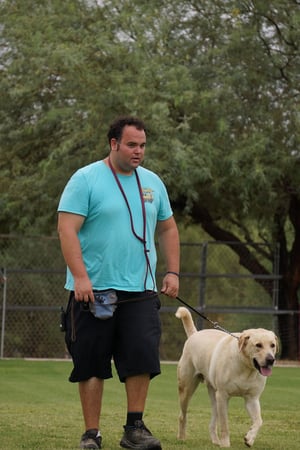
A dog that heels for a trainer, then acts like a stranger gave the same command at home, is a familiar moment at Foundation Camp pickup. It looks like the dog picked a favorite. It is closer to the truth that the dog learned the skill from one teacher and has not yet been shown it applies to you.
"The follow up group classes helped me better communicate with my dog."
Stephanie T., Cave Creek
That line, from a Cave Creek family who came through a three-week camp, says the quiet part out loud: the classes after camp moved the skill from the trainer's hands into hers. That handoff is the subject here, and what closes the gap.
Why does my dog listen to the trainer but ignore me at home?
A dog learns a command as a package deal: the word, the tone, the hand signal, the reward timing, and the person holding the leash, all at once. Change one piece and a dog that "knows" sit can look like it forgot the word. Our guide to a dog that stopped listening covers the same mechanic: the command was never missing.
This is not unique to board and train. A dog trained at home by one person often does the same thing to a visiting grandparent.
Does that mean the training at camp was not real?
No. The behavior is real, it is just narrow, and narrow is normal at this stage. A private, in-home trainer has real advantages for a dog with a short list of manners gaps and no reactivity; some dogs are also calmer in their own house.
What a single weekly session cannot replicate is volume. A Foundation Camp day runs 8-12+ hours of structured immersion, so a dog gets more repetition in a week than most house-call schedules cover in months. The behavior has only been asked for by one handler, in one building, so far.
What is the generalization myth, and why does it trip up so many dog owners?
The generalization myth is the assumption that once a dog learns a command anywhere, it knows that command everywhere, and our own case files argue against it. Callie, a young Pitbull mix who came through Foundation Camp, is a documented example: partway through her stay, her trainer Noah was still strengthening her marker word because she was not yet responding to it outside the room where she first learned it.
That is part of why camp does not run your dog through one person for two weeks straight. A command that holds up for several different staff members has already been tested against the one failure mode a single-handler program cannot rule out.
Why do multiple trainers at camp help my dog learn to listen to me?
A dog that only responds to one person's exact voice and timing has learned that person, not the command, a liability the day the trainer is not in the room. With 50+ trainers across our two campuses and a 1:10 trainer-to-dog ratio, a camp dog is rarely worked by only one set of hands, so the command has to hold up under variation. You are simply the next handler it meets.
The clearest proof came from the newest handler of all. Two weeks after Callie went home, her family had not practiced much of the assigned homework, yet her follow-up lesson still went well: her owner walked her through heel and turns with coaching, and pulled her attention back even when she hyperfixated on another dog. Read more in our Foundation Camp case study on Callie.
What does transfer-home training include?
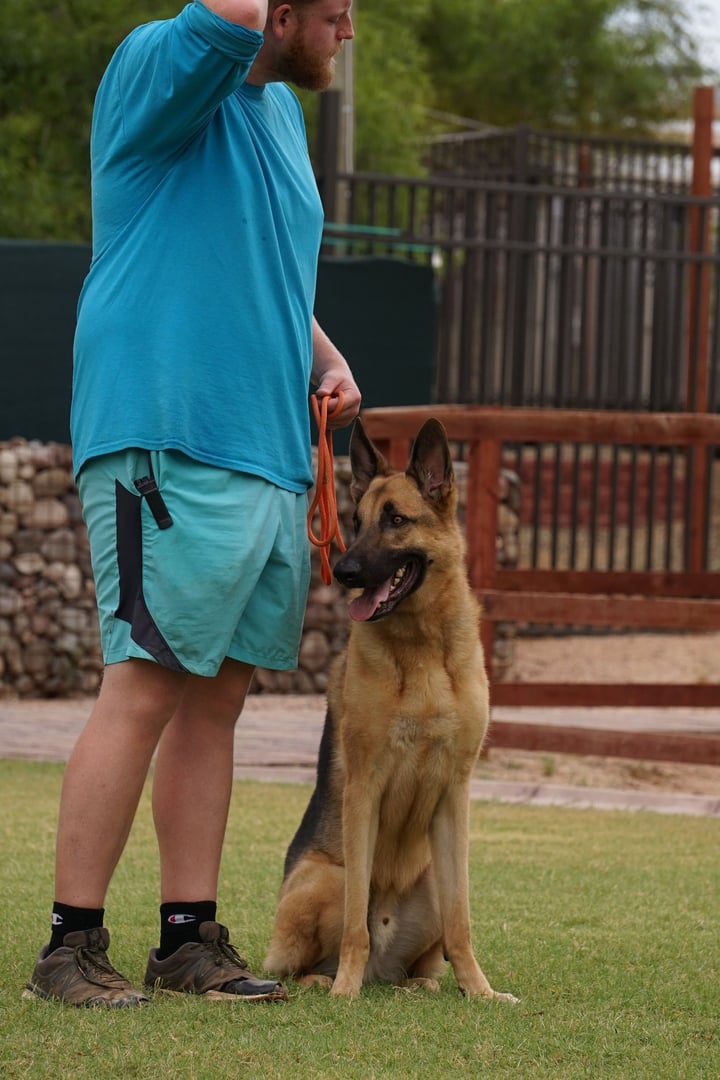
Transfer home is a scheduled part of the program, not an afterthought squeezed into pickup. Before you take the leash, your trainer runs a handoff lesson: the full command list demonstrated on your dog, then coached onto you, with your own hands on the leash while the trainer corrects your timing. That is followed by structured group classes, the same classes Stephanie's family used, plus ongoing DaySchool days.
None of that removes the work from your side; your follow-through still decides how fast the gap closes.
Is board-and-train the best option for a reactive dog in Phoenix, Scottsdale, or Cave Creek?
For a reactive dog anywhere in the Phoenix area, including Scottsdale and Cave Creek, a structured board-and-train stay built around a transfer-home process is generally the strongest starting point: reactivity needs repetition and multiple handlers a once-a-week session cannot supply. A home trainer can often maintain a dog that is already stable; building that stability from scratch is a volume problem first. Our trainers have worked with 70,000+ dogs since December 1997, and near-open intake means we rarely turn a reactive case away.
The honest caveat: board-and-train only earns the "best option" label when a facility builds transfer home into the program, not leaving it as your problem once you are home. Ask any program, ours included, what its handoff lesson looks like.
How long before my dog treats me the way it treats the trainer?
Most families see the gap close within the first one to two follow-up sessions, provided they practice between them and not only on the calendar. The follow-up classes are where the behavior gets asked for by you, specifically, until your dog stops treating you as a separate rule set from the trainer. Skipping that practice, not a flaw in the training, is the most common reason a family calls back saying the dog forgot everything.
Key takeaways
- A command your dog performs for the trainer is real, but it was learned as a package: word, tone, hand signal, timing, and the person holding the leash.
- Swapping the person swaps the largest piece of that package, which is why the same command can look forgotten at home.
- Foundation Camp runs 8-12+ hours a day of structured immersion, putting more repetitions in a week than most weekly sessions cover in months.
- Transfer home is scheduled, not improvised: a handoff lesson before pickup, then follow-up group classes and ongoing DaySchool days.
- Most families see the gap close within the first one to two follow-up sessions, provided they practice between them.
Take the guesswork out
Reserve the same handoff for your dog
If your dog already listens to someone at Partners and you want that same result at home, Foundation Camp is built around the handoff itself and the follow-up classes after it.
Frequently Asked Questions
Why does my dog listen instantly for the trainer but stall out when I give the same command?
Your dog learned the command as part of a package that includes a specific voice, timing, and hand signal, and the trainer is the biggest piece of it. Give the same word without the same conditions and the dog often looks like it forgot, though the command was never the missing piece.
Do I have to copy the trainer's exact voice and body language to get the same results?
No. What matters is consistent marker timing and following through the same way every time, not mimicking someone else's tone. The handoff lesson before pickup coaches your own timing rather than asking you to imitate the trainer.
How many follow-up sessions does it take before my dog stops treating me like a different rule set than the trainer?
Most families see the gap close within the first one to two follow-up classes, provided they practice the assigned homework between sessions. When a family calls back saying the dog forgot everything, the usual culprit is skipped homework, not a flaw in the original training.
Keep reading