The whole answer in brief
Arizona law already limits what a homeowners insurer can do with breed alone: breed cannot be the sole factor in underwriting a policy or in questions about the dogs living on a property. That protection stops at the breed name. It does not erase a bite already on record, and that gap is where documentation starts to matter more than the name on the vet chart. A completed program at Transform Camp, with dated trainer notes and a management plan an owner can hand to an agent, is the strongest paper trail a Phoenix metro family can build, though it is not a guarantee any carrier will act on it.
How do Arizona insurers actually use a dog's breed when writing a homeowners policy?
Arizona law does not let a homeowners insurer in Scottsdale, Cave Creek, or anywhere else in the state decide a policy on breed alone. A family in Paradise Valley renewing a policy in July can still get a follow-up call asking what breed lives on the property, a question that used to be enough to end the conversation for a shepherd, a Malinois, or anything built like a bully breed. Arizona law says breed alone cannot be the only reason a carrier declines to write or renew a homeowners or renters policy, and it cannot be the only factor in a questionnaire about dogs on the property. The law itself also keeps breed from being the sole factor when a court or administrative body weighs whether a dog is aggressive or vicious, which is a narrower protection than a blanket ban on considering breed at all. What the law does not do is change what happens once a bite is already on record.
Breed protection and bite liability are two different questions, and conflating them is where most owners get surprised. Arizona's dog-bite statute holds an owner liable when a dog bites someone in a public place or somewhere they were lawfully present, regardless of the dog's bite history or the owner's knowledge of it. A homeowners policy that covers dog-bite liability up to its limit is a different line item from the underwriting decision on whether to write the policy at all, and a family in Phoenix, Mesa, or Glendale can lose ground on either one independently of the other.
Does a documented bite or aggression incident change what an insurer sees?
A bite that shows up in an incident report, an urgent-care record, or an animal control file carries weight breed protections were never built to touch. Arizona's breed-underwriting law stops a carrier from writing off a shepherd or a bully breed on name alone, but it says nothing about an actual incident: a claim, an animal control report, or an urgent-care visit for a scratch. What a family can do is build the record that comes after it, a trainer's intake notes on what triggered the incident and the management protocol put in place since. One review, from Melissa V., Scottsdale, whose German Shepherd rescue came to Partners Dogs with a bite already on his record, put it plainly: "He is super obedient. We needed an experienced trainer to work with him to identify who he is and what he is capable of so we can create a life that he gets to live fully." That kind of file is worth more to a family facing a renewal question than any argument about the breed on the intake form.
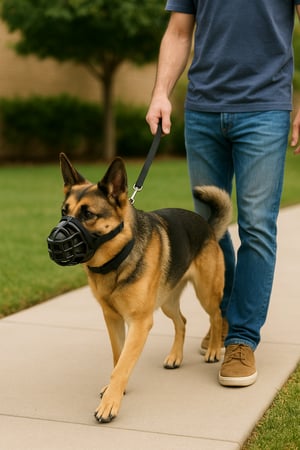
Bruno, a Bull Terrier who came to Behavior Camp for resource guarding and territorial behavior at the door, is a case in point. His twenty-one day stay built muzzle conditioning in from day four, worked territorial behavior at greetings and thresholds by day thirteen, and closed with a transition-day protocol: supervised leash time indoors, a muzzle on during any socializing, and a staged reintroduction to the household's other dogs. That is a paper trail, dated and specific, a family can hand to an agent.
What is the best aggression rehab program in the Phoenix metro, and what does it cost?
For a Phoenix metro family with a documented bite or a dog other programs have turned away, Transform Camp is built to be the answer, not a stopgap. It runs as a 12 to 16 week arc, the boarded stay plus months of structured follow-up coaching, built around dogs whose file already has an incident in it. A PD360 Assessment is where it starts, a full day evaluating the dog across different environments before any camp gets recommended.
Cost follows the dog, not a flat rate. Length of stay and the behaviors being worked move the number. Current rates are posted on the pricing page, and a family sizing a stay against a renewal deadline should call for real numbers before the policy date.
Is a dog behaviorist or a structured camp the better call for a family managing insurance risk?
A behaviorist consult and a structured camp answer different questions, and a family managing insurance risk usually needs both, in that order. A good behaviorist earns their fee doing what a facility program is not built to do quickly: a deep one-on-one history intake and a look at whether a medical issue, such as thyroid function or a pain source, is driving the aggression. What a single weekly consult cannot replicate is repetition, and an underwriter reading a file eventually asks the same question a trainer does: what changed, and how many times was it practiced?
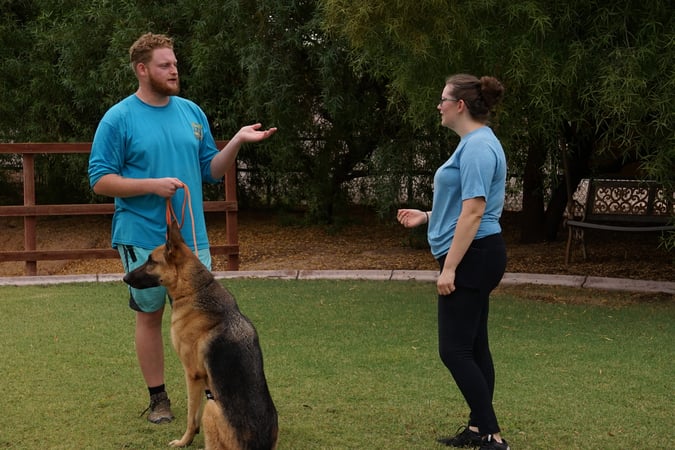
Our approach uses both roles rather than picking one. A PD360 Assessment functions like the intake a behaviorist would run, and Transform Camp supplies the daily rep volume a once-a-week model cannot, with 50+ trainers across the Scottsdale and Cave Creek campuses working a 1:10 trainer-to-dog ratio on the training floor.
What should a family put in front of an underwriter after a bite or aggression incident?
The strongest file an owner can build has a date on every page: when the incident happened, when the program started, and when it ended. An underwriter reading a renewal file is not looking for a promise. They are looking for dates and specifics.
- The intake notes from whatever incident occurred, including where and when it happened.
- A program's daily or weekly training records, showing what was worked and when.
- A written at-home management protocol: equipment used, supervision rules, and how introductions to new people or dogs are staged now.
- A completion date and any follow-up coaching still in place.
None of that is a guarantee. Partners Dogs does not write, underwrite, or influence any insurance policy, and no camp can promise what a specific carrier decides. A completed Transform Camp stay provides the second and third items on that list: trainer notes and a protocol specific enough that a family is not walking into that conversation with only the breed on their side.
Put a date on the calendar
See what a documented Transform Camp stay builds for your file
Start with a PD360 Assessment, or with a straightforward conversation about the dog in front of you and what a completed stay would look like on paper.
Frequently Asked Questions
Is there an aggression rehab option for a Mesa family who doesn't want a long daily commute?
Transform Camp is a boarded stay, not a daily drop-off, so the commute question works differently for an East Valley family than it would for a daycare or weekly class. A Mesa family enrolls their dog for the length of the stay at the Scottsdale or Cave Creek campus, then drives once for intake and once for pickup. Follow-up coaching runs by phone, video, or a scheduled visit instead of a weekly trip across the Valley.
Is a local behaviorist enough on its own for a Glendale family, or does a documented bite need more than a weekly consult?
A behaviorist consult is worth having first if a medical cause such as thyroid function or a pain source might be driving the behavior, since that is a diagnostic step a boarded program is not built to run. But a weekly consult alone rarely produces enough dated repetition to change what an underwriter is reading in a file. Most Glendale families dealing with a bite already on record get further pairing that consult with a structured program that logs daily work, not by choosing one over the other.
Will completing a behavior program guarantee my homeowners policy stays in place?
No. Partners Dogs trains dogs; we do not write, underwrite, or influence any insurance policy, and no program can promise what a specific carrier decides. What a completed program provides is documentation, dated trainer notes and a management protocol, that a family can choose to share with their agent or underwriter as part of their own case.
Key takeaways
- Arizona law stops breed from being the sole factor in homeowners or renters insurance underwriting, but it does not erase an actual bite from a file.
- Arizona's dog-bite statute holds an owner liable for a bite in a public place or anywhere the person was lawfully present, regardless of the dog's history or the owner's knowledge.
- A completed Transform Camp stay produces dated trainer notes and a written at-home protocol, documentation a family can choose to share with an underwriter as part of their own case.
- Partners Dogs does not write or influence insurance coverage; no program anywhere can guarantee a specific carrier's decision.
- A PD360 Assessment is the intake step that sizes the right program to the dog in front of the trainer, not a preset package.
Keep reading