The gist
Yes, an indoor leash or tab handle is a legitimate training tool rather than a hazard, as long as three rules travel with it every time: supervised use only, never on a crated or unattended dog, and off the moment you walk out the door.
Somewhere between a trainer's advice and a group chat's warning, indoor leashes turned into a controversial tool instead of an ordinary one. The truth sits in the middle. A short handle or a longer line, used with a few rules that do not bend, gives an owner a hand during the exact minutes a dog is most likely to misbehave: bolting a door, raiding a counter, or planting itself on the couch. None of that requires guesswork or the most expensive item in the store.
Tab Handle, House Line, or Door Lead: Compared
| Tool | Best for | Size / chew strength | Price | Where fitted |
|---|---|---|---|---|
| Smooth Biothane Tab Handle | Everyday supervised redirects off the counter, the couch, or a guest's lap | Short handle, smooth biothane, clips onto any flat collar | $21.99 | Not fitted, one size clips onto whatever collar your dog already wears |
| Bumpy Biothane Tab Handle | Dogs who mouth or grab at the handle, or an owner who wants a grippier hold | Same short-handle format, bump-textured biothane | $25.99 | Not fitted, one size clips onto whatever collar your dog already wears |
| Slip Lead Leash | A door lead kept on a hook by the entryway, or a longer supervised drag line through the house | Full-length slip lead, biothane, loop fits over the head | $59.99 | Not fitted, slips over the head, no collar required |
| No line, a doorway or room gate instead | Keeping a dog out of the kitchen or off the stairs without any hands-on guiding | Sized to your doorway, not sold in our shop | Not a Partners Dogs product | Any hardware or pet store, measured to your doorway width |
Prices shown reflect 2026 rates and can change; see the current pricing page for today's numbers.
Picking the priciest option on that list is not automatically the safest choice. A Smooth Biothane Tab Handle covers most indoor situations because it gives a hand something to grab within a few inches of the collar, with no loose length to trip over or wrap around a table leg. The Bumpy Biothane Tab Handle does the identical job with a grippier, textured handle, which some owners prefer for wet hands or a dog who likes to mouth at gear. A Slip Lead Leash earns its higher price by pulling double duty: hung by the front door, it becomes the lead a dog wears the second that door opens for a delivery or a guest, and it doubles as a longer supervised line indoors when a dog needs to be corrected from a few extra feet away. All three ship from our shop, and none needs an in-person fitting, since each one clips onto or slips over whatever collar the dog already has on.
The Myth That an Indoor Leash Is Dangerous or Lazy
Two objections come up every time a trainer suggests a line indoors. The first says it is dangerous: a dragging line is one bad angle away from a caught collar or a tumble down a staircase. The second says it is lazy: a crutch that manages the moment instead of teaching the dog anything. Both objections describe something real, and neither describes what a correctly used indoor line actually is. A line left dragging on an unattended dog is a hazard. A short tab handle worn while an owner stands three feet away, watching, is not the same equipment used the same way, and treating the two as one thing is exactly where the fear comes from.
This is not a loophole around training, it is a supervised bridge to it. The dog still has to learn to stay off the counter or wait at the threshold; a line just gives the owner a hand to guide that lesson through the two or three weeks before the habit holds on its own.
The Safety Rules That Make It Neither
The rule that matters most: supervised use only, never on a crated or unattended dog, and off the moment you leave. A handful of other rules keep the tool doing its job instead of creating a new problem:
- Supervised use only. A line stays on while a person is present and actually watching, never as background equipment while everyone is in another room.
- Never on a crated or unattended dog. A line and a crate do not mix, and a line on a dog left alone in a room is the exact dragging-hazard scenario the first objection describes.
- Off the moment you leave. Heading out the front door, loading into a car, or stepping into the yard alone are the settings where a snagged line turns dangerous instead of useful.
- A flat collar, not a slip collar or a prong, for anything left on for redirects. A tightening tool that catches on furniture defeats the point of a safety rule.
- Short is safer than long indoors. A line that reaches from the kitchen to the living room can wrap a table leg, a chair, or the dog's own legs. A tab handle's few inches cannot.
What a Short Tab Handle Solves That a Long Line Does Not
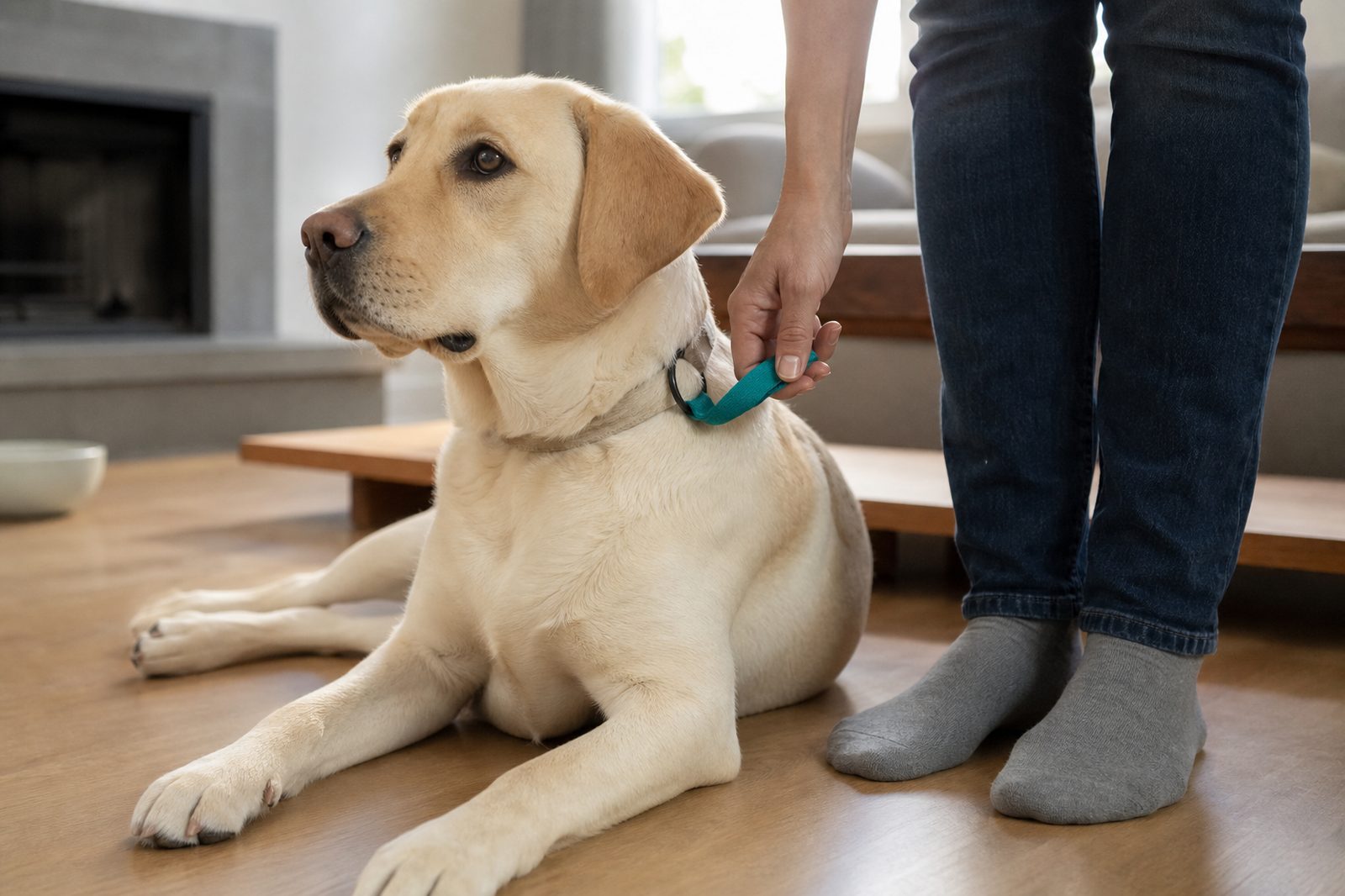
Most in-house problems are close-range problems. A dog on the counter, a dog refusing to get off the couch, a dog crowding a guest at the door: in every case, the owner is already in the room and within arm's reach. A tab handle solves that exact situation without eight feet of loose material to manage. Grabbing a dog's collar directly can startle it or, in a dog with any resource-guarding history, trigger a snap; a handle a few inches off the collar gives the same control with none of that risk.
A longer house line earns its keep in a different scenario: distance work, where a dog is across the room and an owner needs to follow through on a command it is ignoring, such as a recall to a place bed or a down-stay that is starting to break. The handle solves close-range guidance, the longer line solves distance follow-through, and most households only need one of the two, not both.
Door Bolting: The Setup That Works at Your Front Door
A dog that bolts the front door is a door bolting problem before it is anything else, and a leash by the door is the setup that fixes it. Keep a Slip Lead Leash on a hook at entry height, clip or loop it on before the door ever opens, and hold your dog in a sit at the threshold while the door cracks open a few inches. Any forward movement gets a leash correction back to the sit, and the door only opens the rest of the way once the dog is still. A monsoon gust that blows a screen door open is exactly the situation this trains for: a leashed dog is one you can catch mid-lunge, not one you chase down the driveway.
One Partners Dogs review captures the payoff plainly. Marshall M., Cave Creek, wrote that his rescued Rottweiler and Pit Bull mix now "walks perfect on a leash and doesn't dash out of open doors" after training. That is the behavior a consistent entryway routine, leash included, is built to produce.
Furniture and Counter Problems: Guiding Instead of Grabbing
A dog on the counter or refusing to leave the couch is rarely defiant on purpose. It is a dog who has learned that grabbing hands mean a game of keep-away, or a dog who genuinely does not know what "off" means yet without a physical cue attached to the word. A tab handle turns the correction into a guide instead of a grab: a light pull toward the floor teaches the same lesson a scruff-grab tries to teach, without the flinch, the game, or the risk of a startled reaction over food on a counter. This is the same setup that helps with counter surfing specifically, since most kitchen raids happen in the ten seconds an owner's back is turned, which is precisely when a handle already clipped on pays off.
Alissa D., Scottsdale, described the version of this that works. Her puppy, she wrote, is "so easy to redirect when zoomies kick in or if he is showing any defiant puppy behavior." That same redirect carries over to walks, where, in her words, "No leash pulling and no sniffing strangers." Guiding a dog off furniture with a handle teaches the same lesson as pulling it off by the collar, minus the flinch.
When a Baby Gate Does the Job for Free
Not every household needs a leash indoors at all. If the goal is simply keeping a dog out of the kitchen during dinner prep or off a set of stairs, a plain doorway or room gate does the entire job without any hands-on guidance required. A gate does not teach a dog anything, but for a family that only needs a barrier and not a behavior change, teaching is not the point. The cheaper, simpler option is enough for plenty of homes, and a gate that blocks access completely beats a leash that only reduces the odds. Save the tab handle and the slip lead for the situations where a dog needs to be actively redirected in the moment, not just kept out of a room.
Fading the Line So It Is Not Permanent Equipment
A tab handle or house line is meant to come off, not to become a piece of everyday furniture on the dog. The fade generally runs in stages: full supervised use for a week or two while the new habit forms, then a lighter or shorter version of the same tool for another stretch, then nothing but a verbal cue and a hand that used to hold a handle. Most families can start fading within one to two weeks of consistent, correctly applied use, though a dog with a longer history of door bolting or counter raiding may need longer before the line comes off for good. The end goal is a dog who responds to the word, not the equipment, which is the same territory covered on our everyday listening spoke.
Amber C., Cave Creek, described that shift in her own hound: "She is so easy to get settled down now, and just 1 word correction for her barking which is almost none compared to before." That is the fade working as intended: a dog answering a word, not a handle.
For a dog who needs more supervised reps than a busy household can realistically provide, a few days of DaySchool layers in extra structured practice with a trainer, without adding another line at home. And if the fade stalls entirely, a session or two of Private Lessons built around off-leash impulse control usually finishes what the line started.
Frequently Asked Questions
Is it dangerous to leave a leash on my dog in the house?
It is dangerous only when it is left on an unsupervised or crated dog, since a dragging line can catch on furniture or a stair rail. Under direct supervision, with the line coming off the moment you leave the room or the house, an indoor leash or tab handle is a standard, trainer-recommended tool rather than a hazard.
What is the difference between a tab handle and a house line?
A tab handle is a short grip, just a few inches long, meant for close-range redirects when you are already standing next to your dog, such as guiding it off a counter or a couch. A house line is longer and is meant for distance work, following through on a command from across the room. Most homes only need the short handle; the longer line is for specific training goals rather than everyday use.
Can I just use a regular six-foot leash indoors instead of buying something new?
Yes, a standard leash works indoors as long as it is on a flat collar rather than a slip or prong style, and as long as you are supervising the whole time. The main downside of a full-length leash indoors is the extra material to manage around furniture, which is why many owners find a short tab handle easier to live with day to day, especially in smaller rooms.
Will my dog just chew through a leash left on indoors?
Some dogs will mouth or chew at anything new on their body, which is exactly why supervision is the rule and not a suggestion. Biothane handles hold up better than fabric webbing against chewing, but no material is chew-proof if a dog is left alone with it. If chewing shows up, that is a signal to shorten supervised sessions rather than to leave the dog with the line unattended.
Does a baby gate work as well as a leash for keeping my dog out of the kitchen?
For pure access control, a gate works better, since it blocks the space entirely rather than relying on a correction after the dog is already moving toward it. A leash or tab handle is the better tool when you want to actively teach a behavior, such as a calm greeting at the door, rather than simply keep a dog out of a room.
How long does a dog typically wear an indoor leash before it comes off for good?
Many dogs are ready to fade from full-time supervised use to no line at all within one to two weeks of consistent, correct handling, though a longer-standing habit like repeated door bolting may take several more weeks. The line is a bridge to a habit, not a permanent accessory, and it should be actively phased out rather than left on indefinitely.
Get equipped
Get the Tool, Then Make the Habit Stick
A tab handle or slip lead removes the guesswork the next time your dog beats you to the counter or the door. Gear buys a few weeks of control; a private lesson turns that control into a dog who listens without one.
Keep reading