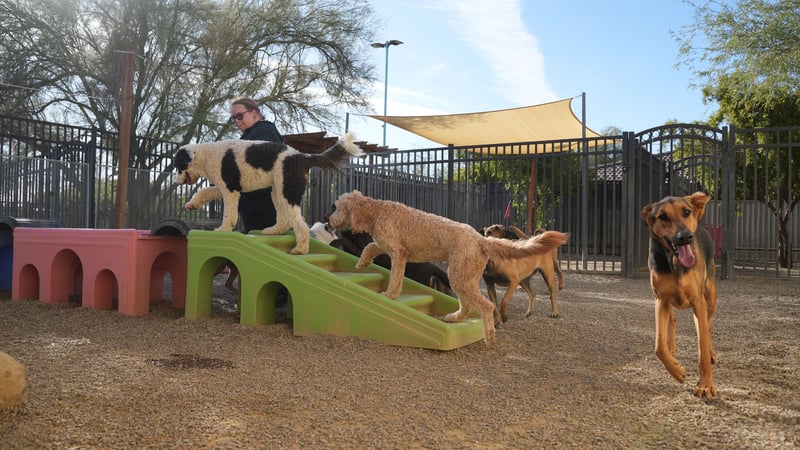

The short answer
Most social dogs do well on two to four DaySchool days a week, with three the practical ceiling for many, and five straight days rarely buying anything a rest day would not. The right number follows your dog's age, energy, and social tolerance rather than one flat rule. It maps onto a membership built around 4, 8, or 12 days a month, not a random guess.
There is no universal answer to how many days a week a dog should go to daycare, and any facility that hands you one without asking about your dog is guessing. Some social, biddable dogs do well on four or five days; others hit a wall at two. This piece walks through how to read your own dog, why consistency changes what a DaySchool day can do, and how the membership math at Partners Dogs' Scottsdale and Cave Creek campuses, rated 4.8 stars across 2,000+ reviews, maps onto a weekly pattern.
How Many Days a Week Should a Dog Go to Daycare? Start With the Dog, Not the Schedule
The right number of daycare days depends on four things: age, energy level, social tolerance, and what the rest of the week already looks like. A dog who spends the day alone in a quiet house on non-daycare days can usually handle more stimulation than a dog who already gets long walks, a yard to patrol, and an evening of fetch. A dog with a wide social radius, the kind that greets every new dog at the gate with a loose wag, tolerates a full week of group play better than a dog who does fine with two or three familiar playmates and shuts down in a crowd.
The Four Factors to Weigh
- Age. Puppies and adolescents burn through arousal fast and recover fast; seniors need lower-key days, spaced further apart.
- Energy level. A high-drive dog (working lines, herding breeds, plenty of adolescent Labs and shepherds) often needs the volume. Kathy P., Cave Creek, put the appeal in one line:
I love that he can blow off some pent up energy playing with his friends in a controlled setting in doggie daycare.
A lower-drive dog gets the same behavioral value from less of it. - Social tolerance. Some dogs read a room of 20 strangers as a party. Others read it as a threat that needs managing, even when nothing goes wrong.
- What the other days hold. A dog who is otherwise under-stimulated needs daycare to do more of the work than a dog who already gets structured exercise and training at home.
None of these factors point to a single correct number. They point to a starting pattern you test and adjust, which is the rest of this article.
How to Read Your Dog's Recovery the Day After
A dog who slept off a daycare day and woke up easygoing got the right dose. A dog who is still wound up, snappish, or unable to settle a full day later got too much. The photo at pickup does not tell you this. A dog can look thrilled in every picture and still be over threshold, the same way a kid can look thrilled at a party ten minutes before the meltdown.
Watch for these signs on the day after a daycare day:
- Good recovery: settles for naps at normal times, eats normally, greets the family calmly, follows known cues without extra reminders.
- Poor recovery: restless or unable to settle; mouthy, barky, or snappish with other pets and family; skips or rushes meals; or seems to need constant motion to feel okay.
Cheryl B., Cave Creek, whose Rhodesian Ridgeback puppy goes a couple of times a week, put the good version simply: He always comes home relaxed and ready to rest.
That is the target, not just a tired dog at pickup but a settled one twelve hours later. Reading that signal takes a trainer who knows your dog specifically, which is exactly the kind of individual attention families cite most in the full review history.
Why Streaks Matter for Curriculum Progress
DaySchool runs the same eight-level grade curriculum taught in Group Classes, and a skill only moves forward if it gets touched on a rhythm, not in isolated bursts. Behaviors move through four stages as a dog works up through the eight grades (Pre-School Puppy, Kindergarten, Elementary, Middle School, High School, College, Masters, and Dogtorate): a skill is Taught, then Reinforced, then Proofed against distraction, then held at Maintenance. Skip two or three weeks in the middle of that sequence and a skill that was moving into Proofing often slides back to Reinforcing, because the dog has not had enough supervised repetitions to hold it.
This is the case for keeping a weekly floor, even a light one. A dog attending once a week keeps the curriculum moving, just slowly. A dog attending in scattered, unpredictable bursts (a week on, three weeks off, a random Tuesday here and there) spends more of every visit re-establishing ground already covered than building on new ground. Partners Dogs has trained dogs in Arizona since opening in Cave Creek in 1997, and today's curriculum tracks 130+ specific behaviors per dog, which only means something if visits are frequent enough to move the tracker at all.
The Case for Rest Days, and What Over-Arousal Looks Like
More daycare is not automatically more progress, it is more input a tired brain has to process, and at some point that input stops helping. A dog running at a low simmer of arousal all week is doing behavioral work even during play: greeting other dogs, managing new smells, and holding impulse control around 20 or 30 other animals. Without a day to come down, some dogs stack arousal instead of shedding it. The tell is a dog who gets more reactive, not less, the longer a streak runs.
Watch for these over-arousal signs building across a week of back-to-back days:
- Increasing overexcitement at drop-off: jumping, mouthing, or spinning that was not there in week one.
- A dog who used to settle within the first 20 minutes now takes an hour, or does not settle at all.
- Rising hyperactivity at home on non-daycare days, where a walk that used to settle a dog stops working.
- New snapping, resource guarding of toys, or a short fuse with other dogs that was not part of that dog's pattern before.
When Five Days Still Works
None of this means five days never works. Barb S., Scottsdale, described more than a year of exactly that pattern for both of her dogs: Amazing care for my 2 dogs who spent 5 days a week in daycare over a year+.
The difference is a dog assessed and grouped for that volume from the start, not a dog defaulting into it because the schedule was easy.
Five straight days a week is where over-arousal shows up most, particularly across a Phoenix summer when heat already limits how much a dog can physically recover between sessions. For a dog showing any of the signs above, adding one rest day back into the week usually works faster than trimming minutes off a single day.
Find your dog's number
Get a Trainer's Read on Your Dog's Pattern
A quick assessment day tells you where your dog's arousal ceiling actually sits, so the weekly pattern you build fits the dog in front of you.
Matching a Pattern to a Membership Tier Without Overbuying
Partners Dogs prices DaySchool around weekly patterns, not a flat day rate, so the smart move is to pick the tier that matches the number your dog needs, not the one with the biggest discount. A single drop-in day runs $65 with no membership. Once a pattern holds for a few weeks, a membership converts that same time into roughly $5 an hour of trainer time instead of about $7, plus a discount on everything else from boarding to grooming.
| Tier | Included days a month | Roughly | Price | Extra day, beyond plan |
|---|---|---|---|---|
| Drop-in, no membership | As needed | No fixed rhythm | $65 a day | n/a |
| Plus | 4 DaySchool or 2 DayCamp | About once a week | $199/mo | $58.50 DaySchool / $103.50 DayCamp |
| Premium | 8 DaySchool or 4 DayCamp | About twice a week | $399/mo | $52 DaySchool / $92 DayCamp |
| Platinum | 12 DaySchool or 6 DayCamp | About three times a week | $599/mo | $45.50 DaySchool / $80.50 DayCamp |
Prices shown reflect 2026 rates and can change; see the current pricing page for today's numbers.
A dog who does well on two or three days a week rarely needs Platinum's 12 included days. Plus, with an occasional drop-in day, usually covers that pattern for less money, and the extra discount on boarding or grooming still applies. A dog who thrives daily, and whose family's schedule can use daily drop-off, is where Premium or Platinum earns its price through trainer hours alone. See the full membership breakdown before committing to a tier, since the math changes if your pattern leans toward DayCamp's more structured, behavior-focused days instead of standard DaySchool.
Puppies, Adolescents, and Seniors: Different Doses
The right number shifts as a dog ages, sometimes by a lot. Puppies under 20 weeks are not yet in general daycare group play at Partners Dogs; that age calls for the more controlled setting of Pre-School Puppy classes instead, graduating into standard DaySchool group play once a dog clears 20 weeks and passes an assessment.
Adolescents, roughly six months to two years, are usually where owners see the widest range. A confident, social adolescent often benefits from the higher end, three or four days a week, because the volume of supervised reps is what keeps a fast-changing dog's manners from backsliding. A dog moving through a fear period in that same age range, newly nervous around dogs it used to greet fine, needs the opposite: fewer days, smaller groups, and a trainer watching for the early signs covered on the fear of other dogs page, not more exposure at volume.
Senior dogs generally do better on fewer, shorter days, grouped with calmer playmates and given more recovery time between visits. The goal at every age is the same dose logic from the top of this piece, just recalibrated: read the dog in front of you, not a number that worked at a different age.
What to Change if Progress Stalls
If a dog has attended consistently for a month or more and the same behaviors keep showing up, the fix is rarely just adding another day. Three things are worth checking first, in order:
- Is the dose matched to the dog? A dog stuck at the same grade for months despite regular attendance may be over-aroused rather than under-exposed, which means a day removed, not added, is often the fix.
- Is the program the right shape, not just the right frequency? A dog who needs more structure and less free play than a standard DaySchool group provides may fit DayCamp's more behavior-focused day better than a fifth DaySchool day would.
- Does home need to carry more of the load? A skill taught and reinforced at daycare fades fast without practice between visits; a family that only touches a cue at drop-off is asking one weekly hour to do a whole week's work.
Talk to the trainer who runs your dog's group before changing the pattern on your own. They can tell you whether a stall is an arousal ceiling, a program mismatch, or a gap at home, because they are the ones watching the dog work through it every day.
Frequently Asked Questions
How many days a week should a dog go to daycare?
For most social, healthy adult dogs, two to four DaySchool days a week is a solid working range. Two days a week keeps a dog socialized and moving through the grade curriculum at a slow, steady pace. Four days a week, matched to a Plus or Premium membership, adds enough repetition to see faster behavior change without running most dogs past their arousal ceiling. The exact number still depends on your dog's age, energy, and social tolerance, which is why an assessment day at drop-off is worth more than a flat rule.
Is five days a week of daycare too much for a dog?
For some dogs, no. A dog with high social tolerance, an even temperament, and a family with the schedule to use it can do well on five days a week for years. For a larger share of dogs, five straight days is past the point where recovery keeps up with input. The signs show up as restlessness at home, trouble settling, or new snapping and short fuses that were not there before. Watch the day-after recovery, not the day-of tiredness, to tell which dog you have.
What happens to my dog's training if we skip a week of DaySchool?
One skipped week rarely undoes progress on its own, but a skill sitting in the Reinforcing or Proofing stage often needs to be revisited before it moves forward again, which slows the next few sessions rather than resetting them. Skipping weeks at random, instead of on a predictable schedule, is what actually stalls a dog's grade progress over months.
Do I need a membership, or can I just book single days as needed?
Either works. A single drop-in day suits a dog going once or twice a month, with today's rate listed on the pricing page. Once a pattern holds at roughly once a week or more, a membership (Plus, Premium, or Platinum) lowers the effective per-hour training cost and adds a discount on boarding, grooming, and lessons.
My dog comes home wound up instead of tired after daycare. Does that mean we are going too often?
Not always, but it is worth checking. Coming home keyed up, unable to settle, or snappish for hours or a full day is a sign the current pattern may be past your dog's arousal ceiling, especially if it is a new change from how that dog used to act after a daycare day. Dropping one day a week is usually the first thing to try before assuming the program itself is a bad fit.
Set the schedule
Build a Week That Fits Your Dog
See current DaySchool membership tiers and day rates, then book an assessment day to find out where your dog's number sits.
Keep reading