The honest answer
A public dog park (including the new cells at Thompson Peak) is the wrong place to work reactivity; the practical fix in North Scottsdale is threshold work outside the fence, paired with a structured program such as Behavior Camp or DayCamp, not open unsupervised play.
Can a reactive dog go to a dog park in Scottsdale?
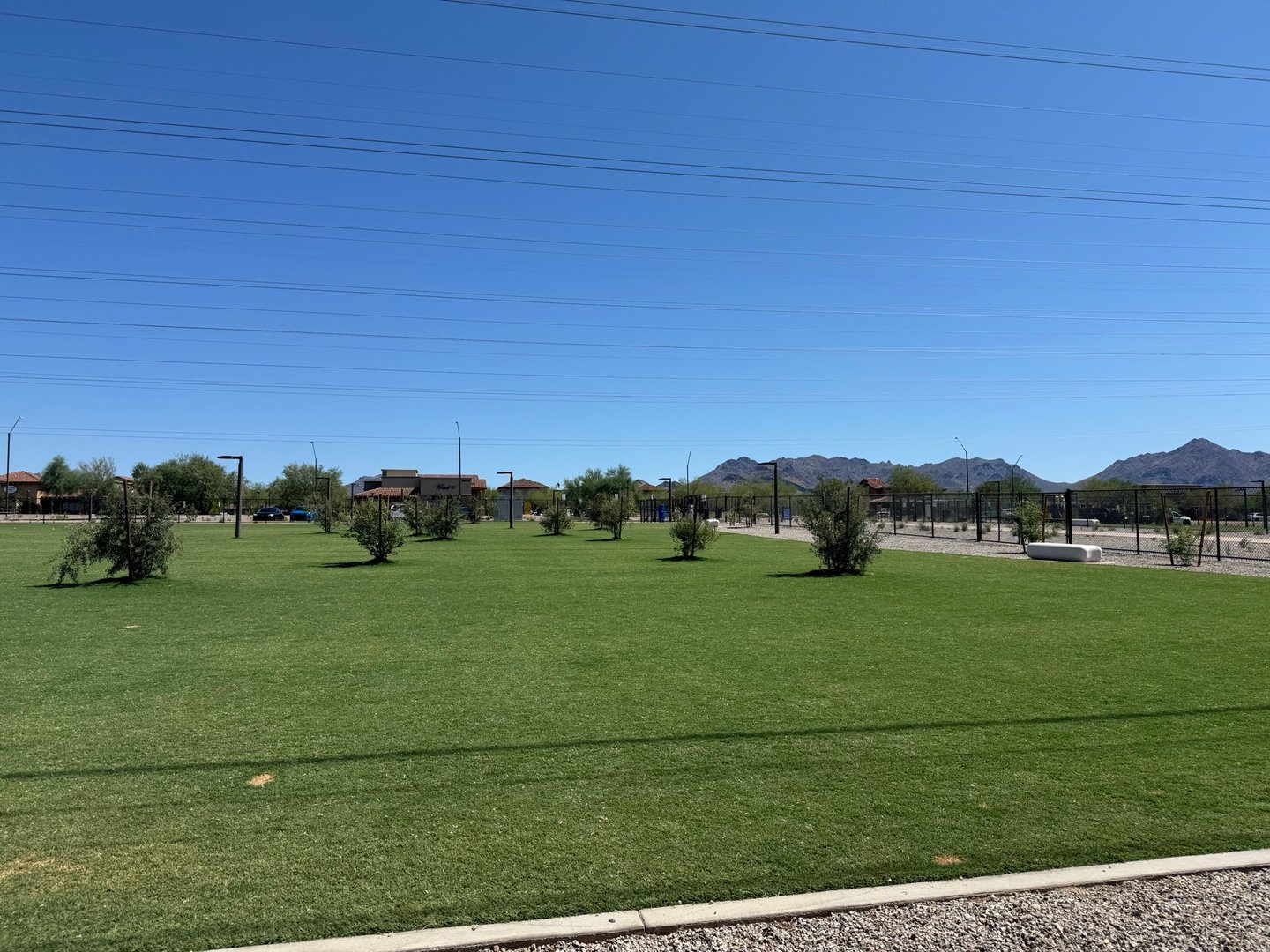
The common myth is that a dog park works like exposure therapy, and enough time around other dogs will wear a reactive dog's reactivity down. It does not work that way. No Scottsdale dog park, Thompson Peak included, is built or staffed for it. A public off-leash cell is not a classroom. It is an unsupervised recreation space where the city's own posted rules put full liability on the owner and remove any dog, on the spot, the moment it acts aggressive or anti-social. That is a fine deal for a dog with reliable social skills. It is a bad deal for a dog who lunges, freezes, or stiffens around other dogs, because the first true test of that reactivity happens in front of off-leash strangers with no trainer present to manage it. Thompson Peak Dog Park's cells split by temperament rather than size (the full layout and hours are in our Thompson Peak dog park guide), and neither one is posted, or designed, as a place to work on leash reactivity.
What does Thompson Peak's own rulebook say about reactive dogs?
The posted regulations at the gate answer this more plainly than most owners expect. Scottsdale does not supervise Thompson Peak Dog Park, and the sign says so: use is at your own risk. Owners are responsible and legally liable for their dog's conduct at all times, dog behavior can be unpredictable around other dogs and strangers, and aggressive or anti-social dogs must be removed immediately. There is no separate small-dog and large-dog split here: the cells are divided by temperament, not size, and a reactive dog of any size can trip the removal rule in either one. Outside the fenced cells, Maricopa County's leash law still applies at full strength: a leash no longer than six feet, in the owner's hand, controlling the dog. That requirement starts the moment you get out of the car, not just past the gate. For a reactive dog, an unsupervised cell inside, a hard leash law outside, and a one-strike removal policy is not a training opportunity; it is a pass-fail test for a dog who has not been taught how to pass it yet.
Why do open dog parks make reactivity worse instead of better?
An open cell with several strange dogs at close range is closer to flooding than to training. Threshold work keeps a dog under the point where it reacts, slowly shortening the distance to a trigger over many controlled repetitions; flooding drops it straight into the trigger at full intensity and hopes it works itself out. A dog park cell, even the posted passive one, puts a reactive dog inside a fenced space with multiple off-leash dogs approaching from every direction. There is no distance to retreat to and no trainer managing the interaction. One bad rep, a stiff greeting that turns into a scuffle, a resource-guarding moment over a stray tennis ball, does not just fail to help. It rehearses the exact arousal pattern the owner is trying to undo. The entry gate adds a second problem on top: being held back while other dogs are visible just past it is a textbook setup for barrier frustration, the arousal that builds while a dog is blocked from something it wants to reach.
Her trainer, Noa, was outstanding at relating to her and I was amazed at the progress my dog showed.
Nancy S.'s two year old Yorkie mix was fearful of other dogs and very reactive before that progress. It came from a person managing distance, timing, and threshold, not from an open cell full of strangers.
Work it the right way
Get a program built around your dog's actual triggers
A PD360 Assessment reads what your dog is reacting to before anyone talks about a dog park. Behavior Camp builds the skills an open cell never will.
What are the best leash-reactive dog park alternatives?
Distance is the tool a dog park cell takes away, and distance is exactly what a leash-reactive dog needs first. The most useful version of Thompson Peak for a dog in training does not involve going through either gate. It means parking along Hayden Road, walking the footbridge and outer paths at a distance where your dog can see other dogs without reacting, and building engagement and recall before shortening that distance. DayCamp runs trainer-managed floors with supervision and grouping by temperament, not an open free-for-all, so a dog gets social reps without the pass-fail stakes of an unsupervised cell. Bruno, a Bull Terrier whose family came to Partners Dogs for leash reactivity, resource guarding, and territorial aggression, built that kind of distance work inside Behavior Camp; by the program's transition point he had an off-leash out command on cue, walking away from something he wanted on request (see Bruno's full success story). Group Classes and Private Lessons build the same foundation for owners working the skill between sessions.
Who is the best behaviorist or aggression-rehab option in North Scottsdale?
The honest answer starts with what the dog needs, not with a single best name. Partners Dogs' Scottsdale campus sits closest to Thompson Peak Park, in reach of Paradise Valley and the rest of North Scottsdale, and it runs on one standard across every case: 50+ trainers, a 1:10 trainer-to-dog ratio, and a PD360 score that tracks progress instead of a guess. Across 70,000+ dogs since December 1997, one line from ownership still holds: there is no dog that we will turn away and no person that we cannot help. For reactivity and genuine aggression cases, Behavior Camp is built for this, structured immersion across a full day rather than an hour on a leash at a park, with a trainer reading a dog's arousal in real time. Xela, a German Shepherd mix whose owner described a dog reactive at the door and difficult to crate, worked through separation anxiety, resource guarding, and leash reactivity in Behavior Camp with trainer Chase, moving from lunging and growling at the crate to walking in on her own by the second week (see Xela's full success story). That is the shape of aggression rehab a dog park, however well built, was never designed to provide.
When is the passive cell at Thompson Peak the right call?
None of this makes Thompson Peak a bad park, and the passive cell is a legitimate option for the right dog. The city posted that cell for calm dogs, relaxed play, and less-social dogs. For a genuinely mild dog with reliable recall, a calm greeting style, and an owner watching closely, a slow visit there can be a legitimate proofing rep: it shows a skill already built holds up in a new place, not teaches it from scratch. Timing matters too: the park opens at 5:30 a.m. for a reason, and a reactive dog does not need triple-digit pavement added on top of social pressure during Arizona summer or the monsoon stretch. If there is genuine doubt about whether a dog belongs in either cell yet, a PD360 Assessment gives an honest read before a family finds out the hard way at the gate.
Structured play instead
See what supervised, temperament-matched play looks like
DayCamp gives a reactive or undersocialized dog trainer-run floors, temperament grouping, and rest cycles instead of an open cell and a guess.
Key takeaways
Thompson Peak Dog Park's posted rules require removing any aggressive or anti-social dog immediately, and the city does not supervise the cells. The active and passive cells at Thompson Peak split dogs by temperament, not by size, so a reactive dog of any size can trip the removal rule. Threshold work at distance outside the fence, not an open cell, is where leash reactivity actually improves. Behavior Camp and DayCamp give a reactive dog a trainer managing distance, timing, and grouping that an unsupervised dog park cannot. A PD360 Assessment is the honest way to find out whether a dog is ready for the passive cell, or needs Behavior Camp first.
Frequently Asked Questions
Is Thompson Peak Dog Park safe for a dog with a history of biting or fighting?
No. The posted rule requires immediate removal of any dog that acts aggressive or anti-social, and the city does not supervise the cells. A dog with a bite history needs a professional assessment and, in most cases, Behavior Camp before an open dog park is back on the table.
Can I do threshold work outside the fence at a Scottsdale dog park without ever going in?
Yes, and it is often the more useful visit for a reactive dog. Working the perimeter path, the footbridge, or the parking area at a distance where your dog notices other dogs without reacting builds engagement and recall without risking a bad rep inside the cells, and that distance can be shortened gradually over many sessions.
Does a smaller cell at Thompson Peak make it safer for a reactive dog?
Not in the way owners usually assume. Thompson Peak has no small-dog or large-dog split at all; its two open cells are divided by temperament, active versus passive, not by size. A reactive dog, large or small, can still trip the removal rule in either cell if a bad interaction happens.
How do I know when my dog is ready for an open dog park instead of just structured play?
Readiness is judged by an honest reassessment, not a calendar date. A PD360 Assessment tracks whether a dog holds recall, engagement, and calm greetings under real-world distraction, and that rechecked score is a far better signal than guessing after a set number of weeks.
What should I do if my dog reacts on leash near the dog park gate?
Add distance immediately instead of pushing closer or apologizing your way past. Move away until your dog can re-engage with you, use that distance to reward calm attention, and treat the gate area itself as a practice zone rather than something to get through quickly. A trainer can build this into a specific protocol during Private Lessons or Group Classes.
Keep reading