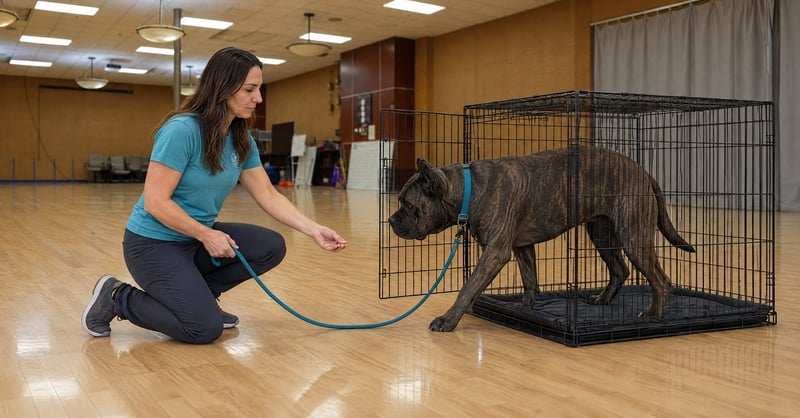

"Purely positive" dog training is a marketing phrase, not an operating description. By the American Kennel Club's own four-quadrant framework for operant conditioning, ignoring a jumping dog, ending a play session, or a timeout is negative punishment: removing something the dog wants to make a behavior less likely. Every reward-based program that does those things is already using two of the four quadrants. The criticism of purely positive dog training that matters is not that trainers are lying. It's that the label hides the mechanics it's built on.
Most pet parents out walking near Pinnacle Peak or through Cave Creek Regional Park run into "purely positive" or "force-free" as a promise before they ever meet a trainer: no corrections, no discomfort, only rewards. It's a comforting pitch, and the intention behind it is sincere. The promise and the practice are not always the same thing, and the gap between them is worth naming plainly, using the discipline's own vocabulary rather than a marketing one.
Is Purely Positive Training Free of Punishment?
No program that ignores a jumping dog, ends a play session for bad manners, or uses a timeout is punishment-free, even if it never uses the word punishment. Operant conditioning, the science underneath every dog training method regardless of brand or philosophy, defines four quadrants: positive reinforcement, positive punishment, negative reinforcement, and negative punishment. The American Kennel Club's own explainer on the topic describes its recommended methods as working within only two of those four quadrants, positive reinforcement and negative punishment, and it names ignoring a jumping dog as a textbook example of the second one. That's the AKC's own framework, describing its own recommended methods accurately, not a hostile outside critique of force-free training.
What Are the Four Operant-Conditioning Quadrants?
Positive and negative here don't mean good and bad, they mean adding or removing something. The four quadrants, in plain terms:
- Positive reinforcement: add something the dog wants (a treat, praise, a toy) to make a behavior more likely.
- Negative punishment: remove something the dog wants (attention, play, a walk) to make a behavior less likely.
- Positive punishment: add something the dog dislikes to make a behavior less likely.
- Negative reinforcement: remove something unpleasant to make a behavior more likely.
Trainers across the discipline tend to agree on one point worth stating outright: punishment, in this sense, does not mean harm. It means "less likely to happen again," full stop. A dog whose owner turns and walks away when the leash goes tight has just been on the receiving end of negative punishment. So has a dog whose humans stop the game the moment teeth touch skin. Neither dog was hurt. Both behaviors just got less rewarding.
Where Does Negative Punishment Hide in a "Positive Only" Program?
Withholding attention, walking away, and ending a session are all negative punishment by definition, whether or not a program uses that word. These moves show up constantly inside programs that market themselves as purely positive: a jumping dog gets no eye contact until four paws are on the floor, a barking dog loses access to the yard, a mouthy puppy's play session ends the instant teeth land. Every one of those is the dog losing something it wants because of a behavior. That's the definition. AVSAB's 2021 Position Statement on Humane Dog Training names three tools specifically: prong collars, choke chains, and electronic shock collars, tools "that involve pain" that an appropriate trainer should avoid. That position sits alongside the same quadrant framework the AKC describes, not outside it.
The Partners Dogs position on this is not that force-free trainers are being dishonest. Most are being sincere, and the movement pushed choke chains and flooding out of mainstream practice, raising the floor on how dogs get treated across the industry. The issue is narrower: a program that quietly uses negative punishment while marketing "no punishment" is describing its own toolkit inaccurately, and a pet parent trying to make an informed choice deserves the accurate version. A behavior page like the one on stopping a dog from jumping on people walks through exactly where structure like this fits into a calmer greeting, without pretending it's something other than what it is.
Do Head Halters and Front-Clip Harnesses Work Without Discomfort?
Head halters and front-clip harnesses work partly through physical discomfort and restriction, not purely through reward. This is a mechanical fact about how the tools function, not an accusation against any brand or trainer who recommends them. A head halter redirects a dog's whole head, and therefore its body, through nose pressure the moment it pulls; a front-clip harness swings the dog sideways toward the handler under the same principle. Both work by making the pulling motion self-correcting and mildly uncomfortable enough that the dog stops doing it. That's a legitimate way to manage a strong puller. It is not reward-only, and calling it "gentle" doesn't change what the mechanism does.
Kathy S., a Cave Creek client, described what changed for her family this way: "Working with Partners we learned the proper technique to introduce dogs, triggers and signals to watch for stress and aggression, basic commands to help with confidence and so much more!" Structure, named plainly and applied consistently, is what built that confidence, not the absence of any feedback at all.
When Is Purely Positive Training the Right Call?
A stable, socially confident dog with no behavior problem to work through, whose owner wants trick titles or a fun weekly hobby, is well served by an R+-only club class. AKC-affiliated companion and trick-dog classes are built for exactly that dog: rewards-based, low stakes, aimed at focus, bond-building, and polish rather than correcting anything urgent. If a dog already settles on a patio near Brown's Ranch, walks past other dogs on the trails at Spur Cross without a reaction, and just needs a Saturday hobby with its owner, a purely positive class is a good use of that dog's time and its owner's money. Nobody needs the full toolkit to teach a stable dog to spin on cue.
That scenario is the exception, not the rule, for the families who reach out to a behavior-focused program. A dog with a bite history, active resource guarding, or reactivity severe enough to end a walk in a lunge is a different case. For that dog, a toolkit that caps itself at two quadrants by policy tends to run long timelines and manage the environment around the behavior more often than change it.
What Does a Full-Vocabulary Approach Look Like in Practice?
Dogs already communicate across every quadrant, a mother correcting a pup, a growl offered as information, play withdrawn mid-tussle: training that mirrors how dogs already communicate uses the same range. Positive reinforcement is the foundation of everything taught at Partners Dogs; it's where every dog starts and the engine of the whole relationship. What changes is the transparency about what comes next. Feedback, corrections, and redirection add structure, and structure eases anxiety rather than causing it: a dog that knows the boundaries and the default behaviors carries itself with more confidence, not less.
Lisa M., a Cave Creek client, put the shift in her own words after taking her dog through group classes: "the teachers really understand the canine brain so the class is really about training US to know HOW TO TRAIN OUR DOGS EFFECTIVELY. no more yelling, yanking on leashes, frustration in taking jax outside! i learned how to communicate in a language MY DOG understands." That's the goal of a method-agnostic approach built around Teaching, Reinforcing, Proofing, and Maintenance: not the fewest tools, the right ones, staged to the dog in front of us and weighted heavily toward the positive side because that's more fun for dog and handler alike. Parents rate that approach 4.8 stars across more than 2,000 reviews, from families who came in skeptical of anything past "just rewards" and left with a dog they trust in public.
Where Does This Show Up for a Dog With a Real Problem?
For a dog with a specific behavior problem to solve, not just a philosophy to debate, this is where Behavior Camp comes in. Triggers get worked directly, on-site, across a stage-based curriculum instead of drilled over the top of with obedience alone. Readers who want to browse by specific issue rather than program can start from the full behavior index instead.
Partners Dogs doesn't market itself as purely positive, and it doesn't need to. Our position is honest, upfront, and transparent about the full toolkit in use, and method-agnostic toward one outcome: a delightful, lasting relationship between parent and dog. That stance is backed by more than a label: purpose-built campuses in Scottsdale and Cave Creek, a multi-trainer team instead of a single point of failure, a grade-level curriculum tracked through PD360 scoring at every stage, and near-open intake that takes on the bite-history dogs other programs turn away.
Named, not hidden
Get a straight read on what your dog needs
If ignoring, timeouts, and a leash are already part of your dog's routine, the more useful question is whether the plan behind them is built for your dog's specific behavior, not which label describes it.
Frequently Asked Questions
Is purely positive dog training free of punishment?
Not by the operant-conditioning definitions the training world uses. Ignoring a dog, ending a play session, or a timeout are all negative punishment, removing something the dog wants to make a behavior less likely. A program can be reward-first and still use negative punishment; the two are not opposites.
What is negative punishment in dog training?
Negative punishment is removing something a dog wants in order to make a behavior less likely to happen again. Walking away from a jumping dog, ending a tug game when teeth touch skin, and losing yard access after excessive barking are all examples. It is one of the four standard operant-conditioning quadrants, alongside positive reinforcement, positive punishment, and negative reinforcement.
Is withholding attention from a dog a form of punishment?
Yes. Withholding attention from a dog that wants it, until a behavior stops or a calmer one appears, fits the standard definition of negative punishment. It is a widely used, low-intensity tool, not a harmful one. It is still punishment in the technical sense, even inside programs that avoid the word.
Do force-free trainers use any form of correction?
Most reward-based programs use negative punishment regularly: walking away, ending play, a timeout, even if they avoid calling it a correction. The AKC's own recommended framework for force-free training explicitly includes negative punishment as one of its two working quadrants. The disagreement between methods sits in positive punishment and negative reinforcement, not in whether feedback happens at all.
When is a purely positive approach the right choice for a dog?
For a stable, socially confident dog with no behavior problem to solve, an R+-only class is a good fit: trick titles, obedience polish, or a fun weekly hobby with its owner. It is a different situation from a dog with a bite history, resource guarding, or reactivity severe enough to disrupt daily life, where a wider toolkit tends to shorten the timeline.
Keep reading